
New TikTok accounts see flat results while posting consistently. The challenge isn’t effort, it’s choosing the right content format.
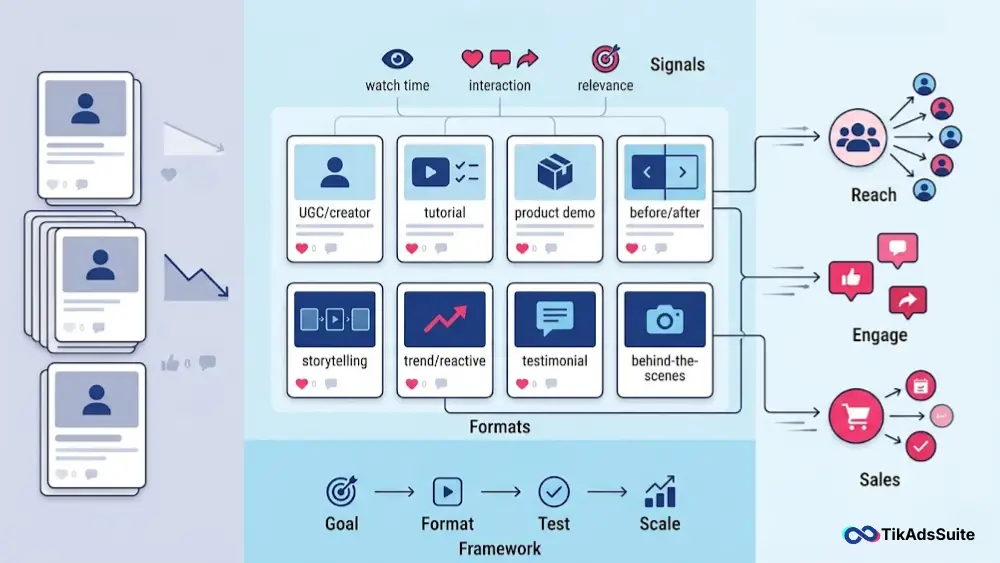
You can post every single day and still reach almost no one if you keep choosing the wrong formats for your goals. The TikTok algorithm does not reward frequency alone. It rewards content that holds attention, earns real interaction, and signals relevance to the right audience.
What you need is a clear breakdown of which TikTok content types actually perform in 2026, why each one works, and how to match format to goal.
This article covers all of that. You will get a breakdown of the 10 highest-performing content types, a goal-based selection guide, and a practical framework for building a mix that drives real results.
Get Up to $6000 Free TikTok Ad Credit
What Are TikTok Content Types and Which Work Best in 2026
TikTok content types are the different types of TikTok videos, formats, and categories that creators and brands use to reach, engage, and convert audiences on the platform. Top-performing TikTok content types and categories for businesses in 2026 include educational how-to content, entertainment-driven videos, trend-based formats, product demonstrations, and direct response content. Which types perform best varies significantly by niche, audience size, and whether you are optimizing for reach, engagement, or sales.
Why TikTok Content Types Matter for Growth and Performance
Choosing the right content type is not a creative preference. It is a strategic decision that directly affects your distribution and results.
TikTok recommends videos using a combination of signals, including user interactions, video information, and account or device settings. Watch behavior, likes, shares, comments, and other interactions can all contribute to recommendations. Different content types naturally drive different signals.
A tutorial drives saves and rewatches, and a trend video drives shares. A product demo drives profile visits and link clicks.
When you post without a clear content strategy, it can become harder to learn which topics and formats resonate with your audience. Use your analytics to identify what earns meaningful viewer response and refine your content mix accordingly.
TikTok’s Creative Center highlights that videos with clear hooks and structured content outperform unplanned posts in both reach and engagement. Brands and creators who build a deliberate content strategy see faster audience growth and stronger follower retention.
Your content type choice also shapes audience expectations. If your account mixes formats without any clear logic, your audience has no reason to follow or come back. When you own one or two formats with consistency, you build a presence that followers actively seek out.
The 10 Best Performing TikTok Content Types in 2026
These TikTok content types cover the most useful types of TikTok posts for businesses, from educational and entertainment videos to UGC, product demonstrations, and conversion-focused content.
Educational and How-To Content
Educational content is one of the most durable formats on TikTok. It works because it delivers immediate, tangible value.
Teach your audience one specific thing. The more specific the topic, the higher your completion rate, because viewers stay to get the answer.
What works here:
- Step-by-step tutorials with on-screen text overlays
- “Things you didn’t know about X” formatted videos
- Skill breakdowns aimed at beginners in your niche
- Quick tips structured as numbered lists within the video
Creators like finance educator Humphrey Yang built large audiences primarily through educational short-form content by making complex topics simple and repeatable.
This format performs especially well in cooking, finance, beauty, fitness, tech, and DIY. If you have expertise, educational content is your fastest path to becoming a trusted voice in your category.
Entertainment and Relatable Content
Entertainment content drives the highest share rates on TikTok. When something makes people laugh or feel understood, they send it to others immediately.
Relatable content works on a simple principle: your audience sees themselves in your video and wants others to see it too.
What performs well:
- Comedy skits tied to a niche frustration
- Relatable day-in-the-life moments
- Reaction-style videos to shared experiences
- Self-aware humor from brand accounts
Duolingo is the most cited brand example in this category. Their TikTok account drove millions of followers through absurdist comedy without ever promoting the app directly. The brand made people laugh, and the association did the rest.
Entertainment content is harder to plan and replicate, but when it lands, it compounds fast.
Trend-Based and Viral Formats
Jumping on trends is one of the fastest ways to reach audiences beyond your existing followers. TikTok surfaces trend-based content aggressively because it drives platform-wide engagement.
Speed is everything here. Trends have a short window, typically three to seven days, before saturation drops their performance.
How to use this format effectively:
- Check TikTok’s Creative Center Trending section daily
- Identify trends relevant to your niche or brand voice
- Add your own angle instead of simply copying
- Post within the first 48 hours of a trend appearing
You do not need to chase every trend. Focus on the ones where your take adds something new. Generic participation rarely stands out.
Looking for trending keywords? Start with our blog on TikTok trending keywords
User-Generated Content (UGC)
UGC is content created by real customers or users, either organically or through a structured program. It is one of the most trusted formats on the platform.
According to Nielsen’s Trust in Advertising Study, which surveyed 40,000 people across 56 countries, 88% of global respondents trust recommendations from people they know more than any other channel. UGC on TikTok works directly from this dynamic.
UGC works in two forms:
- Organic UGC: Real customers posting about your product unprompted
- Creator-directed UGC: Brands working with everyday creators to produce authentic-style reviews and testimonials
Brands like CeraVe built a significant TikTok presence largely through UGC before investing in paid influencer content. The format signals social proof at scale.
If you are a brand, your first priority should be making it easy for customers to create and share. That means clear unboxing experiences, shareable packaging, and a good reason to post.
Product Demonstrations and Reviews
Product demo content converts. It moves viewers closer to a purchase decision because it removes uncertainty directly.
Showing exactly how a product works in real conditions answers the questions your audience has before they ever ask them.
Creators like Lexi Rosenstein build content around product demos and problem-solving, leading to their content going viral on TikTok.
High-performing demo structures:
- Problem setup, product introduction, live demonstration, result
- Side-by-side comparison with a competitor or older method
- “Does this actually work?” framing with an honest outcome
TikTok Shop data consistently shows that short-form video is the top-performing sales channel on the platform, ahead of in-app shops and livestreaming. Product demos that speak directly to a specific viewer need to drive the most purchase activity.
Be specific, be honest, and show real use. Polished product ads consistently underperform authentic demos across most categories.
Storytelling and Behind-the-Scenes Content
Storytelling content builds the emotional connection that keeps followers loyal over time. It is not the fastest format for reach, but it is the strongest for retention and community depth.
Behind-the-scenes content works because it creates proximity. Your audience sees the real process, the real person, or the real business behind the account.
Effective storytelling formats:
- Founder or creator origin stories in short form
- Day-in-the-life content that shows real workflow
- Business failures and lessons shared openly
- “How this started” series for growing brands
Alex Hormozi has used behind-the-scenes and raw storytelling content extensively on short-form platforms to build an audience that trusts his expertise before buying anything.
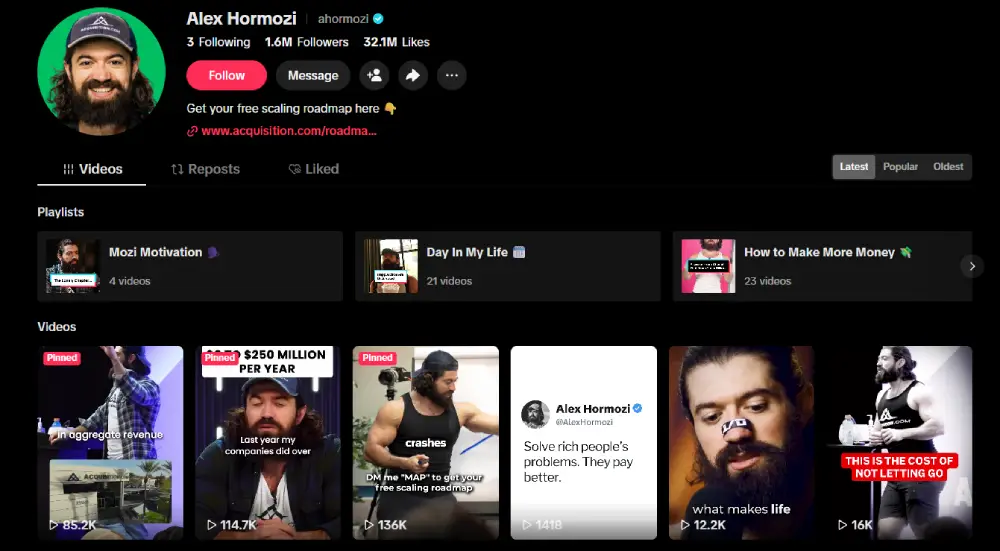
Raw, direct storytelling consistently outperforms scripted, polished versions. Audiences on TikTok reward honesty with attention and loyalty.
Problem-Solution (Pain Point) Content
This format hooks viewers immediately because it names a specific frustration they already carry. When someone hears their exact problem stated out loud, they stop scrolling.
The structure is simple: identify the pain, explain why it happens, deliver the solution, and show the result.
What makes this work:
- The problem must be specific, not generic
- The hook must name the pain in the first two seconds
- The solution must be actionable within the video itself
- Results should be shown, not just described
This format is highly effective for SaaS tools, coaching, health and wellness, and home services categories. If your product solves a real problem, this is your most direct path to converting viewers into buyers.
Before-and-After Transformations
Before-and-after content triggers curiosity and drives completion. Viewers stay to see the result, which pushes up your watch time signal.
This format works across fitness, beauty, home renovation, cooking, design, and personal finance. The contrast is the content.
Rules for effective before-and-after videos:
- Make the starting point clearly visible and relatable
- Keep the transformation credible, not exaggerated
- Show the process steps, not just the two endpoints
- Use text overlays to explain what changed and why
The format also earns saves. People bookmark transformations they want to attempt themselves, which extends your content’s long-term reach well past the initial post.
Creators like Aminulkins produce weight-loss transformation content, showing clear before-and-after results that drive strong viewer engagement and viral reach. This format is also common in product transformation videos.
Avoid over-dramatizing the starting state. Audiences on TikTok are quick to flag content that feels staged, and losing credibility is harder to recover from than a missed trend.
Influencer and Creator-Led Content
Creator-led content puts your brand in front of audiences that already trust the person delivering it. You reach people who follow and believe in that creator, which shortens the trust-building cycle significantly.
This does not require celebrity-level influencers. Micro-creators with 10,000 to 100,000 followers often deliver higher engagement and more targeted audiences than larger accounts.
According to Influencer Marketing Hub’s 2024 Benchmark Report, TikTok micro-influencers average an engagement rate of 8.7%, a figure that significantly outpaces what most macro-influencers deliver at the same investment level.
How to use this format well:
- Match the creator content style to your product category
- Give creators brief guidance, not rigid scripts
- Prioritize authentic storytelling over promotional messaging
- Track performance by creator and content angle, not just total spend
Creator-led content works best when the creator has genuine experience with your product. Scripted endorsements consistently underperform on TikTok because audiences are trained to spot them.
Direct Response and Conversion-Focused Content
Direct response content is built to get one specific action: a click, a purchase, a sign-up, or a save. Every element of the video serves that single goal.
Most brands use this format for paid TikTok ads, but the structure works just as well organically when executed correctly.
Structure of a high-converting direct response video:
- Hook that names a specific problem or desire within two seconds
- Brief credibility signal or social proof
- Product or offer shown in action
- Clear, simple call to action
TikTok for Business recommends placing your call to action within the first three seconds of your video. The platform’s internal testing consistently shows front-loaded CTAs outperform those placed mid-video or at the end in click-through rate.
Keep the message singular. One video, one offer, one action. Complexity kills conversion in this format.
Which TikTok Content Types Perform Best for Each Goal
Best for Reach and Virality
| Content Type | Why It Drives Reach |
| Trend-Based Content | Algorithm boosts trend participation aggressively |
| Entertainment and Relatable | High share rate extends organic reach |
| Before-and-After Transformations | Curiosity-driven completion boosts distribution |
Reach is driven by shares and completion rate. Trend-based and entertainment content earn the most shares. Transformation content earns the highest completion rates. When testing reach-focused formats, some creators also use paid visibility tools to give selected videos a stronger initial view count. For example, they can buy TikTok views for specific posts while still relying on watch time, shares, saves, and other engagement signals to evaluate which content formats actually resonate with their audience.
Best for Engagement and Community Building
| Content Type | Why It Drives Engagement |
| Educational How-To | Earns saves and comments from people who want to learn |
| Storytelling and BTS | Builds emotional connection that drives replies |
| Problem-Solution Content | Generates comments from people sharing their own experience |
Engagement goes beyond likes. Comments and saves signal a deeper connection and drive algorithmic favor over time.
Best for Conversions and Sales
| Content Type | Why It Converts |
| Product Demonstrations | Removes purchase hesitation directly |
| UGC | Social proof accelerates buying decisions |
| Direct Response Content | Designed specifically for one clear action |
Conversion content needs to match the audience’s temperature. Cold audiences convert better on UGC and demos. Warm audiences respond better to direct response offers.
How to Choose the Right TikTok Content Type for Your Brand
Start with your goal, not your preference.
If you are a new account with under 1,000 followers, reach is your first priority. Focus on trend-based and entertainment formats to put your account in front of new audiences.
Between 1,000 and 50,000 followers, shift toward educational and storytelling content. You have enough of an audience to start building loyalty and authority.
If you are running TikTok for sales, you need product demos, UGC, and direct response content in your mix. Reach without a conversion layer is wasted effort.
Three questions to guide your selection:
- What does your audience need to do next: watch more, follow, or buy?
- What content type does your niche already respond to based on what performs for others in your space?
- What can you produce consistently without burning out your team or yourself?
Consistency in one or two formats beats sporadic use of all ten. Your audience needs to recognize what your account delivers before they commit to following.
What TikTok Content Types Go Viral in 2026?
TikTok viral content types can vary widely, but the videos that spread most often share four consistent traits: a strong hook in the first two seconds, a clear emotional or informational payoff, a shareable angle, and alignment with current platform behavior.
No single content type guarantees virality. What we consistently see is that entertainment, trend, and transformation formats generate the most unprompted shares. But virality is not a strategy. It is a byproduct of making content people value enough to send to others.
What actually drives viral performance:
- Hooks that create immediate curiosity or emotional recognition
- Payoffs that feel worth the watch time invested
- A specific, relatable angle rather than a broad topic
- Content that makes the person sharing it look good for sending it
You cannot manufacture virality. You can build content that earns the signals that lead to viral distribution. That is where your focus belongs.
Common Mistakes When Using TikTok Content Types
Posting the same format every time. One-format accounts plateau faster. Your audience segments have different needs, and your content mix should reflect that.
Ignoring hook quality. The format only works if the first two seconds earn attention. A great tutorial with a weak hook gets buried before it reaches anyone.
Optimizing for likes instead of the right metric. Likes are a vanity metric on TikTok. Watch time, shares, and saves drive algorithmic distribution. Measure what actually matters for your goal.
Copying format without understanding the signal. If a before-and-after video performs well in your niche, understand why it worked before you try to replicate it. Format alone is never the full reason for performance.
Posting without a call to action. If you want a conversion, you have to ask for it. Most organic posts underperform in sales because the creator never tells the viewer what to do next.
Chasing trends outside your niche. Participating in an off-brand trend for a short reach spike sends mixed signals to the algorithm about who your audience actually is.
How to Build a High-Performing TikTok Content Mix
A strong TikTok content mix balances three functions: reach, engagement, and conversion. You need content that attracts new viewers, content that builds loyalty, and content that drives action.
A practical starting framework we recommend is:
- 40% reach-focused content: Trend-based videos, entertainment content, transformation posts
- 40% engagement-focused content: Educational tutorials, storytelling, problem-solution videos
- 20% conversion-focused content: Product demos, UGC, direct response videos
This is our planning framework, not a TikTok-recommended ratio. Adjust it based on your actual goals and performance data.
How to execute this in practice:
- Plan content in weekly batches, not daily
- Assign each planned video a content type and a primary goal
- Check your TikTok analytics every week for completion rate and share rate by content type
- Double down on the format that consistently earns the right signal for your goal
- Cut formats that do not perform after six to eight attempts
Your mix will shift as your account grows. What works at 500 followers is different from what works at 50,000. Revisit your strategy every 90 days and adjust based on real performance, not assumptions.
FAQs About TikTok Content Types
What are the main TikTok content types?
The 10 main TikTok content types are educational and how-to videos, entertainment and relatable content, trend-based formats, user-generated content (UGC), product demos and reviews, storytelling and behind-the-scenes, problem-solution content, before-and-after transformations, influencer and creator-led content, and direct response videos. Each one fits a different goal: reach, engagement, or sales.
What type of content performs best on TikTok?
The best content type depends on your goal. For reach, trend-based and entertainment videos usually work best. For sales, product demos, UGC, and problem-solution videos tend to get stronger results. Educational how-to content works across many niches. Test a few formats and track which ones perform best for your audience.
What type of TikTok videos get the most views?
Entertainment and relatable videos, especially humor and lifestyle content, tend to get the most views and shares on TikTok. Educational content in finance, health, and skill-based niches has also grown strongly in average watch time. No single format gets the most views in every niche, though.
How do I choose the right TikTok content type?
Pick your main goal first: reach, engagement, or conversions. Look at what works for accounts in your niche with a similar follower count. Test two or three formats for 30 days each, track completion rate and shares, and keep the format that gives consistent results.
What TikTok content types work best for small businesses?
Product demos, UGC, and problem-solution videos usually work best for small businesses. They build trust without big production budgets. UGC works especially well because real customer opinions feel more believable than polished brand videos. You can get UGC by sending samples to micro-creators or asking customers to tag you.
What is the difference between UGC and influencer content on TikTok?
UGC is made by real customers or everyday users sharing their own experience with a product. Influencer content is made by creators with an established audience, usually for payment. UGC tends to build more trust at a lower cost per result, while influencer content gives you more reach. Many brands use both.
How often should you switch TikTok content types?
Don’t switch after one or two weak posts. Test each format for at least six to eight videos before you judge it. Review performance every 30 days and change one thing at a time. Switching too often keeps TikTok from learning who your audience is.
Conclusion
TikTok rewards content that earns attention, holds it, and gives people a reason to act. The format you choose determines which of those signals your video is built to generate.
You now have a clear picture of the 10 content types that drive real performance in 2026, the goals each one serves, and the strategic logic behind matching the right format to your situation.
The platform will keep changing, but the fundamentals stay consistent: specificity beats generality, value drives retention, and format has to match the goal.
Building a content mix that balances reach, engagement, and conversion takes honest analysis of your current results, a clear understanding of what each format is designed to do, and the discipline to stay consistent long enough to generate real data.
The brands and creators winning on TikTok are not the ones posting the most. They are the ones posting with the most purpose.