
Plenty of TikTok ads lose the viewer in the first second or two, and the product is rarely the reason. More often, the opening frame simply looks like an ad.
You can have a great product, a real budget and a clean campaign setup and still lose people right away. Below are six real TikTok campaigns, with results taken from TikTok for Business case studies, a company newsroom and trade press, plus what each one can teach you.
What this article covers:
- Six ad campaigns with sourced, linkable results, from a 2019 hashtag challenge to a 2025 brand relaunch
- The actual hook-body-close structure TikTok’s own creative research supports
- A format guide that reflects TikTok’s current ad lineup
- A realistic creative testing process based on TikTok’s own optimization guidance
- Current TikTok budget minimums and how fast to raise spend
Quick Answer
A TikTok ad tends to perform well when it opens with a fast hook that feels native, tells a short story instead of pitching, and ends with a clear next step. TikTok’s creative guidance ties most ad recall to the opening seconds. Beyond that, results depend on your format, objective, offer and how often you test new creative.
Table of Contents
Get Up to $6000 Free TikTok Ad Credit
Key Takeaways
- The first few seconds carry most of the job, so build the hook before anything else.
- The strongest case studies in this piece (Guess, Isle of Paradise, Too Faced, and Duolingo) come directly from TikTok for Business, with results TikTok itself published.
- Not every viral TikTok moment is a paid ad. Chipotle’s #GuacDance ran mostly as an organic hashtag challenge, and Gap’s Better in Denim relaunch mixed paid, organic and creator posts, which changes what you should copy from them.
- TikTok’s optimization guidance favors several ads per ad group and regular creative refreshes, so plan new versions before fatigue sets in.
- TikTok sets a minimum daily budget for each campaign and each ad group, and it limits how fast you should raise spend.
What Actually Makes a TikTok Ad Perform Well
Forget the idea that TikTok has a secret virality formula. It doesn’t publish one, and no outside source has proven one either.
What TikTok does publish is creative research built from real ad campaigns. Its creative best practices guide lays out a three-part structure: hook, body, close. Each part has a specific job.
Here is what that same TikTok guide reports:
| Creative element | What TikTok’s data shows |
|---|---|
| Hook (first six seconds) | TikTok’s creative best practices: 90% of ad recall impact happens within the first six seconds |
| Product visibility | Showing the product on screen drives a 65% increase in brand affinity and a 25% lift in recall |
| Trend participation | 77% of TikTok users say they like it when brands join trends, memes, or challenges |
Notice what’s missing from that table: a ranked list of signals like shares beating saves beating likes. That kind of claim shows up a lot in TikTok marketing blogs, but TikTok’s own creative documentation doesn’t rank engagement types that way. If you see it elsewhere, treat it as an opinion, not a platform fact.
The Hook-Body-Close Structure, Straight From TikTok
TikTok’s creative best practices recommend building every ad around three parts: a hook, a body and a close. Here’s what each one needs to do.
Hook. Get your value proposition on screen early. Use suspense, surprise or emotion to hold attention, since the opening seconds carry most of the recall.
Body. Weave your brand and product in naturally instead of saving it for the end. Text overlays that give viewers a reason to keep reading also increase view time.
Close. Give the viewer a clear next step. TikTok recommends a clear call to action, not a vague or missing one.
One correction worth making here: don’t treat never show your logo early as a rule. TikTok’s own case studies, including Too Faced later in this article, show consistent product and brand visibility performing well. What matters is balance. Your brand should be identifiable early without opening on a static logo card.
How to Write a TikTok Hook That Stops the Scroll
Your hook decides whether the rest of your ad gets watched. Here are four hook types that show up again and again in strong TikTok creative, along with a simple formula for each.
Curiosity gap. State a specific result without explaining why yet. For example: This drugstore serum replaced my whole skincare routine. Here’s why.
Pain-first. Name a frustration your audience already feels before you offer a fix. For example: If your ads keep getting skipped, you’re probably doing this.
Pattern interrupt. Say something that pushes against common advice, then back it up fast. For example: Stop polishing your videos. That’s why they’re getting skipped.
Social proof. Lead with a real, specific number before you explain how you got it. For example: This campaign hit 45 million views during our slowest season.
If you’re stuck on wording, a TikTok ad hook generator can give you a first draft, and these tips on writing TikTok ad hooks cover more formulas.
6 TikTok Ad Campaigns With Verified Results
Every result below comes from a TikTok for Business case study, a company newsroom, or verified press coverage. Three of these campaigns ran years ago and are labeled that way. One ran in 2025. What you should copy from each is different, so read the what to steal line before you borrow anything.
| Campaign | Year | Format | What it actually was |
|---|---|---|---|
| Chipotle #GuacDance | 2019 | Branded Hashtag Challenge | Organic/UGC challenge, not a paid ad |
| Guess #InMyDenim | 2018 | Brand Takeover + Hashtag Challenge | Paid takeover plus organic challenge |
| Isle of Paradise | 2020-2021 | Spark Ads | Paid amplification of creator content |
| Too Faced | Undated (TikTok case study) | Brand Takeover | Direct-response paid takeover |
| Duolingo | 2025 (award) | Spark Ads + TikTok-first creative | Paid amplification of an ongoing brand story |
| Gap Better in Denim | 2025 | In-Feed + organic + creator | Mixed paid and organic brand relaunch |
1. Chipotle Turned a Hashtag Challenge Into 430 Million Video Starts
Chipotle built its #GuacDance challenge around National Avocado Day, using a song by children’s musician Dr. Jean. According to Chipotle’s own newsroom announcement, the challenge drove over 250,000 video submissions and nearly 430 million video starts in six days, and Chipotle served a record 802,000 sides of guacamole that day. TikTok called it the highest-performing branded challenge to run in the US at that point.
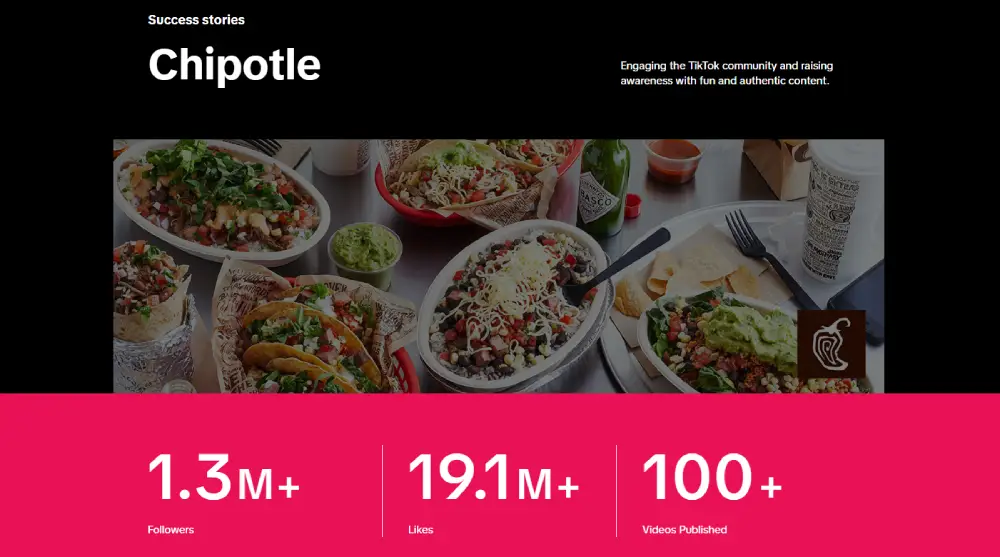
This was largely an organic and creator-seeded campaign, not a paid ad in the traditional sense. That distinction matters because the lessons are different from a Brand Takeover or In-Feed ad.
What to steal: tie a challenge to a real calendar date, offer one tangible reward, and give people exactly one simple action to copy.
2. Guess Used a Brand Takeover to Kickstart a Six-Day Hashtag Challenge
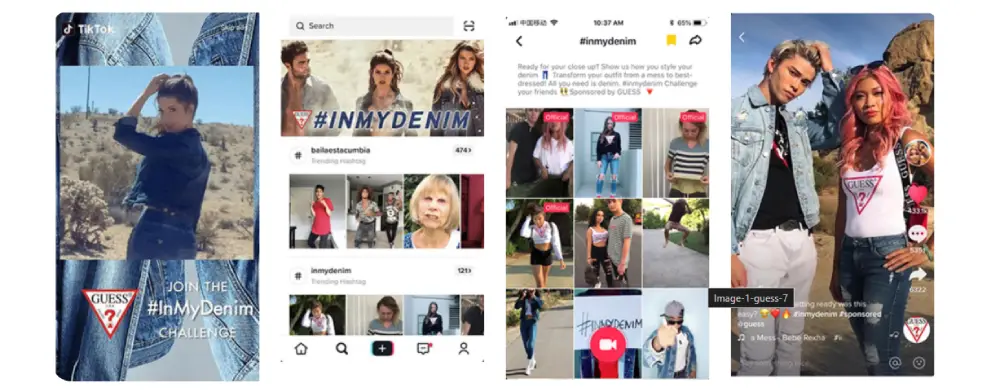
Guess launched a Brand Takeover on day one to promote its #InMyDenim challenge, paired with influencer seed videos using Bebe Rexha’s song I’m a Mess. According to the TikTok for Business case study on Guess, the six-day campaign generated over 5,550 user-generated videos, 10.5 million video views, a 14.3% engagement rate, and more than 12,000 new followers for the brand’s account.
What to steal: if you’re launching in a short window, a Brand Takeover on day one can seed fast initial engagement that a hashtag challenge then carries forward.
3. Isle of Paradise Turned Creator Reviews Into a 500% ROI Spark Ads Campaign
Isle of Paradise didn’t shoot new content for this campaign. It found creators already posting organic testimonials about its Glow Drops product, licensed that content, and ran it as Spark Ads through TikTok Ads Manager. According to the TikTok for Business case study, the campaign produced a 500% return on investment, 45 million video views, a 1.1% click-through rate, and a 68% increase in weekly revenue compared to the nine weeks before launch. That result came during the brand’s off-season.
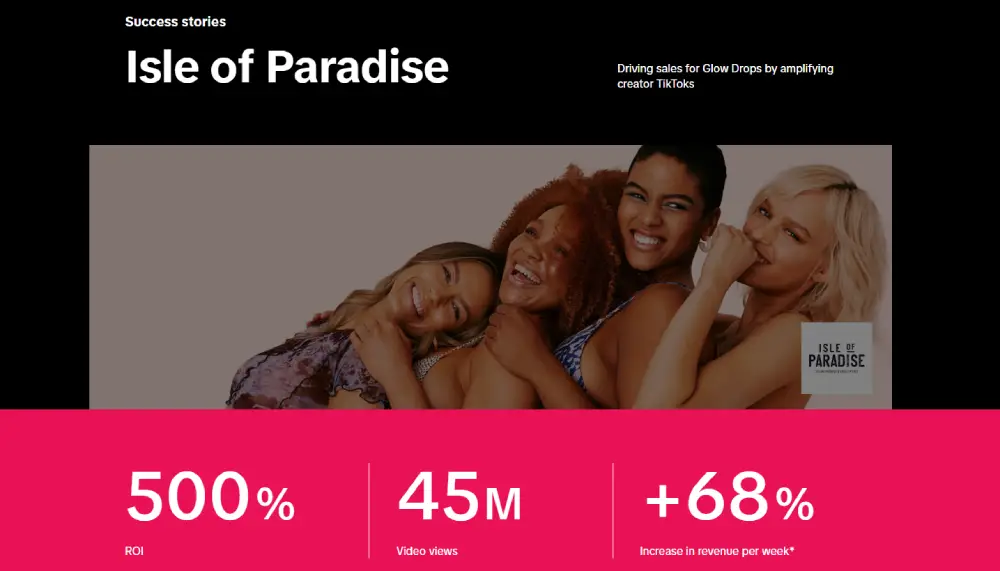
Because the content already carried real likes and comments, it read as an organic post rather than an ad. That’s a real advantage of Spark Ads. It’s not proof that creator testimonials always beat scripted creative everywhere, just that they worked well here.
What to steal: before shooting anything new, look for creators already talking about your product and consider licensing what’s already working.
4. Too Faced Proved a Brand Takeover Can Show the Logo and Still Convert
Too Faced used a five-second, full-screen Brand Takeover to promote its Lip Injection Extreme lip gloss to Gen Z shoppers in the UK. Per the TikTok for Business case study, the ad earned 7.6 million impressions and 2.54 million unique views in a single day, drove 1.3 million clicks to the product page, and hit an 18.38% click-through rate, well above the UK beauty benchmark at the time.
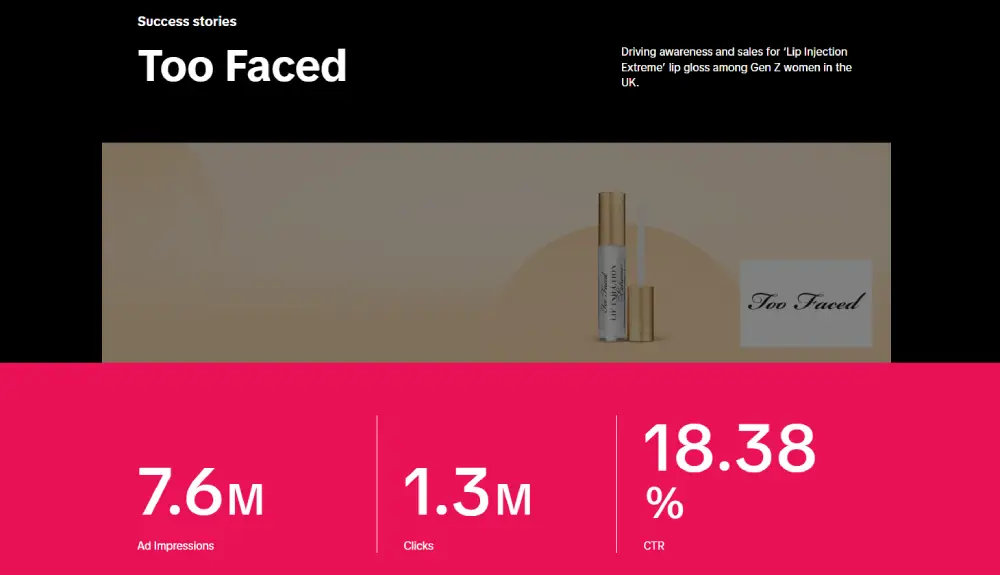
This case cuts against a common piece of advice. The creative used consistent product placement and clear branding throughout, not a hidden logo. Visible branding and a strong CTA worked together here.
What to steal: if your product delivers a fast, visible result, a Brand Takeover built around a clear before-and-after can work without hiding your brand.
5. Duolingo Used TikTok Lore and Spark Ads to Drive 12.63% Engagement
Duolingo’s Cult Mass campaign, which won Greatest TikTok at the 2025 TikTok Ad Awards, shows how a brand can turn a viral moment into an ongoing story that feels native to TikTok. It built on the viral story of Duo the Owl’s supposed death and reimagined him as a cult leader. The campaign ran in Germany and used TikTok-first creative, including immersive POV content, cinematic scenes and native TikTok assets.
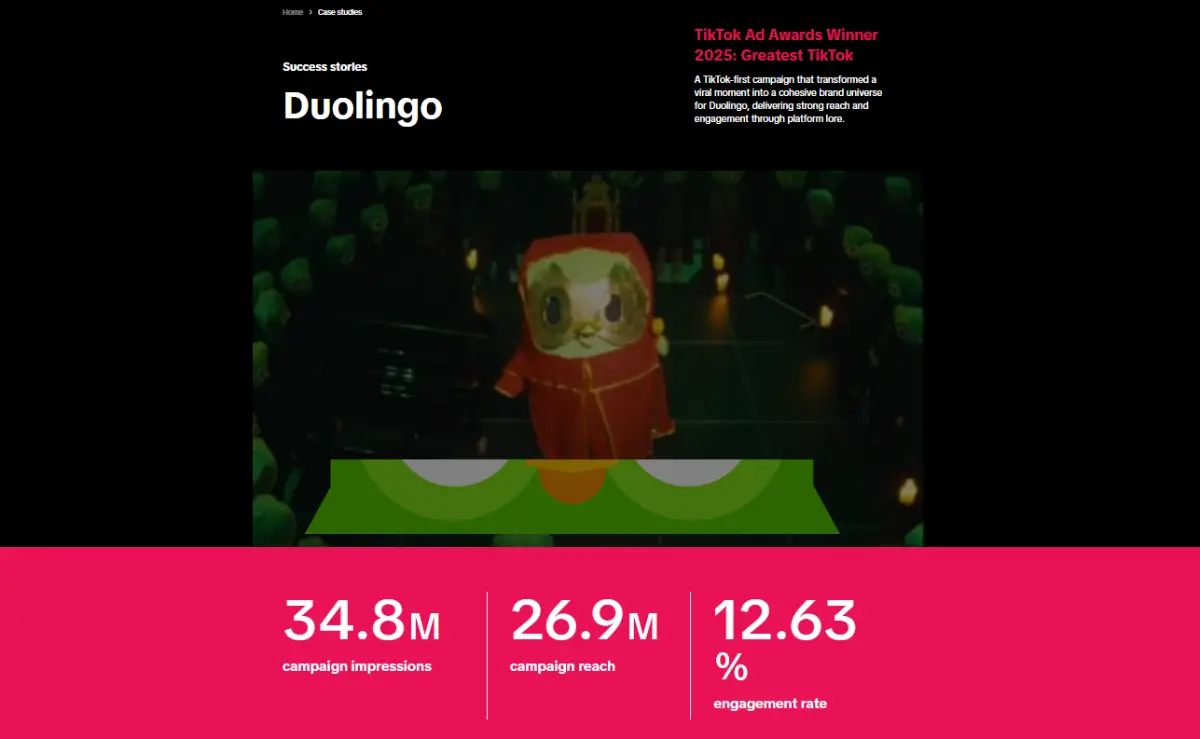
Duolingo also used Spark Ads to amplify the content that was already resonating with the TikTok community. The campaign connected Duolingo’s app mechanics with its fictional world, turning streak punishment into a ritual and positioning Duo as the cult’s high priest.
According to the TikTok Ad Awards case study, the campaign generated 34.83 million impressions, reached 26.89 million users and produced 4.55 million interactions, with a 12.63% engagement rate and 3.84 million reactions.
What to steal: Build a recognizable brand world around your TikTok content, then use Spark Ads to amplify the creative that already connects with the community instead of relying on conventional advertising alone.
6. Gap Built a Dance-Led Campaign That Reached 8 Billion Impressions
Gap’s fall 2025 campaign paired the girl group KATSEYE with a dance routine set to Kelis’s song Milkshake to relaunch its low-rise denim line. According to Marketing Dive’s coverage of Gap’s Q3 2025 earnings, the campaign generated 8 billion media impressions and more than 500 million views across platforms, and contributed to a 7% year-over-year rise in comparable sales alongside double-digit growth in Gap’s denim category.
This campaign mixed paid In-Feed placement, organic posting, and creator partnership rather than running as one isolated ad format, which is worth knowing before you try to copy it as a single tactic.
What to steal: pairing a song your audience already has emotional history with, alongside a simple, repeatable dance, gives people a reason to make their own version instead of just watching yours.
Which TikTok Ad Format Fits Your Goal
TikTok’s ad lineup has grown well past Brand Takeovers and Hashtag Challenges. Here’s a current starting point by goal, based on TikTok’s own creative advertising guide and current format documentation.
| Your goal | Format to start with | Why |
|---|---|---|
| Mass awareness on app open | TopView / Brand Takeover | Full screen, zero competing content |
| Community and UGC | Branded Mission | Crowdsources creator videos and promotes the best ones as ads |
| Amplify existing content | Spark Ads | Keeps social proof intact, feels native |
| Website traffic or conversions | In-Feed Ads | Full targeting control, scrollable |
| High-intent discovery | Search Ads | Reaches people already searching your category |
| Direct in-app sales | Video Shopping Ads / GMV Max | Shoppable product tiles, automated bidding |
Treat this as a starting point, not a rulebook. The format earns you the placement. Your creative still has to earn the result.
How Long Should a TikTok Ad Be?
There’s no single correct length for a TikTok ad. TikTok’s own In-Feed spec page now allows non-Spark videos of up to 10 minutes, while its ad format policy still lists 5 to 60 seconds. In practice, start with the shortest cut that shows the product working, then test a longer version against it.
A few points worth keeping in mind:
- Brand Takeover creative has historically run around three to five seconds for video, based on TikTok’s own case studies.
- Spark Ads should generally keep the original creator’s video length, since trimming it can undercut the organic performance you’re trying to borrow.
- If your product needs more time to demonstrate, a longer, well-retained video can outperform a shorter one with weak completion. Length alone doesn’t decide the outcome.
Creative Strategies Worth Testing
A few creative habits show up again and again across TikTok’s own best-practice research and the case studies above.
Lead with a native, unpolished feel. TikTok’s creative guidance, covered above, links TikTok-first ads to more clicks, likes and shares than ads made for other platforms. That doesn’t mean high production always loses. It means content that feels TikTok-first tends to outperform content that feels lifted from another platform. It also helps to study how to create native-looking TikTok ads before you brief a creator.
Use sound deliberately. Recognizable or trending audio can shape how people feel about your ad before they process a single word. If you need help picking a track, check which music for TikTok ads fits your offer and your audience.
License what’s already working. As Isle of Paradise showed, creators who already made organic content about your product can become your fastest, most credible ad creative. Sourcing and licensing that content is a skill of its own, and TikTok UGC ads work best when you get permissions right first.
Cut your video natively. Tools like CapCut are built for TikTok-style edits, including fast cuts, text overlays, and trending transitions, without needing a full production setup.
Get the CTA right. A CTA that feels like a natural next step, not an interruption, tends to close better than a hard sell. Compare the TikTok CTA button options before you pick the wording for each format.
How to Test and Refresh TikTok Ad Creative
Skip fixed thresholds such as pausing every ad below one completion rate or scaling every ad above one engagement rate. Rules like that show up often in marketing blogs, but they’re not TikTok rules, and they fall apart the moment you compare a 7-second ad to a 45-second one.
Instead, build your testing process around your actual objective:
- Reach campaigns: watch reach, frequency, and ad recall.
- Traffic campaigns: watch click-through rate and landing page views.
- Conversion campaigns: watch cost per action and return on ad spend.
- App campaigns: watch cost per install and retention.
For refresh timing, TikTok’s campaign optimization guidance suggests running 2 to 5 ads per ad group and refreshing creative monthly, ideally every 1 to 2 weeks, while you watch for results that start to slide.
A creative testing framework and an ad A/B testing tool can help you structure this without guessing.
5 Mistakes That Hold TikTok Ads Back
These five mistakes hold back many TikTok ads, even ones with a good product behind them.
Treating every ad like a viral hashtag challenge. A paid In-Feed or Spark Ad is a different thing from an organic UGC moment. Confusing the two leads to the wrong measurement plan.
Opening on a static logo or product shot. This kills momentum in the first second and gives the algorithm less reason to keep showing your ad.
Copying rules that aren’t TikTok’s. Claims like shares always beat likes or soft CTAs always outperform hard ones circulate constantly in TikTok marketing content without a traceable source. If you can’t find it in TikTok’s own documentation, treat it as an opinion.
Running one creative for weeks without checking performance. Creative fatigue is real, but the fix is watching your metrics, not following an arbitrary calendar.
Ignoring Search Ads. Plenty of brands only think in terms of feed interruption. Many people look up products in TikTok search, and Search Ads can catch that intent.
What TikTok Ads Cost
What you pay for TikTok ads starts with a daily floor. TikTok’s budget help page sets daily minimums of more than $50 per campaign and more than $20 per ad group, and it advises raising budget by no more than 40% per change during the learning phase, no more than 30% after it, and not more often than every two days.
Here are the floors at a glance:
| Level | Minimum daily budget |
|---|---|
| Campaign | $50 |
| Ad group | $20 |
Beyond those floors, actual cost per click and cost per impression shift with your industry, audience, and auction competition. For a sense of where your numbers should land, check current TikTok ad benchmarks by objective.
Frequently Asked Questions
What makes a TikTok ad perform well?
A TikTok ad performs well when it pairs a strong hook with a native feel and a call to action that fits the tone. TikTok’s creative research ties most ad recall to the opening seconds, so the hook does most of the work.
Are TikTok’s viral hashtag challenges the same as paid TikTok ads?
No. Campaigns like Chipotle’s #GuacDance ran largely as organic, creator-seeded challenges. Paid formats like In-Feed Ads, Spark Ads and Brand Takeover work differently and need different creative and measurement.
How long should a TikTok ad be?
TikTok’s ad format policy lists 5 to 60 seconds, and its In-Feed spec page now allows non-Spark videos of up to 10 minutes. Match the length to how long your product takes to explain, and test a short cut against a longer one.
How often should I refresh TikTok ad creative?
Refresh TikTok ad creative on a regular schedule and sooner when results slide. Start with a few variations per ad group so you always have a fresh option ready when one tires out.
What’s the minimum budget to run TikTok ads?
TikTok sets a minimum daily budget for each campaign and each ad group. The cost section above lists the current floors from TikTok’s budget help page, along with how fast you can raise spend.
Wrapping Up
To wrap up, start with the hook. Nothing else matters if people scroll past the opening seconds.
Pick one format from the table above that matches your actual goal, not the one that looks most exciting. Then build a short list of creative variations and test them against the metric that matches your objective, not a borrowed threshold from someone else’s campaign.
The six cases above come from different years and formats. TikTok’s ad lineup keeps changing, but the habits that work stay the same: check your numbers, match your creative to your format, and keep testing.