
You got a quote back from a TikTok creator, and now you are staring at the number wondering if it is fair. Maybe you are the creator, and you just typed a rate into a DM and immediately started second-guessing it.
Either way, TikTok influencer pricing feels like a guessing game because there is no public rate card anywhere on the platform.
That confusion costs money on both sides. Brands overpay for creators who cannot actually move a product, and creators underprice themselves because they have no benchmark to compare against.
This guide breaks down what TikTok creators are actually charging in 2026, based on current industry data, so you can walk into your next negotiation with real numbers instead of a guess.
Here is what you will learn:
- What TikTok influencer rates actually look like by follower tier in 2026
- Why two creators with the same follower count can charge very different prices
- How TikTok Shop affiliate deals work as an alternative to a flat fee
- What Spark Ads authorization adds to a creator’s base rate
- How to sanity-check a quote before you agree to it
Rates shift fast on TikTok, so the numbers below reflect the most current data available. Use them as a starting point, then adjust for the specifics of your campaign.
Get Up to $6000 Free TikTok Ad Credit
Table of Contents
Key Takeaways
- TikTok influencer rates range from roughly $50 for a nano creator’s video to $50,000 or more for a mega creator, according to Influencer Marketing Hub’s 2026 cost guide for brands.
- A simple industry rule of thumb puts TikTok sponsored post pricing at about $10 per 1,000 followers, according to Sprout Social’s 2026 influencer pricing data.
- Follower count still drives most buying decisions, even though Influencer Marketing Hub reports that 67.3% of brands select creators mainly by audience size, while only 13.6% weigh engagement most heavily.
- TikTok Shop affiliate deals pay creators a commission instead of a flat fee, and sellers control that commission rate directly inside their Seller Center account.
- Usage rights and Spark Ads authorization are almost always priced separately from the base content fee, so ask about them before you agree to a number.
- Niche matters more than most brands expect. Finance, tech, and other high-intent categories tend to command higher rates than general lifestyle content at the same follower count.
Quick Answer
TikTok influencer rates in 2026 typically run from about $50 to $200 per video for nano creators, $200 to $800 for micro creators, $800 to $5,000 for macro creators, and $5,000 to $50,000 or more for mega and celebrity creators, based on data from Influencer Marketing Hub. Niche, engagement rate, and usage rights can push any of these numbers higher.
What a TikTok Influencer Charges Depends on More Than Followers
Follower count is the easiest number to see, so it is the one most brands lead with. But it is a weak predictor of what a creator should actually charge.
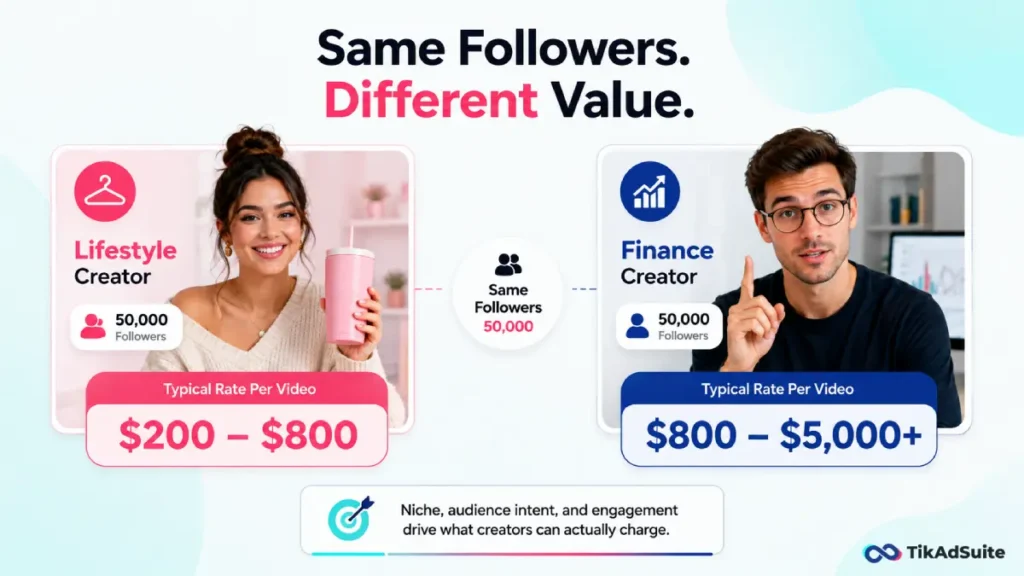
Two creators with 50,000 followers can quote completely different prices. One might have a highly engaged, niche audience that watches every video to the end.
The other might have followers who barely interact at all. The first creator is worth more, even though the follower count looks identical on paper.
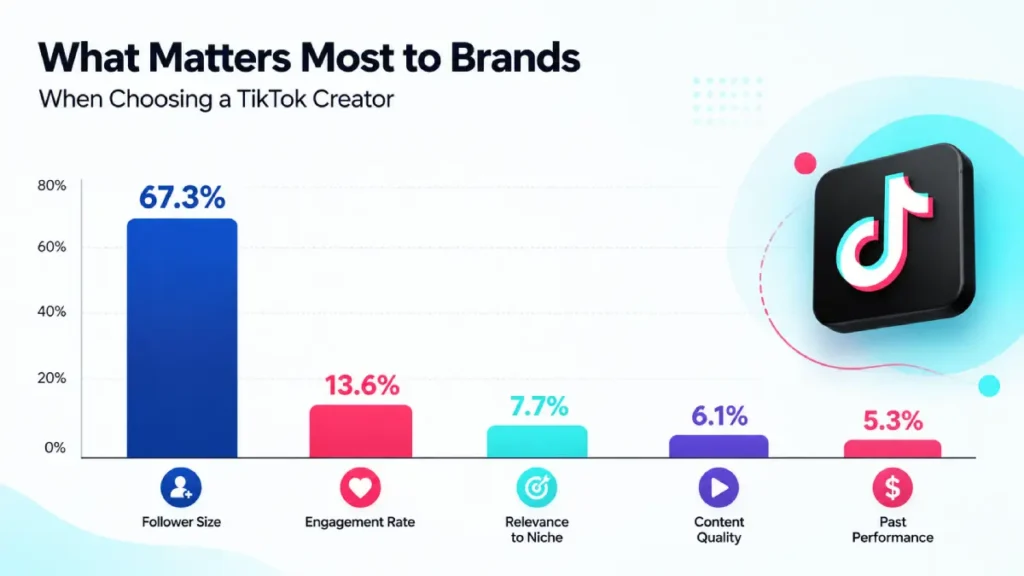
1,000Influencer Marketing Hub’s research found that 67.3% of brands still prioritize follower size when picking a creator, while only 13.6% treat engagement as the deciding factor. That gap explains why so many brands end up overpaying for reach that never converts. (Source)
TikTok Influencer Rates by Follower Tier in 2026
Rate benchmarks vary depending on how they are measured. Some sources report the full negotiating range brands should expect. Others report the average price actually paid across a large sample of real deals. Both are useful, so here is a look at each.
Influencer Marketing Hub’s 2026 benchmarks break TikTok rates into four tiers based on typical negotiating ranges:
| Tier | Follower Range | Typical Rate Per Video |
|---|---|---|
| Nano | 1,000 to 10,000 | $50 to $200 |
| Micro | 10,000 to 100,000 | $200 to $800 |
| Macro | 100,000 to 1,000,000 | $800 to $5,000 |
| Mega and celebrity | 1,000,000+ | $5,000 to $50,000+ |
Sprout Social’s influencer marketing data, pulled from real TikTok campaign activity, shows a different picture: the average price actually paid per post:
| Creator Size | Average Price Per Post |
|---|---|
| Nano | $15 |
| Micro | $75 |
| Mid-tier | $687.50 |
| Macro | $1,875 |
| Mega | $13,750 |
| Celebrity | $27,500 |
Notice the gap between the two tables. The Influencer Marketing Hub numbers show what brands should expect to negotiate.
The Sprout Social numbers show the average of what actually gets paid, which pulls lower because a large share of nano and micro deals involve product gifting or very small budgets rather than a full flat fee. Both are real.
Use the higher range when you are budgeting for a serious campaign, and use the average when you want a sanity check on a low-ball quote.
Sprout Social also confirms the simple rule many creators already use: roughly $10 per 1,000 followers for a sponsored post. It is not exact, but it is a fast way to spot a quote that is way out of line.
How TikTok Rates Compare to Paid Ads
Once you have a rate in front of you, the natural next question is whether that money would work harder as a paid ad instead.
The honest answer is that they solve different problems. Influencer content builds trust and produces reusable creative. Paid ads scale reach on a fixed budget with predictable, if not viral, results.TikTok One
If you are weighing the two, our comparison of TikTok influencers versus TikTok ads breaks down when each approach makes more sense for a given goal. And if you want a baseline for what paid campaigns cost on their own, our guide to TikTok ads cost covers current CPM and CPC benchmarks.
Most brands that scale successfully on TikTok end up doing both. They pay creators for authentic content, then boost the best-performing videos with ad spend on top.
TikTok Shop Affiliate Deals Pay Differently Than Sponsored Posts
Not every TikTok creator gets paid with a flat fee. TikTok Shop runs on an affiliate model instead, where creators earn a commission on every sale their content generates rather than a set price for the video itself.
Sellers set their own commission rate inside TikTok Shop Seller Center, and that rate is negotiated directly between the seller and the creator through the platform’s Affiliate Marketing tools.
When a creator promotes a product through an open collaboration, the rate they lock in stays protected for at least 30 days, even if the seller lowers it later. If the seller raises the rate instead, creators get the higher number right away.
For paid promotion layered on top of affiliate content, sellers can also set a separate Shop Ads commission, entered as a whole number anywhere from 1 to 80 percent.
That number determines how much extra a creator earns when a sale comes through a boosted, paid version of their post rather than an organic view.
If you are building out a TikTok Shop strategy, our guide to affiliate marketing on TikTok Shop walks through how to set this up from the seller side. It is also worth reviewing our breakdown of TikTok Shop fees so commission costs do not catch you off guard once referral fees and other platform charges are added in.
Commission-based deals can work out cheaper than a flat fee for products with strong conversion rates. They can also cost far more than a flat fee would have if a video goes viral and drives a huge volume of sales. Model both scenarios before you commit to one structure.
Spark Ads Add a Separate Cost on Top of the Base Rate
Spark Ads let a brand turn a creator’s existing organic TikTok video into a paid ad, and the ad still runs from the creator’s own account. TikTok describes Spark Ads as a native format that lets advertisers boost organic content while keeping the same likes, comments, and shares the video already earned.
That authenticity is valuable, which is why authorization for Spark Ads is almost always priced separately from the content fee itself.
A creator agreeing to a sponsored video is not automatically agreeing to let a brand spend ad dollars behind it for weeks or months. If you want that right, ask for it directly in the negotiation and expect to pay more for it.
Before you agree to a price, confirm three things in writing: how long the Spark Ads authorization lasts, whether the brand can use the content anywhere besides TikTok, and whether the fee already includes that usage or is billed on top.
Niche Changes What a Creator Can Charge
A finance creator with 40,000 followers can often charge more than a lifestyle creator with 150,000 followers. The reason comes down to who is watching.
Audiences with clear purchase intent, like finance, tech, and business content, are worth more to brands because the path from view to sale is shorter and easier to track.
Beauty and fashion creators also tend to command a premium because competition for those audiences is intense and conversion rates are historically strong.
General entertainment and comedy content usually sits at the lower end of its tier, since the audience is broad but not necessarily shopping.
Before you assume a quote is too high, check whether the creator’s niche justifies it. Our guide to TikTok user demographics can help you understand who is actually watching a given content category, which makes it easier to judge whether a creator’s audience lines up with your target customer.
How to Check If a Quote Is Fair Before You Pay It
A rate is not fair or unfair in isolation. It only makes sense next to the creator’s actual performance. Here is a simple way to sanity-check any quote before you agree to it.
- Ask for the creator’s average views across their last 10 to 20 videos, not just their best-ever post
- Compare the quote against the $10 per 1,000 followers benchmark and against the tier ranges above
- Divide the quoted fee by expected engagements to estimate cost per engagement, then compare that against other creators in the same niche
- Ask directly what the price includes: number of revisions, raw footage, cross-posting, and usage rights
- Factor in whether Spark Ads or paid usage rights are needed, since those are usually priced on top
If you want a faster way to run these numbers, our TikTok influencer ROI calculator estimates what a given rate and follower count could return before you commit budget to a creator.
Where Brands Find and Vet TikTok Creators
Most brand-creator matches now happen through TikTok’s own tools rather than cold DMs. TikTok One brings together the platform’s Creator Marketplace and other creative tools in a single place, giving brands creator discovery filters and campaign management features built directly into TikTok’s advertising ecosystem.
It replaced the standalone Creator Marketplace and Creative Exchange as TikTok consolidated its brand-facing tools.
Working through official tools gives you access to a creator’s real performance data instead of relying on numbers they hand-pick for you. That matters, since inflated screenshots are common in cold outreach.
If you would rather search and compare creators outside TikTok’s own dashboard first, our TikTok influencer finder helps you shortlist creators by niche and audience fit before you ever open a negotiation.
It is also worth pulling up a few of a creator’s past brand partnerships before you reach out. Our guide to using the TikTok Ad Library to research competitors shows you how to see which sponsored content is already running in your category, which gives you a real sense of going rates in your niche.
Common Pricing Mistakes Brands and Creators Both Make
A few mistakes show up again and again on both sides of a TikTok deal.
Brands often anchor to follower count alone and skip checking average views, which leads them to overpay for a large but disengaged audience. They also forget to ask about usage rights upfront, then get hit with a second invoice once they want to reuse the content in ads.
Creators often underprice their work by copying a number they saw in a random online rate chart, without adjusting for their own engagement rate or niche. They also sometimes bundle Spark Ads rights into a flat fee without realizing what that permission is actually worth.
The fix on both sides is the same: talk about deliverables and usage rights before you talk about price. A vague brief almost always produces a higher quote, because the creator is pricing in uncertainty rather than the actual scope of work.
Frequently Asked Questions
How much do TikTok influencers charge per video in 2026?
According to Influencer Marketing Hub’s 2026 benchmarks, nano creators (1,000 to 10,000 followers) charge about $50 to $200 per video. Micro creators (10,000 to 100,000) charge about $200 to $800. Macro creators (100,000 to 1 million) charge about $800 to $5,000, and mega creators charge $5,000 to $50,000 or more. A common rule of thumb is about $10 per 1,000 followers.
How much should a nano influencer with 5,000 followers charge on TikTok?
A nano creator with 5,000 followers usually charges about $50 to $200 per video. Using the $10 per 1,000 followers rule, that works out to around $50. A highly engaged account in a valuable niche can charge toward the top of that range or more.
Is TikTok cheaper than Instagram for influencer marketing?
Not necessarily. At most follower tiers, TikTok rates are close to Instagram rates, although they vary by niche and creator. Instead of assuming one platform is cheaper, compare quotes from creators with similar engagement rates and audiences on both platforms.
Do TikTok creators charge extra for Spark Ads authorization?
Yes, in most cases. Spark Ads let a brand run paid ads through the creator’s own post and account, which is a separate right from a sponsored post. Creators usually charge for this on top of their base content fee, so confirm it in writing before the deal starts.
What is the difference between a flat fee and a TikTok Shop affiliate deal?
With a flat fee, the creator gets a set amount for a video no matter how it performs. With a TikTok Shop affiliate deal, the creator earns a commission on actual sales, at a rate the seller sets in TikTok Shop Seller Center. Affiliate deals tie the creator’s pay to results.
Why do two creators with the same follower count charge different rates?
Engagement rate, niche, and audience quality matter more than follower count. A smaller creator with a highly engaged, high-intent audience in finance, tech, or beauty can charge more than a bigger creator with a broad, less engaged entertainment audience. Usage rights and Spark Ads permissions also raise the price.
Wrapping Up
TikTok influencer rates are wide because the platform rewards very different things depending on the creator. A nano creator with a loyal, niche audience can be worth more than a mid-tier account with weak engagement, and no single number captures that.
The most useful thing you can do before your next campaign is compare any quote against real 2026 benchmarks, check the creator’s actual average views, and get clear on usage rights before you agree to a price.
If you are setting up your first Creator Marketplace campaign, a TikTok Business account is the starting point TikTok’s own tools are built around, and it gives you access to the creator discovery and campaign management features covered above.
Rates will keep shifting as TikTok Shop and Spark Ads mature, so revisit these numbers every few months rather than treating them as fixed.