
Most marketers still picture TikTok’s audience as college students chasing viral trends. The reality in 2026 looks quite different.
TikTok user demographics have matured considerably, and the platform now reaches adults across every age group, income bracket, and time zone in meaningful numbers.
Knowing exactly who is on TikTok removes the guesswork from content strategy and ad targeting. You stop building campaigns for the wrong audience and start speaking to the people most likely to engage, click, and buy.
In this guide, you will learn:
- How TikTok’s global user base breaks down by age and gender
- Which regions and countries drive the most users
- How each generation uses the platform differently
- What the demographic shifts mean for your targeting and content strategy
- How TikTok stacks up against other major social platforms
Table of Contents
Get Up to $6000 Free TikTok Ad Credit
Key Takeaways
- According to Sprout Social, citing Data Reportal’s Digital 2026 report, TikTok has more than 1.9 billion monthly active users globally.
- Users aged 25 to 34 are the largest age segment on the platform, not teenagers.
- In the US, women make up approximately 61% of TikTok’s user base, while the global split leans slightly male.
- Gen Z drives platform culture, but is no longer the majority age group by volume.
- TikTok ranks fifth among social platforms by monthly active users but second globally by total daily time spent per user.
- The 45-and-older audience is one of the fastest-growing segments on the platform, opening up new verticals for advertisers.
Who uses TikTok in 2026?
Users aged 25 to 34 make up TikTok’s largest global segment, followed by 18 to 24 year olds. Gen Z remains the platform’s cultural force, but Millennials are now the biggest audience by volume. The global gender split leans slightly male, while the US audience is majority female. With more than 1.9 billion monthly active users across 155 countries, TikTok reaches a wider range of ages and backgrounds than most advertisers expect.
How Big Is TikTok in 2026?
Getting the scale right matters before digging into demographics. According to Statista, TikTok has more than 1.9 billion monthly active users worldwide. That places TikTok among the five most-used social platforms globally by active user count.
What separates TikTok from platforms with similar or larger audiences is time spent. Data Reportal’s Digital 2026 report found that TikTok users spend about 55 minutes per day on the app, the highest average daily time per user of any social network. Users are not just opening TikTok occasionally; they are staying.
Sprout Social also reports that TikTok has over 90 million daily active users in the United States alone, underscoring how deeply embedded the platform is in American digital habits.
TikTok ranks fifth globally by monthly active users, but climbs to second place when platforms are ranked by total daily time spent. That combination makes TikTok one of the most attention-efficient channels available to advertisers right now.
TikTok Age Demographics: Who’s Really Using the App?
Age is where assumptions about TikTok most often break down. The platform built its reputation on Gen Z, but that story has shifted.
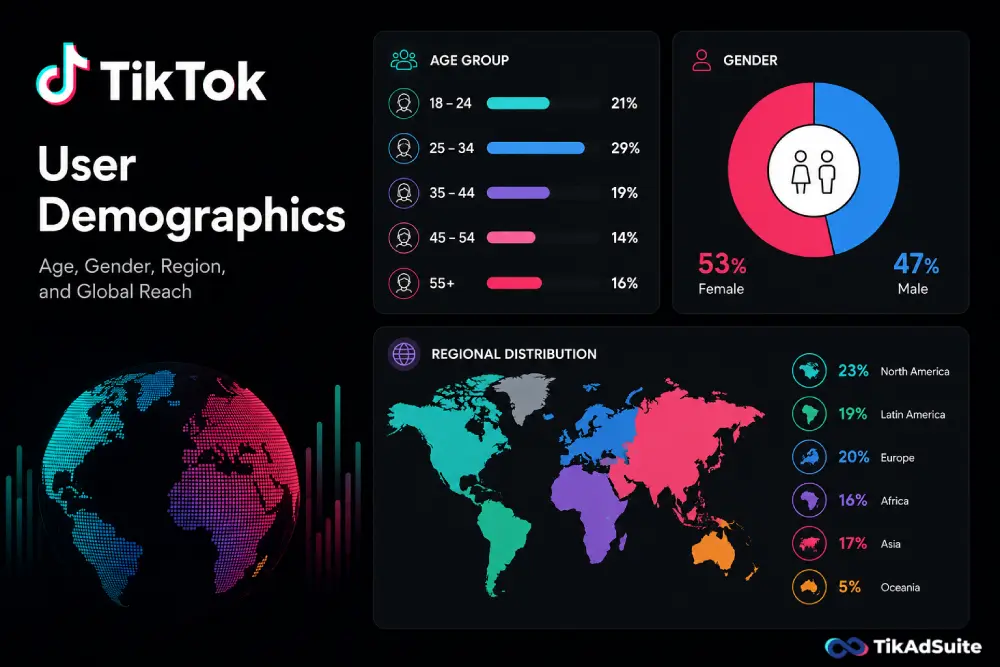
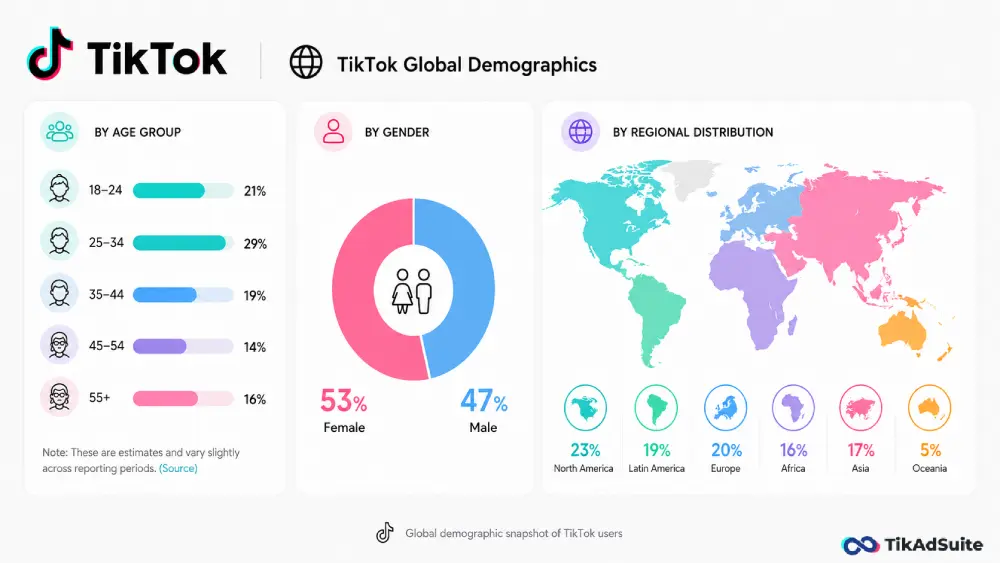
According to Statista’s TikTok user distribution data, users aged 25 to 34 now make up the single largest age group on the platform globally. The 18 to 24 segment follows as the second largest. Together, these two groups represent the clear majority of TikTok’s active user base.
The age distribution breaks down roughly as follows, based on Statista’s global estimates:
| Age Group | Estimated Share of Global Users |
| 18 to 24 | 21% |
| 25 to 34 | 29% |
| 35 to 44 | 19% |
| 45 to 54 | 14% |
| 55 and older | 16% |
Gen Z Still Leads Platform Culture
Raw numbers do not capture the full story. According to Sprout Social, Gen Z makes up about 60% of TikTok’s active user base, and 72% of Gen Z users have a TikTok account. That concentration gives Gen Z an outsized influence on what trends, what goes viral, and what kind of content performs well.
So while Millennials now outnumber Gen Z on the platform overall, how Gen Z uses TikTok shapes the environment that every other age group participates in.
What About Older Users?
Adults aged 45 and older are among the fastest-growing segments on TikTok, even if they still represent a smaller overall share. These users tend to gravitate toward content about personal finance, home improvement, health, and parenting. Their growing presence changes which verticals make sense on TikTok.
If you are running TikTok ads targeting products that serve adults 35 and older, the audience exists and is reachable. Reaching them simply requires different creative approaches than what works for younger cohorts.
TikTok Gender Demographics: Male vs. Female Users
TikTok’s gender split changes depending on whether you are looking at global data or a specific market, and the difference is significant enough to affect campaign strategy.
At the global level, Statista’s TikTok user data shows approximately 54.5% of users are male, and 45.5% are female. A slight male majority, but not a dramatic lean.
The US Gender Split Is Essentially Reversed
In the United States, the numbers flip. Statista data consistently shows that approximately 61% of US TikTok users are female, with men at around 39%. That gap is substantial for US-focused campaign planning.
This female majority shows up most clearly in categories like beauty, fashion, wellness, and lifestyle content. If your product fits any of these verticals, building creative strategies around a female-majority audience is supported directly by the data.
Regional Variations Matter
Gender distribution shifts considerably across markets. Regions across South and Southeast Asia and parts of Africa tend to have a higher proportion of male users, driven largely by differences in digital access and cultural context. North America, Western Europe, Australia, and Latin America generally trend closer to the US pattern.
If you are running campaigns across multiple regions, checking TikTok audience insights for each target market before finalizing your creative brief helps you avoid applying US audience assumptions where they do not hold.
TikTok Regional Demographics: Where Are the Users?
TikTok’s user base spans every major global region, but the distribution is uneven. Knowing where users concentrate helps you match your campaign scope to a real opportunity.
Top Countries by Monthly Active Users
Based on 2026 estimates from industry reports:
| Country | Estimated Monthly Active Users |
| United States | 153.12 million |
| Indonesia | 180.11million |
| Brazil | 130.84 million |
The United States is one of TikTok’s largest national markets and its most commercially valuable. American users generate a disproportionate share of the platform’s advertising revenue relative to their share of total global users.
How Regions Differ in Usage Behavior
Southeast Asia, led by Indonesia, Vietnam, and the Philippines, produces some of the highest content creation volumes on the platform and is where TikTok Shop has scaled most aggressively. For brands running TikTok ads for eCommerce, Southeast Asia and the US represent the two highest purchase-intent environments on the platform.
Latin America, particularly Brazil and Mexico, shows strong community engagement and influencer-driven behavior. Europe has a larger TikTok presence than many advertisers expect, with the UK and Germany as standout markets for brand campaigns.
How Different Generations Use TikTok
Knowing which generations are on TikTok is a starting point. Knowing how each one uses the platform is what actually informs creative and campaign decisions.
Gen Z (Born 1997 to 2012)
Gen Z treats TikTok as a primary media environment rather than just a social app. They use it for entertainment, product research, and trend discovery in roughly equal measure.
According to Sprout Social, 55% of Gen Z users engage with brand content on TikTok at least once per day, and 42% of Gen Z consumers turn to TikTok specifically for product discovery.
They respond to fast-paced content with a strong hook in the first two seconds, trend-connected formats, and creators who feel genuine rather than produced.
Crafting the right TikTok ad hooks is especially important for this group because Gen Z’s path to purchase runs through creator trust and social proof, not traditional ad formats.
Millennials (Born 1981 to 1996)
Millennials are now TikTok’s largest demographic by volume, and they bring real purchasing power to the platform.
They engage differently than Gen Z. Tutorials, how-to content, relatable storytelling, and practical content that solves a real problem tend to land better with this group than trend-driven formats.
According to YouGov data, 25 to 34-year-olds represent the largest share of influencer-driven product discovery on TikTok at 29%, ahead of 18 to 24-year-olds at 21%. That makes Millennials the most commercially actionable segment on the platform for most product categories right now. (Source)
Timing also matters with this group. Millennials are more active during evening hours and weekends, which has direct implications for when you schedule both organic content and paid campaigns.
Gen X and Baby Boomers (Born Before 1981)
Adults 45 and older are still a minority on TikTok, but they are not negligible. This group engages most with content around personal finance, home improvement, health, and nostalgia.
Their growing presence means product categories like insurance, home services, supplements, and financial planning now have an addressable TikTok audience that simply did not exist a few years ago.
If your brand has been avoiding TikTok because you assumed the older adult audience was not there, that assumption is worth testing with current data.
How TikTok Demographics Are Shifting in 2026
Three patterns define where TikTok’s audience stands heading into the second half of 2026.
The core audience is older than it used to be. Millennials displacing Gen Z as the dominant volume segment means TikTok’s aggregate audience has more disposable income, makes more complex purchase decisions, and tolerates slightly longer content formats than it did in 2021. This changes which ad types and creative approaches are worth prioritizing.
The older adult segment is growing steadily. Users 45 and older have grown consistently over the past two years. This trend opens consumer categories that were genuinely unreachable on TikTok not long ago, including financial services, home improvement, healthcare products, and senior-adjacent consumer goods.
Gen Z still sets the tone. Even as older segments grow, Gen Z continues to determine which formats spread, which sounds go viral, and which kinds of openings hold attention. Brands that understand Gen Z behavior on TikTok stay ahead of creative trends that eventually move across all age groups on the platform.
What TikTok Demographics Mean for Your Ad Strategy
Demographic data earns its keep when it changes how you make decisions. Here is how the data above maps to practical targeting choices.
Targeting by Age Group
TikTok’s ad platform lets you set age ranges directly, but creative style is the stronger lever. The algorithm reads engagement signals, and users self-select based on whether the content feels relevant to them.
- For 18 to 24 year olds: high-energy, trend-aware content with a strong hook in the first two seconds
- For 25 to 34 year olds: value-driven content, product demonstrations, creator-led reviews with genuine voices
- For those 35 and older: educational formats, relatable scenarios, slightly longer storytelling with a clear payoff
If you are new to paid campaigns, the TikTok ads beginner guide walks through targeting setup in detail. For more advanced audience building, TikTok lookalike and custom audiences let you move beyond demographic defaults and build targeting segments from your actual customer data.
Targeting by Gender and Region
For US campaigns, female-forward creative performs more consistently across broad audiences given the platform’s 61% female user base. That said, verticals like gaming, personal finance, and technology skew male even in the US, so category matters as much as geography.
For regional campaigns, Southeast Asia and Latin America offer high user volume at typically lower CPMs. North America and Western Europe bring smaller audiences with stronger commercial intent and purchase readiness. Running separate creative and targeting for each region almost always outperforms a single global campaign.
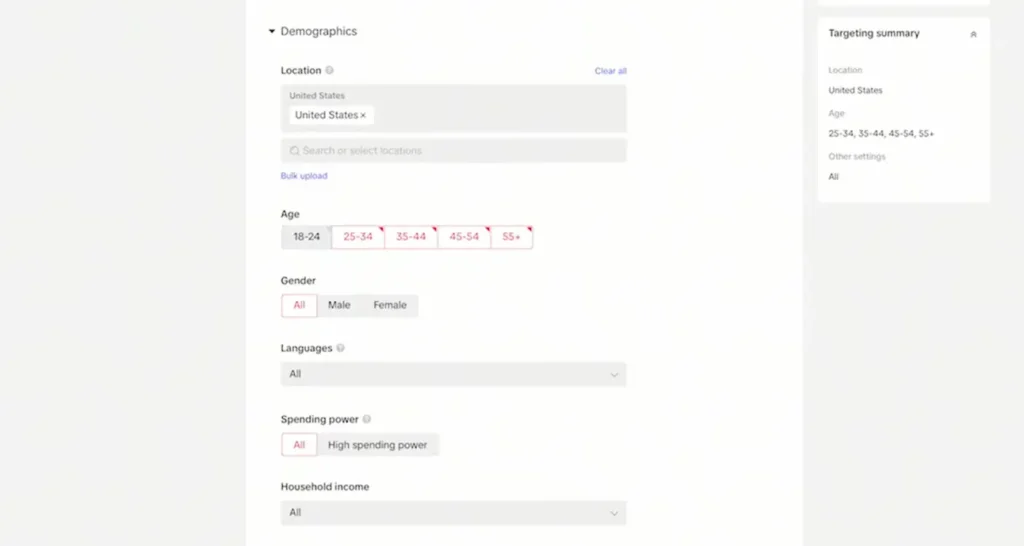
You can layer demographic targeting against TikTok’s interest-based targeting categories to narrow in on the right audience clusters within a broad demographic.
TikTok Demographics for Specific Industries
Demographics shape which industries get the most traction on TikTok, and knowing that overlap before you commit budget prevents wasted spend.
Beauty and Personal Care: TikTok’s female-majority US audience and Gen Z’s strong product discovery behavior make beauty one of the platform’s highest-performing verticals. Beauty brands consistently benefit from creator-led tutorials, transformation content, and before-and-after formats that match how the audience already consumes content in this space.
Fitness and Wellness: Strong engagement across both Gen Z and Millennials makes fitness a natural fit. Short workout demos, nutrition content, and transformation storytelling all resonate. Running TikTok ads for fitness and gym businesses works because the platform’s audience actively seeks out health content unprompted.
Lead Generation: With Millennials as the dominant age group and the 45-and-older audience growing, TikTok has become a realistic lead generation channel for financial services, real estate, education, and home services. The professional adult audience that was missing a few years ago is now there in real numbers. TikTok lead generation ads give you a direct path to capturing this audience beyond pure awareness campaigns.
B2B: Expectations matter here. TikTok is not where B2B buying decisions get made, but it is a low-competition awareness channel for reaching decision-makers between 25 and 44. If you are exploring that angle, TikTok ads for B2B companies cover what realistically works and what does not.
TikTok’s Engagement Depth as the Audience Matures
As TikTok’s demographic range broadens, a reasonable concern is whether engagement quality declines. So far, the numbers say no.
According to Socialinsider, TikTok maintains an average engagement rate of 3.73%, far ahead of every other major social platform where engagement typically falls below 1%. Broader demographics have not diluted the core quality that makes TikTok valuable to advertisers.
Combined with an average of 55 minutes of daily use per person, that engagement rate signals something platforms like Instagram and Facebook have struggled to maintain as they matured: TikTok is still capturing both time and interaction, not just passive scrolling.
The platform’s organic distribution model reinforces this. TikTok surfaces content to users who do not follow the creator, which means your reach is not capped by your follower count the way it is on most other platforms.
For demographic targeting purposes, this means you are not just reaching people who already know you, but the right new audience based on real behavior signals.
TikTok vs. Other Major Platforms: Audience Snapshot
| Platform | Largest Age Group | Estimated MAU (2026) | Avg. Daily Time |
| TikTok | 25 to 34 | 1.9 billion | 55 min |
| 25 to 34 | 2 billion | 30 min | |
| 35 to 44 | 3 billion+ | 30 min | |
| YouTube | 25 to 34 | 2.7 billion | 45 min |
| Snapchat | 18 to 24 | 900 million | 30 min |
All figures are approximate and based on publicly available 2026 estimates. TikTok’s daily time figure is from Data Reportal’s Digital 2026 Global Overview Report. MAU methodologies differ across platforms.
TikTok does not lead in raw audience size. Where it leads is daily time spent and engagement depth, which matters more for brands focused on recall, action, and purchase behavior than impression volume alone.
If you are weighing channel investment, TikTok ads vs. Facebook ads break down how the two platforms compare for paid campaigns.
Frequently Asked Questions
What age group uses TikTok the most in 2026?
Users aged 25 to 34 make up the largest single age segment on TikTok globally, according to Statista’s TikTok demographic data. The 18 to 24 group is the second largest. Teenagers remain highly active and culturally influential, but they are no longer the biggest group by total user count.
What is TikTok’s gender split globally and in the US?
Globally, Statista data shows TikTok’s user base is approximately 54.5% male and 45.5% female. In the United States, that split is roughly reversed: around 61% of US TikTok users are female. The US gender distribution is meaningfully different from the global average and should directly inform creative and targeting decisions for US-focused campaigns.
Is TikTok still mainly a Gen Z platform?
By user count, no. Millennials have overtaken Gen Z as the largest demographic group on TikTok. But by cultural influence, Gen Z still leads the platform. According to Sprout Social’s 2026 Social Media Content Strategy Report, 72% of Gen Z users have a TikTok account, and Gen Z makes up approximately 60% of TikTok’s active user base. Gen Z continues to set trends, content formats, and platform behavior patterns that shape the experience for all age groups.
Where does TikTok have the most users globally?
The United States is TikTok’s largest single national market with an estimated 150 million monthly active users, followed by Indonesia and Brazil. At a regional level, Latin America and Southeast Asia collectively host the largest user pools globally. The US also leads as TikTok’s most commercially active market by advertising revenue and purchase intent per user.
How much time do users spend on TikTok each day?
According to Data Reportal’s Digital 2026 Global Overview, users spend an average of about 55 minutes per day on TikTok. That is the highest average daily time spent per user of any major social network, according to the same report. It reflects consistent, active engagement rather than brief check-ins.
How do TikTok demographics help with ad targeting?
Knowing that 25 to 34-year-olds are the largest segment tells you TikTok supports products that require real purchasing power. The female-majority US audience shapes creative strategy for consumer goods, beauty, and wellness campaigns. The growing older adult segment opens verticals like financial services and home improvement that were previously out of reach. Use TikTok audience targeting to combine age, gender, location, and interest data into precise audience segments rather than relying on the platform’s broad demographic defaults.
Conclusion
TikTok’s audience in 2026 is genuinely broad. Millennials are the largest segment by volume, Gen Z is the most culturally influential, and older adults are growing faster than most advertisers have accounted for.
The US audience skews female while the global audience leans slightly male, and regional differences are significant enough to warrant separate campaign strategies.
What has not changed is what makes TikTok effective: the engagement holds, daily time spent is unmatched among major platforms, and the algorithm distributes content beyond your existing followers. Those fundamentals remain intact even as the demographic picture becomes more complex.
If you are ready to move from understanding your audience to actually reaching them, start with TikTok audience insights to build a clear baseline, then apply the targeting and creative guidance above to put it into action.