
You set up your first TikTok campaign, and now you face a choice that stalls a lot of advertisers. Do you target people who already know your brand, or go find brand new people who act like them?
That single decision shapes your cost, your reach, and how fast you grow. Pick wrong, and you either burn budget on strangers or keep talking to the same small crowd. This guide makes the choice simple.
Here is what you will walk away knowing:
- What a Custom Audience actually is and where its data comes from
- What a Lookalike Audience does and how TikTok builds it
- The exact moments each one wins
- How the two work together inside a real campaign
- A side-by-side table so you can decide in seconds
By the end, you will know which audience to reach for and why. Let’s break it down in plain terms.
Get Up to $6000 Free TikTok Ad Credit
Table of Contents
Key Takeaways
- A Custom Audience targets people who already interacted with your business, like past buyers or website visitors.
- A Lookalike Audience finds new people who behave like your existing customers, so you can expand past your current reach.
- According to the TikTok Business Help Center, a Custom Audience needs at least 1,000 matched users before you can use it for targeting.
- Custom Audiences are best for retargeting and loyalty, while Lookalike Audiences are best for scaling and finding fresh buyers.
- The strongest campaigns use both: a Custom Audience as the seed, and a Lookalike Audience built from it to grow.
What’s the Difference?
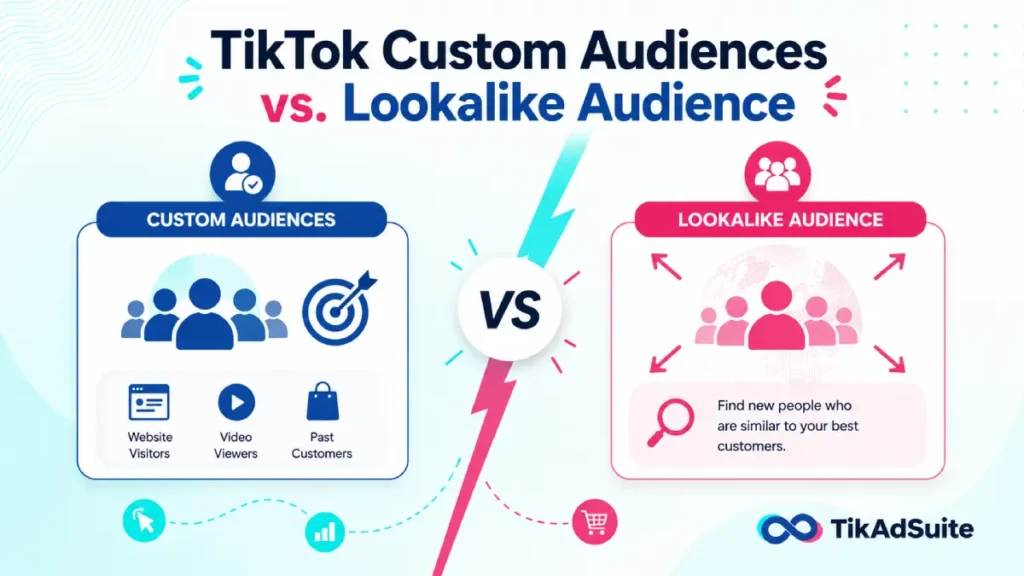
A TikTok Custom Audience targets people who already know you, such as past visitors, buyers, or video viewers. A Lookalike Audience uses one of those Custom Audiences as a model to find brand new people with similar behavior. Custom Audiences re-engage known users. Lookalike Audiences expand your reach to fresh prospects.
What Is a TikTok Custom Audience?
A Custom Audience is a group of people who already had contact with your business. You are not guessing who they are. You already have the data.
TikTok lets you build these audiences from sources you control. That includes your customer list, your website traffic, your app activity, and people who engaged with your TikTok content or ads.
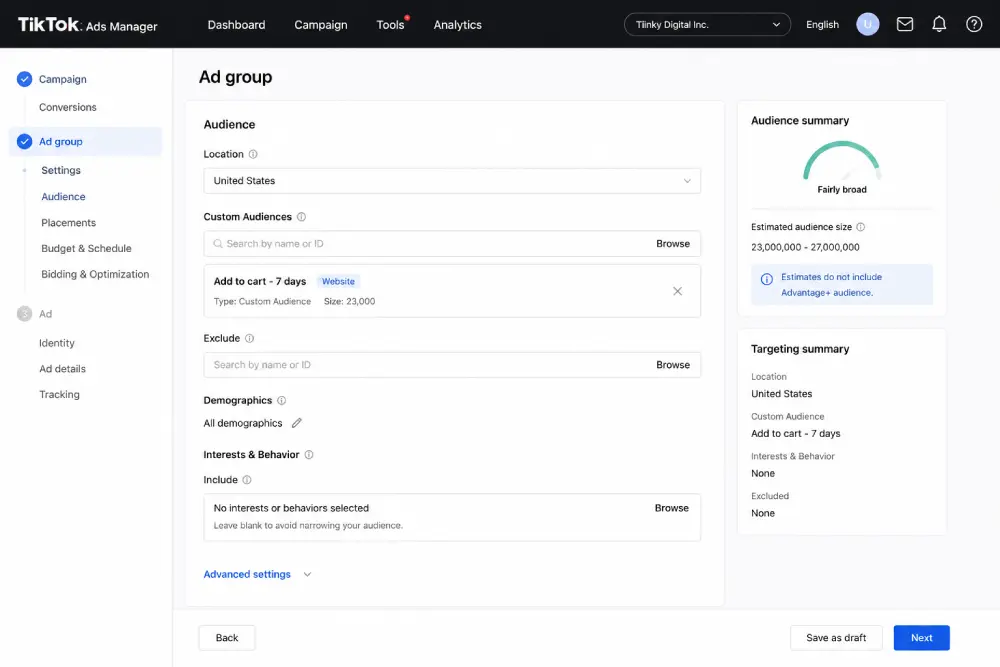
Common Custom Audience sources include:
- Customer files, like email or phone lists you upload
- Website visitors tracked through your pixel
- App users who took specific actions
- People who watched your videos or visited your TikTok profile
- Users who interacted with your lead forms
These audiences are warm. The people in them have seen your brand before, so they tend to convert at a lower cost. To capture website and event data cleanly, you need tracking in place first, which is why setting up the TikTok Pixel correctly matters so much before you build anything.
What Is a TikTok Lookalike Audience?
A Lookalike Audience is a group of new people who act like your best existing customers. You do not upload these people. TikTok finds them for you.
Here is the logic. You give TikTok a source audience, usually a Custom Audience. TikTok studies the traits and behavior of that group. Then it scans its user base to find others who match the pattern.
The result is a fresh pool of prospects who have never heard of you, but who share signals with people who already buy from you. That makes Lookalikes a powerful way to grow without targeting random strangers.
You can also control how broad the match is. A tight Lookalike stays very close to your source and stays smaller.
A broad Lookalike reaches further but loosens the match. This trade-off between precision and reach sits at the heart of how you scale TikTok ads over time.
Custom Audiences vs. Lookalike Audiences: Side by Side
This table shows the core differences at a glance.
| Feature | Custom Audience | Lookalike Audience |
| Who it targets | People who already know you | New people similar to your customers |
| Data source | Your own data (list, pixel, app, engagement) | A Custom Audience used as a model |
| Audience temperature | Warm | Cold to cool |
| Main goal | Re-engage and retarget | Expand and scale |
| Typical cost per result | Lower | Higher, but improves with quality seeds |
| Best campaign stage | Middle and bottom of funnel | Top and middle of funnel |
| Reach size | Limited to your known users | Much larger |
The pattern is clear. Custom Audiences protect and convert the people you already earned. Lookalike Audiences go find more of them.
When Should You Use Custom Audiences?
Reach for a Custom Audience when the people you want already had some contact with your brand. The relationship exists, and you just need to bring them back.
Custom Audiences work best for these goals:
- Retargeting visitors who viewed a product but did not buy
- Bringing back customers for repeat purchases or upsells
- Excluding existing buyers so you stop paying to reach them twice
- Re-engaging people who watched your videos but never clicked
- Building loyalty with past customers through new offers
Retargeting is where Custom Audiences shine brightest. People who already visited your site convert far more often than cold traffic. If you have not built this flow yet, learning how to set up retargeting campaigns on TikTok is the fastest way to recover lost sales.
There is one limit to keep in mind. Your Custom Audience can only be as large as your own data. Once you have shown ads to everyone in it, you hit a ceiling. That is exactly where Lookalikes take over.
When Should You Use Lookalike Audiences?
Use a Lookalike Audience when you have squeezed value from your known users and need to grow. Your warm pool is small. The world of potential buyers is huge.
Lookalike Audiences fit these situations:
- You want more sales, but your Custom Audiences are tapped out
- You have a strong seed audience, like recent purchasers, to model from
- You are launching a new product and need fresh reach
- You want to test a cold audience that still carries buying signals
- You aim to lower your cost per acquisition compared to broad targeting
The quality of your Lookalike depends on the quality of your seed. A Lookalike built from your top spenders performs better than one built from all website visitors. Feed TikTok your best data, and it finds better matches.
To get the most from Lookalikes, pair them with smart audience segmentation so each ad group speaks to one clear type of buyer.
Can You Use Custom and Lookalike Audiences Together?
Yes, and you should. The two are not rivals. They are teammates that cover different parts of your funnel.
A simple, proven structure looks like this:
- Build a Custom Audience from your best customers, such as recent buyers.
- Use that Custom Audience as the seed for a Lookalike Audience.
- Run cold campaigns to the Lookalike to bring in new prospects.
- Retarget those new prospects with a Custom Audience once they engage.
- Exclude existing buyers so your budget stays efficient.
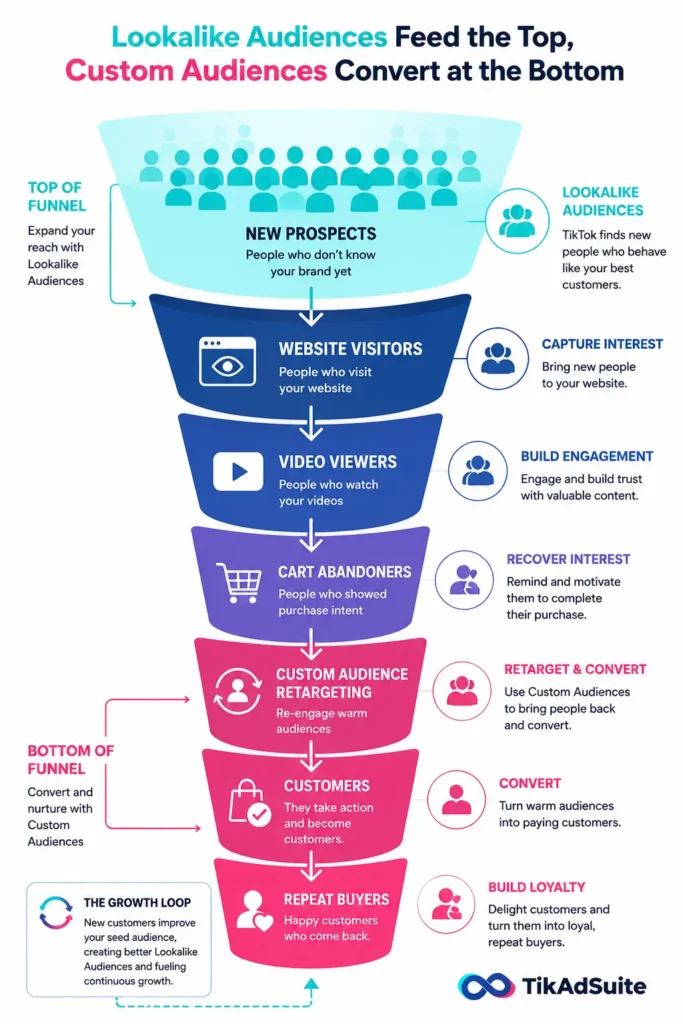
This loop keeps your funnel full at every stage. Lookalikes feed the top. Custom Audiences catch and convert at the bottom. Each new buyer can then improve the seed you model from next time.
If you want a deeper view of every targeting layer available, the full breakdown of TikTok ad targeting options shows how these pieces connect with interests and behaviors too.
Getting this setup right inside TikTok Ads Manager only takes a few clicks once your data sources are connected.
Which Audience Type Is Better for TikTok Ads?
Neither one is better on its own. The right choice depends on your goal at that moment, not on a fixed rule.
If your goal is to recover sales and re-engage warm users, Custom Audiences win. They cost less and convert faster because trust already exists.
If your goal is growth and your warm pool is small, Lookalike Audiences win. They open the door to people you could never reach with your own data alone.
Most accounts that grow steadily do not pick one forever. They use Custom Audiences to defend revenue and Lookalikes to expand it. The smart move is matching the audience to the job, then testing what your own data proves.
Common Mistakes to Avoid
A few errors quietly drain budget. Watch for these before you launch.
- Building a Lookalike from a weak seed, like all visitors instead of buyers
- Forgetting to exclude current customers from cold campaigns
- Letting a Custom Audience get too small to deliver, since targeting needs at least 1,000 matched users
- Setting your Lookalike too broad too soon, which loosens the match
- Skipping the pixel, which starves both audience types of data
Fix the data foundation first. Strong audiences come from clean, well-tracked signals, not from clever settings alone.
Frequently Asked Questions
How long does it take to build a TikTok Lookalike Audience?
TikTok usually needs a few hours to process a Lookalike Audience after you create it. The exact time depends on your source audience size and how many matches TikTok finds. Larger, cleaner seed audiences often process faster and produce stronger matches than tiny or low-quality sources.
What is the minimum size for a TikTok Custom Audience?
A Custom Audience needs at least 1,000 matched users before TikTok lets you target it. If your uploaded list or pixel data falls short, the audience stays unusable. To fix this, grow your data sources or combine related groups until you clear the threshold.
Do Lookalike Audiences expire?
Lookalike Audiences refresh based on your source. If your seed Custom Audience updates with new data, the Lookalike can update too. Static sources, like a one-time customer file, will not refresh on their own, so you should rebuild them with current data periodically.
Are Custom Audiences cheaper than Lookalike Audiences?
Usually, yes. Custom Audiences target warm users who already know your brand, so they tend to convert at a lower cost per result. Lookalikes target colder prospects, which often costs more upfront. Strong seed data can narrow that gap over time.
Can I create a Lookalike Audience without a pixel?
Yes. You can build a Lookalike from a customer file or engagement audience instead of pixel data. Still, a pixel-based source often performs best because it captures real buying behavior on your site, giving TikTok stronger signals to model from.
Wrapping Up
The choice between Custom and Lookalike Audiences comes down to one question. Do you want to re-engage people who know you, or find new people who act like them?
Start by building one strong Custom Audience from your best buyers. Then use it as the seed for a Lookalike, and let the two work as a system. Custom Audiences hold your revenue. Lookalikes grow it.
Get your pixel and data sources in order first, claim any available TikTok ad credit to test cheaply, and let your own results guide how far you scale.