
You have a product and a small budget. You open TikTok and see two paths. One lets people buy inside the app. The other lets you pay for traffic to your own website.
Pick wrong, and you can burn your cash before your first sale. Pick right, and you can build momentum that funds everything else. That is the real stakes behind TikTok Shop vs TikTok Ads.
This guide cuts through the noise with current numbers and a clear decision path. By the end, you will know exactly which one fits your product, your margins, and your timeline.
Here is what you will learn:
- What each option actually does, in plain terms
- The true cost to start with each one
- Which one converts better, backed by verified data
- How smart brands combine both to lower risk
- A simple checklist to make your call today
Both can work. The trick is matching the tool to your situation, not to the hype. Let’s break it down.
Get Up to $6000 Free TikTok Ad Credit
Table of Contents
Key Takeaways
- TikTok Shop lets shoppers buy without leaving the app, which removes friction and lifts conversion compared to sending traffic to an outside website.
- TikTok Ads give you control over your funnel, your data, and your scaling math, which matters for higher-priced items and services.
- TikTok Shop is exploding. According to Momentum Works, TikTok Shop’s U.S. GMV grew 68% to reach $15.1 billion in 2025, while global GMV hit $64.3 billion.
- TikTok Shop charges a referral fee but no monthly fee. TikTok Ads cost money upfront whether or not anyone buys.
- The lowest-risk path for most physical-product sellers is to start with Shop, then add paid ads once a product proves it sells.
TikTok Shop vs TikTok Ads
Start with TikTok Shop if you sell physical products under about $80 and want in-app sales without paying for traffic first. Start with TikTok Ads if you sell services, software, high-ticket items, or need to capture emails and own your customer data. Most brands eventually run both for the best results.
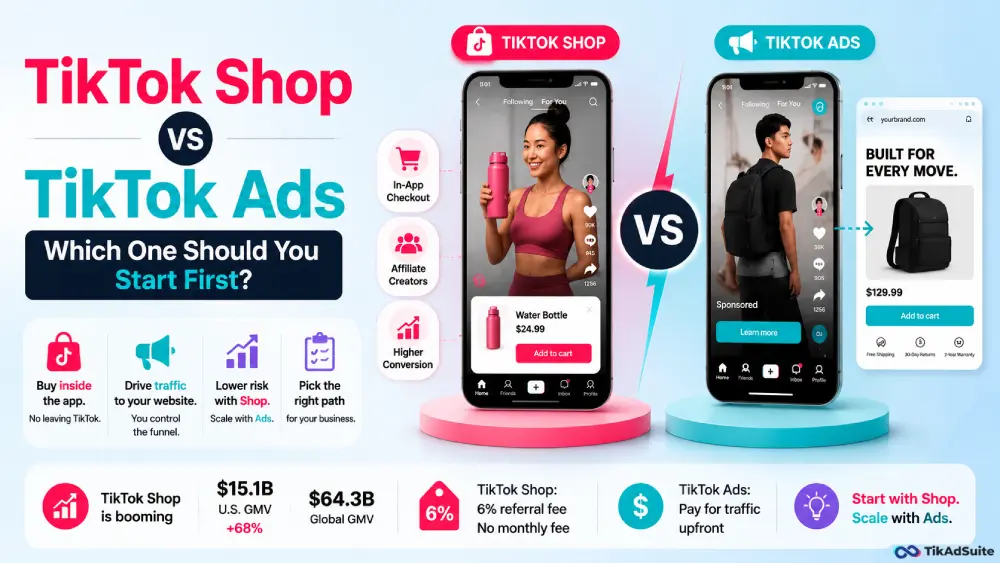
What’s the Real Difference Between TikTok Shop and TikTok Ads?
Think of them as two different storefronts in the same city.
TikTok Shop is a stall inside a packed marketplace. A shopper watches a video, taps the cart icon, and checks out without ever leaving the app. The sale happens on TikTok’s turf, powered by organic videos and affiliate creators.
TikTok Ads work like a billboard pointing to your own store. A user sees a sponsored video, taps through, and lands on your Shopify or WooCommerce site. You pay for each set of eyeballs, and you decide what happens next.
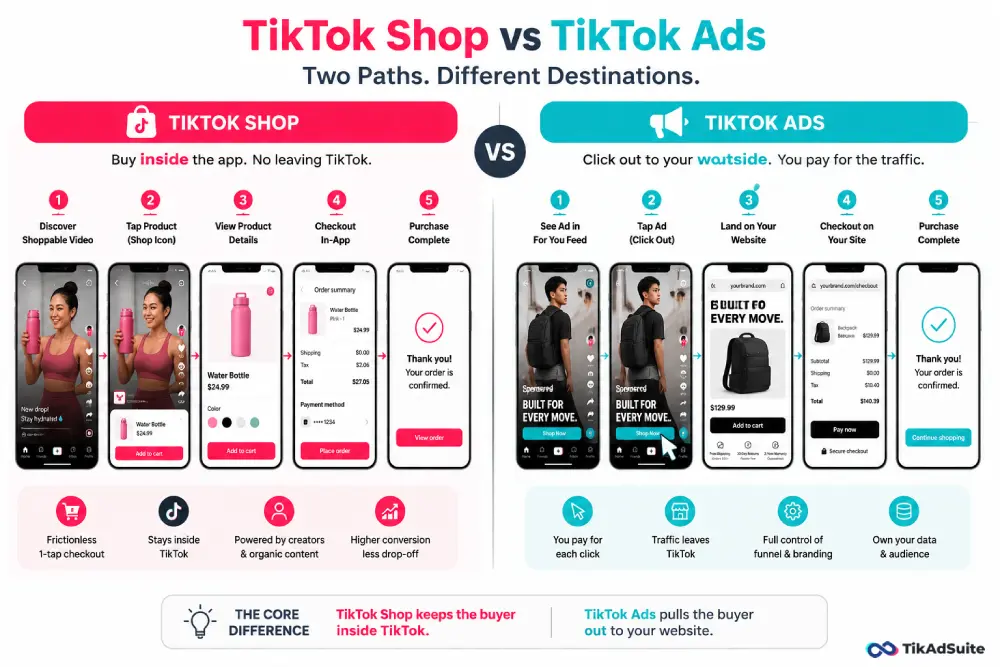
The core split is simple. Shop keeps the buyer inside TikTok. Ads pull the buyer out to a page you control. That one difference shapes cost, conversion, data, and the kind of products that thrive in each.
How Much Does Each One Cost to Start?
Money is usually the deciding factor for new sellers. The two paths charge you in very different ways.
TikTok Shop has no monthly fee and no listing fee. You only pay when you sell. The platform takes a referral fee on each order.
Based on TikTok’s official seller documentation, the standard U.S. referral fee is 6% per order for most categories, with a lower 5% rate on certain jewelry items.
TikTok Ads flip that model. You set a daily budget and pay for impressions, win or lose. TikTok’s documented minimum is $20 per day at the ad group level, but that is a floor, not a real testing budget.
Most sellers need more to gather useful data, which our minimum budget for TikTok ads breakdown explains in detail.
Here is how the entry costs stack up:
| Cost factor | TikTok Shop | TikTok Ads |
| Monthly fee | None | None |
| Pay when | Only after a sale | Per impression, always |
| Main cost | 6% referral fee + affiliate commission | Daily ad spend (CPM based) |
| Cash needed upfront | Low (samples, inventory) | Moderate to high |
| Best fit | Tight budget, time to engage creators | Budget for paid testing |
The full picture of platform charges, including fulfillment and affiliate cuts, sits in our TikTok Shop fees guide.
When TikTok Shop Is the Better First Move
For many new direct-to-consumer brands, Shop is the easier on-ramp. Three things make it powerful.
First is the frictionless checkout. Payment details are already saved in TikTok, so buying takes one tap. Fewer steps means fewer drop-offs, which is why in-app shopping tends to convert better than outside traffic.
Second is the affiliate engine. You list a product in the Affiliate Center and set a commission, often somewhere between 10% and 20%. Creators can then promote it for you, and you only pay after a sale lands.
That turns content creation into a no-risk cost. Our guide to affiliate marketing on TikTok Shop walks through how to recruit the right creators.
Third is the discovery boost. TikTok wants people shopping in-app, so shoppable videos often get a reach advantage in the For You feed.
The scale here is real. Momentum Works reports that the U.S. counted more than 15 million influencers and over 803,000 stores on TikTok Shop in 2025.
That same data shows more than half of stores recorded no sales, so a good product and active promotion still matter.
The catch is logistics. You must ship fast and keep your performance score healthy, and pure overseas dropshipping does not fit the model well.
If that is your plan, read dropshipping on TikTok Shop before you commit. You can set up a store with a free TikTok Seller account in under an hour.
When TikTok Ads Are the Better First Move
If Shop is so strong, why do brands still pour billions into paid ads? Because Shop has limits, and ads solve them.
Ads give you control over the funnel. If you sell a $300 device, nobody buys that on impulse in 30 seconds.
They want reviews, a clear landing page, and maybe an email sequence. With ads, you send traffic to a page you control, where you handle the pitch, the upsell, and the email capture. Many sellers route that traffic to their own Shopify store for exactly this reason.
Ads also give you predictable math. Viral organic videos are a gamble. Paid ads are arithmetic. If $100 in spend reliably returns $300 in sales, you can pour in more and grow on purpose. Our guide on how to scale TikTok ads shows how to do that without breaking your returns.
Ads are also your only option for non-physical offers. You cannot sell consulting, software, or subscriptions through TikTok Shop. For those, TikTok lead gen ads let you collect contacts right inside the app.
The trade-off is creative fatigue and rising costs. Ads tire out fast, so you need fresh videos often. Costs are climbing too. Triple Whale reports that the median TikTok CPM rose 16% year over year to $13.26 in 2025, with an average cost per acquisition of $32.74. (source)
Should You Run TikTok Ads to Your TikTok Shop?
Yes. If you’re already selling through TikTok Shop, paid promotion can help scale products and creative that are generating sales organically. The current approach is GMV Max, which uses TikTok’s automated optimization to drive gross merchandise value from TikTok Shop.
Once your Shop is live, you can use GMV Max to promote your products and optimize delivery toward purchases. You get the reach and optimization capabilities of TikTok Ads Manager while keeping the buying journey within TikTok Shop. That means customers can discover a product, tap through to its listing, and complete checkout without being sent to an external website.
The lower-risk approach looks like this:
- Launch your Shop and give creators or affiliates opportunities to promote your products.
- Identify products and creative that are already generating genuine sales.
- Use GMV Max to scale the products and creative with proven demand.
- Keep testing new creative rather than relying entirely on a single winning video.
This approach gives you a stronger starting point than putting significant budget behind completely untested products or creative. Organic sales don’t guarantee that a paid campaign will succeed, but they can provide useful evidence of product-market and creative fit before you scale.
Which One Converts Better?
In-app shopping usually wins on raw conversion because there is almost no friction. The buyer never leaves TikTok, never loads a slow page, and never retypes a card number.
Standard ads that send traffic to an outside website convert lower by nature. People click out, get distracted, and abandon. Triple Whale’s 2025 full-year data puts the average TikTok ad conversion rate around 2.01%, with returns on ad spend near 2.21.
That does not make ads worse. It makes them different. Ads trade some conversion rate for control, data ownership, and the ability to sell things Shop cannot touch. For deeper numbers by industry, see our TikTok conversion rate benchmarks.
The market context backs the in-app momentum. Per Statista, TikTok Shops worldwide generated about $33 billion in sales in 2024, with $9 billion from the United States. That number more than doubled in 2025.
A Simple Way to Choose
Still stuck? Run your situation through this quick filter.
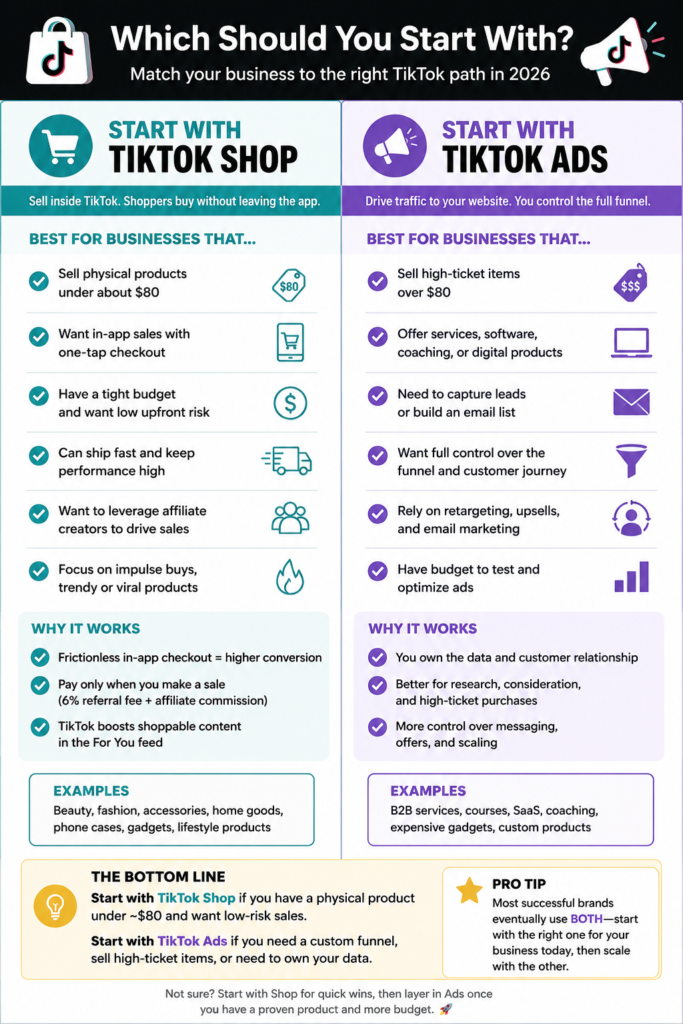
Start with TikTok Shop if:
- You hold physical inventory in a local warehouse.
- Your product is easy to show off on camera.
- Your price sits in the impulse range, roughly under $80.
- You have time to message and recruit creators.
Start with TikTok Ads if:
- You sell a service, software, or a digital product.
- Your item is high-ticket and needs research before buying.
- You want to build an email list you fully own.
- Your offer needs a quiz, demo, or custom landing page.
Frequently Asked Questions
Do I need 1,000 followers to start either one?
No follower count is required to run TikTok Ads. You can advertise from a brand-new account right away. For TikTok Shop, business sellers only need valid documents, not followers. The 1,000-follower rule mainly applies if you want to join as an affiliate creator promoting other people’s products.
Which one is cheaper to start?
TikTok Shop is cheaper to begin because you pay nothing until a sale happens. Your main cost is the 6% referral fee plus any affiliate commission. TikTok Ads require cash upfront, since you pay for impressions whether or not anyone buys. Shop protects a tight budget better in the early days.
Can I use the same account for both?
Yes, and you should. One business account can host your Shop storefront while a connected ad account drives traffic. They live in different dashboards, the Seller Center and Ads Manager, but they work together. This setup is exactly what powers GMV Max.
Is dropshipping allowed on TikTok Shop?
Pure overseas dropshipping with long shipping times does not fit TikTok Shop’s fast-fulfillment rules. You risk penalties or a frozen shop. If long shipping is unavoidable, TikTok Ads pointing to your own site give you more flexibility over how you present delivery times to buyers.
How fast can I expect a first sale?
TikTok Ads can drive clicks within hours of going live, so traffic is fast. TikTok Shop sales can take longer because you often need to build an affiliate network first. The upside is that Shop sales tend to cost less per order once that engine is running.
What to Do Next
The honest answer to TikTok Shop vs TikTok Ads is that they solve different problems, so your business model decides the winner.
If you sell affordable physical products, start with TikTok Shop. Build real sales and reviews with affiliate creators before you risk a dollar on paid traffic. Once a product proves itself, add GMV Max Ads to pour fuel on what already works.
If you sell services, software, or high-ticket items, lead with TikTok Ads so you control the funnel and keep your data. Either way, claim your TikTok ad credit before you spend, so your first tests stretch further.
Pick one path, commit for 30 days, and let the numbers tell you when to add the other.