
You set a $500 budget, launch your first campaign, and feel ready. Then the invoice lands and you owe $600. That extra $100 is tax, and most beginners never see it coming.
The tax implications for TikTok ads trip up new advertisers more than bad creative ever does. You can fix a weak video.
You cannot fix money quietly leaking from every invoice because of one blank field. Once you know how TikTok ads tax works, you stop overpaying and start keeping receipts that lower your bill at year-end.
Here is what you will walk away knowing:
- When TikTok adds VAT or GST to your ad spend, and when it does not
- How a valid VAT number can legally remove that charge
- Why TikTok ads tax is different from the tax you collect on TikTok Shop sales
- How to deduct your ad spend as a business expense
- What records to keep so an audit never scares you
None of this is complicated once you see the pattern. Let’s break it down step by step.
Get Up to $6000 Free TikTok Ad Credit
Table of Contents
Key Takeaways
- TikTok charges VAT or GST on your ad spend in most regions unless you add a valid tax ID. In the UK, that rate is 20%, and skipping the field means paying it as a final consumer.
- A valid VAT number tells TikTok you are a business, which can zero out the tax on your invoice in the EU under the reverse charge rule.
- TikTok ads tax (what you pay) is not the same as TikTok Shop tax (what you collect from buyers). Mixing them up is the most common beginner mistake.
- Your ad spend is almost always a deductible business expense. The IRS allows write-offs for advertising that is “ordinary and necessary” for your trade.
- TikTok pulled in roughly $33 billion in global ad revenue in 2025, per Statista, so tax authorities now watch this spending closely.
Is There Tax on TikTok Ads?
Yes. In most regions, TikTok adds VAT or GST to your ad spend unless you provide a valid tax ID. In the UK and much of the EU, that means up to 20% to 27% on top of your budget. The fix is simple: enter your VAT number in your payment settings. Separately, your ad spend is tax-deductible as a business expense.

How TikTok Ads Tax Actually Works
TikTok treats your ad purchase like any other digital service you buy online. The platform looks at three things: where your business is located, whether your ads are for business use, and whether you gave them a valid tax ID.
Get those three right, and you often pay little or no extra tax. Get them wrong, and the platform treats you like a regular shopper buying a product. That means full tax on every dollar you spend.
The charge shows up as a separate line on your invoice. Many beginners never read past the campaign total, so they miss it for months. By the time they check a credit card statement, hundreds of dollars are already gone.
This is why your tax setup matters as much as your bidding strategy. A clean setup protects your return on ad spend. You can dig deeper into pricing in this guide to TikTok ads cost once your tax side is sorted.
VAT and GST on Ad Spend
VAT stands for Value Added Tax. GST means Goods and Services Tax. They are the same idea with different names, used in different countries. Both are taxes added to the price of a service, including the service of running ads.
If your business sits in the UK, the EU, Australia, Singapore, or many other regions, TikTok may add this tax to your ad bill.
The rate depends on your country. According to TikTok’s official VAT guidance, businesses that skip the VAT field are treated as final consumers and still pay the local rate. (Source)
Here are real rates pulled straight from TikTok’s own documentation:
| Region | Tax type | Rate |
| United Kingdom | VAT | 20% |
| Germany | VAT | 19% |
| France | VAT | 20% |
| Spain | VAT | 21% |
| Hungary | VAT | 27% |
| Ireland | VAT | 23% |
| Singapore | GST | 9% |
Hungary sits at the top with a 27% rate, the highest in the EU. Imagine a $1,000 budget turning into a $1,270 charge because of one empty box. That is the real cost of ignoring TikTok ads VAT.
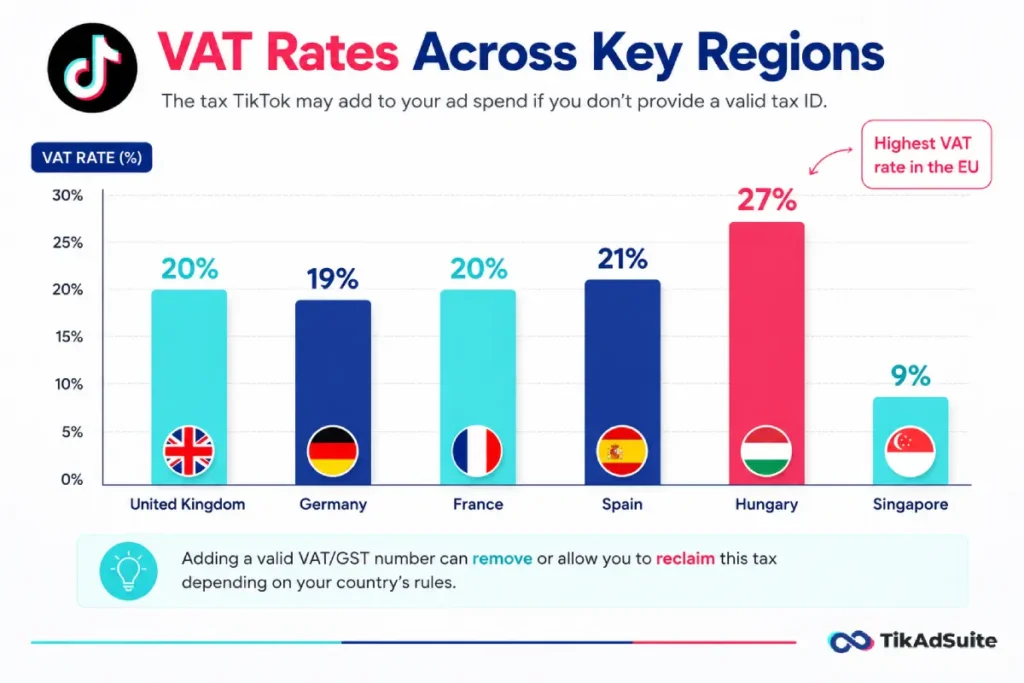
The Singapore rate jumped from 8% to 9% on January 1, 2024, based on TikTok’s Singapore GST notice. TikTok collects this as a non-resident supplier, which means the charge appears automatically unless you act.
What Is a TikTok VAT Number and Why It Matters
A VAT number is the ID your government gives your registered business. It proves you are a real trading business, not a private shopper. Adding your VAT number to TikTok changes how the platform taxes you.
Here is the simple version. When you add a valid VAT number, TikTok in the EU treats the sale under the reverse charge rule. That means TikTok does not add VAT on top of your ad cost. You account for it later through your own VAT return, which usually nets to zero for a registered business.
In the UK, the rule works a little differently. With a valid VAT number, you still see the 20% rate, but you get a full tax invoice. That invoice lets you reclaim the VAT through HMRC. Without the number, you are a consumer and reclaiming gets messy.
You can check whether your number is valid before you enter it. UK businesses use the HMRC VAT checker. EU businesses use the European Commission VIES tool. A typo here can cost you the whole exemption.
Where do you add the VAT number on TikTok? It goes in your payment settings inside the Business Center. If you are still setting up, walk through how to create a TikTok Business account first, then add your tax ID before you spend a cent.
Where Do You Add Your Tax ID on TikTok?
You add it under Tools, then Payment, inside TikTok Ads Manager. Look for the tax information field during account setup or in your billing settings later.
Enter your VAT, GST, or business tax number there. This single step decides whether TikTok treats you as a business or a consumer, so do it before your first campaign goes live.
For a full walkthrough of billing fields, deposit methods, and where the tax box hides, this breakdown of TikTok ads billing and payment methods shows each screen. Skipping this field is the single most expensive beginner error on the platform.
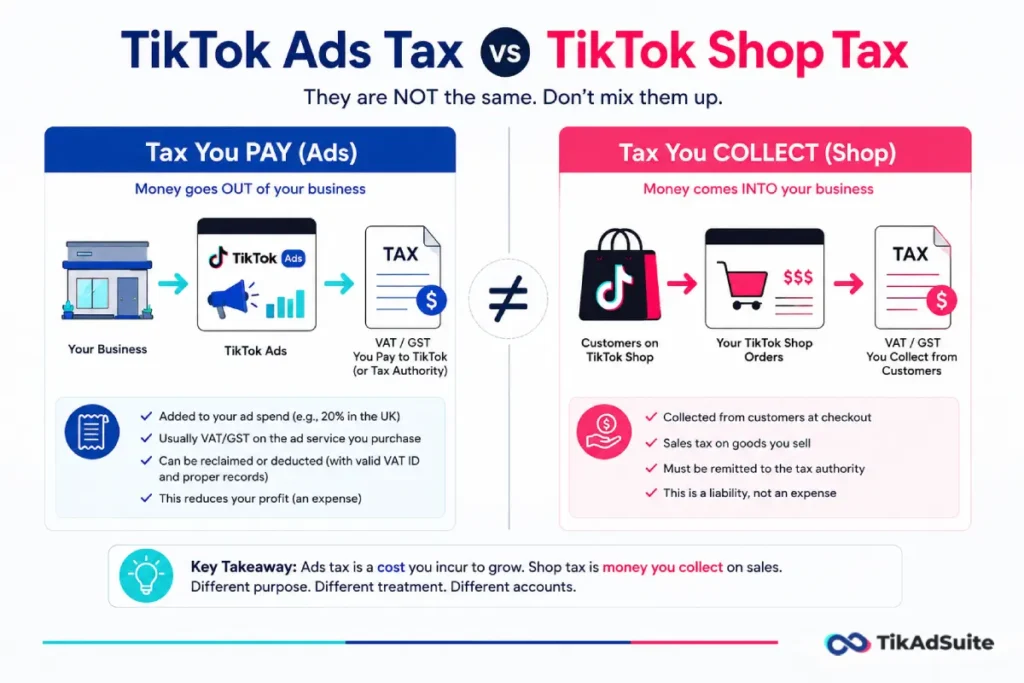
TikTok Ads Tax vs TikTok Shop VAT: The Big Confusion
This is where new sellers panic, and it is worth slowing down. There are two completely different taxes in the TikTok world.
The first is the tax you pay to run ads. That is TikTok ads VAT or GST, the charge on your ad spend covered above.
The second is the tax you collect from customers when you sell a product. That is TikTok Shop VAT, the sales tax baked into a buyer’s order at checkout.
These two never mix. You can owe ad tax and collect product tax at the same time. They live on separate invoices and separate returns.
The good news for sellers is that TikTok Shop often acts as the marketplace facilitator. That means TikTok collects and remits the sales tax for you in many regions. You do not chase every order yourself. To see how those selling costs stack up, review the TikTok Shop fees before you set prices.
If you run both ads and a store, keeping these straight saves real stress. This comparison of TikTok Shop vs TikTok Ads helps you map which tax belongs to which activity.
What About TikTok Ads Tax in the United States?
The US works differently from Europe. Most US states do not charge sales tax on digital advertising services. When you spend $500 on TikTok ads, you usually pay $500, with no VAT-style charge added.
There are exceptions, and they are growing. A handful of states have explored taxes on digital advertising, with Maryland being the most talked-about example after it pioneered a digital advertising gross revenues tax. Rules shift fast, so check your own state before you assume.
Take Pennsylvania as a common question. Pennsylvania applies its 6% sales and use tax to many digital products under Act 84 of 2016. That law targets things like e-books, streaming, and canned software, not the service of buying ad placement. Still, the safe move for any US advertiser is to confirm your state’s current stance rather than guess.
The bigger US story is not the tax you pay on ads. It is the tax you save by deducting them. That is where the real money sits.
Advertising as a Business Expense
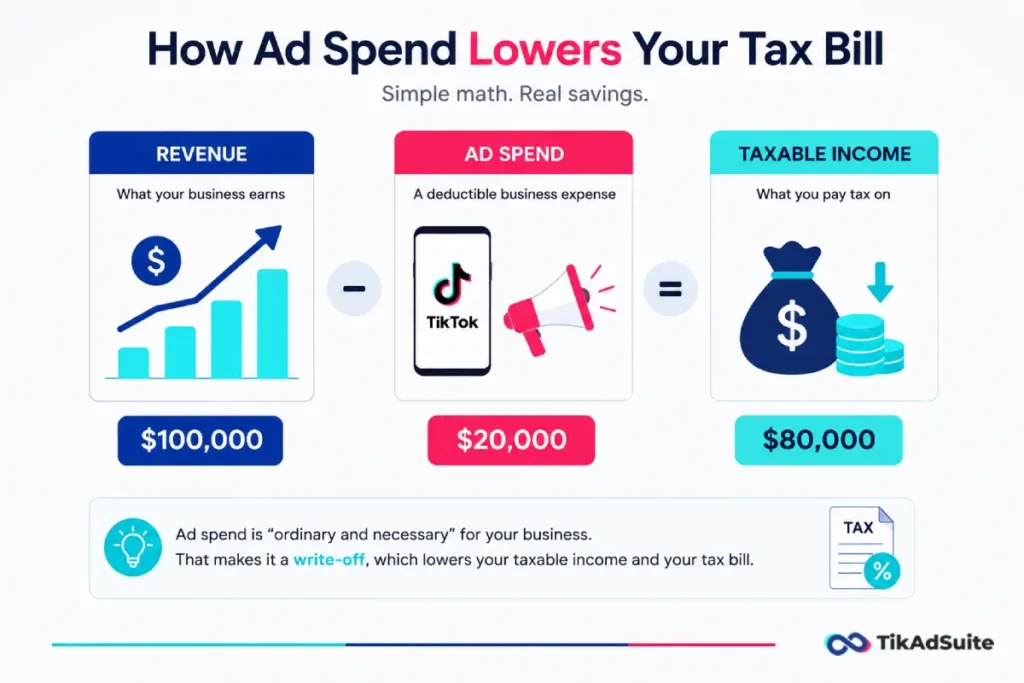
Here is the part that turns tax from a cost into a benefit. Your TikTok ad spend is almost always a deductible business expense. That means it lowers the income you get taxed on.
The IRS rule is simple. An expense is deductible when it is “ordinary and necessary” for your trade or business. The IRS confirms that advertising and marketing costs are usually deductible when they meet that test. Running TikTok ads to sell your products clears that bar with room to spare.
Picture this. You earn $50,000 in profit and spend $8,000 on TikTok ads during the year. You deduct that $8,000, so you only get taxed on $42,000. At a 24% rate, that deduction saves you nearly $1,920 in tax.
In the US, sole proprietors and single-member LLCs usually report this on Schedule C. The ad spend lands under advertising expenses or, for product sellers, sometimes as part of cost of goods sold. A tax pro can tell you which line fits your setup.
This benefit exists across platforms, not just TikTok. The same logic applies if you split budget with Meta.
If you are weighing that split, this look at TikTok ads vs Facebook ads frames the Facebook TikTok decision through cost and return, both of which feed your deductible total.
Record Keeping: The Habit That Protects Your Deduction
A deduction is only as strong as the proof behind it. If the IRS asks how you spent $8,000 on ads, “trust me” is not an answer. Records are.
Save every TikTok invoice. TikTok stores them in your billing dashboard, so download them monthly and keep a backup. Match each invoice to a card statement so the dates and amounts line up.
Keep these for each campaign year:
- Monthly TikTok ad invoices showing spend and any tax charged
- Bank or credit card statements that confirm the payments
- A simple log linking ad spend to the business it promotes
- Proof of your VAT or tax registration if you claimed an exemption
Good records do more than survive an audit. They show you which months you overpaid tax because of a missing VAT number, so you catch leaks early. They also make your accountant faster and cheaper.
Manual spreadsheets work when you start out. As spend grows, accounting software like FreshBooks can pull in expenses, tag ad spend, and store receipts in one place. That cuts the year-end scramble and keeps your write-offs clean.
The advertisers who scale without panic are the ones with tidy books. If growth is your goal, pair clean records with this guide on how to scale TikTok ads so your tax tracking keeps pace with your budget.
Is There a Cheapest Tax Region for TikTok Ads?
New advertisers often ask about the cheapest tax region for TikTok and dream of registering somewhere with a 0% rate. Slow down before you chase that.
Your TikTok ad tax is tied to where your business is legally based, not where you wish it was. You cannot pick Luxembourg’s 17% rate while operating from London at 20%. Tax authorities treat fake relocation as evasion, and the fines dwarf any savings.
The honest answer is that the cheapest setup is a correct one. Register your business properly, add a valid VAT number, and you remove most of the ad tax through the reverse charge or a reclaim. That beats any region-hopping scheme.
Focus your energy on spending efficiently instead. Knowing the minimum budget for TikTok ads helps you test small, keep tax exposure low, and scale only what works.
Frequently Asked Questions
Does TikTok charge VAT on ads?
Yes, in most VAT regions. TikTok adds VAT to your ad spend unless you provide a valid VAT number. In the UK, the rate is 20%, and across the EU it ranges from 17% to 27% depending on your country. Adding a valid tax ID can remove or reclaim that charge for a registered business.
What happens if I do not enter my TikTok VAT number?
TikTok treats you as a final consumer and charges the full local VAT rate on every ad invoice. You keep paying that tax with no easy way to reclaim it. The money is gone unless you fix the setting and, in some cases, request corrected invoices for future spend.
Is TikTok Shop VAT the same as TikTok ads VAT?
No. TikTok ads VAT is tax you pay to run ads. TikTok Shop VAT is sales tax collected from buyers at checkout, often handled by TikTok as the marketplace facilitator. They appear on separate invoices and belong to separate tax obligations, so never combine them in your books.
Can I write off TikTok ads on my taxes?
Yes. TikTok ad spend is a deductible business expense in most countries when it promotes your trade. The IRS allows deductions for advertising that is ordinary and necessary. You report it on Schedule C in the US or the equivalent business return elsewhere, which lowers your taxable income.
How much tax does TikTok charge in Singapore?
TikTok charges 9% GST on ad spend for Singapore-based advertisers as of 2024. GST-registered businesses can usually claim this back through their GST return. Providing your GST registration number in TikTok’s payment settings ensures your invoices are handled correctly under the Overseas Vendor Registration rules.
Putting It All Together
The single most valuable action you can take today is to open your TikTok payment settings and enter a valid VAT or tax number. That one field decides whether you pay full tax as a consumer or run ads as a recognized business.
After that, build the record-keeping habit. Download every invoice, track every dollar, and claim your ad spend as the business expense it is. The tax you save through clean deductions often outweighs the tax you pay to run the ads in the first place.
TikTok ad spending is huge and still growing fast. Treating your tax setup with the same care as your creative is what separates advertisers who keep their margins from those who watch them quietly disappear.