
Ask ten creators how often to post on TikTok and you will hear ten numbers, from three times a week to four times a day. Most of them sound sure. Very few say where the number came from.
That matters when you are planning a content calendar for a business. Posting four times a day takes real time, and you want to know whether it pays off before you commit a team to it.
Get Up to $6000 Free TikTok Ad Credit
This guide separates what TikTok itself says about its For You feed from what outside studies have measured, then turns both into a posting plan a small team can keep.
Table of Contents
Quick Answer
TikTok has not published a posting quota, and its explainer on how the For You feed works does not list posting frequency as a factor. For most business accounts, 2 to 5 posts a week is a sound place to start.
That range comes from a third-party source, Buffer’s study of 11.4 million TikTok posts from more than 150,000 accounts. It found the biggest jump in views per post when accounts moved from one post a week to two to five. Posting more still helped, but each extra post added less, and the gain came mostly from more chances at a breakout video.
Key Takeaways
- TikTok ranks each video on its own signals, such as likes, shares, comments and whether people finish watching.
- TikTok says follower count and past hit videos are not direct ranking factors.
- Buffer’s data points to 2 to 5 posts a week as the most efficient step up from posting once.
- More posts raise the odds of one video taking off; they do not lift the typical video much.
- A steady pace you can keep beats a burst of daily posts that drops off after a month.
What TikTok Says Moves the For You Feed
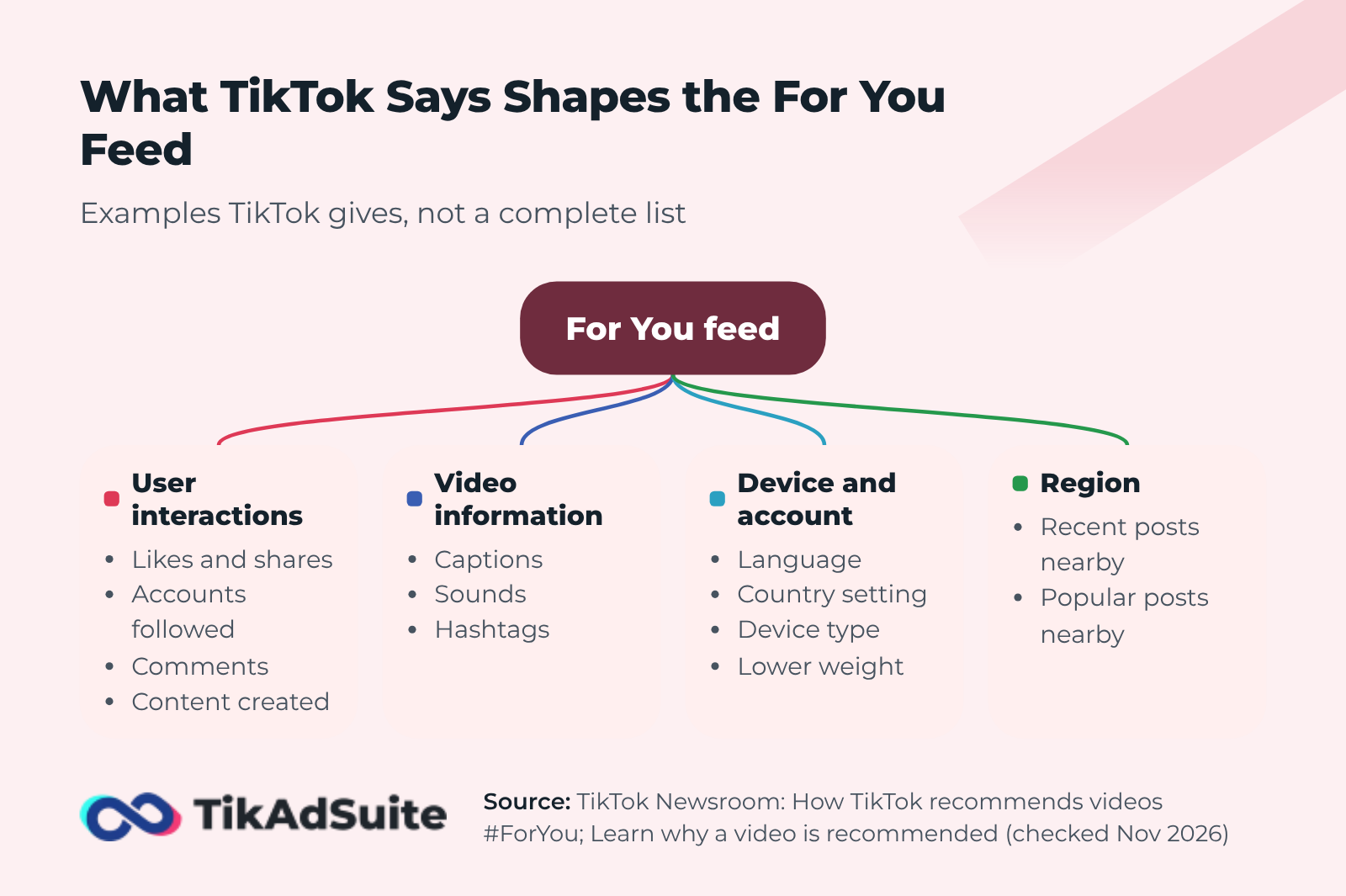
TikTok says its For You feed ranks videos using a mix of signals, and it names three main groups. In How TikTok recommends videos #ForYou, the company lists them as examples, not as a complete list:
- User interactions: videos a person likes or shares, accounts they follow, comments they post and content they create.
- Video information: details such as captions, sounds and hashtags.
- Device and account settings: language, country setting and device type. TikTok says these get less weight than the other two.
TikTok also explains that strong signals count more than weak ones. Its example of a strong signal is a viewer watching a longer video all the way through, compared with a weak one such as the viewer and creator being in the same country.
A later TikTok post on why a video is recommended adds two more reasons people may see a video: content posted recently in their region, and content that is popular in their region.
Does TikTok Reward Posting More Often?
Not directly, based on what TikTok has published. None of the signals TikTok names is how often an account posts, and the company says videos are ranked by how likely each one is to interest a viewer.
TikTok’s recommendations explainer also says that neither follower count nor a history of high-performing videos is a direct factor. It adds a fair caveat: an account with more followers is likely to get more views simply because more people follow it.
So why does posting more seem to help? Each post is a new chance to earn the signals TikTok does use. More posts mean more tries at a video people watch to the end and share.
There is a limit to that, and TikTok’s own explainer points to it. The company says the For You feed generally will not show two videos in a row made with the same sound or by the same creator, and it does not recommend duplicated content or spam. Ten near-identical clips in a day are not ten fresh chances.
The Number: What the Data Says
Outside data gives a clearer answer than TikTok does. Buffer’s study compared each account with itself over time, which removes differences in follower count, niche and brand.
Compared with posting once a week, Buffer found that accounts posting 2 to 5 times a week got up to 17% more views per post, accounts posting 6 to 10 times got up to 29% more, and accounts posting 11 or more times got up to 34% more.
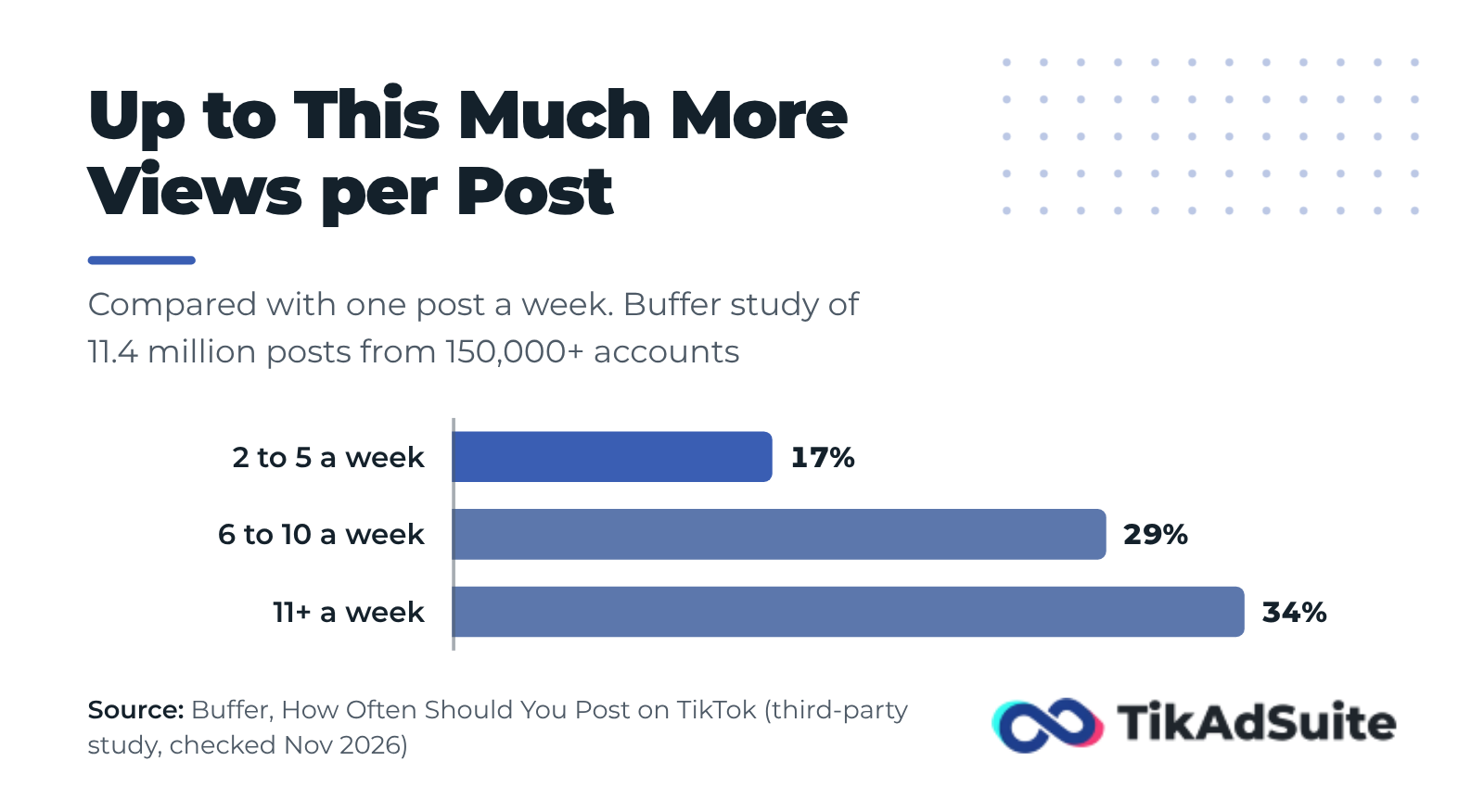
Two details in the study matter more than the headline. According to Buffer, the median post stayed at around 500 views no matter how often an account posted, and the gains came from the best posts doing better. Posting more raised the ceiling, not the floor.
The second detail is the shape of the gains. Going from one post to two to five a week gave the biggest lift for the extra work, and each step after that added less. Buffer also reports that the relative gains held across account sizes.
Keep in mind what this is: one company’s analysis of accounts that use its tool, not a rule from TikTok. It is still the most useful large data set on the question.
A Posting Plan You Can Keep
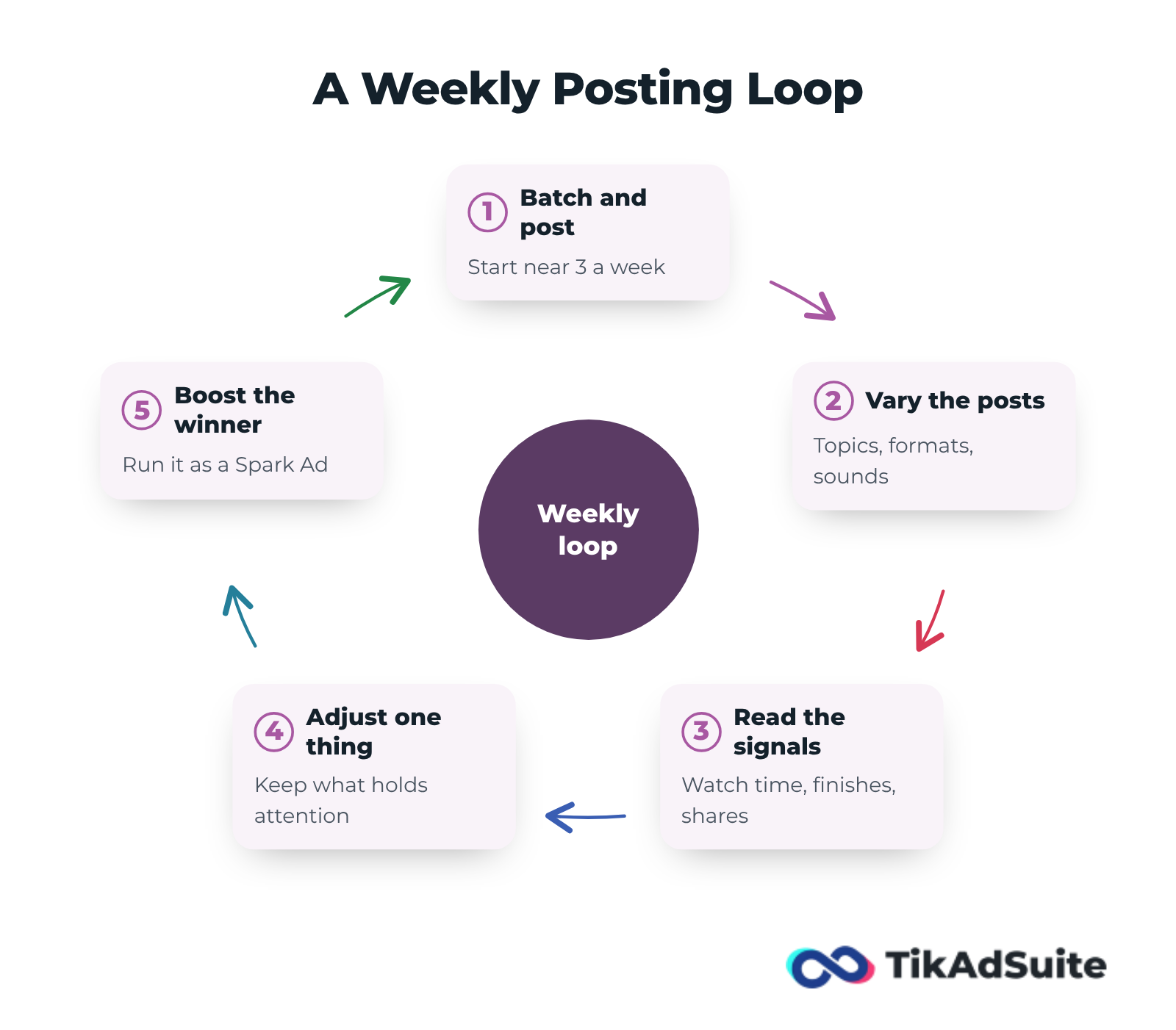
The right posting frequency is the highest pace you can keep for months without the quality dropping. For most small teams, that means starting at about three posts a week.
- Pick a pace you can sustain. Start with three posts a week for a month. Move up only if the team can hold quality at the higher pace.
- Batch the work. Film several videos in one session and edit them over the week, so a busy day does not break the schedule.
- Vary the posts. Rotate topics, formats and sounds. Given how TikTok spreads out similar videos, variety gives each post its own chance.
- Check the signals weekly. In TikTok analytics, look at average watch time, how many viewers finish the video, shares and follows from each post.
- Adjust one thing at a time. Keep what holds attention, drop what does not, and only then think about adding posts.
When you post during the day is a separate question: pick your TikTok posting times by when your audience is active.
Organic Posting and Paid Ads Work Together
A steady posting schedule also feeds your ads. Every organic post is a test, and the ones people watch to the end and share are your best candidates for paid reach.
TikTok’s Spark Ads page explains that Spark Ads run an organic post as an ad, and the views, likes, comments and follows the ad earns count on the original post. That makes a proven organic video an easy first ad for a business.
If you are weighing Spark Ads vs. non-Spark Ads, start with a post that already has real engagement. For a wider plan that mixes both, see organic vs. paid TikTok.
Common Mistakes
The most common posting mistakes come from chasing a number instead of the signals TikTok names:
- Posting daily at the cost of quality. A rushed clip with a weak first second and generic hashtags gives the feed little reason to push it.
- Reposting the same video with small changes. TikTok says it does not recommend duplicated content and spreads out videos with the same sound or creator.
- Expecting a big account to carry weak videos. TikTok says follower count is not a direct ranking factor. A larger audience helps because more people already follow you, not because the feed favors big accounts.
- Ignoring your region. TikTok lists recent and popular content in a viewer’s region among its reasons for a recommendation, so local trends and local language are worth watching.
- Quitting after a few weeks. Buffer’s data shows the gains come from more chances at a breakout post, which takes time.
Frequently Asked Questions
How many times should I post on TikTok a week?
Start with 2 to 5 posts a week. Buffer’s study of 11.4 million posts found that moving from one post a week to that range gave the biggest lift in views per post. TikTok itself has not published a posting quota.
Does posting more often help my videos get recommended?
Not directly, based on what TikTok has published. TikTok ranks each video on signals such as interactions and watch time, and it does not list posting frequency. Posting more gives you more chances at a video that earns those signals.
Does follower count affect whether my videos get recommended?
TikTok says follower count is not a direct factor in its recommendation system. It also notes that accounts with more followers are likely to get more views simply because more people follow them.
Is posting several times a day bad for my account?
TikTok has not said that posting often hurts an account. It does say the For You feed avoids showing two videos in a row from the same creator or with the same sound, and it does not recommend duplicated content, so many similar posts in a day add little.
Should a business post every day on TikTok?
Only if the team can keep quality up at that pace. Buffer found more posts per week still added views per post, but each extra post added less than the step from one post to two to five a week.
Wrapping Up
TikTok has not given anyone a magic number. What it has published says each video earns its own reach through interactions, watch time, its captions and sounds, and what is active in a viewer’s region.
Outside data adds the practical part: two to five posts a week is where most accounts get the best return on their effort, and more posts mostly buy more chances at a hit. Pick a pace you can keep and make each post worth watching to the end. When one of them takes off, that is the video to put ad money behind.