
Timing your TikTok ads correctly is one of the fastest ways to cut wasted ad spend. Most advertisers set a budget, hit publish, and hope for the best. That approach leaves significant ROAS on the table.
The reality is that TikTok’s algorithm rewards engagement velocity. When your ad reaches users during peak activity windows, your cost-per-click drops and your relevance score climbs. When it runs during dead hours, you pay more for less.
Get Up to $6000 Free TikTok Ad Credit
This article gives you precise timing windows backed by platform data, a breakdown by industry, a guide to dayparting, and a step-by-step method to find your own best times using TikTok Analytics. By the end, you will know exactly when to run your ads and why.
Table of Contents
Best Times to Run TikTok Ads in 2026
The best time to run TikTok ads in 2026 is Tuesday through Friday between 9 AM and 11 AM, and again from 7 PM to 9 PM in your target audience’s local timezone. According to Pew Research Center’s 2024 study on how U.S. adults use TikTok, the vast majority of TikTok users consume content passively rather than post it, meaning most of your audience is scrolling during predictable leisure windows. Results vary based on your industry, target geography, and audience age group. Running ads outside these windows is not wasted spend; it simply requires tighter creative testing to compensate for lower organic traffic volume.
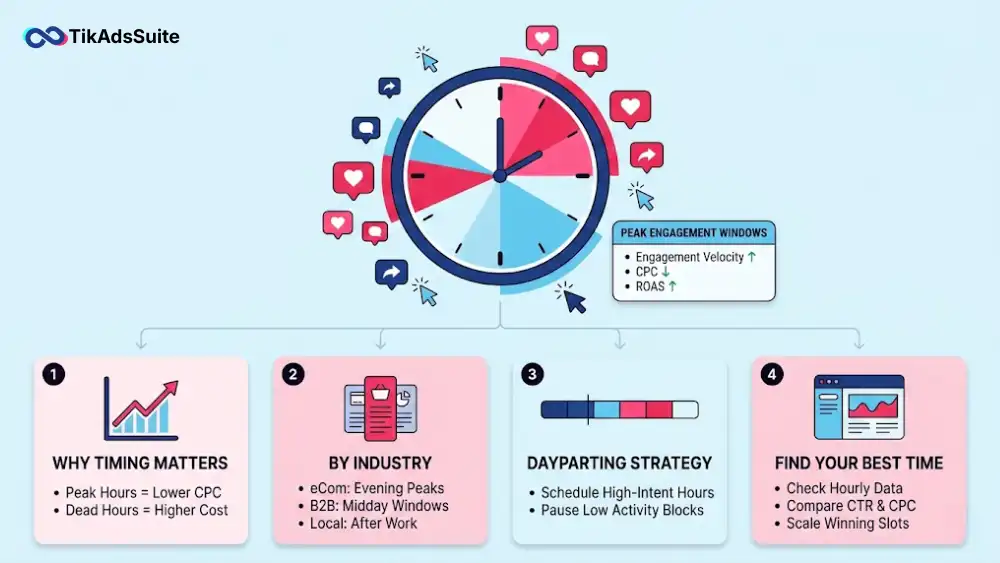
| Best Days | Best Hours (Local Time) | Performance Notes |
| Tuesday | 9 AM to 11 AM, 7 PM to 9 PM | Highest weekday CTR on average |
| Wednesday | 9 AM to 11 AM, 7 PM to 9 PM | Strong mid-week scroll behavior |
| Thursday | 9 AM to 11 AM, 8 PM to 10 PM | Pre-weekend purchase intent rises |
| Friday | 3 PM to 5 PM, 8 PM to 11 PM | Strong evening entertainment mode |
| Saturday | 11 AM to 1 PM | Casual browsing, leisure shopping |
| Sunday | 7 PM to 9 PM | End-of-week planning and impulse buys |
Why Ad Timing Works Differently for TikTok Ads vs. Organic Posts
Organic content and paid ads on TikTok operate under completely different distribution rules. Understanding this difference stops you from applying the wrong timing logic to your campaigns.
Organic posts rely on the For You Page algorithm to decide when your content surfaces. TikTok can push an organic video hours or days after you post it, depending on initial engagement signals. Timing matters for organic, but the algorithm absorbs some of the penalty for off-peak publishing.
Paid ads are different. You are buying impressions in real time. Your ad enters an auction the moment your campaign is live, and TikTok serves it based on bid competition and audience activity at that exact moment. If your audience is not active, your impressions cost more, and your engagement rate drops. That lower engagement rate feeds back into TikTok’s ad relevance scoring, which raises your future CPMs.
There is also the user intent factor. A person scrolling at 2 AM on a Tuesday is in a different mindset than someone scrolling at 8 PM on a Friday. Casual, low-intent browsing produces fewer conversions even when your CPM looks cheap.
This is why we treat ad timing as a budget efficiency lever, not just a scheduling preference.
Best Hours to Run TikTok Ads for Maximum Engagement (2026 Data)
TikTok usage patterns in 2026 follow a predictable daily curve. Pew Research Center’s data on TikTok usage shows that 62% of adults ages 18 to 29 use TikTok, making it the dominant platform for that age group. Their consumption behavior follows three distinct daily windows:
- 6 AM to 9 AM: The morning commute and pre-work scroll window. Users are passive but present. This window works well for brand awareness campaigns targeting 18 to 34-year-olds.
- 9 AM to 11 AM: Active decision-making hours. Users are more likely to click through, save, or purchase. This window consistently delivers strong CTR for direct-response ads.
- 7 PM to 10 PM: The highest-volume window of the day. Users are in entertainment mode. Creative-heavy ads, product demos, and UGC-style ads perform best here. TikTok’s own What’s Next Trend Report confirms that community engagement and entertainment-driven content peak in the evening hours when users are in active discovery mode.
The weakest performing hours are 12 AM to 6 AM. CPMs can look attractive during these hours because competition drops. However, lower engagement rates typically cancel out any CPM savings within 48 to 72 hours of campaign data accumulation.
A note on timezone targeting: Always align your ad schedule to your audience’s local timezone, not your own. If you are running a US campaign targeting the West Coast, your 9 AM window is 9 AM Pacific, not Eastern. TikTok Ads Manager allows you to schedule by timezone in the campaign settings.
Best Days of the Week to Run TikTok Ads
Weekday Power Hours
Tuesday, Wednesday, and Thursday are your most reliable weekdays for paid performance. Pew Research Center’s 2024 teen technology report found that about 60% of teens visit TikTok daily, with 16% on it almost constantly. This habitual daily usage pattern means mid-week engagement is deeply consistent, driven by routine scrolling behaviors that make Tuesday through Thursday reliable windows for paid campaigns.
Monday carries a scroll-fatigue effect. Users re-enter work routines and disengage from ads more quickly. If you must run on Mondays, prioritize the 7 PM to 9 PM slot when the post-work unwind begins.
Thursday is worth treating as a pre-weekend warmup. Purchase intent starts climbing on Thursday evenings, particularly for fashion, food delivery, and entertainment categories. Running retargeting ads on Thursday nights to warm audiences can lift your weekend conversion rates.
Friday afternoons between 3 PM and 5 PM mark the start of the leisure window. Users shift from work mode to personal browsing earlier on Fridays, making this a productive slot for impulse-friendly products.
Weekend Opportunities and Risks
Weekends on TikTok are high-volume but high-competition. More advertisers bid aggressively on Saturday and Sunday, which drives CPMs higher compared to mid-week.
Saturday mornings between 11 AM and 1 PM are the weekend sweet spot. Users are relaxed, have disposable time, and are more likely to watch a full ad. This window works especially well for leisure, beauty, fitness, and home products.
Sunday evenings between 7 PM and 9 PM produce strong results for brands targeting planned purchases. Users reflect on the week and mentally prepare for the next one. Subscription services, meal prep brands, and productivity apps consistently see strong Sunday evening performance.
Avoid running heavy-spend campaigns on Saturday evenings unless you have tested a creative that has already proven its CTR. The competition is high, and user intent is diffuse. You will burn the budget faster without a proportional return.
Best Times by Industry: Ecommerce, SaaS, Restaurants & More
Timing is not universal. Your industry determines when your audience is most receptive, and running on the wrong schedule for your vertical costs as much as running bad creative.
| Industry | Best Days | Best Hours | Key Notes |
| Ecommerce (Fashion, Beauty) | Thu, Fri, Sat | 7 PM to 10 PM | Impulse purchases peak in evening entertainment mode |
| Ecommerce (Home/Lifestyle) | Sat, Sun | 11 AM to 1 PM | Weekend browsing with purchase intent |
| Food and Restaurants | Wed, Thu, Fri | 11 AM to 1 PM, 5 PM to 7 PM | Pre-meal decision windows drive delivery orders |
| SaaS and B2B | Tue, Wed, Thu | 9 AM to 11 AM | Business decision-makers are active during work hours |
| Fitness and Wellness | Mon, Tue, Wed | 6 AM to 9 AM, 5 PM to 7 PM | Motivation peaks at start-of-week and post-work |
| Entertainment and Media | Fri, Sat | 8 PM to 11 PM | Leisure-mode users actively seek new content |
| Education and Online Courses | Sun, Mon, Tue | 7 PM to 9 PM | Planning and self-improvement mindset |
| Travel | Thu, Fri | 12 PM to 3 PM | Midday daydreaming and travel planning behavior |
| Gaming | Fri, Sat, Sun | 9 PM to 12 AM | Late-night active gaming audience |
These windows are starting benchmarks, not fixed rules. Your specific audience’s behavior should override general industry data after you collect 7 to 14 days of your own campaign analytics.
How TikTok Ad CPMs Fluctuate Throughout the Day
CPM fluctuation is the core reason timing matters financially. Understanding when CPMs spike and drop helps you protect your budget without sacrificing reach.
TikTok operates on a real-time bidding auction system. Every impression is priced based on how many advertisers are competing for the same audience at the same moment. High competition means higher CPMs. Low competition means cheaper impressions, but also fewer active users to show them to.
Here is how the daily CPM curve generally moves:
- 6 AM to 9 AM: Moderate CPMs. Fewer advertisers are active. A solid window for budget-conscious awareness campaigns.
- 9 AM to 12 PM: CPMs start rising as business advertisers activate campaigns at the start of the workday.
- 12 PM to 2 PM: Lunch hour spike. High competition from retail and food advertisers pushes CPMs toward their midday peak.
- 2 PM to 5 PM: CPMs stabilize. A productive window for direct-response campaigns targeting 25 to 44 year olds.
- 7 PM to 10 PM: Highest CPMs of the day. But also the highest audience volume and engagement rates. For most brands, the cost increase is justified by conversion volume.
- 10 PM to 12 AM: CPMs begin dropping. Engagement remains solid for 18 to 24 year old audiences who stay active late.
- 12 AM to 6 AM: Lowest CPMs. Lowest engagement. Usually not worth the tradeoff unless your audience is night-shift workers or you are targeting international time zones with a favorable overlap.
Key principle: A low CPM during a low-engagement window does not mean a lower cost per conversion. Always track your cost per result, not your CPM in isolation.
Should You Use Dayparting or Run Ads 24/7?
Dayparting means restricting your ads to run only during specific hours or days. Running 24/7 means your campaign is always on. Both approaches have clear use cases, and choosing the wrong one wastes budget just as much as poor creative does.
Use dayparting when:
- Your budget is under $100 per day. Spreading thin budgets across all 24 hours starves your peak-hour windows of sufficient bid strength.
- Your target audience has a highly predictable schedule, such as office workers or students.
- Your conversion data already shows a strong concentration of results in specific time windows.
- You are running a time-sensitive promotion, such as a same-day flash sale.
Run 24/7 when:
- Your daily budget is $300 or higher. Larger budgets can compete effectively across all hours without underperforming in any single window.
- You are in the early testing phase and do not yet have enough data to identify winning time slots.
- Your audience spans multiple time zones across regions like the US, UK, and Australia.
- You are running a broad awareness campaign where impression consistency matters more than conversion timing.
Our recommendation for most advertisers: Start 24/7 for the first 7 to 10 days to gather unbiased data. Then apply dayparting based on your own analytics, not general industry benchmarks. Your audience may not follow the typical pattern, and assuming it does costs you money.
TikTok Ads Manager allows dayparting at the ad group level under the “Dayparting” option in the scheduling section. You can set this to your account’s timezone or the audience’s local timezone. TikTok’s official Business Help Center covers these scheduling settings in detail if you need step-by-step setup guidance directly from the platform.
How to Find Your Best Ad Run Time Using TikTok Analytics (Step-by-Step)
Your own account data is the most reliable timing guide available.
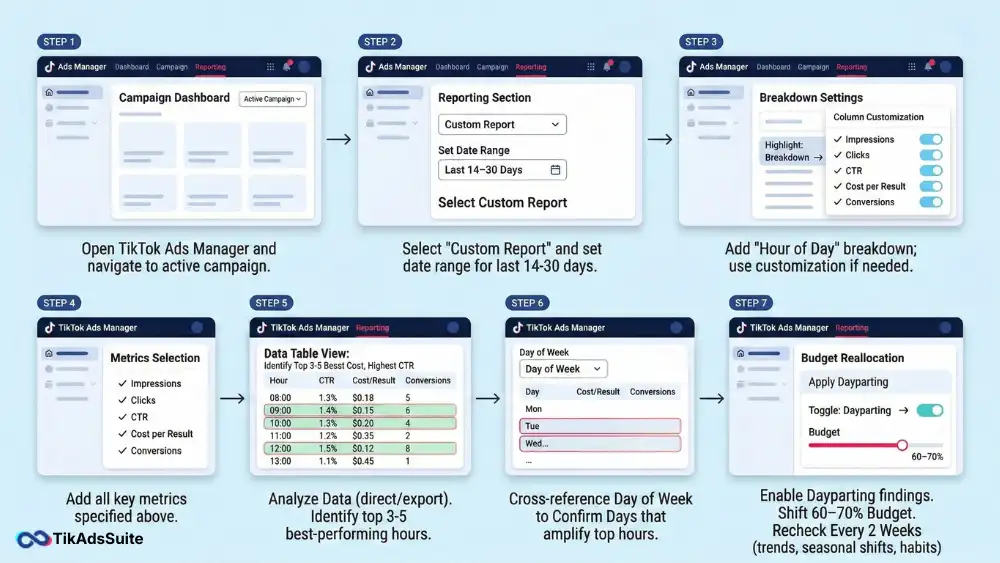
Here is exactly how to pull it:
- Open TikTok Ads Manager and navigate to your active campaign.
- Click “Reporting” in the top navigation bar.
- Select “Custom Report” and set your date range to the last 14 to 30 days.
- Add the “Hour of Day” breakdown under the “Breakdown” column. If this option is not visible, add it through the column customization menu.
- Add the following metrics: Impressions, Clicks, CTR, Cost per Result, and Conversions.
- Export the data to a spreadsheet or read it directly in the interface.
- Look for the top 3 to 5 hours with the lowest cost per result and highest CTR. These are your dayparting targets.
- Cross-reference with the day of the week. Repeat the same process using the “Day of Week” breakdown to confirm which days amplify your best hours.
- Apply your findings by enabling dayparting on your top-performing ad groups and shifting 60% to 70% of your budget toward those windows.
- Revisit every 2 weeks. User behavior shifts with seasons, trends, and your audience’s evolving habits.
One important note: TikTok Analytics requires a minimum data volume before hour-level breakdowns become statistically meaningful. Aim for several hundred impressions per hour across your reporting period before treating the data as fully actionable. Campaigns with very small daily budgets may need 3 to 4 weeks to accumulate enough data to draw reliable conclusions.
Seasonal and Event-Based TikTok Ad Timing in 2026
Seasonal demand changes how users behave on TikTok, and your ad schedule should reflect that. Treating every month the same is one of the most common budget mistakes we see.
Q1 (January to March): Post-holiday spending slows in January. Gupta Media’s CPM data shows January consistently produces the lowest CPMs of the year, making it a strong testing window. Fitness, self-improvement, and financial products see high engagement as users pursue New Year goals. Super Bowl weekend (February) drives elevated activity for entertainment and food-related ads, and is worth a budget increase in the 3 to 4 days surrounding the event.
Q2 (April to June): Spring buying season kicks in. Fashion, outdoor, and home improvement categories see increased engagement. Mother’s Day (May) and Memorial Day (late May) create 48 to 72-hour windows of elevated purchase intent. Run heavier budgets in the 4 to 5 days leading up to these events, not just the day before.
Q3 (July to September): Back-to-school season, running from late July through August, is one of the highest-volume periods for education, fashion, electronics, and school supplies. Pew Research Center data shows teens are among the most active daily TikTok users, and this demographic drives disproportionate engagement during back-to-school windows. CPMs climb from mid-August through Labor Day weekend as advertiser demand increases across these categories.
Q4 (October to December): The highest-CPM quarter of the year. According to Gupta Media’s seasonal CPM analysis, Black Friday produces some of the highest CPM spikes of the entire year, and these elevated rates hold through late December. If you are running Q4 campaigns, increase your budgets by 30% to 50% and shift dayparting toward evening windows from November 25 through November 30. Christmas and holiday gifting sustain elevated CPMs through December 20.
Platform-specific events in 2026: TikTok Shop Live events, trending hashtag challenges, and creator partnerships can spike relevant category CPMs significantly in short bursts. Monitor TikTok’s Business Calendar, available inside TikTok Ads Manager, and the platform’s trending page to anticipate these windows before they drive up your costs.
Common Mistakes in TikTok Ad Scheduling
Most timing errors fall into predictable patterns. Knowing them in advance saves you from learning through wasted spend.
Scheduling based on organic posting guides
Organic best-time guides measure when your followers are online. Your paid audience is not limited to your followers. Applying organic timing to paid campaigns is a category error. The data sources are different, and so are the outcomes.
Running full budgets during holidays without adjusting bids
Major holidays compress competition into narrow windows. If you do not raise your bids or increase your daily budget cap during these periods, TikTok will underspend your campaign because your bids cannot compete in the auction.
Ignoring time zone mismatches
If you are based in New York and targeting Los Angeles, your 9 AM is their 6 AM. Your prime window becomes a dead zone. Always set your campaign timezone to match your primary audience’s location before launching.
Applying dayparting too early
Restricting hours before you have statistically significant data creates a self-fulfilling loop. You suppress hours you have not yet properly tested, which means you never get the data to evaluate them fairly.
Treating all ad formats the same
TopView and Brand Takeover ads have fixed placements that TikTok controls. Dayparting logic applies primarily to In-Feed Ads and Spark Ads. Applying the same scheduling assumptions across all formats leads to incorrect conclusions about timing performance.
Stopping campaigns during low-engagement periods without tracking the full funnel
Some users see your ad at 2 AM and convert the next morning. Last-click attribution will credit the morning, not the original impression. Use view-through attribution windows to get an accurate picture of off-peak performance before cutting those hours entirely.
More helpful articles you’ll want to explore:
👉 TikTok Ads Credit: Get Free $6000 Cash Back Promo
👉 Proven TikTok Ad Hooks That Boost Watch Time
👉 TikTok Ad Specs: Image, Video & Copy Requirements
👉 TikTok Ads Cost Breakdown: How to Budget
FAQ: Best Time to Run TikTok Ads
What is the best time of day to run TikTok ads?
The best time of day to run TikTok ads is between 9 AM and 11 AM and again from 7 PM to 9 PM in your target audience’s local timezone. These windows combine peak user activity with above-average purchase intent. For direct-response campaigns, the evening window tends to outperform because users in entertainment mode are more receptive to product discovery content.
Does TikTok ad timing affect performance?
Yes, TikTok ad timing directly affects performance through two mechanisms: audience activity levels and CPM fluctuation. When you run ads during low-activity hours, engagement rates drop, which signals lower ad relevance to TikTok’s system and raises your future costs. Timing your ads to align with peak audience windows typically produces a lower cost per result over time, without requiring any changes to your creative.
What days are best for TikTok ads?
Tuesday, Wednesday, and Thursday are the most consistent days for TikTok ad performance. Pew Research Center data confirms that TikTok users, especially the 18 to 29 age group, engage with the platform in daily habitual patterns that make mid-week the most predictable and competitive window for reach. Weekends have high volume but elevated CPMs due to increased advertiser competition, so they require tighter budget management.
How do I schedule TikTok ads to run at specific times?
You can schedule TikTok ads to run at specific times using the Dayparting feature in TikTok Ads Manager. Go to your ad group settings, scroll to the “Schedule” section, and select “Select Specific Time.” You can then choose individual hours across each day of the week. This setting operates based on your account’s timezone, so confirm your timezone matches your primary audience’s location before enabling it.
Should I run TikTok ads on weekends or weekdays?
The right choice depends on your industry and audience. Weekdays, especially Tuesday through Thursday, deliver more consistent CPMs and engagement for most B2B and direct-response campaigns. Weekends work better for leisure, entertainment, food, and fashion brands because users are in a higher-spending mindset. We recommend running both initially and using your own TikTok Analytics data to allocate budget based on where your actual cost per result is lowest.
How does TikTok decide when to show my ads?
TikTok decides when to show your ads through a real-time auction system. Every time a user opens the app, TikTok runs an auction to determine which advertiser’s ad to show. Your bid amount, ad relevance score, estimated action rate, and targeting all influence your likelihood of winning each auction. Your ad timing interacts with this system because audience activity levels directly affect how many impressions are available in the auction at any given hour.
Conclusion
Timing is a precision tool, not a scheduling checkbox. The difference between a 9 AM launch and a 2 AM launch on the same budget can mean the difference between a campaign that scales and one that drains spend without results.
We have covered the core windows that consistently produce results across industries, the CPM dynamics that explain why those windows work, and the step-by-step process to find your specific best times from your own data. We have also shown where most advertisers lose money through lazy scheduling defaults and misapplied organic content logic.
The underlying principle holds across every section of this article: align your ad delivery with your audience’s active, high-intent moments, and your cost per result will improve without a single change to your creative. Start with the benchmark windows provided here, validate them with your own analytics within 14 days, and apply dayparting once the data supports it.
The best time to run TikTok ads is when your specific audience is ready to act, and now you have the framework to find exactly when that is.