
Plenty of TikTok campaigns lose money before the first video plays, and the creative is not the reason. The campaign was built for the wrong result.
Pick Reach when you need sales and TikTok will happily find cheap impressions that never buy. Push a sales campaign to people who have never heard of you and you pay a lot for each order. The platform spends your budget either way.
Get Up to $6000 Free TikTok Ad Credit
This guide walks through every campaign type you can build in TikTok Ads Manager: the objectives, the two ways to buy, the Manual, Smart+ and Search setups, and the GMV Max campaign for TikTok Shop. Then it shows how to match each one to a goal. If you are new to the platform, our guide to getting started with TikTok ads covers the basics first.
Table of Contents
Quick Answer
TikTok ads campaign types come from three choices you make when you build a campaign. First, the objective: Reach, Traffic, Video views, Community interaction, App promotion, Lead generation or Sales. Second, the buying type: Auction or Reach & Frequency. Third, the setup: Manual, Smart+ or Search, plus GMV Max for TikTok Shop.
Auction is the standard way to buy and fits most Traffic, Lead generation and Sales campaigns. Reach & Frequency suits planned brand pushes, and GMV Max is the campaign TikTok now uses for TikTok Shop ads.
Key Takeaways
- The objective is the real campaign type: it tells TikTok which result to find, and it limits the settings you see next.
- TikTok has merged Website Conversions and Product Sales into one Sales objective, rolling out in phases.
- Auction is the default way to buy; Reach & Frequency books reach at a fixed CPM for planned brand campaigns.
- Smart+ is a setup inside an objective, not a separate objective, and the upgraded version lets you choose full, partial or no automation.
- GMV Max is the default and only campaign type for new TikTok Shop ads.
How TikTok Ads Are Structured: Campaigns, Ad Groups, and Ads
Every TikTok ad sits inside a three-level structure, and the campaign type is set at the top level. What you choose there shapes the options at the two levels below it.
- Campaign: the objective, the buying type and, if you want one, a campaign budget.
- Ad group: targeting, placements, budget, schedule, optimization goal and bidding.
- Ad: the video or image, the text, the link and the call to action.
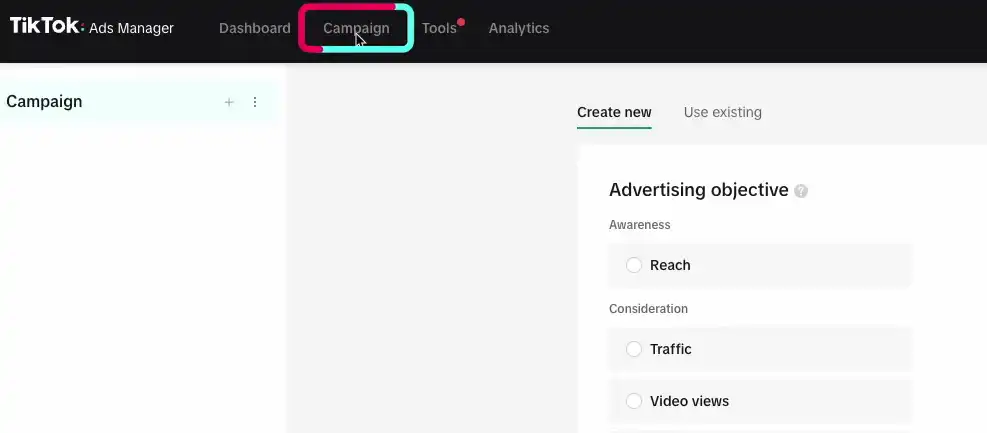
This is why the objective decision matters so much. A Reach campaign optimizes for people reached, so it cannot be told to find buyers at the ad group level. The objective locks in the outcome that the TikTok ads algorithm works toward.
Ad formats are a separate decision made at the ad level. An In-Feed video or a Spark Ad can run under many different objectives, so the format does not define the campaign type.
TikTok Campaign Types by Objective
TikTok groups its advertising objectives into three categories that follow the buyer’s path: Awareness, Consideration and Conversion. The current list in TikTok’s guide to choosing an objective looks like this.
Awareness
- Reach: shows your ad to as many people as possible. It is also the objective where you can choose Reach & Frequency buying.
Use Reach when people need to know your brand exists before they will act, such as a launch or a move into a new market.
Consideration
- Traffic: sends people to your website or app.
- Video views: gets your video watched by people likely to pay attention. TikTok’s video views objective page says it optimizes for focused views of 6 or 15 seconds and bills per focused view.
- Community interaction: grows followers or profile and page visits, or promotes a LIVE.
- Branded Mission: gets more engagement through what TikTok calls collaborative solutions.
Use these when people know you but need a reason to look closer.
Conversion
- App promotion: drives installs and in-app actions.
- Lead generation: collects leads, for example through a form inside TikTok.
- Sales: drives sales on your TikTok Shop, website, app, or website and app.
Sales replaces two older objectives. TikTok’s Sales objective page says Website Conversions and Product Sales were merged into one Sales objective, rolling out in phases, so some accounts may still see the old names for a while. You will also find them in older guides.
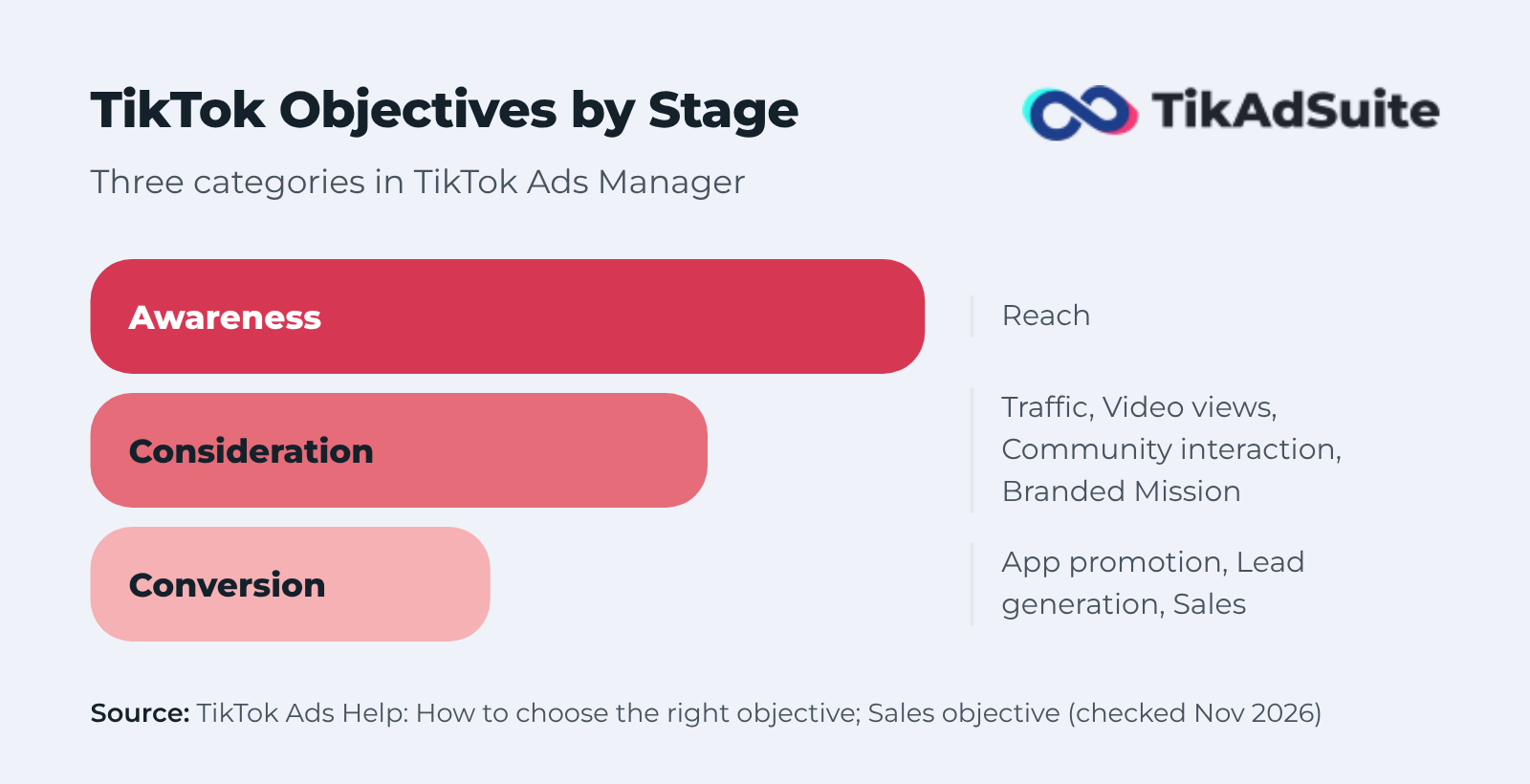
Each of the TikTok ad objectives has its own optimization goals, which you pick later at the ad group level.
Auction vs Reservation: Two Ways to Buy
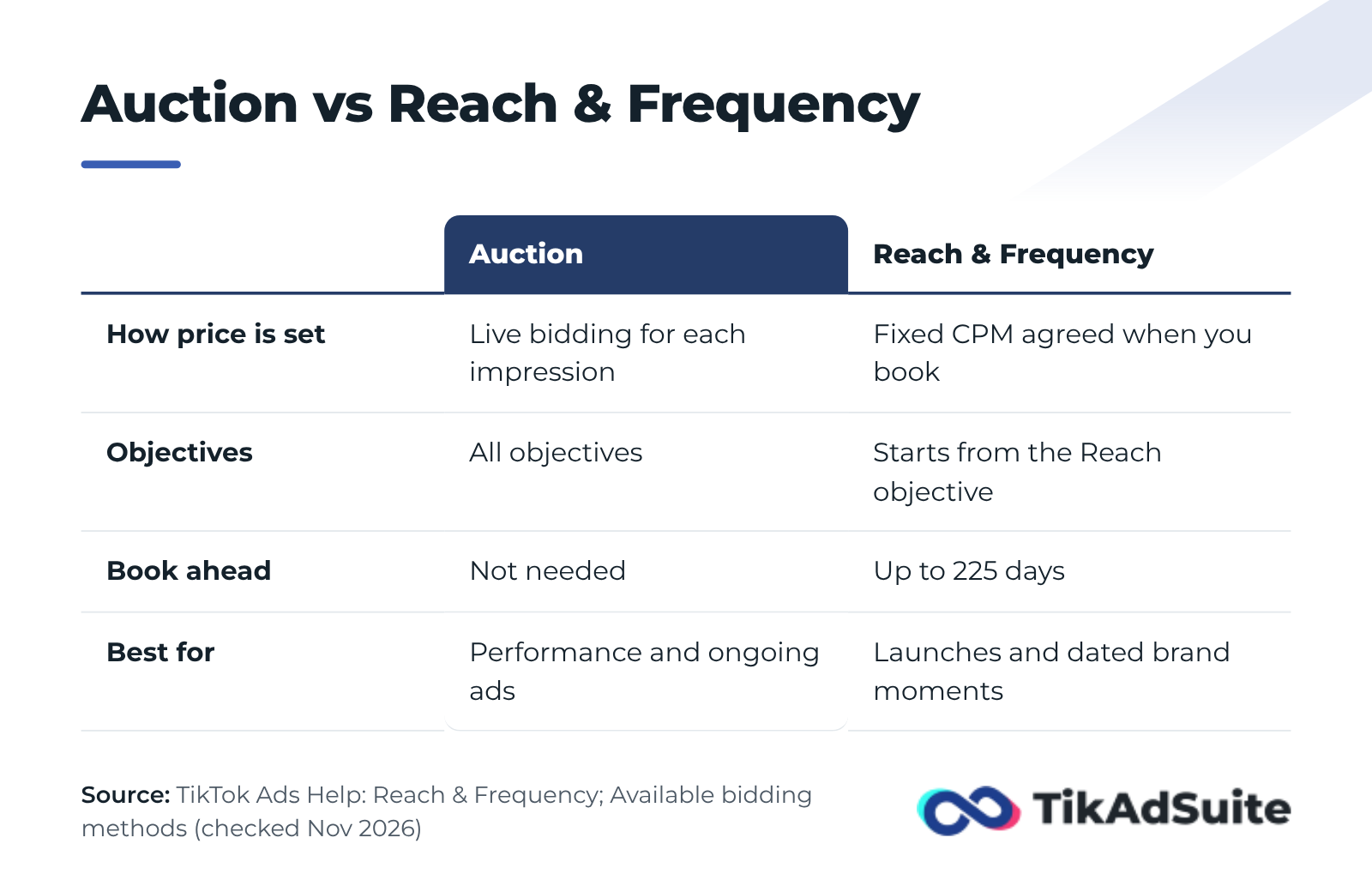
TikTok ads are bought in one of two ways: through the auction, or by reserving delivery in advance with Reach & Frequency. Most campaigns use the auction.
Auction is the standard buying type in TikTok Ads Manager. Your ad competes in real time, and TikTok’s bidding methods page says the auction ranks ads by bid price and how relevant the ad is likely to be to each person. It works with every objective and any budget above the minimums.
Reach & Frequency is TikTok’s reservation option. TikTok’s Reach & Frequency page says you can plan and reserve a campaign at a fixed CPM up to 225 days ahead, and control how often each person sees the ad. You choose it after picking the Reach objective, and if it is not in your account, TikTok says to contact your sales representative.
| Auction | Reach & Frequency | |
|---|---|---|
| How price is set | Live bidding for each impression | Fixed CPM agreed when you book |
| Objectives | All objectives | Starts from the Reach objective |
| Delivery | Changes with competition | Planned reach and frequency |
| Best for | Performance and always-on ads | Launches and dated brand moments |
Pick the auction for anything you will judge by clicks, leads or sales. Pick Reach & Frequency when a planned date and a set reach matter more than cost per result, such as a product launch week.
Manual, Smart+, and Search Campaigns
Once you pick an objective, you choose how much of the campaign to set up yourself. For a Sales campaign that sends people to a website, TikTok’s Sales objective page lists three setups: Manual, Smart+ and Search.
Manual campaigns let you pick each setting: audience, placements, optimization goal, bid strategy and creative. They give you the most control and the clearest test results.
Smart+ campaigns hand most of those choices to TikTok’s system. You give it your goal, creative and budget, and it automates targeting, bidding and which creative runs. TikTok’s Smart+ upgrade page says the upgraded flow puts Manual and Smart+ in one place, so you can choose full automation, partial automation or fully manual, for the Traffic, Sales, Lead generation and App promotion objectives. TikTok notes the upgrade may not be in every account yet.
TikTok has published results for Smart+. In its Smart+ launch announcement, TikTok said advertisers using Smart+ Web Campaigns to optimize for value saw a 52% improvement in return on ad spend, based on its own data, and Ray-Ban reported a 50% lower cost per acquisition. These are TikTok’s own figures from selected advertisers, so your own results may land well away from them.
Search campaigns use keywords to show your ads on TikTok’s search results page, similar to search ads on other platforms.
A simple way to decide: run Manual while you are still learning what works for your offer and audience, and try Smart+ once you have creatives and conversion tracking that give the system something to work with. If you lean toward Smart+, read up on TikTok ads automation first.
Campaign Types for TikTok Shop: GMV Max
If you sell through TikTok Shop, the campaign type to build is GMV Max. TikTok’s GMV Max migration page says that from July 2025, GMV Max became the default and only supported campaign type for TikTok Shop ads.
That change retired some names you may still read about. With the Sales objective and TikTok Shop as the destination, you can no longer create, edit or duplicate LIVE Shopping Ads, Product Shopping Ads or Video Shopping Ads. Campaigns that already existed stay active.
GMV Max comes in two versions, Product GMV Max and LIVE GMV Max. According to TikTok’s Product GMV Max page, it optimizes for your shop’s total return on investment, uses your organic and affiliate videos as well as ads, and can show across the TikTok feed, search, the Shop tab and TikTok Ad Network.
You set a return on investment target, and the campaign spends within that range. If you sell on your own website instead, use the Sales objective with your website as the destination. For setup steps and ROI targets, read more on TikTok GMV Max.
Where Ad Formats Fit
Ad formats are the creative containers your ad runs in, such as In-Feed videos, Spark Ads and carousels. They are chosen at the ad level, after the campaign type is set.
Spark Ads deserve a mention because they work under most objectives. TikTok’s Spark Ads page explains that a Spark Ad runs an organic post from your account or a creator’s account, with permission, and keeps the engagement on that post.
For every format and where it can run, read up on TikTok ad formats.
How to Choose the Right TikTok Campaign Type for Your Goal
Choose the campaign type by the action you want people to take, then pick the setup that fits how much you know already. This table is a starting point:
| Your goal | Objective | Buying type | Setup to start with |
|---|---|---|---|
| Get known fast in a new market | Reach | Auction | Manual |
| Book a dated launch with set reach | Reach | Reach & Frequency | Reserved in advance |
| Send people to your site or app | Traffic | Auction | Manual or Smart+ |
| Get a video watched | Video views | Auction | Manual |
| Grow followers or LIVE viewers | Community interaction | Auction | Manual |
| Get app installs | App promotion | Auction | Manual or Smart+ |
| Collect leads | Lead generation | Auction | Manual or Smart+ |
| Sell on your website | Sales | Auction | Manual, then Smart+ |
| Sell on TikTok Shop | Sales | Auction | GMV Max |
One rule holds for every row: the result you pick is the result you get. If you choose Video views, you get views, not buyers.
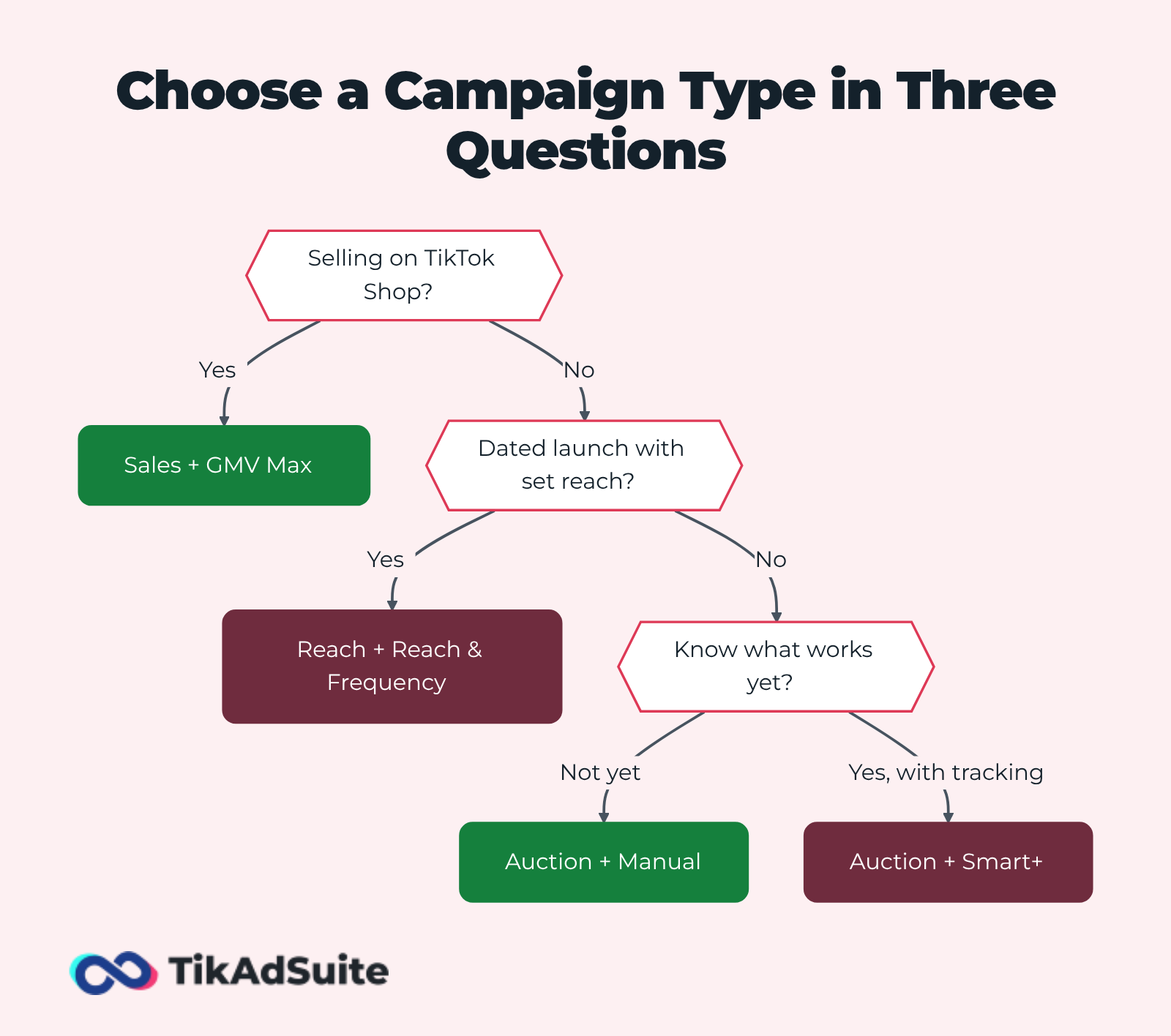
People who have never seen your brand can cost more to convert than people who already watched or visited. A short Reach, Traffic or Video views phase can build that warm audience first, and then a TikTok retargeting campaign can reach them with a Sales or Lead generation objective.
Common Mistakes When Setting Up TikTok Campaign Types
Most campaign type mistakes come down to asking TikTok for the wrong result or not giving it time to learn.
- Picking the objective by format. Running a video does not mean you need Video views. Ask what you want people to do after watching, and pick that objective.
- Running Sales without tracking. A website Sales campaign needs conversion events to learn from. Set up the TikTok Pixel and test that events fire before you launch.
- Setting budgets under the minimum. TikTok’s budget page says a daily budget must be more than $50 at the campaign level and more than $20 at the ad group level.
- Editing during the learning phase. TikTok’s learning phase page says results usually start to settle after about 25 results or 7 days. Pausing, or making edits that retrigger learning in that window, can keep the campaign from leaving that phase.
- Raising budgets too fast. TikTok’s budget page also advises increases of no more than 40% at a time during learning and 30% after it, no more often than every two days.
- Running awareness and sales campaigns at the same people. Your own ad groups can end up competing for the same people. Give each campaign its own audience.
Frequently Asked Questions
What is the difference between TikTok campaign types and ad formats?
A campaign type is the objective and setup you choose at the campaign level, such as Traffic with a Manual setup or Sales with GMV Max. An ad format is how the ad looks, such as an In-Feed video or a Spark Ad, and you choose it at the ad level.
Does TikTok use an auction for ads?
Yes. Most TikTok ads are bought in an auction that ranks ads by bid and by how relevant they are likely to be to each person. TikTok also offers Reach & Frequency, a reservation option with a fixed CPM booked in advance.
Which TikTok campaign type is best for sales?
Use the Sales objective. Choose your website as the destination for a store on your own site, with the TikTok Pixel tracking purchases, or TikTok Shop as the destination, which uses a GMV Max campaign.
Do I need TikTok Shop to run Shop ads?
Yes. GMV Max campaigns promote products and LIVE streams from a TikTok Shop. If you sell only on your own website, use the Sales objective with your website as the destination instead.
Is Smart+ a separate objective?
No. Smart+ is a way of setting up a campaign inside an objective. TikTok says the upgraded Smart+ flow is available for Traffic, Sales, Lead generation and App promotion, and lets you choose full, partial or no automation.
Wrapping Up
A TikTok campaign type is really three choices: what result you ask for, how you buy it, and how much of the setup you hand to TikTok. Get the objective right first, because every other setting follows from it.
Start with an Auction campaign, a Manual setup and the objective that matches the one action you care about. Add Smart+ or Reach & Frequency when you have a reason to, and use GMV Max if your products live on TikTok Shop.