
TikTok ads have a specific three-tier structure that controls everything from your daily spend to how your data gets organized. Most of the performance issues people blame on bad creative or weak targeting actually trace back to a messy account structure.
If your campaigns, ad groups, and ads are not organized clearly, your reporting gets harder to read, your optimizations get harder to act on, and your budget gets harder to control.
The structure itself is not complicated. The decisions about how to use it are where most advertisers run into trouble.
In this guide, you will learn:
- How TikTok’s three-tier ad structure actually works
- Which settings live at each level
- How many campaigns and ad groups does your account really need
- A clean structure template you can apply right away
- Naming conventions that save hours of work later
Once your structure is set up properly, every other decision you make (targeting, budget, creative testing) becomes easier to manage and measure.
Get Up to $6000 Free TikTok Ad Credit
Table of Contents
Key Takeaways
- TikTok ads follow a three-tier hierarchy: Campaign, Ad Group, and Ad
- Each level controls specific settings, and decisions made at one level affect everything below it
- One campaign per business objective is the most reliable starting point for most accounts
- Two to four ad groups per campaign gives you room to test audiences without splitting data too thin
- Clear naming conventions across all three levels save significant time as your account grows
Quick Answer
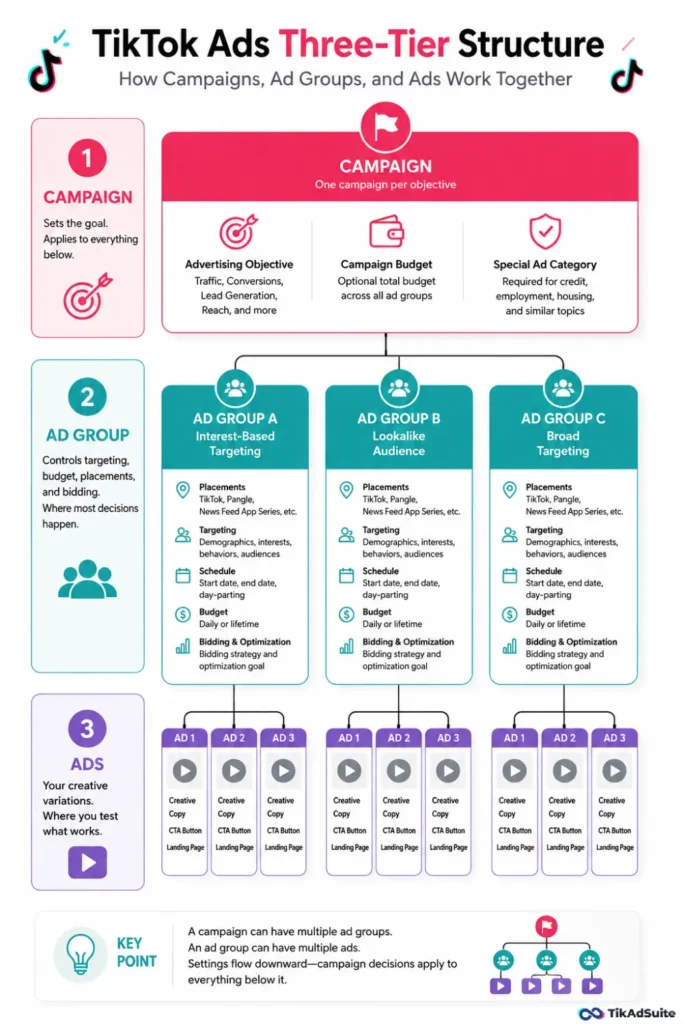
TikTok ads use a three-tier structure: Campaign, Ad Group, and Ad. The campaign sets the objective, the ad group controls targeting, budget, schedule, placements, and bidding, and the ad level holds your creative variations. A clean starting structure is one campaign per objective, two to four ad groups for audience testing, and three to five ads per ad group for creative testing.
The Three Tiers of TikTok Ads Structure
TikTok organizes every account into the same hierarchy. Understanding what each level controls is the foundation for everything else.
| Level | What It Controls |
| Campaign | Advertising objective, total campaign budget (optional), promotion type |
| Ad Group | Targeting, placements, schedule, daily or lifetime budget, bidding strategy, optimization goal |
| Ad | Creative assets (video, image), ad copy, call to action, landing page URL |
A campaign can contain multiple ad groups. An ad group can contain multiple ads. Settings flow downward, so a campaign-level decision (like an objective) applies to every ad group and ad inside it.
Campaign Level: The Settings That Apply to Everything Below
Your campaign is where you choose what you want TikTok to optimize for. This is the single most important decision in your account, because it determines how TikTok delivers your ads and which metrics it tries to improve.
Campaign-level settings include:
- Advertising objective: Traffic, Conversions, Lead Generation, Reach, Video Views, App Promotion, and others
- Campaign budget: Optional, controls total spend across all ad groups within the campaign
- Special ad category declaration: Required for ads related to credit, employment, housing, and similar regulated topics
The cleanest rule for most accounts is one campaign per objective. If you are running a Traffic campaign and a Conversion campaign, keep them in separate campaigns. Mixing objectives inside one campaign creates messy reporting and makes it harder to read your performance data.
For a deeper look at when to use which objective, the TikTok ad objectives guide covers each option with practical use cases.
Ad Group Level: Where Most of Your Decisions Actually Happen
The ad group is where the bulk of your campaign decisions live. Most performance differences across an account come from choices made here.
Ad group settings include:
- Placements: Where your ads run (TikTok, Pangle, News Feed App Series, or all)
- Targeting: Demographics, interests, behaviors, custom audiences, lookalikes
- Schedule: Start date, end date, day-parting if needed
- Budget: Daily or lifetime spend at the ad group level
- Bidding strategy: Cost cap, max delivery, or another option, depending on your objective
- Optimization goal: The specific action TikTok optimizes toward
Because targeting lives at the ad group level, this is where you build separation between different audiences you want to test. If you want to compare interest-based targeting against a lookalike audience, those go in two separate ad groups under the same campaign.
For a complete breakdown of budget control at the ad group level, the TikTok ads budget optimization tips guide covers how to allocate spend across multiple ad groups effectively.
Ad Level: Your Creative Variations
The ad level holds your actual creative. Each ad inside an ad group shares the same targeting, budget, and bidding, but has its own video, copy, call to action, and destination URL.
This is where you run creative tests. Three to five ads per ad group is a reasonable starting point. Fewer than that gives you limited data on what works. More than that splits the delivery too thin and slows down the learning phase.
For a structured way to test creative variations inside an ad group, the TikTok creative testing framework guide covers exactly how to set up tests that produce usable results.
How Many Campaigns Does Your Account Actually Need?
This is one of the most common structure questions, and the answer depends on how many distinct objectives you are running.
A simple guideline:
- One business goal: One campaign with multiple ad groups for audience testing
- Two business goals (e.g., awareness and conversions): Two campaigns, each optimized for its respective objective
- Multiple product lines or services: Separate campaigns per product line if budgets and audiences differ significantly
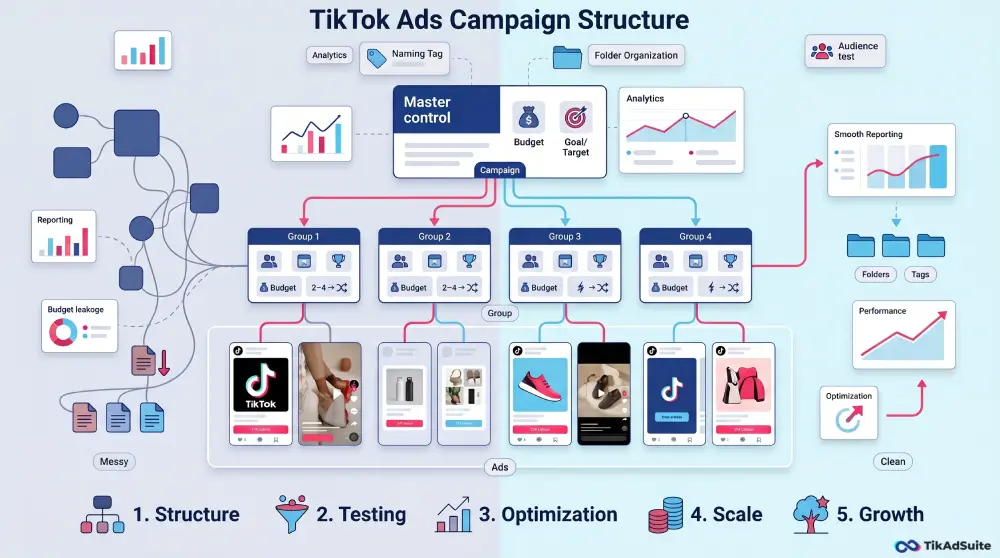
Resist the urge to create a new campaign for every small variation. Creating ten campaigns with one ad group each gives you fragmented data and ten learning phases to wait through.
Consolidating into fewer, well-structured campaigns gives TikTok’s algorithm enough volume to optimize properly.
A Clean Starting Structure for Most Accounts
For most businesses launching their first set of campaigns, this baseline structure works well:
Campaign 1: Conversion
- Ad Group A: Interest-based targeting (3 to 5 ads)
- Ad Group B: Lookalike audience (3 to 5 ads)
- Ad Group C: Broad targeting (3 to 5 ads)
Campaign 2: Traffic (optional, if you are also driving site visits)
- Ad Group A: Cold audience (3 to 5 ads)
- Ad Group B: Retargeting (3 to 5 ads)
This gives you clean separation between objectives, room to test multiple audiences, and enough creative variation within each ad group to identify what works. As your account grows, you can scale this structure with more ad groups, more creative variations, or additional campaigns for new objectives.
If you are running campaigns through TikTok Ads Manager, the campaign builder walks you through each level in order, which makes it easier to keep the structure consistent.
Naming Conventions That Save You Time Later
Once your account has more than a few campaigns running, naming gets critical. A clear naming system makes reporting faster, prevents mistakes, and makes it obvious which ad group does what without opening every setting.
A reliable format looks like this:
- Campaign: [Objective] | [Product/Service] | [Date]
- Ad Group: [Audience Type] | [Targeting Detail] | [Placement]
- Ad: [Creative Concept] | [Hook] | [Version]
Example:
- Campaign: Conversion | Summer Promo | Jun26
- Ad Group: Lookalike | Past Purchasers 1% | TikTok Only
- Ad: UGC Testimonial | Hook 1 | V2
This structure makes it instantly clear what is running where. When you scale into dozens of ad groups, you will thank yourself for setting this up early.
Common Structure Mistakes That Slow Down Performance
Splitting audiences across too many ad groups: Five tiny ad groups testing five overlapping audiences will starve each one of data. Combine similar audiences and let TikTok’s algorithm find the best signal.
Mixing objectives in one campaign: Running a Reach ad group and a Conversion ad group inside the same campaign muddies your reporting and limits TikTok’s ability to optimize. Keep objectives separated at the campaign level.
Restarting structure too often: Every time you rebuild a campaign or ad group, you reset the learning phase. Plan your structure carefully up front rather than reorganizing after every test.
Running only one ad per ad group: Without creative variation, you have no way to compare what is working. Always run at least three ads per ad group when budget allows.
As your account grows beyond the initial setup, scaling needs a different approach to structure. The how to scale TikTok ads, guide covers how to expand without breaking the structure that already works.
FAQs
What is the correct order to build a TikTok ads campaign?
Start at the campaign level by choosing your objective. Then create your ad group with targeting, budget, schedule, and bidding settings. Finally, add your ads with creative, copy, and destination URLs at the bottom level. Building from the top down keeps your decisions aligned at each step.
How many ad groups should I have per campaign?
Two to four ad groups per campaign is a practical range for most accounts. This gives you enough room to test different audiences without splitting your budget so thin that no single ad group gets enough data to optimize properly.
Can I change the campaign objective after launching?
No. TikTok’s campaign objective is set at creation and cannot be changed after the campaign goes live. If you need a different objective, you have to build a new campaign. Choose carefully before launching.
Should I use campaign budget optimization or ad group budgets?
Campaign budget optimization works well when your ad groups have similar audiences and similar value to your business. Ad group budgets give you more control when audiences differ significantly in cost or expected performance. Start with ad group budgets if you want predictability, then test campaign budget optimization once you know which ad groups perform consistently.
Wrapping Up
A well-built TikTok ad structure does not guarantee great performance, but a messy structure almost always limits it.
One campaign per objective, two to four ad groups for audience testing, three to five ads per ad group for creative testing, and a clear naming system give you a foundation that scales cleanly as your account grows.
Get the structure right early, and the rest of your work (creative, targeting, bidding) becomes much easier to refine.
Spend time on this upfront, and you will spend less time later trying to untangle reports that should have been clear from the start.