
Picking the wrong TikTok ad objective is one of the most expensive mistakes you can make in campaign setup. It does not matter how strong your creative is. If your objective does not match your actual goal, TikTok’s algorithm will optimize for the wrong outcome, and you will pay for results that do not move your business forward.
The confusion is more justified in 2026 than it has ever been. TikTok has added new objectives, updated existing ones, and quietly changed how the campaign creation interface works. If you are working from a guide written even six months ago, you are already operating with incomplete information.
Get Up to $6000 Free TikTok Ad Credit
This article gives you a clear, current breakdown of every TikTok advertising objective: what each one does in 2026, when to use it, how it affects your cost, and exactly how to pick the right one for your specific campaign goal.
Table of Contents
What Are the TikTok Ad Objectives?
TikTok ad objectives are the campaign goals you select inside TikTok Ads Manager to tell the platform what outcome to optimize for. They fall into three categories: Awareness (maximize reach and brand visibility), Consideration (drive clicks, views, app installs, leads, engagement, or high-intent brand interest), and Conversion (generate sales across your website, app, or TikTok Shop). Your choice directly controls how TikTok’s algorithm delivers your ads, but results vary based on your budget, pixel maturity, and creative quality.
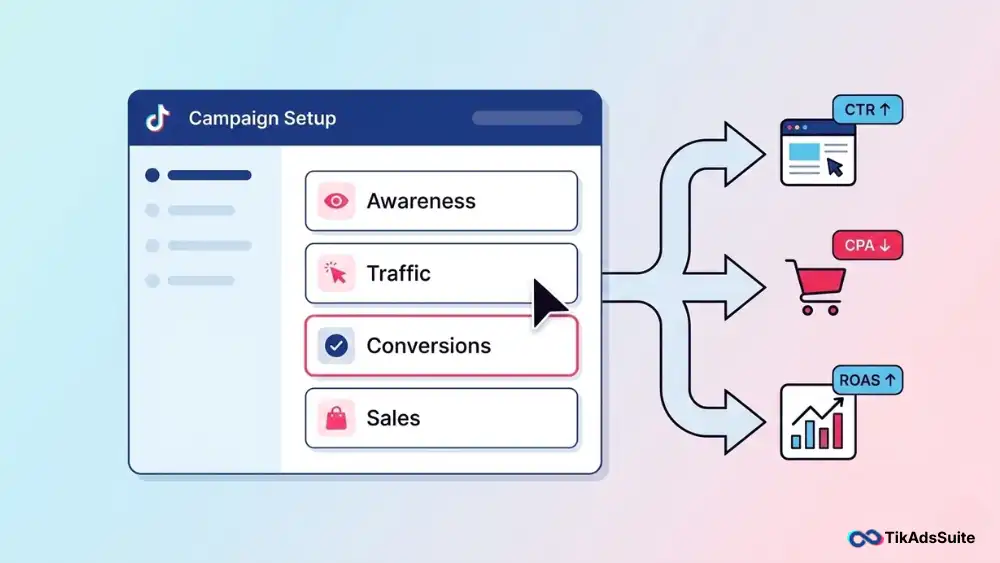
TikTok Ad Objectives vs. Campaign Objectives: What’s the Difference?
These two terms get used interchangeably, but they are not the same thing. Mixing them up leads to misaligned optimization and budget waste before your campaign even gets a fair chance.
A TikTok advertising objective is your business goal. It is the real-world outcome you are trying to achieve: more brand awareness, more website traffic, more app downloads, or more sales.
A campaign objective is the in-platform setting inside TikTok Ads Manager that translates your business goal into a signal TikTok’s algorithm can act on.
Here is why the distinction matters: when you select a campaign objective, TikTok uses that signal to decide who sees your ads, how often, and on which placements. Select Traffic, and TikTok finds users most likely to click. Select Sales, and TikTok prioritizes users most likely to complete a purchase.
Your advertising objective comes first. You define what success looks like. Then you select the campaign objective in Ads Manager that most accurately reflects that goal. When those two are misaligned, your campaign optimizes for the wrong signal from day one, and no amount of budget increase will fix it.
The 3 Categories of TikTok Advertising Objectives
TikTok organizes all campaign objectives into three funnel stages. Each category serves a distinct role in moving your audience from first impression to purchase.
| Funnel Stage | Category | Core Purpose |
| Top of Funnel | Awareness | Get your brand in front of as many relevant users as possible |
| Mid Funnel | Consideration | Drive a specific action: click, view, install, lead, or brand interest |
| Bottom of Funnel | Conversion | Generate a purchase or revenue-driving event |
The category you start with depends on where your audience is in their relationship with your brand. A new brand launching on TikTok has a very different starting point than an established ecommerce store running retargeting campaigns. We will break each one down in full detail below.
Awareness Objectives: How to Maximize Your Brand Reach
Reach is TikTok’s sole Awareness objective. According to TikTok’s Reach Objective Help Page, it allows you to show your ads to the maximum number of impressions in your targeted audience at the most efficient price. Frequency caps are applied automatically to control how often the same person sees your ad, keeping exposure high without overloading any individual user.
When to use it: Reach works best when visibility is the goal, not immediate action. Use it for new product launches, seasonal brand campaigns, or any situation where getting your name in front of a large audience matters more than driving clicks or purchases right now.
Bidding model: Reach campaigns use CPM (Cost Per Mille). You pay per 1,000 impressions. You can run Reach campaigns under Auction buying or Reach and Frequency buying, depending on how much control you want over delivery pacing.
Best fit: Mid-size to large brands running upper-funnel campaigns, businesses entering a new market, and advertisers running creative testing at scale. If you have a tight budget and need direct ROI quickly, Reach is not the right starting point.
Consideration Objectives: Drive Clicks, Views, and Interest
The Consideration category now contains six objectives in 2026, following the addition of Brand Consideration as a standalone option. Each one optimizes for a different mid-funnel action.
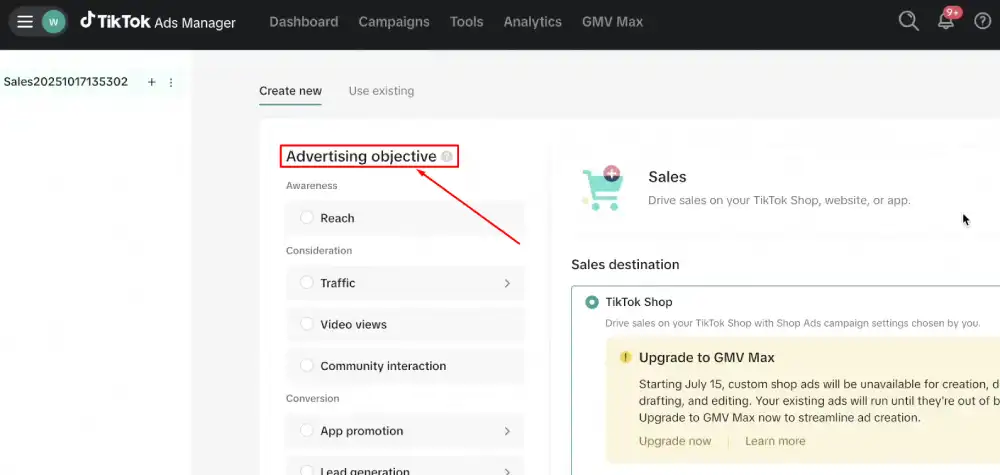
Here is a full breakdown:
Traffic
Traffic optimizes for link clicks. TikTok finds users within your target audience who are most likely to tap your ad and visit your destination URL, whether that is your website, landing page, or app store listing.
In January 2026, TikTok added a significant update to this objective. You can now toggle on consideration signals inside your ad group settings. This changes how TikTok targets your audience: instead of optimizing purely for clicks, it can now optimize for cost per consideration (users who engage deeply through likes, shares, comments, brand searches, or repeated video views) or cost per new buyer (users who have not purchased from your brand in the past 180 days).
A higher CPC is typical with consideration signals enabled, but advertisers using this toggle have reported stronger downstream conversion rates because the traffic quality improves. Bidding model: CPC (Cost Per Click).
Video Views
Video Views optimizes for video watch time. TikTok will show your ad to users most likely to watch it for a meaningful duration, typically 6 seconds or through to completion, depending on your selected optimization event.
Use this when your creative requires time to communicate its message, or when brand consideration is the goal, and watch engagement itself is the measure of success. It works well for product demonstrations, testimonials, and story-driven content. Bidding model: CPV (Cost Per View).
Community Interaction
Community Interaction optimizes for profile visits and followers. TikTok will deliver your ad to users most likely to follow your account or visit your profile page after seeing the ad.
Use this when building a TikTok-native audience as part of your broader strategy. It is a strong fit for brands that invest in organic TikTok content and want paid support to accelerate audience growth. Bidding model: CPM or CPE (Cost Per Engagement), depending on your selected optimization goal.
Brand Consideration
Brand Consideration is a mid-funnel objective designed specifically to grow your pool of high-intent audiences. It uses advanced modeling to assess historical behavior and automatically bid for users who are most likely to move from awareness into active consideration of your brand.
According to TikTok’s 2026 Product Preview, the objective now optimizes for both intent and attention, balancing cost per consideration with a six-second view-through rate. TikTok tracks 12+ in-platform behaviors to define a consideration audience, including commenting, in-app searches, content shares, follows, and product card clicks.
One important access note: Brand Consideration is currently available in the US and requires onboarding to TikTok Market Scope. You will need to contact your TikTok Partner to request access. It is not available as a self-serve option for all accounts. Bidding model: Cost Per Consideration.
App Promotion
App Promotion optimizes for mobile app installs or in-app events. TikTok targets users most likely to download your app or complete a defined action inside it, such as registration, a first purchase, or tutorial completion.
Use App Promotion if you run a mobile app and want to grow your user base or re-engage lapsed users. You will need to integrate the TikTok SDK or connect a mobile measurement partner (MMP) such as Adjust or AppsFlyer before the campaign can optimize accurately. Bidding model: CPI (Cost Per Install) for installs, CPA (Cost Per Action) for in-app events.
Lead Generation
Lead Generation lets users submit their contact information directly inside TikTok, without ever leaving the app. TikTok’s native instant form pre-fills fields using the user’s profile data, which reduces friction significantly compared to sending traffic to an external landing page.
Use Lead Generation for service businesses, B2B advertisers, real estate, finance, education, and any campaign where collecting qualified contact information is the primary goal. Include at least one qualifying question in your form. Without it, you will collect high volume with low quality. Bidding model: CPL (Cost Per Lead).
Conversion Objectives: Turn Attention Into Action
Sales: Website, App, and TikTok Shop
Sales is TikTok’s bottom-of-funnel objective. TikTok merged the previously separate Website Conversions and Product Sales objectives into a single unified Sales objective. According to TikTok’s official Sales objective page, this rollout is still phased, meaning not every account will see the updated interface immediately. TikTok recommends switching to the new framework since all upcoming features will only be available in the updated version.
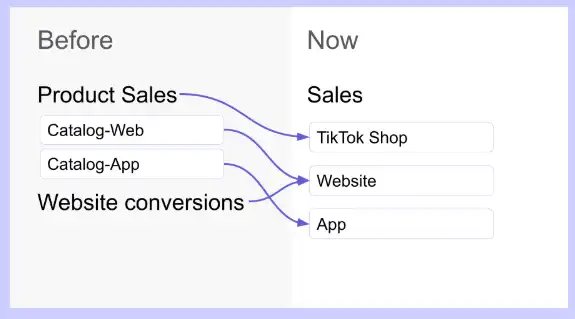
The Sales objective now covers three purchase destinations in one campaign type:
- Website: Requires a TikTok Pixel installed and verified on your site
- App: Requires TikTok SDK integration or a connected MMP
- TikTok Shop: No catalog or Pixel required. TikTok Shop is available for advertisers registered in the US, UK, Indonesia, Ireland, Malaysia, Mexico, the Philippines, Singapore, Spain, Thailand, and Vietnam
You can run Sales campaigns as a Manual campaign (where you configure each setting yourself), a Smart+ campaign (where TikTok automates placements, targeting, and optimization using its AI), or a Search campaign (where your ads appear within TikTok’s search results page targeting keyword-matched queries).
When to use it: Use Sales when you have a functioning purchase flow and proper tracking in place. Running a Sales campaign without a verified pixel or SDK integration forces the algorithm to optimize blindly. You will spend the budget without giving TikTok the signal it needs to find actual buyers.
Bidding model: Sales campaigns use oCPC (Optimized Cost Per Click), where TikTok dynamically adjusts your bids to maximize conversion events within your target cost. CPA bidding is also available for a fixed cost-per-purchase target.
Best fit: Ecommerce brands driving website purchases, app-based businesses with in-app purchase flows, TikTok Shop sellers, and retargeting campaigns targeting cart abandoners or past site visitors.
How to Choose the Right TikTok Ad Objective for Your Goal
Use this framework as your starting point. Match your current goal to the objective, not your ideal goal or your future goal: your goal right now.
| If your goal is… | Use this objective | Why |
| Getting your brand in front of a large audience | Reach | Optimizes for maximum unique impressions at CPM |
| Sending people to your website or landing page | Traffic | Optimizes for link clicks at CPC; enable consideration signals for higher-quality traffic |
| Getting users to engage with your video content | Video Views | Optimizes for view duration at CPV |
| Growing your TikTok followers | Community Interaction | Optimizes for profile visits and follows |
| Growing a high-intent mid-funnel audience | Brand Consideration | Optimizes for 12+ engagement behaviors and 6-second view-through rate |
| Driving app downloads or in-app actions | App Promotion | Optimizes for installs using SDK or MMP data |
| Collecting leads without leaving TikTok | Lead Generation | Uses native instant forms at CPL |
| Driving website, app, or TikTok Shop purchases | Sales | Optimizes for purchase events using Pixel, SDK, or TikTok Shop |
Three rules that will save you real money:
- New pixel with no data: Start with Traffic for one to two weeks before switching to Sales. TikTok’s conversion algorithm needs enough purchase event data to exit the learning phase. According to TikTok’s Learning Phase FAQ, 25 conversions is the most significant indicator of passing the learning phase. Without that volume, Sales campaigns will underperform consistently.
- Small daily budget under $50: Avoid Sales campaigns until you can generate consistent conversion volume. Traffic and Lead Generation have lower data requirements and will deliver more reliable results at smaller budgets.
- Awareness creative under a Sales objective: Do not run a soft brand story video under a Sales campaign. The creative intent and the campaign signal conflict. Match your creative to the action your objective is optimized for.
Simplified Mode vs. Custom Mode: Does Your Objective Change?
Yes, and the interface itself changed in 2026. TikTok removed the “buying type” option from the campaign creation flow to make the objective selection process faster and more straightforward. If you have not been in Ads Manager recently, the layout looks different from older guides and tutorials.
Simplified Mode is built for advertisers new to TikTok ads. It consolidates campaign setup into fewer steps and presents a reduced set of objectives. According to Shopify’s 2026 TikTok Ads guide, Simplified Mode currently surfaces five condensed objectives: increase traffic, drive community interaction, improve lead generation, generate website conversions, and encourage app installs. TikTok handles many technical decisions automatically in this mode, including placements, bidding, and optimization settings.
Custom Mode gives you access to every TikTok advertising objective, full bidding strategy control, manual placement selection, advanced audience targeting parameters, and detailed optimization settings. This is the mode you need for Brand Consideration, Smart+ campaigns, Search campaigns, and any advanced campaign strategy.
If you open Ads Manager and cannot find all the objectives described in this article, you are most likely in Simplified Mode. Switch to Custom Mode in your campaign creation settings to access the complete objective library.
The objectives themselves function identically in both modes. What changes is the depth of control surrounding them. For any serious campaign strategy where you need to diagnose performance and make data-driven adjustments, Custom Mode is the correct choice.
How Your Objective Affects Ad Cost and Bidding
Your TikTok ad objective does not just define your goal. It determines the bidding model your campaign uses, and that controls your cost structure from the first day of spend.
| Objective | Bidding Model | You Pay Per… |
| Reach | CPM | 1,000 impressions |
| Traffic | CPC | Link click |
| Video Views | CPV | Video view (6-second or completion) |
| Community Interaction | CPM or CPE | Impressions or engagement |
| Brand Consideration | Cost Per Consideration | High-intent engagement event |
| App Promotion | CPI or CPA | App install or in-app event |
| Lead Generation | CPL | Lead form submission |
| Sales | oCPC or CPA | Optimized click or purchase event |
Here is what each model means for your budget in practice:
CPM campaigns (Reach, some Community Interaction) charge you regardless of whether users take action. You pay for exposure. Frequency caps and audience size are your primary budget management levers.
CPC campaigns (Traffic) charge only when someone clicks. Your cost ties directly to your creative’s click-through rate. A low-relevance ad with a weak CTR will drive your CPC up significantly. If you enable consideration signals on Traffic, expect a higher CPC but lower CPA in most cases, because you are paying for deeper engagement intent.
oCPC campaigns (Sales) use dynamic bidding. TikTok adjusts your bids in real time based on the probability that a specific user will complete a purchase. The more conversion data your pixel has, the more accurate TikTok’s predictions, and the more efficiently your budget gets allocated.
One variable worth stating clearly: bidding model performance interacts with your audience size, creative quality, and pixel maturity. A Reach campaign targeting a narrow audience will carry a higher CPM than one targeting a broad audience. A Sales campaign with strong pixel data and a high-performing creative will consistently outperform a new campaign without that foundation, even at the same daily budget.
Common Mistakes When Selecting a TikTok Ad Objective
These are the mistakes we see most often across underperforming campaigns. Every one of them is avoidable.
- Using Reach when the goal is sales. Reach optimizes for impressions, not purchase intent. You are paying to be seen by users whom TikTok has not qualified as likely buyers. If revenue is the goal, move to Sales with proper tracking in place.
- Running Traffic campaigns without a TikTok Pixel installed. Traffic brings clicks, but without a pixel, you cannot track what happens after the click, and you cannot retarget those visitors later. Install and verify your pixel before launching any Traffic campaign.
- Using Video Views for a bottom-funnel product. Watch time does not equal purchase intent. Video Views optimizes for viewers, not converters. If you are selling a product and want buyers, this is the wrong objective.
- Launching a Sales campaign on a brand-new pixel. A new pixel with zero conversion history puts your campaign in a prolonged learning phase with no data to guide optimization. Start with Traffic to seed the pixel, then transition to Sales once initial conversion events are recorded.
- Ignoring the consideration signals toggle on Traffic. Since January 2026, you can switch Traffic from pure click optimization to consideration-intent targeting. If you are running Traffic to a high-consideration product or a longer sales cycle service, leaving this toggle off means you are paying for clicks from low-intent users who will bounce quickly.
- Mismatching creative intent with campaign objective. A soft, narrative-style brand video under a Sales objective creates a signal conflict between what your creative communicates and what TikTok is trying to optimize for. Your ad creative should align clearly with the action your objective expects users to take.
More helpful articles you’ll want to explore:
👉 TikTok Ads Credit: Get Free $6000 Cash Back Promo
👉 The Ultimate TikTok Ads Funnel for eCommerce: TOFU, MOFU, BOFU & Retention Explained
👉 How to Advertise on TikTok Shop: A Complete Beginner’s to Advanced Guide
👉 How to Set Up Retargeting Campaigns on TikTok
Frequently Asked Questions About TikTok Ad Objectives
What is the best TikTok ad objective for ecommerce?
For ecommerce, the Sales objective is the right choice in most cases. It optimizes directly for purchase events using your TikTok Pixel for website sales, your SDK for app sales, or your TikTok Shop connection for in-app purchases. If you are launching with a new pixel and no conversion history, start with Traffic for one to two weeks to build pixel data first. Your cost per acquisition will improve meaningfully once the algorithm has enough purchase events to learn from.
What is the difference between Reach and Traffic on TikTok?
Reach optimizes for unique impressions: TikTok shows your ad to as many different users as possible, and you pay per 1,000 impressions using CPM. Traffic optimizes for link clicks: TikTok finds users most likely to tap your ad and visit your URL, and you pay per click using CPC. As of January 2026, you can also enable consideration signals on Traffic campaigns to target users with deeper engagement intent rather than raw click likelihood. Reach is an awareness tool. Traffic is a consideration tool. They serve different stages of the funnel.
How did TikTok ad objectives change in 2026?
In 2026, TikTok made two significant additions: Brand Consideration was updated to optimize for both intent and attention simultaneously, and the Traffic objective received a new consideration signals toggle that lets you optimize for high-intent users and new buyers rather than pure click volume.
Which TikTok ad objective should I use if I have a small budget?
With a daily budget under $50, Traffic or Lead Generation will outperform Sales in most situations. Sales campaigns require sufficient conversion volume to exit the learning phase and optimize effectively. According to TikTok’s Learning Phase FAQ, 25 conversions are the most significant indicator for passing the learning phase. Without that volume, the algorithm cannot learn. Traffic and Lead Generation have lower data requirements and produce more consistent results at smaller budgets.
Can I change my TikTok ad objective after a campaign goes live?
No. Once a campaign is live, the objective is locked and cannot be changed. If you need a different objective, you must create a new campaign. This matters because switching objectives means restarting the learning phase entirely, which resets any optimization data your previous campaign accumulated. Getting your objective right before launch is not optional: it is foundational.
What TikTok ad objective should I use for a service business?
Lead Generation is the strongest fit for most service businesses. It captures contact information through a native TikTok instant form without requiring the user to leave the app, which reduces drop-off significantly. If you are targeting an audience that needs multiple touchpoints before converting, consider pairing Lead Generation with a Brand Consideration campaign to warm up high-intent users first. For service businesses with strong landing pages and full conversion tracking, Traffic with consideration signals enabled is also a strong option.
Conclusion
Choosing the right TikTok advertising objective is not a minor setup detail you can revisit later. It is the foundational decision that determines how TikTok’s algorithm allocates every dollar of your budget. Every targeting decision, every bid adjustment, and every optimization the platform makes flows directly from that single selection.
You now have a complete and current picture of all objectives across the three funnel categories as they stand in 2026. You know what each one optimizes for, how it affects your cost structure, and when each one fits your situation.
You also understand the updates that most guides still get wrong: the consideration signals toggle added to Traffic in January 2026, the Brand Consideration objective and its Market Scope requirement, the Sales objective consolidation, and how pixel maturity shapes your realistic options before you spend a single dollar.
The right objective is the one that matches your current goal, your current pixel maturity, and your current budget. Start there, collect real data, and let those results guide every decision that follows.