
The TikTok ads algorithm is a machine learning system that predicts which ads will generate the best user experience and advertiser results at the same time. It ranks ads using three core signals: predicted relevance to each user, engagement signals (including watch time and completion rate), and conversion feedback from post-click behavior.
Results vary significantly based on creative quality, pixel maturity, and how well your campaign setup feeds the system clean data, but only when those inputs are consistently maintained.
Most advertisers treat TikTok like a black box. You set a budget, launch a creative, and wait. Sometimes it works, but often it does not.
That gap between guessing and knowing is exactly where winning TikTok ads are separated from campaigns that waste budget. Understanding the algorithm is the foundation of any effective TikTok ad strategy.
The TikTok ads algorithm is not random. It follows a logic, and it scores your ad before a single person sees it. It tests, learns, and scales based on signals most advertisers never track. And if you are working against it, your CPMs go up while your results go down.
This article breaks down exactly how the TikTok ads algorithm works in 2026. You will learn the auction mechanics, the ranking signals, the delivery phases, and the specific optimization moves that align your campaigns with how the system actually operates.
Get Up to $6000 Free TikTok Ad Credit
Table of Contents
What Is the TikTok Ads Algorithm? (2026 Definition)
The TikTok ads algorithm is the automated decision system that controls which paid ads get shown, to whom, at what cost, and how often.
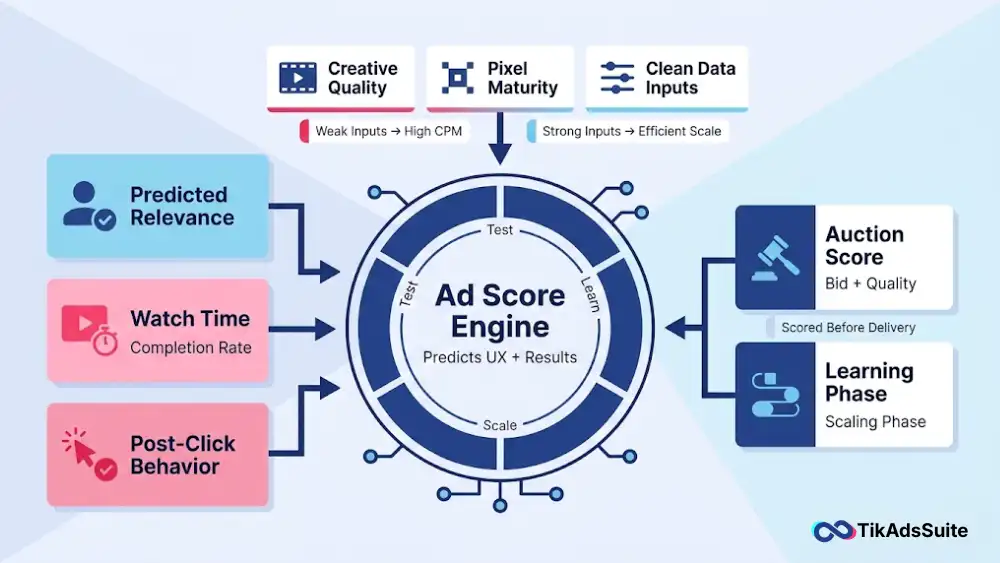
It is not a manual process, and no human at TikTok decides what your ad gets shown to. A model makes that call in real time, millions of times per second.
Understanding this system is the difference between scaling a campaign and burning budget.
Recommendation Engine vs. Traditional Ad Auction
Most platforms run a straightforward auction. You bid. The highest qualified bid wins placement. That is largely how Google Search has worked for years.
TikTok operates differently. Its ad delivery system is built on top of the same recommendation engine that powers the For You Page. The FYP already knows what keeps users watching. The ads algorithm layers paid intent on top of that behavioral model.
This means your ad does not just compete on bid price. It competes on predicted relevance to each specific user. As TikTok’s official bidding documentation confirms, “TikTok’s auction ranks ads based on bid price and the relevance an ad might have to people”. An ad with a lower bid but stronger predicted engagement can outplace a higher-spending competitor.
That shift changes everything about how you should set up and optimize your campaigns.
How AI Predicts Ad Relevance Before Delivery
Before your ad reaches a single user, TikTok’s system runs a pre-delivery scoring process. It analyzes your creative, your landing page signal, your historical account performance, and your targeting inputs. It builds a predicted performance model for that specific ad.
This is why two creatives with the same budget and audience can produce completely different CPMs.
The algorithm already has a view on which one it expects to perform better. It will push spend toward that prediction immediately.
According to TikTok’s Creative Best Practices documentation, the platform recommends 3 to 5 different creatives per ad group precisely because the system uses those variations to identify which creative it predicts will perform best for your audience. Your creative is evaluated before the learning phase even begins.
How the TikTok Ad Auction Actually Works
Every time a TikTok user opens the app and a feed slot becomes available, an auction runs. It happens in milliseconds. The winner gets the impression. Here is what actually determines who wins.
eCPM Formula and How Ads Compete for Placement
TikTok uses an eCPM (effective cost per thousand impressions) model to rank competing ads.
The confirmed formula for eCPM structure is:
eCPM = Bid x Predicted CTR x Predicted CVR
Your bid is one input. The algorithm multiplies it against predicted click-through rate and the predicted conversion rate. This means an ad with a strong creative performance history and a high predicted CTR will win more impressions than a competitor who simply bids higher.
Beyond these three inputs, TikTok also factors in creative quality and relevance signals when determining delivery priority. These signals influence how the system weights your ad within the auction, though they are not a single published standalone variable.
You are not just competing against other budgets. You are competing against other performance predictions.
Why Bid Alone Does Not Win the Auction
We see this misunderstood constantly. Advertisers increase bids, hoping for better delivery. Sometimes it works short-term. But the underlying problem is usually creative performance, not bid floor.
If your predicted CTR is low, doubling your bid produces a marginal lift. You are multiplying a weak number by a larger number. The output is still weak.
Core Signals That Control Ad Ranking in 2026
TikTok’s delivery algorithm weighs several signals when deciding how aggressively to push your ad into the feed. These are the ones that matter most.
Predicted Quality Score (Pre-Delivery)
Your ad’s predicted quality is built from multiple inputs: your creative format, your account’s historical engagement benchmarks, the relevance of your ad to the targeted audience segment, and the quality of your destination URL.
TikTok does not publish a single named “quality score” metric in its Help Center the way Google Ads does. But the signal exists inside the system. You see it reflected in your CPMs. Strong predicted relevance produces lower CPMs for the same bid level. Weak relevance drives costs up even when you increase the budget.
Creative freshness matters here, too. An ad that has accumulated negative engagement signals over several weeks (high skip rates, mutes, rapid exits) will carry a degraded performance prediction into future delivery windows.
Watch Time, Completion Rate, and Rewatch Signals
Watch time is the signal TikTok weighs most heavily across both organic and paid delivery. The more of your ad a user watches, the stronger the quality signal sent back to the algorithm.
According to TikTok’s Creative Best Practices documentation, TikTok recommends prioritizing your hook in the first 6 seconds to boost engagement and increase watch time. Your first 6 seconds of creative have one job: stop the scroll. The rest of your ad earns the watch time signal.
Rewatch signals, when a user replays your video, are weighted even more positively. They indicate genuine interest. If you are running content that gets replayed, the algorithm interprets that as a strong quality endorsement and increases delivery frequency.
Engagement Feedback Loops
Beyond watch time, the algorithm tracks likes, comments, shares, saves, and profile visits generated by your ad. These signals feed back into your quality model in near real time.
Shares carry the heaviest weight in this cluster. When a user shares a paid ad, it tells TikTok that the content felt organic enough to recommend to a personal network. That is a strong quality endorsement.
Comments signal active engagement. Saves tell the algorithm the content has lasting utility. Each of these signals compounds. An ad with strong engagement metrics gets pushed to broader audiences at a lower cost because the algorithm has high confidence it will perform there, too.
Post-Click and Landing Page Quality Signals
This signal is underweighted in most advertiser conversations, but it is a real input. TikTok’s algorithm monitors what happens after a click. If users bounce from your landing page immediately, that negative signal returns to the delivery model over time.
A slow-loading page, a poor mobile layout, or a large disconnect between ad promise and landing page content will degrade your delivery quality. According to Google’s Core Web Vitals documentation, pages loading beyond 2.5 seconds fall below the “good” threshold for Largest Contentful Paint, which directly correlates with higher mobile bounce rates.
Your landing page is part of your ad’s performance score. Treat it that way.
TikTok Ads Delivery Phases: How the Algorithm Tests and Scales
Every campaign goes through a structured learning process before TikTok optimizes delivery. Most performance issues can be traced back to mismanaging one of these three phases.
Learning/Exploration Phase
When you launch a new ad set, TikTok enters an exploration phase. The algorithm does not know yet how your specific audience will respond to this specific creative.
So it tests broadly, showing your ad to a range of users within your targeting parameters and collecting initial performance signals.
According to TikTok’s Learning Phase FAQ, “achieving 50 conversions is the most significant indicator of passing the learning phase”. The main Learning Phase documentation adds that volatility typically starts to decline after approximately 25 campaign results or 7 days from when the learning phase begins.
Do not make major changes during this phase. According to TikTok’s documentation, the following actions will interfere with or prevent your campaign from exiting the learning phase: pausing campaigns or ad groups, making edits that re-trigger the learning process, and setting unreasonable budgets or creative volumes.
Expansion and Scaling Phase
Once the system exits the learning phase, it enters expansion. Delivery becomes more consistent. CPMs typically drop. The algorithm has a confident enough model to push your ad to higher volumes at better costs.
This is when you can begin testing budget increases. TikTok’s official Learning Phase documentation is clear about scale: a small increase, such as going from $100 to $110, allows the system to find additional audience quickly.
But a large jump, such as going from $100 to $300, forces the system to find a large new group of users and will push the campaign back into the learning phase. Keep increases measured and give the algorithm 48 to 72 hours between adjustments.
Stability and Optimization Phase
In the stability phase, delivery has normalized. ROAS is predictable. CPMs have settled. The algorithm is delivering to your best-fit audience at an efficient cost.
This phase does not last forever. Creative fatigue will eventually set in, with timelines varying widely based on audience size, daily spend, and creative format. You will see it as a gradual rise in CPM and a decline in CTR.
The right response is not to pause the campaign. It is to introduce new creative variations under the same ad set so the algorithm can shift delivery toward fresher content without losing the performance history the account has built.
As TikTok’s Creative Best Practices documentation confirms, you should “add new creatives to an existing ad group instead of creating a new ad group to extend its lifetime”.
2026 Algorithm Updates: What Changed for Advertisers
TikTok made several significant changes to its ad delivery infrastructure in late 2025 and early 2026. Here is what is actually different and how it affects your campaigns.
Smart Creative and AI creative rotation:
TikTok’s Smart Creative feature allows the algorithm to choose which creative variation it serves, rather than rotating ads equally.
The system favors creatives that match its predicted performance model for each user segment. If you are running multiple creatives in one ad set, you may notice one receiving the majority of the spend. That is the algorithm expressing a performance preference, not a bug.
As TikTok’s Creative Best Practices documentation notes, having 3 to 5 diverse creatives per ad group is recommended specifically to give this system meaningful variations to test.
Smart+ bidding and automated targeting:
TikTok expanded its Smart+ campaign type as a default recommendation for new advertisers. Smart+ uses fully automated targeting and bidding.
It removes manual interest and demographic inputs in favor of algorithmic audience discovery. Early practitioner data shows lower CPAs at smaller budgets, but less control over audience composition.
If brand-fit matters as much as conversion volume for your business, monitor placement and audience reports closely.
Privacy and data shifts affecting targeting signals:
iOS privacy changes and evolving cookie restrictions across browsers have reduced the richness of third-party behavioral signals available to TikTok’s targeting system.
The algorithm has compensated by placing heavier reliance on first-party signals: pixel events you own, engagement data from your TikTok profile, and customer list uploads.
Your pixel setup is now more critical than it was 18 months ago. A mature, well-configured pixel gives the algorithm better data to work with in a signal-reduced environment.
How to Optimize for the TikTok Ads Algorithm in 2026
Understanding the algorithm is only half the work. Here is how you build campaigns that actively align with how the system scores and delivers ads.
Creative Strategy Aligned to Algorithm Signals
Your creative is your primary lever. If you’re wondering how to make a good TikTok ad, the answer starts with understanding the signals the algorithm rewards: strong hooks, high watch time, authentic storytelling, and clear calls to action. Every other optimization is secondary.
TikTok’s Creative Best Practices documentation recommends prioritizing your hook in the first 6 seconds to boost engagement and increase watch time.
Structure your creatives around the algorithm’s preferred signals:
- Hook (0 to 6 seconds): stop the scroll with movement, text on screen, or a direct verbal hook
- Value delivery (6 to 15 seconds): give a reason to keep watching
- Proof or social signal (15 to 25 seconds): reduce resistance
- CTA (final 3 to 5 seconds): direct and specific
Test at least 3 to 5 creative variations as part of your TikTok ads strategy. Giving the algorithm multiple creative options helps it identify which ads are most likely to succeed.
Broad Targeting First, Then Refinement
TikTok’s algorithm performs better with room to explore. Starting with overly narrow targeting constrains the system and produces expensive, slow learning phases.
TikTok’s Web Auction Best Practices Guide explicitly states: “Avoid setting a target that is too narrow. When the audience size is too narrow, ad groups will have difficulty exiting the learning phase”.
This approach is one of the most reliable foundations of a modern TikTok ad strategy, especially for new accounts without extensive conversion data.
Once your pixel has consistent weekly conversion volume, you can layer retargeting, lookalikes, and audience refinements on top of a proven base.
We have seen this approach, starting broad and then narrowing based on pixel data, consistently outperform manually built narrow audiences, especially at budgets under $500 per day.
Bidding and Budget Strategy
Match your bidding strategy to your campaign stage.
During the learning phase: Use Lowest Cost (automatic bidding). It gives the algorithm maximum flexibility to find conversions efficiently while it is still building its performance model.
During the scaling phase: Consider Cost Cap bidding once your target CPA is clearly established. This caps what you pay per conversion while still allowing the algorithm to optimize delivery.
Budget rules to follow, based on TikTok’s official Bidding and Budget documentation:
- Set your daily budget using the formula: daily budget = target CPA x 10. This is TikTok’s officially recommended calculation for generating enough conversions to pass the learning phase.
- Avoid large single-step budget increases. TikTok’s documentation uses the example of jumping from $100 to $300 as a change large enough to push your campaign back into the learning phase.
- Do not pause campaigns during the learning phase. Pausing is listed by TikTok as one of the actions that will prevent your campaign from exiting the learning phase.
Pixel Setup and Event Tracking as Algorithm Fuel
Your TikTok Pixel is the primary feedback system between your website and the algorithm. Every conversion event your pixel fires sends a signal back to TikTok about which users converted, what they bought, and how much they spent.
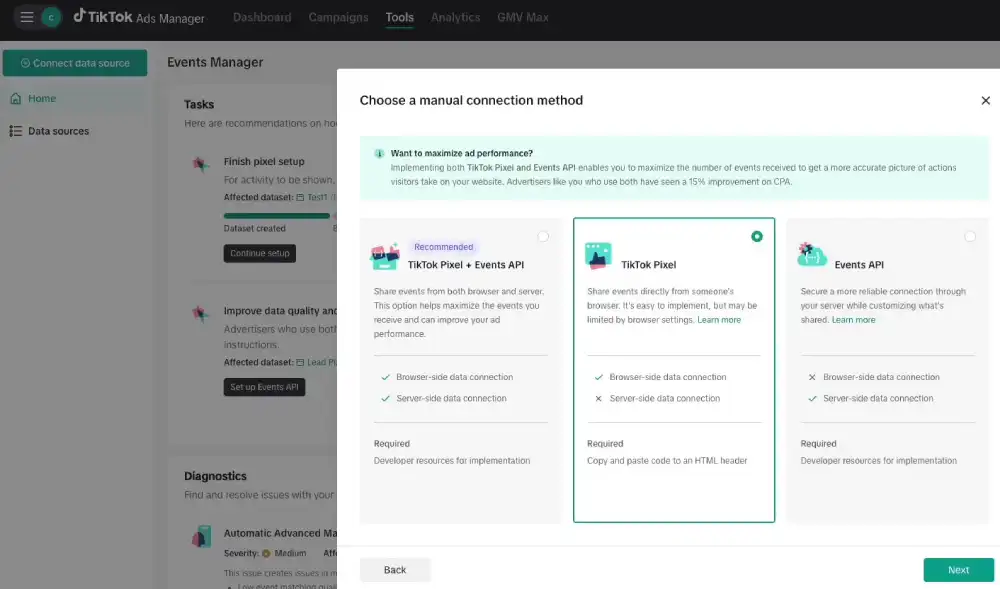
Set up your pixel to fire these events in order of the funnel, as outlined in TikTok’s Standard Events and Parameters documentation:
- ViewContent
- AddToCart
- InitiateCheckout
- Purchase (with value parameter)
Accurate event tracking is especially important if you’re running TikTok conversion ads, since the algorithm depends on reliable conversion signals to optimize delivery. It allows TikTok to optimize for revenue, not just transaction volume. This enables Value-Based Optimization (VBO), which targets users predicted to spend more.
According to TikTok’s VBO documentation, achieving 50 conversions remains the key indicator of passing the learning phase even when using value-based optimization.
If your pixel is not firing correctly, or if it is missing mid-funnel events, the algorithm is making decisions with incomplete data. That directly raises your CPA and lowers your ROAS.
Common Mistakes That Kill Algorithm Delivery
The most common reason TikTok ads stop delivering or underperform is that the campaign has not cleared the learning phase.
According to TikTok’s Learning Phase documentation, this happens when recent edits have reset the process, the budget is insufficient to generate the conversion volume required, or the campaign has been paused during the learning window.
Other frequent causes of delivery failure:
- The audience size is too small. TikTok’s Web Auction Best Practices Guide confirms that overly narrow audiences make it difficult for ad groups to exit the learning phase. Expand your targeting or use Smart Targeting.
- Ad was killed too early. TikTok’s Learning Phase FAQ states that 50 conversions are the most significant indicator of exiting the learning phase. Pausing before you hit that threshold discards the learning the system has built.
- Creative has low predicted relevance. If your hook is slow, your visuals are static, or your audio is low quality, pre-delivery scoring will restrict distribution. The fix is a new creative, not a higher bid.
- Ignoring watch time and completion metrics. If users are exiting your ad quickly, the algorithm reads it as low value and reduces delivery. Check your video retention curve under the creative insights tab in TikTok Ads Manager.
TikTok Ads vs. Organic FYP Algorithm: What’s Different
People often assume the paid ads algorithm and the organic FYP algorithm are the same system. They share foundational logic, but they operate with different objectives.
| Factor | Paid Ads Algorithm | Organic FYP Algorithm |
| Primary objective | Advertiser conversion outcomes | User engagement and retention |
| Bid input | Required, affects delivery priority | Not applicable |
| Content source | Paid ad creatives only | All uploaded content |
| Key signal weighting | CTR, CVR, and post-click behavior | Watch time and shares are most heavily weighted |
| Account history | Ad account and pixel performance affect scoring | Creator profile history affects distribution |
| Speed of distribution | Can scale rapidly with budget | Organic growth is paced by engagement accumulation |
The most useful practical implication: strong organic performance on a piece of content is a positive signal that a paid version of that content may perform well too.
If a video already has strong completion rates and shares organically, using it as a Spark Ad gives the algorithm a warm performance history to build on, rather than starting from zero.
However, organic virality does not guarantee paid performance. The objectives are different. An organic video might go viral because it is entertaining.
A paid ad needs to convert. If the content does not include a clear CTA or a reason to buy, organic success will not translate to paid ROAS.
FAQs
What is the TikTok ads learning phase?
The TikTok ads learning phase is the period after launch when the algorithm collects performance data to optimize delivery. According to TikTok’s official Learning Phase documentation, volatility typically declines after approximately 25 campaign results or 7 days.
The Learning Phase FAQ confirms that 50 conversions are the most significant indicator of successfully passing this phase.
You should avoid pausing your campaign or making major edits during this window, as either action will interfere with or reset the process.
How does TikTok decide which ads to show?
TikTok uses an eCPM-based auction where your bid is multiplied against the predicted click-through rate and the predicted conversion rate to produce an effective value for each impression slot.
As TikTok’s bidding documentation confirms, the system ranks ads based on both bid price and the relevance the ad is predicted to have for each user.
Creative quality, audience relevance, and post-click performance all influence how the system scores your ad before and during delivery.
Why are my TikTok ads not spending?
Your TikTok ads may not be spending due to insufficient daily budget relative to your target CPA, an audience too narrow for the algorithm to explore efficiently, a campaign that has been paused or edited during the learning phase, or a creative with low predicted relevance.
TikTok’s official budget guidance recommends setting your daily budget at a minimum of 10 times your target CPA to generate enough conversions to pass the learning phase.
How does the TikTok ads algorithm differ from Meta’s algorithm?
TikTok’s ads algorithm relies more heavily on content signals like watch time and completion rate to determine distribution, while Meta’s algorithm places greater weight on audience targeting precision and historical account data.
TikTok also uses a content-first discovery model, meaning your ad can reach users with no declared interest in your category if the creative performs well. Meta’s system is more tightly anchored to declared interests and behavioral targeting layers, which gives it more predictable audience control but less organic discovery upside.
Does increasing your TikTok ad budget improve algorithm performance?
Increasing your budget can help you reach the conversion volume needed to exit the learning phase faster. But budget alone does not improve your ad’s predicted CTR or CVR, which are the core inputs that determine your eCPM ranking in the auction.
TikTok’s own documentation gives the example that jumping from $100 to $300 in a single budget increase will push your campaign back into the learning phase. Fix your creative quality first, then scale the budget in measured increments.
How often should you refresh TikTok ad creatives to avoid algorithm fatigue?
Creative fatigue timelines vary based on audience size, daily spend, and creative format. The signal to watch is not time, but performance: a consistently declining CTR and rising CPM indicate fatigue is setting in.
TikTok’s Creative Best Practices documentation recommends refreshing creatives by adding new ones to your existing ad group rather than creating a new ad group, which preserves your campaign’s performance history while giving the algorithm fresh content to test.
Conclusion
The TikTok ads algorithm is not something you fight or outwit. It is a system you learn to align with. Once you understand how it predicts ad relevance before delivery, how it runs auction decisions using eCPM based on your bid, predicted CTR, and predicted CVR, and how it moves through learning and scaling phases, your campaign decisions start making more sense.
You have seen how watch time and engagement feed the algorithm real-time quality signals. You know that bid alone does not win impressions, and that your landing page is part of your quality signal, whether you treat it that way or not.
The 2026 updates around Smart Creative, Smart+, and first-party data only increase the premium on getting your pixel and creative fundamentals right.
The advertisers who consistently produce winning TikTok ads are not the ones who found a shortcut. They are the ones who understand the algorithm, follow a disciplined TikTok ads strategy, and continuously improve creative, targeting, and conversion tracking.
Strong creative, clean data, patient scaling, and a setup that produces measurable feedback at every stage of the funnel.
That is how the algorithm works. And that is how you work with it.