
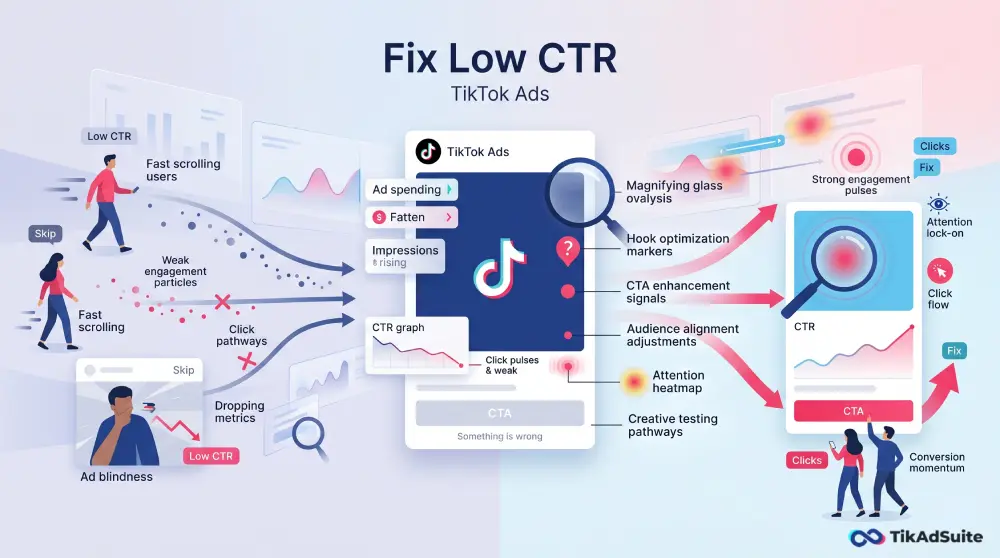
You check your TikTok Ads Manager, and the numbers look painful. Your ad is spending. Your impressions are climbing. But barely anyone is clicking.
A low click-through rate (CTR) is one of the most common problems TikTok advertisers face, and it almost always has a fixable cause.
The problem is that most guides tell you to “test more creatives” without helping you figure out why the current ones are failing. That difference matters because fixing the wrong thing wastes more time and money.
This guide takes a troubleshooting approach.
You will learn:
- What CTR numbers actually count as low on TikTok
- The most common root causes behind poor click-through rates
- Specific fixes for each cause, not just general advice
- How to confirm your fixes are working inside Ads Manager
By the end, you will know exactly where to look and what to change.
Key Takeaways
- A TikTok ad CTR below 1% is generally a signal that something needs attention, though benchmarks vary by industry and ad format.
- The first three seconds of your video are the single biggest factor in whether someone clicks or scrolls.
- Audience mismatch is a leading cause of low CTR that ad creative alone cannot fix.
- Changing one variable at a time is the only way to know what actually moved your CTR.
- Average TikTok in-feed ad CTR benchmarks typically range from 1% to 3%, depending on the vertical and creative quality.
- Your ad placement settings can suppress CTR without you realizing it.
Quick Answer
A low TikTok ad CTR usually comes from a weak hook in the first three seconds, an audience that does not match your offer, or a creative format that blends into the feed. Fix it by rewriting your opening line, narrowing your targeting, and testing one change at a time. Most CTR problems are solvable without rebuilding your entire campaign.
What CTR Numbers Count as “Low” on TikTok?
CTR means click-through rate. It is the percentage of people who see your ad and click it.
The formula is simple: clicks divided by impressions, multiplied by 100.
For TikTok in-feed ads, a CTR below 1% is a warning sign. Between 1% and 2% is average for most industries. Anything above 2% is solid performance, and top-performing creatives can push past 3%. (source)
These numbers shift depending on your niche, your offer, and the time of year. A broad awareness campaign will naturally pull lower CTR than a retargeting ad shown to warm audiences. Context matters when you read your numbers.
The point is not to obsess over a specific target. The point is to spot a gap between what your ad is doing and what it should be doing, then close it.
Why Is My TikTok Ad CTR So Low?
Before you change anything, you need to identify the actual problem. Most low-CTR situations fall into one of five categories.
Weak or missing hook: Your video did not grab attention in the first two to three seconds. The viewer scrolled before they saw the value.
Audience mismatch: Your ad is reaching people who have no interest in what you are offering. Impressions are high, clicks are not, because the wrong people are seeing it.
Unclear call to action: Viewers watched but had no idea what to do next or why they should bother.
Ad fatigue: Your creative has been running long enough that your audience has already seen it multiple times. Familiarity breeds indifference.
Wrong placement: Your ad is appearing in placements where your target audience is less likely to engage.
Identifying which one applies to you determines everything that follows.
Fix 1: Rebuild Your Hook From the First Frame
If your CTR is low and your video completion rate is also low, your hook is the problem.
The hook is the first two to three seconds of your video. On TikTok, that window is everything. Users are trained to swipe fast. If your opening does not create immediate curiosity, urgency, or recognition, they leave.
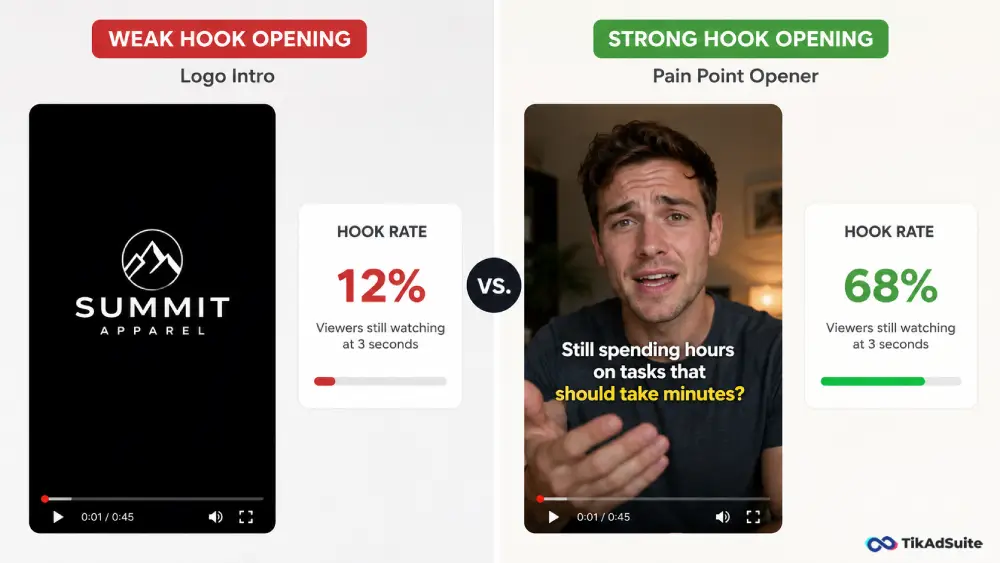
A strong hook does one of three things: it names a specific problem the viewer has, it makes a bold claim that demands attention, or it opens with a visual that stops the scroll.
Instead of starting with your brand name or a product shot, lead with the outcome or the tension. “Your TikTok ads are spending, but nobody is clicking” works far better than “Introducing our new product.”
Check out the breakdown on TikTok ad hooks to see what high-performing opening structures look like across different industries. Understanding the TikTok 3-second rule will also show you exactly how TikTok’s algorithm rewards or punishes your opening.
Fix 2: Tighten Your Audience Targeting
If your hook is strong but CTR is still low, look at who is actually seeing your ad.
A common mistake is targeting too broadly. When your audience is too wide, TikTok delivers your ad to people who technically match your parameters but are not the right buyers. They see the ad, do not recognize the relevance, and scroll.
Start by reviewing your TikTok ad targeting options. Check whether your interest categories are actually aligned with your offer, not just loosely related.
If you have been running ads for a while, consider switching from broad interest targeting to a custom audience built from your website visitors or customer list. Warm audiences almost always deliver higher CTR because the relevance is already established.
Also, review your age and location filters. A mismatch between your audience demographics and your product can tank CTR even if the creative is strong.
Fix 3: Match Your Creative Format to the Feed
Not every ad format performs equally in every situation.
TikTok users respond to content that looks and feels native. Ads that look like polished brand commercials tend to get scrolled past faster than ads that feel like organic TikTok content.
If you are running a standard video ad and CTR is low, consider:
- Switching to a UGC-style format (someone talking directly to the camera)
- Adding captions, since many users watch without sound
- Shortening the video to under 15 seconds to reduce drop-off before the CTA
- Testing a different aspect ratio or thumbnail
If you need editing help, CapCut is built for TikTok-native video formats and makes it straightforward to produce content that fits the feed without looking over-produced.
Testing formats systematically matter more than guessing. A TikTok creative testing framework will stop you from changing too many things at once and help you know what actually moved the needle.
Fix 4: Make Your CTA Impossible to Miss
A viewer can like your ad and still not click if they are not given a clear reason to act right now.
Your call to action (CTA) needs to be specific, visible, and timely. “Learn More” is vague. “See how it works” or “Shop today, ships free” gives the viewer a concrete reason.
Place your verbal or on-screen CTA before the 10-second mark, not at the end. Most viewers will not reach the final second of your video. If your CTA only appears in the last two seconds, most of your audience never sees it.
TikTok also allows you to add an overlay CTA button to your in-feed ads. Use it. Clicks increase when there is a visible tap target throughout the video, not just an implied action.
Fix 5: Review Where Your Ad Is Being Placed
TikTok Ads Manager defaults to automatic placement, which distributes your ad across TikTok, Pangle, and other partner apps. That is not always ideal.
If your CTR is low, check your placement performance in Ads Manager. Break it down by placement to see where your clicks are actually coming from. You may find that one placement is burning spend with almost no clicks while another is performing well.
If the data shows weak performance on Pangle or third-party placements, consider switching to TikTok-only placement and running a clean test. For most direct-response campaigns, in-feed TikTok placements outperform broader network placements for CTR.
You can also review your TikTok ad placement options to understand what each placement type delivers and when to use it.
How to Track CTR Improvements After You Make Changes
Making changes is step one. Knowing whether they worked is step two.
Inside TikTok Ads Manager, go to your campaign, select the ad set or ad level view, and check the CTR column. Compare the period before your change to the period after using the date range filter.
Give each test at least three to five days of data before concluding. Decisions made on 24 hours of data are usually wrong.
For a deeper look at which metrics to read alongside CTR, the TikTok ads metrics guide explains how CTR, CPM, and conversion rate connect. A low CTR alongside a low CPM often tells a different story than a low CTR with a high CPM.
If you want to set up structured experiments rather than manual comparisons, TikTok’s built-in A/B testing tool lets you split test two variables cleanly within the same campaign.
You can also read our TikTok Pixel article to learn more about data tracking on TikTok.
Frequently Asked Questions
What is a good CTR for TikTok ads?
A CTR between 1% and 2% is typical for most TikTok in-feed ads. Above 2% is considered strong. Below 1% is a signal to investigate your hook, targeting, or creative format. The right benchmark depends on your industry and campaign objective.
Can low CTR on TikTok ads affect my ad delivery?
Yes. TikTok’s algorithm rewards ads that generate engagement, including clicks. A consistently low CTR can cause your ad to receive less favorable delivery over time, which raises your cost per result. Improving CTR often improves overall campaign efficiency.
Should I pause an ad with low CTR or let it keep running?
If an ad has spent enough budget to be statistically meaningful (usually at least a few hundred impressions per day for several days) and CTR remains below 1%, pause it. Running a failing ad longer will not improve it. Fix the specific issue first, then relaunch with the change applied.
How long should I wait before testing a new creative?
Give a new creative at least three to five days before making judgments. TikTok needs time to exit the learning phase, and early data can be misleading. If, after seven days, CTR has not moved above your baseline, that creative is not the right one.
Does my landing page affect TikTok ad CTR?
Not directly. CTR measures clicks on the ad itself, not what happens after the click. However, if users are clicking and then bouncing immediately, that can signal a mismatch between your ad’s promise and your landing page. That is a conversion problem, not a CTR problem.
Wrapping Up
A low TikTok ad CTR is almost always fixable, but only if you know which part of the chain is breaking.
Start with your hook. If the first three seconds are not earning attention, nothing else matters. Then check your audience, your creative format, your CTA, and your placements in that order. Each one is a distinct lever, and pulling the right one makes the difference.
The most important rule is to change one thing at a time. If you rewrite your hook, change your targeting, and swap your creative all at once, you will never know what actually worked.
If you are just getting started or want to run a cleaner campaign from the foundation up, TikTok Ads gives you access to the tools and campaign structures you need to test and scale properly.
Your CTR can improve. You just need to know where to look.