
TikTok advertising in 2026 is not what it was two years ago. The brands winning right now are not running polished TV-style spots. They are running raw, creator-led videos that feel like organic content and happen to sell something. If your ads look like ads, your performance will suffer.
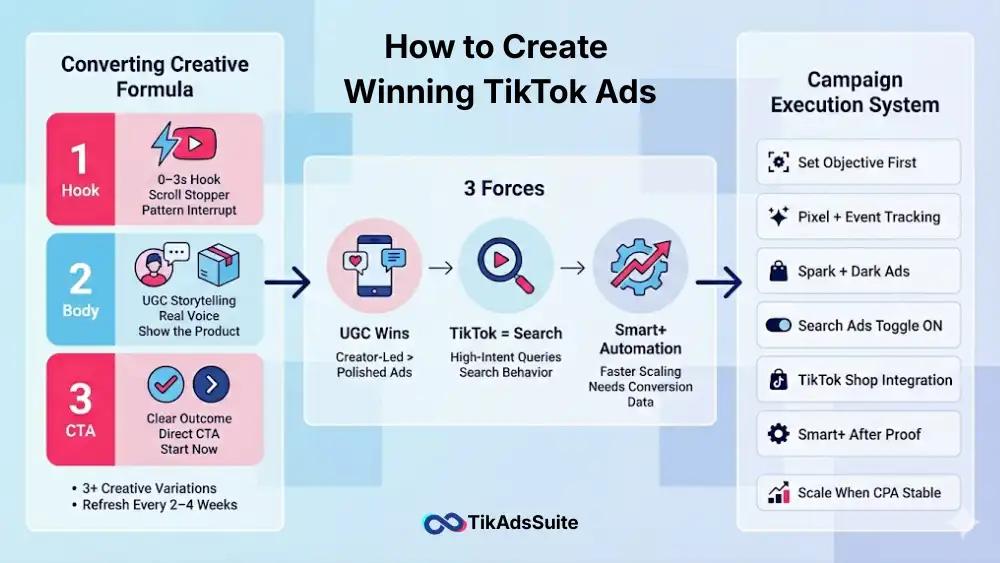
Three forces have changed TikTok advertising fundamentally.
First, UGC-style content now outperforms branded creative across almost every category.
Second, TikTok has become a real search engine, and a growing share of users actively search for products before buying.
Third, automation through Smart+ campaigns has given advertisers a faster path to scale, but it requires creative inputs that actually work before the algorithm can do its job.
In this guide, you will learn about structuring a converting creative from hook to CTA, setting up campaigns correctly from pixel to bidding strategy, using Spark Ads alongside dark ads to capture search traffic, integrating TikTok Shop, and scaling without burning your creatives out.
Table of Contents
Get Up to $6000 Free TikTok Ad Credit
Key Takeaways
- Winning ads open with a three-second hook that stops the scroll, use real voices and UGC storytelling, and close with a CTA that states an action and an outcome.
- Format selection matters: Spark Ads, In-Feed, and the Search Ads. Each serves different funnel stages and different buyer intentions.
- Creative fatigue is the most common reason TikTok ROAS drops. Build a refresh cadence into your workflow from day one.
- Smart+ campaigns can accelerate scaling, but feed them proven creatives and enough conversion data first, or you will waste budget.
- TikTok search behavior is growing fast. Ads aligned to search queries now capture buyers further down the funnel than standard In-Feed placements.
Quick Answer
To create TikTok ads that convert in 2026, open with an under-3-second scroll-stopping hook, build the body using UGC-style storytelling with real voices and product demos, and close with a direct CTA tied to a clear outcome. Select your objective before building anything, run at least three creative variations per ad group, and refresh creatives every two to four weeks. Layer in TikTok Shop for in-app purchasing, activate the Search Ads Toggle to capture high-intent queries, and use Smart+ campaigns to automate scaling once a creative proves itself, but only when you have enough conversion data for the algorithm to learn from.
What Makes a TikTok Ad Winning in 2026?
A winning TikTok ad is one that delivers measurable results against your objective, with metrics that hold steady over time. That means a hook rate above 30%, strong watch time, a CTR that reflects genuine intent, a CVR that justifies your spend, and a CPA and ROAS that fit your margin structure. Frequency stability matters too; when frequency climbs and CTR drops together, your creative is fatiguing.
Step-by-Step: How to Create a Winning TikTok Ad
Step 1: Set Up TikTok Ads Manager and Install the Pixel
Start at ads.tiktok.com and create your TikTok Ads Manager account. You will need a Business Center account to manage multiple ad accounts, pixels, and creator whitelisting in one place.
Set up billing, confirm your payment method, and verify your business details before launching anything.
The campaign structure follows three levels: Campaign, Ad Group, and Ads.
The campaign holds your objective. The ad group controls targeting, budget, placement, and bidding. The ad level holds your creatives.
For pixel setup, go to Assets, then Events, and create a new Web Event. Install the base pixel code on your site, then configure standard events like ViewContent, AddToCart, and Checkout.
If you are running high-volume conversion campaigns or Shop campaigns, prioritize server-side tracking via the Events API.
Server-side tracking reduces signal loss from iOS privacy restrictions and gives Smart+ campaigns cleaner data to optimize against.
For TikTok Shop attribution, connect your TikTok Shop directly inside Ads Manager under the Shop section.
For Search placement optimization, ensure your pixel fires accurately on landing pages tied to search-intent keywords, so the algorithm knows which users convert from search placements specifically.
Step 2: Choose Your Campaign Objective
Your objective tells TikTok’s algorithm who to show your ad to and what action to optimize for. Choosing the wrong objective is one of the fastest ways to waste budget.
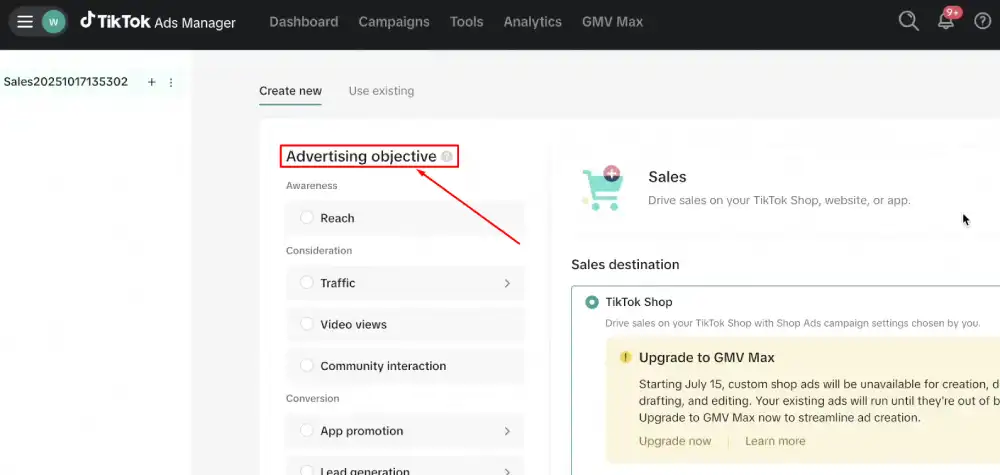
The available objectives are:
- Awareness: Maximize reach and impressions. Use for new product launches or brand building.
- Traffic: Drive clicks to a URL. Use when your landing page does the conversion work.
- Video Views: Optimize for watch time and ThruPlay. Use for content-first or retargeting warm audiences.
- Leads: Collect lead forms inside TikTok. Use for service businesses or high-ticket products.
- Conversions: Optimize for pixel events like Purchase or AddToCart. Use for direct-response eCommerce.
- App Promotion: Drive installs or in-app events. Use for mobile apps.
- Sales / Shop-focused objectives: Optimize directly for TikTok Shop purchases. Use with Video Shopping Ads and product catalogs.
- Smart+ Campaigns: An automated campaign type where TikTok handles placement, targeting, and bidding. Use when you have strong creative assets and sufficient conversion history.
Match your objective to your funnel stage:
- Awareness: In-Feed or TopView placements
- Consideration: Spark Ads with retargeting layered on
- Conversion: Conversion objective or Shop Ads
- High-intent capture: Search Ads Toggle combined with Shop Ads
Step 3: Choose the Right TikTok Ad Format
Each format serves a different purpose. Choosing the right one for your funnel stage and budget prevents wasted spend.
In-Feed Ads appear natively in the For You page. They are the most flexible format, support most objectives, and work at almost any budget. Best for direct response and awareness at scale.
Spark Ads boost existing organic TikTok posts, either your own or a creator’s (with their permission). Because Spark Ads carry the creator’s handle and organic engagement counts, they feel more credible and often deliver lower CPMs for the same creative.
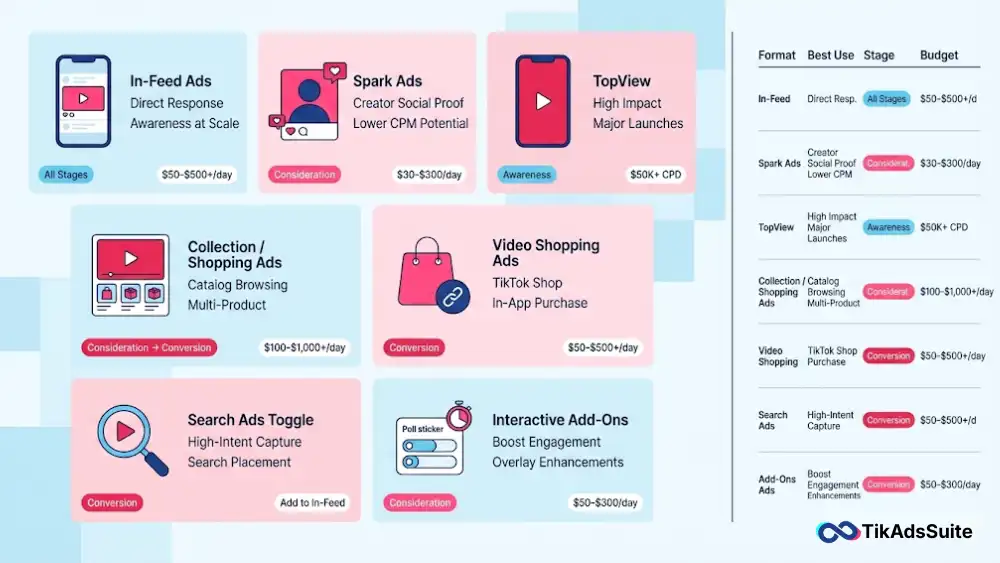
TopView Ads appear as the first video a user sees when they open TikTok. High impact, high cost, best for brand awareness and major product launches.
Collection Ads and Shopping Ads pair a video with a product card grid below. Users can tap to browse and buy. Best for eCommerce brands with a catalog.
Video Shopping Ads (TikTok Shop integration) are shoppable In-Feed videos connected directly to your TikTok Shop. Users tap an anchor link to buy without ever leaving TikTok. This format is seeing strong ROAS for direct-to-consumer brands.
Search Ads Toggle places your existing In-Feed ad creative in TikTok search results when users search keywords relevant to your product. No separate creative required; you activate it at the ad group level.
Interactive Add-Ons add stickers, poll overlays, countdown timers, or product anchors to In-Feed creatives to boost engagement signals.
| Format | Best Use Case | Funnel Stage | Suggested Budget Range |
| In-Feed Ads | Direct response, awareness | All stages | $50 to $500+/day |
| Spark Ads | Creator-led social proof, retargeting | Consideration | $30 to $300/day |
| TopView | Brand awareness, major launches | Awareness | $50,000+ (CPD buying) |
| Collection / Shopping Ads | Catalog browsing, multi-product | Consideration to Conversion | $100 to $1,000+/day |
| Search Ads Toggle | High-intent keyword capture | Conversion | Additive to In-Feed budget |
| Interactive-enhanced In-Feed | Engagement driving, retargeting | Consideration | $50 to $300/day |
Step 4: Build the Hook, Body, and CTA Structure
Every converting TikTok ad follows the same structural logic, whether it is a 15-second product demo or a 45-second creator story.
Hook (0 to 3 seconds): This is the only thing that determines whether someone watches the rest. Your hook must stop the scroll immediately.
Fill-in templates:
- Problem hook: “If you [pain point], stop scrolling for one second.”
- Proof hook: “I [achieved result] in [timeframe] and here is how.”
- Curiosity hook: “Nobody talks about [unexpected thing], and it is costing you [consequence].”
- Search-intent hook: “Looking for the best [product category]? You need to see this.”
- Pattern interrupt: Open mid-sentence, with movement, or with a bold on-screen text claim.
Body: This is where you earn the CTA. Keep it tight and focused.
Structure:
- Name the problem your product solves
- Show the solution in action (demo, before/after, reaction)
- Add social proof (review, stat, user result)
- Present the offer clearly
Fill-in body template: “Most [audience] deal with [problem]. [Product name] fixes that by [mechanism]. [Customer name or type] went from [before] to [after] in [timeframe]. Right now you can get [offer].”
CTA (final 2 to 3 seconds): Tell viewers exactly what to do and why right now.
Fill-in templates:
- Tap the link and grab yours before [scarcity signal]
- Shop now directly on TikTok. The link is right below
- Get yours today. Free shipping ends [date]
- Search-aligned CTA: “Search [brand or product name] on TikTok to see why [X] people switched”
For Smart+ creative variations, produce at least three hooks per concept. Smart+ will test and weight delivery toward the strongest hook without manual intervention.
For Shop ad demos, the body should focus on the product in use, ideally showing unboxing, application, or a before/after result in under 20 seconds.
Step 5: Set Your Budget and Choose the Right Bidding Strategy
TikTok Ads Manager supports daily budgets and lifetime budgets. Daily budgets give you a predictable spend per day and are easier to manage when testing.
Lifetime budgets are better for campaigns with a defined end date, like a product launch or sale event. TikTok recommends a minimum daily budget of $50 per ad group for Conversion campaigns to give the algorithm enough data to optimize.
Lowest Cost (automatic bidding) lets TikTok spend your full budget at the lowest available CPA. It is the faster path to delivery and learning, and it works well when you are in the early testing phase and do not yet know your target CPA.
Cost Cap sets a maximum CPA target, and TikTok optimizes delivery to stay at or below that threshold. It is better for scaling once you know your profitable CPA, but it can slow delivery and under-pace the budget if the cap is set too low.
| Strategy | Best For | Pros | Cons | Recommended Use |
| Lowest Cost | Testing, learning phase | Fast delivery, max data | Less cost control | Early creative testing |
| Cost Cap | Scaling proven winners | CPA control, margin protection | Can under-pace, slower learning | Post-learning phase, scaling |
Smart+ campaigns use Lowest Cost automatically, but TikTok applies additional automation to placements and targeting. Do not manually override bidding inside Smart+ campaigns.
Shop-focused campaigns benefit from Lowest Cost during catalog learning, then Cost Cap once your top-selling SKUs are identified.
Search placements do not require separate bidding. When you activate the Search Ads Toggle, your In-Feed ad group extends into search results using the same bid strategy you set.
What Makes a TikTok Ad Creative Actually Work?
The 3-Second Hook
The hook is the only part of your ad that every viewer sees. Everything after the first three seconds is earned. Your hook needs to do one thing: create enough curiosity, recognition, or surprise that the viewer does not swipe.
Visual pattern interrupts that work: a product being used in an unexpected way, text that calls out a specific pain point, rapid cuts between product states, or someone reacting with visible emotion to a result.
Verbal hooks that work: a bold claim that invites skepticism, a question that speaks directly to a known frustration, or an opening that sounds like a conversation already in progress.
For search-enabled ads, align your verbal and on-screen hook language to the search keywords you are targeting.
If someone searches “best protein powder for women over 40” and your hook says “Finally a protein powder designed for women over 40”, the relevance signal is strong, and watch time improves.
UGC Style and Real Voices
Creator-led content outperforms polished brand ads on TikTok for one reason: users trust people over logos.
A 30-second video of a real person talking about your product at home generates more authentic engagement signals than a studio-produced ad with music and motion graphics.
For Shop-enabled ads, UGC in the form of product demos is particularly effective. Show the product being used, the result it delivers, and the buying process simplified to one tap.
Creator-led commerce storytelling works because the creator is demonstrating value while the product anchor handles the purchase.
When you brief creators, give them the problem, the hook angle, and the outcome to communicate. Do not script every word. Real hesitation, genuine reactions, and natural pacing are what make UGC work.
Native Text Overlays and Trending Audio
Text overlays should reinforce what is being said on screen, not repeat it word for word. Use them to highlight your key benefit, your offer, or your CTA.
Keep fonts large enough to read on mobile without zooming, and time your text overlays to appear with the relevant spoken point.
For search-aligned ads, use on-screen text that mirrors search keyword phrasing. If your search keyword is “affordable skincare routine”, put that phrase or a close variation on screen in the first five seconds.
Trending audio boosts organic reach potential when you run Spark Ads, because TikTok’s algorithm indexes audio. Use trending sounds where they fit the creative, but never force a trend that conflicts with your message.
The CTA That Converts
A strong CTA has three components: an action, an outcome, and a sense of immediacy.
Weak CTA: “Click the link.” Strong CTA: “Tap the link below and get yours delivered by [day].”
Examples that work for different formats:
- TikTok Shop: “Tap to shop. Buy directly on TikTok right now.”
- Direct to website: “Click the link in bio. Free shipping today only.”
- Lead capture: “Fill out the form below. Takes 30 seconds.”
- Search-aligned: “Search [brand name] on TikTok. See what [X] customers are saying.”
Match CTA urgency to your offer. If there is genuine scarcity or a time-limited price, state it. If there is not, do not invent it. False urgency damages brand trust and drives up CPMs through negative ad feedback.
Interactive Add-Ons and Engagement Boosters
Interactive Add-Ons are overlays and features you can add to In-Feed ads inside Ads Manager. Options include poll stickers, countdown timers, product anchor tags, and swipe cards.
Countdown timers reinforce genuine sale deadlines and improve urgency CTR. Product anchors link directly to a TikTok Shop product page and appear as a persistent button during the video.
Poll stickers increase engagement signals, which tell TikTok’s algorithm the ad is worth distributing more broadly.
These features increase the engagement rate on your ad, which matters because TikTok’s delivery algorithm factors in engagement quality, not just bid price.
Higher engagement can reduce your CPM and extend creative longevity before fatigue sets in.
Winning TikTok Ad Strategy and Optimization
A creative-first strategy means you do not set targeting and hope the creative follows. You build the creative first, then let TikTok’s algorithm find your audience through engagement signals.
This is why broad targeting plus strong creative outperforms narrow interest stacks plus weak creative in most TikTok Ads categories.
Build an always-on testing framework from day one. That means new creatives entering the ad account every two to four weeks, a clear process for identifying winners and cutting losers, and a budget allocation that protects your scaling creatives while still funding new tests.
Smart+ Campaigns
Smart+ campaigns automate placement, targeting, and creative rotation inside a single campaign type. TikTok handles the optimization decisions you would normally make manually at the ad group level.
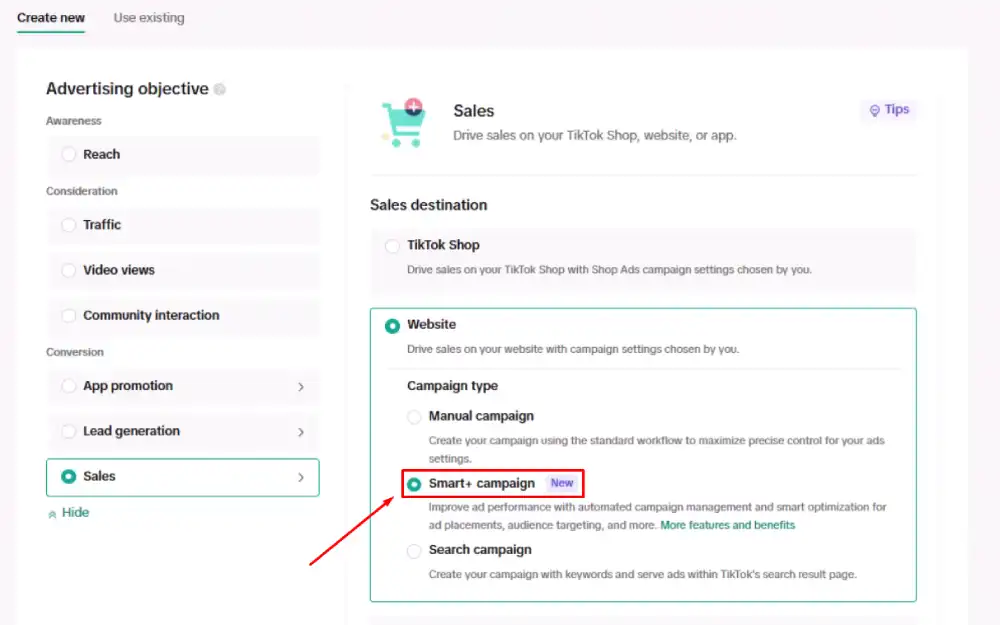
When to use Smart+: After you have identified at least two to three winning creatives through manual campaigns, have a pixel with at least 50 purchase events per week, and want to scale without managing multiple ad groups. Smart+ works well for TikTok Shop campaigns specifically, because TikTok can pull directly from your product catalog and test creative combinations.
Trade-offs: You give up control over placement exclusions, audience stacking, and granular budget allocation per format. If your product has a specific audience that manual targeting has identified, Smart+ may initially waste budget finding it again.
When manual is still better: During the creative testing phase, when you need clean data on which hook or angle is driving results. Manual campaigns isolate variables. Smart+ conflates them.
Collaborate with Creators
Whitelisting a creator allows you to run their organic TikTok content as a Spark Ad under their handle. This means their existing comments, shares, and watch time carry over to the paid post. It also means you are reaching users with content that does not look like an ad.
Build a recurring UGC system:
- Source three to five creators per month in your niche
- Brief each with one specific hook angle, one product demo focus, and one CTA
- Collect raw files and creator-access Spark codes
- Test each creator’s content as both organic Spark and dark In-Feed to compare performance
- For TikTok Shop, prioritize creators who demonstrate the purchase flow on screen
Refresh Creatives
Creative fatigue is visible in your metrics before users consciously notice it. When your CTR drops more than 20% from baseline, your CPA rises more than 15%, or your frequency exceeds 3.5 per user per week, your creative needs refreshing.
A good refresh cadence for most TikTok advertisers is every two to four weeks per creative. High-spend campaigns burning $500 or more per day may need refreshes every 10 to 14 days.
Run a minimum of three creative variations per ad group. This gives the algorithm options and slows fatigue across the group.
Test and Iterate
Test one variable at a time. If you change the hook, the CTA, and the product shown all at once, you will not know which change drove the improvement.
Testing sequence:
- Hook (test three to five variations of the opening three seconds)
- Angle (problem-first vs. proof-first vs. demo-first)
- Offer (free shipping vs. percentage off vs. bundle)
- CTA (urgency framing vs. benefit framing)
Once you identify a winning combination, expand it into multiple formats: Spark Ad version, dark In-Feed version, and Search Ads Toggle version.
Budget and Targeting
CBO (Campaign Budget Optimization) lets TikTok distribute budget across ad groups based on performance signals. Use CBO when you have multiple ad groups you want to compete and want TikTok to weight toward the best performer automatically.
ABO (Ad Group Budget Optimization) gives you manual control over spend per ad group. Use ABO during testing to ensure every variation gets equal exposure before you declare a winner.
Broad targeting outperforms narrow interest stacks for most direct-to-consumer products on TikTok. Let the creative do the targeting work. Add interest or demographic restrictions only when your product genuinely excludes a segment, such as age restrictions for certain product categories.
For Shop campaigns, use Lookalike Audiences built from your purchaser list as a starting point, then expand broadly once you have a proven creative.
For Search placements, the targeting is keyword-driven, not audience-driven. Your keyword list quality matters more than your interest targeting.
Use Native Tools
TikTok Creative Center (ads.tiktok.com/creative-center) shows you trending ads, top-performing sounds, and creative insights by category. Use it before briefing creators or writing scripts.
A/B testing tools inside Ads Manager let you run controlled split tests on creatives, audiences, or placements. Use them when you want statistically clean results on a single variable.
Smart optimization features like Automated Creative Optimization (ACO) automatically combine your uploaded video, copy, and CTA variations into combinations and optimize delivery toward the best performer.
Search performance insights within Ads Manager show you which search terms triggered your ads and which drove the most clicks and conversions. Use this data to refine your keyword list and inform hook language for your next creative batch.
Spark Ads vs. Non-Spark (Dark) Ads: Which One Performs Better?
Spark Ads boost existing TikTok posts, either from your brand account or a creator’s, under the original creator’s handle. They carry organic engagement counts and comments. They feel native because they are native.
Non-Spark (Dark) Ads are ads created inside Ads Manager and served without an organic post behind them. They appear in the For You feed like any other TikTok but do not accumulate engagement counts visible to users. They give you full creative control and do not require creator permission for each activation.
| Type | Best For | Funnel Stage | Key Advantages | Key Drawbacks |
| Spark Ads | Creator UGC, social proof, retargeting | Consideration of Conversion | Carries organic engagement, feels native, lower CPM potential | Requires creator access, dependent on the original post staying live |
| Non-Spark (Dark) | Testing hooks, controlled messaging, search targeting | All stages | Full creative control, no creator dependency, faster to launch | No social proof displayed, feels more like an ad |
Spark works best for Shop-enabled content when the creator has already published a demo or review with organic engagement. Running that post as a Spark Ad adds distribution without losing the credibility of the original organic performance.
Dark ads work better for controlled search targeting when you need precise hook language aligned to specific search queries without waiting on creator approval workflows.
The strongest TikTok advertising strategies blend both.
Run Spark Ads for warm audience retargeting and social proof in the consideration stage.
Run dark ads for broad testing and search-aligned placements. Let your data show you which creative type generates better CPA for your specific product.
For a detailed comparison, read our in-depth Spark Ads vs. Non-Spark Ads comparison.
How to Scale and Refresh Creatives Without Burning Out
Collaborate with Creators
Build a system for ongoing UGC production rather than treating creator content as a one-off task. A monthly batch model works well: identify three to six creators, brief them on two to three angles per month, collect content with Spark codes, and rotate into your ad account on a rolling schedule.
For search-aligned hooks, brief creators to open with phrasing that mirrors how users search. “What is the best [product type] for [use case]?” spoken to camera as an opening line aligns the creative with search intent naturally.
For product demo batches, give each creator a different angle: unboxing, in-use demonstration, before/after, and comparison against a competitor. This gives you four distinct angles from one creator relationship.
Use TikTok Symphony AI to Multiply Output
TikTok Symphony is TikTok’s AI-assisted creative tool, available inside Creative Center. It can help you repurpose winning scripts into new variations, generate caption and hook alternatives from a source video, and create product-focused video scripts aligned to your catalog.
For Shop creatives, Symphony can generate multiple product description scripts from your catalog data, reducing the briefing workload when scaling across many SKUs.
For search-intent variations, input your top-performing search keywords and ask Symphony to generate hook variations that open with those terms naturally. Then film or brief creators on those specific variations.
Symphony does not replace creator-led content. Use it to multiply output volume from already-proven concepts, not to generate first-draft scripts you have not tested.
Test, Iterate, and Double Down on Winners
The scaling loop is straightforward: launch multiple creatives, evaluate performance at the 48 to 72 hour mark for hook rate and CTR, cut what is below baseline, and increase budget on what is working.
Budget increases should be gradual. A 20% daily increase allows TikTok’s algorithm to adjust without triggering a new learning phase. Doubling budgets overnight often destabilizes CPA.
Once a creative wins in manual In-Feed, expand it: activate the Search Ads Toggle on that ad group, duplicate into a Spark Ad if a creator version exists, and feed the proven concept into a Smart+ campaign. This three-format expansion protects your ROAS while increasing reach.
How to Capture High-Intent Traffic with TikTok Search Ads
Search Ads Toggle is a setting at the ad group level in TikTok Ads Manager that extends your existing In-Feed ad creative into TikTok search results.
When a user searches a query that matches your keywords or your creative’s topical relevance, your ad appears in the search results feed. You do not need to create a separate campaign or creative to activate it.
TikTok search behavior matters in 2026 because the platform has shifted. According to euronews, 40% of Gen Z users in the US prefer TikTok over Google for certain types of search, particularly product discovery, how-to content, and local recommendations.
That trend has continued to grow; users searching on TikTok are in an active decision-making state, which makes them higher intent than passive For You feed scrollers.
To structure keyword-aligned hooks for search, match your opening three seconds to the search query language your audience uses. If users search “best moisturiser for oily skin”, your hook should address that exact problem in the opening sentence. On-screen text reinforcing the keyword phrase further strengthens relevance signals.
Search placements outperform awareness campaigns when your product solves a specific, searchable problem. If users are actively looking for a solution you sell, search placement captures them at the moment of intent rather than interrupting them during passive browsing.
How to Track TikTok Ad Performance and Spot Ad Fatigue Early
Tracking TikTok ads well means watching the right metrics at the right frequency. Pulling daily spend reports without looking at creative-level performance data is not optimization; it is bookkeeping.
Key metrics to track:
- Hook rate / 3-second views: The percentage of impressions that result in at least three seconds of watch time. Below 25% signals a weak hook.
- Watch time: Average watch duration and percentage of video watched. Below 25% average suggests the body content is not holding attention after the hook.
- CTR: Click-through rate from the video to your destination. Below 1% on conversion campaigns is a warning sign.
- CVR: Conversion rate on the destination (landing page or TikTok Shop product page). A strong CTR with weak CVR points to a landing page problem, not a creative problem.
- CPA: Cost per acquisition. Compare against your target CPA based on product margin.
- ROAS: Return on ad spend. For TikTok Shop campaigns, track both reported ROAS and blended ROAS, including organic sales influenced by ad exposure.
- Frequency: Average number of times your ad has been shown to a unique user. Above 3.5 per week is a fatigue warning.
For search CTR comparison, pull your search placement data separately and compare the CTR and CVR against your For You page placements. Search typically generates higher CVR and lower reach. If search placements are significantly outperforming For You on CPA, shift more budget there.
Signs of creative fatigue:
- CPA rising more than 15% over three consecutive days
- CPM is increasing while CTR falls
- Negative or disengaged comments appear more frequently
- Frequency exceeding 3.5 per user per week
- Drop in 3-second view rate on a creative that previously performed well
Recommended reporting cadence:
Daily: check spend pacing, CPA, and any dramatic CPM spikes. This is a 10-minute check, not a full analysis.
Weekly: review creative-level performance, hook rates, watch time, and frequency. Decide which creatives to cut, which to scale, and what new concepts to brief for the following week.
FAQ: TikTok Ads Questions Answered
Are TikTok ads worth it?
Yes, TikTok ads are worth it for brands selling products with strong visual appeal and a clearly defined audience that skews under 45. We have seen brands in beauty, apparel, food, fitness, and home goods consistently achieve ROAS above 2.5x.
Results vary significantly by creative quality, product-market fit, and your ability to refresh content consistently. Polished brand ads without UGC elements typically underperform.
How much do TikTok ads cost?
TikTok’s minimum campaign budget is $50, and the minimum ad group budget is $20 per day. In practice, you need at least $50 per day per ad group on Conversion campaigns to exit the learning phase.
CPM on TikTok typically ranges from $3 to $15, depending on audience, objective, and competition level, though costs rise during peak eCommerce periods like Q4. Your actual CPA depends on creative quality and conversion rate.
How do I start TikTok ads?
Create an account at ads.tiktok.com, set up your Business Center, install the TikTok pixel on your website or connect your TikTok Shop, and structure your first campaign using the Conversions or Sales objective.
Upload at least three creative variations per ad group, set a daily budget of $50 or more, and let the campaign run for at least 48 to 72 hours before evaluating performance. Do not make major changes during the learning phase.
Are Search Ads better than In-Feed ads?
Search Ads and In-Feed ads serve different purposes, so direct comparison is not straightforward. Search Ads capture users who are actively looking for a product or solution, which means they are further down the funnel and convert at a higher rate.
In-Feed ads reach a broader, passive audience and are better for building awareness and driving volume. For most accounts, the best strategy uses both: In-Feed for reach and creative testing, Search Ads Toggle to capture high-intent traffic from the same creative.
Should I use Smart+ campaigns or manual setup?
Smart+ campaigns work best after you have proven creatives and a pixel with strong conversion data, ideally 50 or more purchase events per week. Start with manual campaigns to identify which hooks, angles, and offers actually convert.
Once you have two to three winning creatives and a clear CPA target, feed those into a Smart+ campaign to scale. If you jump to Smart+ without proven creative inputs, the algorithm has nothing strong to work with, and you risk wasted spend during a long learning phase.
Conclusion
Creating TikTok ads that convert in 2026 is a system, not a one-time setup. Strong hooks, UGC-style creative, the right format for each funnel stage, and a consistent refresh cadence are what separate accounts that scale from accounts that stall.
Layer in TikTok Shop for in-app purchasing, activate the Search Ads Toggle to capture high-intent buyers, and move proven creatives into Smart+ campaigns when you are ready to scale.
Then keep testing; the gap between ads that drain budget and ads that grow revenue is almost always a creative gap, and now you know exactly how to close it.