
Most TikTok ads fail before they say a single word.
You know this feeling: you spent hours writing a script, launched the campaign with real budget behind it, and watched the numbers go nowhere. Low click-through rate. High cost per result. Zero meaningful conversions.
The problem is rarely your product. It is almost always your copy structure.
TikTok is not Facebook, it’s not Google. The copy rules you learned on every other platform will actively hurt you here. The platform rewards native-feeling, fast-moving, trust-building scripts, and it punishes anything that feels like a traditional ad.
Get Up to $6000 Free TikTok Ad Credit
This guide gives you the exact TikTok ad copywriting formulas that top brands use to stop the scroll, hold attention, and drive real purchases. You will get complete script frameworks, real examples, and a formula-matching table so you know exactly which structure to use for every campaign goal.
Table of Contents
Key Takeaways
- Your hook must earn attention in the first 3 seconds, or the rest of your script does not matter.
- TikTok copy works across three separate layers: audio script, text overlay, and caption. Optimizing only one layer leaves results on the table.
- Match your formula to your campaign objective. AIDA works for cold traffic. PAS works for retargeting. The Skeptic Script works when trust is low.
- Default CTA buttons like “Shop Now” underperform when your copy does not prime the click first.
- Caption copy is a targeting signal on TikTok, not just a description. Treat it like a search keyword field.
- A/B testing hooks first, before testing anything else, gives you the fastest signal on what is working.
What Are TikTok Ad Copywriting Formulas?
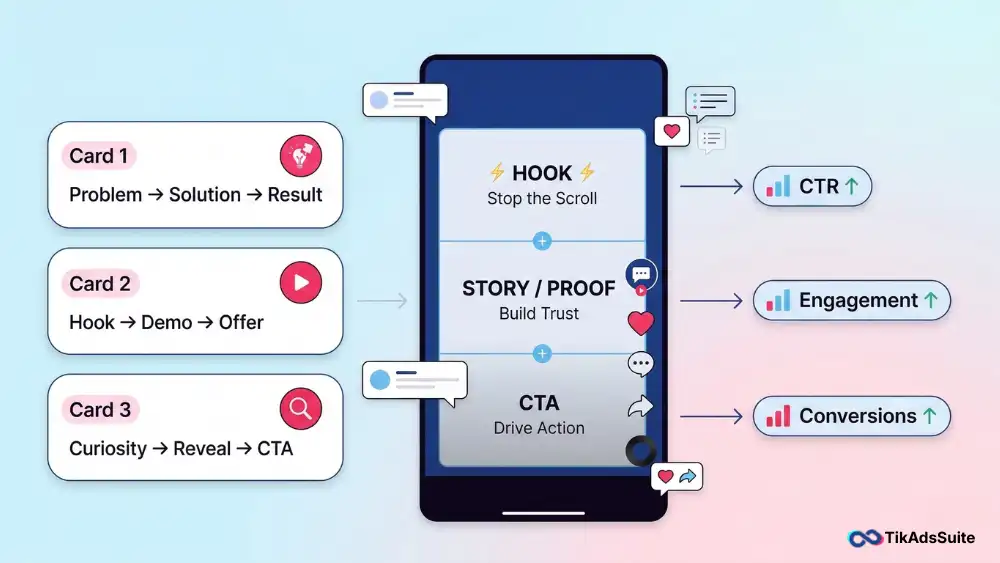
TikTok ad copywriting formulas are structured persuasion frameworks, such as AIDA, PAS, and the Skeptic Script, that give your ad script a proven psychological sequence from attention capture to conversion. The most commonly used formulas are: 1) The Hook Formula, 2) AIDA (Attention, Interest, Desire, Action), 3) PAS (Problem, Agitate, Solution), 4) The Skeptic Script, 5) HVO (Hook, Value, Offer), and 6) The 3-Layer Copy System. Results vary based on your product type, audience awareness level, and campaign objective.
Why TikTok Ad Copy Is Different From Every Other Platform
TikTok is not a social platform where ads interrupt content. It is a native content platform where your ad must blend with the content. That distinction changes everything about how you write.
On Facebook, you can use a headline, a body paragraph, and a link. The user is sitting still enough to read. On TikTok, the user is mid-scroll, sound on, full screen, making a “stay or go” decision in only 3 seconds. According to a research playbook by Precis and TikTok, analyzing 10 Nordic eCommerce brands, strong hooks in the first three seconds are critical to stopping the scroll. The same study found that videos with direct speech, either voiceover or face-to-camera, generated +1 point higher ROI on average compared to text-only creative.
That is a structural difference, not a stylistic one. Your copy framework has to account for it.
There is also the sound factor. TikTok is a sound-on platform by default. Your audio script and your text overlay serve different audiences simultaneously.
Some users are fully watching and listening. Others are watching silently in a public space. If your copy only lives in the voiceover, you are writing for half your audience.
The 3-Layer Copy System
This is the most important concept most TikTok advertisers skip entirely. Your TikTok ad copy does not live in one place. It lives in three layers, and each one must be written with intention.
Layer 1: The Audio Script. This is what the viewer hears. It carries your hook, your persuasion arc, and your CTA. It does most of the conversion work.
Layer 2: The Text Overlay. This is the on-screen text that reinforces or extends what the audio says. It serves sound-off viewers, and it also reinforces your key claims for sound-on viewers who are processing both inputs.
Layer 3: The Caption. Most advertisers treat this as an afterthought. We will cover in a dedicated section why that is a serious mistake.
Write all three layers as a system. When they work together, each one reinforces the others. When they conflict or one is missing, your conversion rate drops.
The Hook Formula: How to Stop the Scroll in Only 3 Seconds
How do you hook someone in a TikTok ad? You make the first 3 seconds more valuable than the next video. The hook is not an introduction; it’s a commitment device. Its only job is to make the viewer decide to stay.
According to SQ Magazine’s attention span analysis, content creators using a hook-in-first-3-seconds strategy report a 58% increase in average video watch time. That is not a marginal gain. That is the difference between an ad that the algorithm distributes and an ad that disappears.
Here are three hook structures that consistently produce results.
The Positive Hook Framework
A positive hook opens with a direct benefit or a surprising outcome. It works because it answers the viewer’s first subconscious question: “What is in this for me?”
The structure is: Result + Timeframe + Qualifier.
Example audio script opening:
“I cleared my back acne in 11 days using one thing from my kitchen.”
Example text overlay: “This cleared my skin in 11 days.”
The specificity matters. “11 days” outperforms “quickly” every time. Vague benefits are invisible. Specific outcomes are scroll-stopping.
Use this hook for: products with a clear, fast, visible result. Works well for beauty, fitness, food, and consumer goods.
The Negative Hook and Reverse Psychology Formula
A negative hook opens with what the viewer is doing wrong, or what they should stop. It works because it creates a threat to the viewer’s current behavior. We are wired to pay more attention to warnings than to promises.
The structure is: Stop + Behavior + Consequence.
Example audio script opening:
“Stop using retinol every night. Here is what it is actually doing to your skin.”
Example text overlay: “You’re using retinol wrong.”
This hook type consistently earns higher early watch time because it creates immediate curiosity combined with mild urgency. The viewer wants to know if they are making a mistake.
Use this hook for: products in categories where the audience has tried other solutions before. Works well in skincare, supplements, finance, and SaaS.
The Question Hook Formula
A question hook opens with a direct question that the viewer can only answer by watching. It works because an unanswered question creates a small cognitive tension that the brain wants to resolve.
The structure is: Question + Implied Stakes.
Example audio script opening:
“Are you still paying full price for your skincare? Because there is a reason you always run out.”
Example text overlay: “Still paying full price?”
The key rule: the question must have a real payoff. If you open with a question and the answer is obvious or irrelevant, you lose the viewer. The question needs to make them feel like the answer matters to them specifically.
Use this hook for: Audiences who are already aware of the problem category. Works well for competitive pricing, subscription offers, and comparison campaigns.
The AIDA Formula for TikTok Ads
What is the AIDA formula for TikTok? AIDA stands for Attention, Interest, Desire, and Action. It is one of the oldest and most tested persuasion structures in advertising, originally documented in 1898 by advertising pioneer Elias St. Elmo Lewis. Adapted for TikTok, it maps each element to a specific section of a short-form video script.
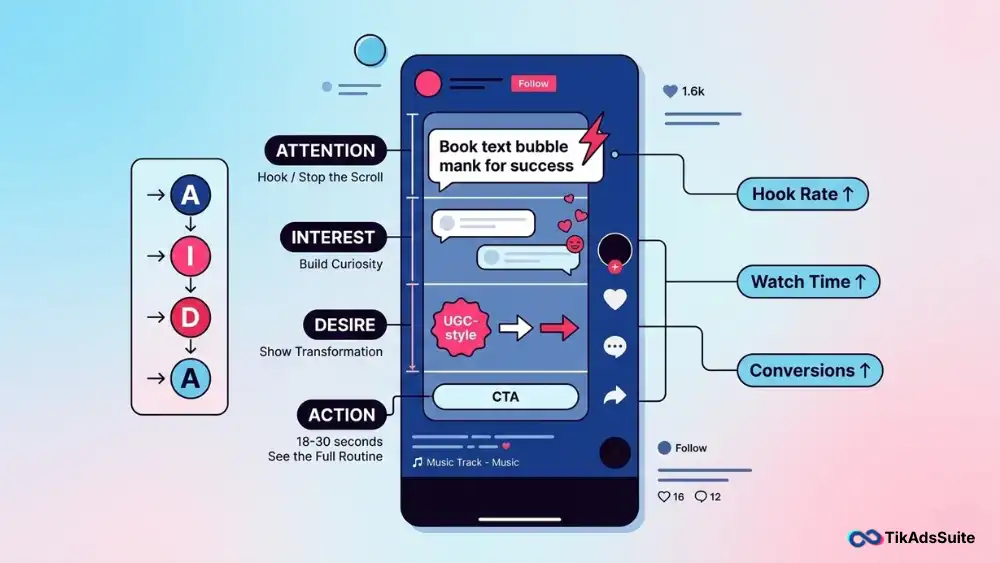
Here is how each stage maps to a TikTok ad:
- Attention (0-3 seconds): Your hook. Use one of the three hook frameworks above. This is not optional. Without the hook, Interest never starts.
- Interest (3-8 seconds): Expand on the hook with a specific claim, fact, or relatable scenario. The viewer decided to stay. Now give them a reason to care.
- Desire (8-18 seconds): Show the transformation or outcome. User-generated content (UGC) style footage, before/after framing, or social proof belong here. According to Precis and TikTok’s research playbook, UGC-style ads deliver +55% ROI compared to polished branded creative.
- Action (18-30 seconds): Your CTA. Make it low-barrier and specific. “See the full routine” outperforms “Shop Now” for cold audiences because it reduces perceived commitment.
When to use AIDA: Cold traffic campaigns, awareness objectives, and new product launches. AIDA works best when the audience does not yet know your brand or product. It builds from zero.
When it falls short: If your audience already knows the problem and is actively looking for a solution, AIDA is too slow in its opening. Use PAS instead.
The PAS Formula for TikTok Ads
What is the PAS copywriting formula? PAS stands for Problem, Agitate, Solution. It is a three-step structure that leads with pain rather than attention. It assumes the viewer already feels a problem. Your job is to name it, deepen it, and then resolve it.
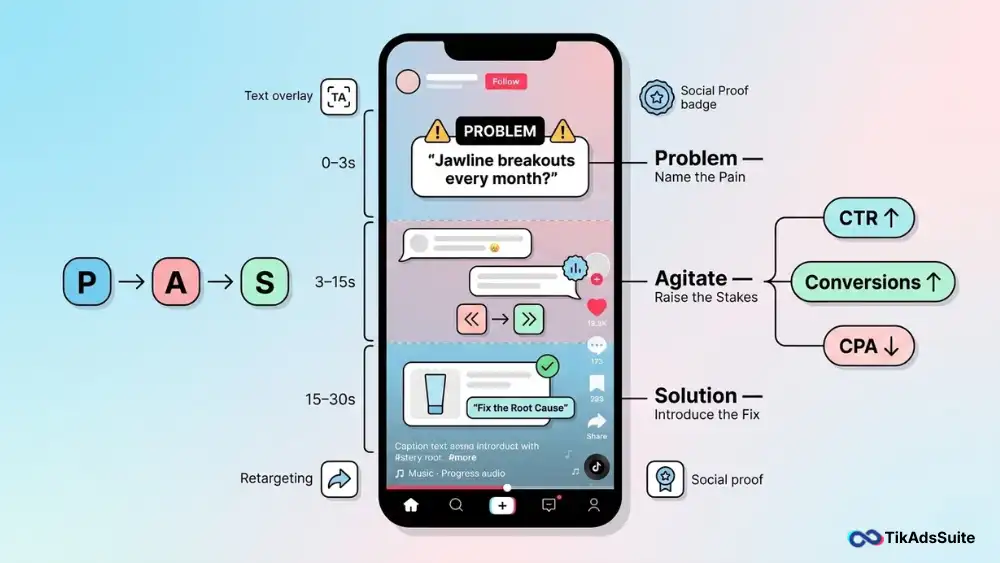
Here is how PAS maps to a TikTok ad script:
- Problem (0-3 seconds): State the problem directly in the first line. “Your skin is breaking out along your jawline every month, and you cannot figure out why.”
- Agitate (3-15 seconds): Expand the emotional weight of the problem. Show what staying in the problem costs the viewer. This is where you can use social proof, specific data, or emotional contrast to raise the stakes.
- Solution (15-30 seconds): Introduce your product as the specific, targeted fix. Connect it directly back to the exact problem you named in step one.
Text overlay tip: Mirror the audio script in the overlay, but compress it. If your audio says, “Your skin breaks out along the jawline every month”, your overlay can say: “Jawline breakouts every month?” This serves the sound-off viewer with the same emotional hook.
When to use PAS: High-pain-point products, direct response campaigns, and retargeting audiences. PAS works especially well when you are re-engaging people who have already visited your site but did not convert. They know the problem. You do not need to build awareness. You need to agitate and close.
When it falls short: For cold audiences with no prior awareness of the problem category, PAS can feel too aggressive, too fast. Pair it with a softer hook if you are unsure about the awareness level.
The Skeptic Script: The Highest-Converting Formula in 2026
What is the best copywriting formula for TikTok ads right now? For low-trust audiences who have already been burned by similar products, the Skeptic Script consistently outperforms both AIDA and PAS.
The reason is simple. When a viewer has tried three solutions that did not work, AIDA feels like another promise they do not believe. PAS agitates a problem they are already tired of hearing about. The Skeptic Script meets them where they actually are: doubtful.
The arc is: Skepticism, Reluctant Trial, Undeniable Proof.
Here is a full script template:
| Audio Script | Text Overlay |
| “I did not believe this would work either. I had tried four serums in six months, spent over $200, and my skin looked exactly the same. My friend kept sending me this one brand. I finally just bought it to prove her wrong. Two weeks later, I had to text her and admit she was right. I am not saying it works for everyone. I am saying it is the first thing that actually worked for me after everything else failed.” | Line 1: “I didn’t think it would work.”Line 2: “I was wrong.”Line 3: “Here’s what happened.” |
Why this formula works: It removes the need for the viewer to trust you. Instead, you borrow social trust from a character who is just like the viewer. The skeptic character acts as a proxy for the viewer’s own doubt. Their reluctant conversion becomes the proof point.
When to use the Skeptic Script: Any product in a saturated category where the audience has seen many competing claims. Beauty, supplements, productivity tools, and home goods all perform well with this structure. It is also highly effective for retargeting campaigns where users have already seen ads from you or your competitors.
The HVO Formula: Hook, Value, Offer
The HVO formula (Hook, Value, Offer) is purpose-built for TikTok’s short attention window. Where AIDA builds a full persuasion arc, and PAS goes deep on pain, HVO moves fast. It works by front-loading value immediately after the hook, then closing with a single focused offer.
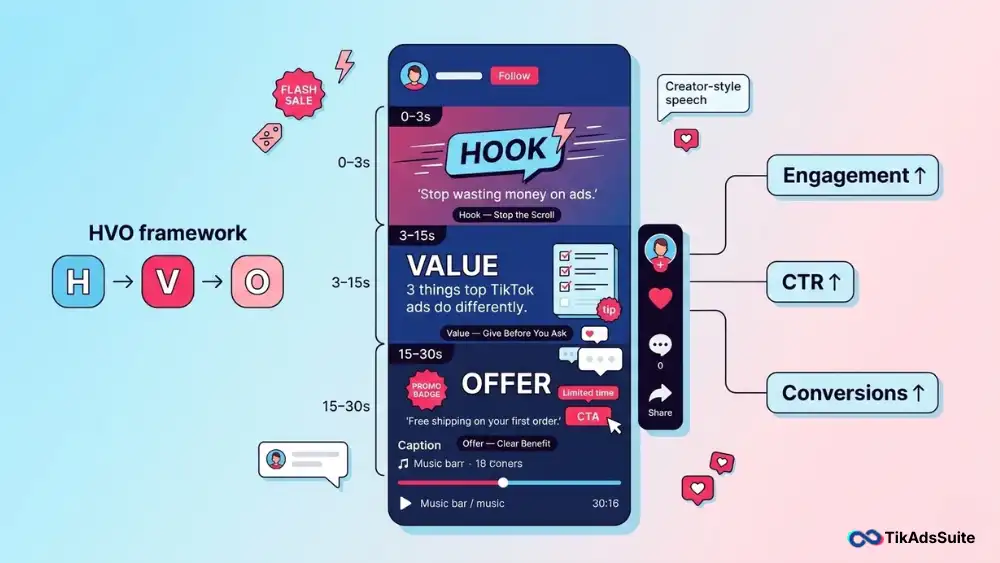
Here is the structure:
- Hook (0-3 seconds): Stop the scroll. Use any of the three hook frameworks.
- Value (3-15 seconds): Deliver something useful, surprising, or genuinely entertaining before asking for anything. This is the critical difference from other formulas. You give before you ask.
- Offer (15-30 seconds): Name one specific, time-bound, or benefit-specific offer. “Right now, first order ships free” is stronger than “visit our website to learn more.”
When to use HVO: Flash sales, limited-time offers, and impulse-purchase products. HVO also works well for top-of-funnel creator-style ads where you want the content to feel organic rather than promotional. The value layer earns the ask that follows it.
When it falls short: HVO is not ideal for high-consideration purchases where the viewer needs more persuasion before an offer feels credible. Use AIDA or the Skeptic Script in those cases.
Which Formula Should You Use? Match Formula to Campaign Goal
What is the best formula for TikTok ads? The answer depends entirely on three variables: your campaign objective, your audience’s awareness level, and your product type. Here is a direct comparison to make that decision faster.
| Formula | Best For | Campaign Objective | Audience Awareness |
| Hook Formula | All ad types | All objectives | All levels |
| AIDA | New products, brand awareness | Reach, Traffic, Awareness | Cold (unaware) |
| PAS | Pain-driven products, retargeting | Conversions, Retargeting | Problem-aware |
| Skeptic Script | Saturated markets, low-trust | Conversions, Retargeting | Solution-aware, skeptical |
| HVO | Flash sales, impulse buys | Sales, Traffic | Warm or cold |
| 3-Layer System | All paid TikTok ads | All objectives | All levels |
One important rule: The Hook Formula is not optional for any of these structures. Every formula above starts with a hook. The table above assumes you have already chosen your hook type and are now selecting the persuasion arc that follows it.
If your audience is seeing your ads for the first time, start with AIDA or HVO. If they have visited your site or seen previous ads, PAS and the Skeptic Script will outperform. If your product category is crowded and trust is low, regardless of funnel stage, the Skeptic Script is your strongest option.
TikTok Caption SEO: The Copy Layer Most Advertisers Ignore
We said earlier that your caption is a targeting signal, not just a description. Here is exactly why that matters.
TikTok has become a search platform. According to Adobe Express’s survey of over 800 US consumers, nearly half (49%) now use TikTok as a search engine, up from 41% in 2024. Your caption contains keywords that TikTok’s algorithm reads when deciding which audiences to serve your ad to, especially under Broad Match targeting.
When you write a caption that contains the exact phrases your target audience searches, you are doing two things at once. You are helping TikTok’s system match your ad to the right people. And you are writing a second hook for viewers who read captions before deciding to watch.
The 3-Line Caption Formula
Line 1 (Hook Line): Restate your video’s core promise in one sentence. This mirrors your visual hook but gives caption-readers a reason to press play.
Example: “This cleared my skin in 11 days using one ingredient.”
Line 2 (Keyword Line): Write naturally using the exact search terms your audience uses. Think about what they would type into TikTok search if they were looking for your product.
Example: “The best vitamin C serum for sensitive skin that actually works.”
Line 3 (Hashtag Line): Use 3 to 5 specific hashtags. Mix one broad category hashtag with two to three niche, high-intent hashtags. Avoid overly generic tags like #fyp, which carry little targeting signal.
Example: #vitamincserum #sensitiveskincare #clearskinroutine
Keep your total caption under 150 characters for the first two lines, so the key message is visible without the viewer needing to tap “more”.
TikTok Ad CTA Copy That Actually Converts
How do you write a CTA for TikTok ads? The short answer: you prime the click with your copy before the button ever appears. A default “Shop Now” button converts poorly when the viewer has not already been told exactly what to expect after they tap.
Most advertisers make the same mistake: they let the platform button carry all the conversion weight. The button alone cannot do that job. Your audio script and text overlay need to verbally and visually direct the viewer toward the action before they see it.
Why default CTAs underperform: The “Shop Now” button creates a friction spike. The viewer enjoyed the content, felt some interest, and then suddenly they are being asked to make a purchase decision with no warm-up. The copy priming reduces that spike.
Here are three low-barrier CTA formulas that work:
Curiosity CTA:
“Tap below and I’ll show you exactly what I used.”
This keeps the ask small. The viewer is not committing to a purchase. They are committed to seeing more information.
Urgency CTA:
“We only have 200 units left at this price. First order ships free.”
This works for HVO-style ads and flash sales. The time or quantity limit must be real. Fake urgency damages brand trust and repeat conversion rates.
Social Proof CTA:
“Over 40,000 people have switched. See why below.“
This works for the Skeptic Script arc and PAS. The social proof removes the viewer’s final objection before they tap.
Text overlay CTA rule: Always mirror your verbal CTA with a matching text overlay. Some viewers watch without sound. If your CTA only lives in the voiceover, you lose them.
How to A/B Test Your TikTok Ad Copy Formulas
You cannot know which formula will perform best for your specific product, audience, and offer without testing. We have seen the same product convert at 3x higher with a Skeptic Script compared to AIDA. We have also seen the opposite. Testing is not optional if you care about budget efficiency.
According to Varos benchmark data, the median TikTok CPC is $0.50. For context, WordStream’s Facebook Ads Benchmarks report shows the Facebook average CPC for traffic campaigns at $0.70 overall. That cost efficiency on TikTok means you can afford meaningful test volume on a moderate budget.
Here is a simple 2-variable test framework:
Step 1: Test hooks first.
Run the same body script with three different hook types: positive, negative, and question. Keep everything else identical. Run each for 3 to 5 days at an equal budget. The hook with the highest 3-second video view rate and lowest CPM wins. That hook moves forward.
Step 2: Test formulas second.
Take your winning hook and attach it to two different persuasion arcs. For example, test AIDA against PAS using the same hook opening. Run for 5 to 7 days. Measure conversion rate and cost per result, not just engagement. Click-through rate tells you what stopped the scroll. Conversion rate tells you what closed the sale.
What not to test simultaneously: Do not change the hook, the body, the CTA, and the visual in the same test. You will not know which variable produced the difference. Change one element at a time.
Budget guidance: TikTok recommends a minimum of 50 conversions per ad set in its Business Help Center documentation before drawing conclusions. If your daily budget is under $30, run tests longer before making decisions. Pulling campaigns too early based on 3 days of data is one of the most common and costly mistakes we see.
More helpful articles you’ll want to explore:
👉 TikTok Ads Credit: Get Free $6000 Cash Back Promo
👉 TikTok Ads for Business Coupons | 50% Off
👉 TikTok Ad Testing Strategy: A/B Testing Explained
👉 How to Choose TikTok Ad Objectives for Success
Frequently Asked Questions
What makes TikTok ad copy different from Facebook or Instagram?
TikTok ad copy works across three simultaneous layers: the audio script, the text overlay, and the caption. On Facebook and Instagram, copy is primarily text-based and static. On TikTok, your audio must hook a sound-on viewer in the first 3 seconds while your text overlay captures the sound-off viewer at the same moment. Treating these layers as separate copy jobs, not a single script, is what separates high-converting TikTok ads from underperforming ones.
How do you write a hook for a TikTok ad?
A TikTok ad hook must deliver a clear, specific payoff signal in the first 3 seconds. You have three proven structures to work from: the positive hook (result + timeframe + qualifier), the negative hook (stop + behavior + consequence), and the question hook (question + implied stakes). According to SQ Magazine’s analysis, creators using a hook-in-first-3-seconds strategy report a 58% increase in average video watch time. Specificity is the variable that separates a working hook from a vague one.
What is the AIDA formula for TikTok?
AIDA stands for Attention, Interest, Desire, and Action. For TikTok ads, Attention is your 0 to 3 second hook, Interest covers seconds 3 to 8 with a specific claim or scenario, Desire shows the transformation or social proof from seconds 8 to 18, and Action closes with a low-barrier CTA. AIDA works best for cold audiences who have not yet encountered your brand, and for campaigns with awareness or traffic objectives. The Precis and TikTok playbook confirms that UGC-style creative in the Desire stage delivers +55% ROI compared to polished branded formats.
Which TikTok ad formula works best for a product in a crowded market?
In saturated markets where your audience has already tried competing products, the Skeptic Script outperforms AIDA and PAS. It opens with the character’s doubt, moves through reluctant trial, and closes with undeniable personal proof. This structure works because it removes the trust barrier by leading with skepticism rather than a claim. The viewer’s doubt becomes an asset, not an obstacle, and the character’s reluctant conversion acts as peer validation.
Can I use the same TikTok ad copy formula for every product I sell?
No, and matching the wrong formula to a campaign goal is one of the most common reasons TikTok ads underperform. Cold audiences with no brand awareness need AIDA or HVO. Retargeting audiences who already know the problem need PAS. Low-trust audiences in crowded categories need the Skeptic Script. Use the formula-to-goal table in this article as a decision guide before writing your next script.
How long should a TikTok ad script be?
The Precis and TikTok research playbook found that longer-form storytelling performed well for the 10 Nordic eCommerce brands studied, but only when paired with a strong first-3-second hook and clear value throughout. Your script length should match your persuasion formula. AIDA and HVO work well at 15 to 30 seconds. PAS and the Skeptic Script often need 30 to 45 seconds to complete their arc effectively. Never pad a script to hit a length target. Every second must earn its place.
Conclusion
The gap between a TikTok ad that converts and one that burns budget is almost always a copy structure problem.
You now have the six core frameworks that top brands use, including the hook system that earns the first 3 seconds, the formula-matching table that removes the guesswork from campaign planning, the 3-layer copy system that most advertisers ignore entirely, and the caption SEO approach that does double duty as both a targeting signal and a second hook.
The formulas in this article are not rules to follow rigidly. They are thinking structures that keep your persuasion arc on track when you are staring at a blank script document at 11 pm before a campaign launch.
Start with the hook. Match your formula to where your audience is in the awareness funnel. Write all three layers. Prime your CTA before the button appears. Then test and let the data tell you what to scale.
The brands winning on TikTok right now are not writing better ads. They are writing more structured ones.