
Most TikTok video ads get skipped in under two seconds. Not because TikTok is a bad platform for advertising, but because most ads are built the wrong way for the platform they’re on.
You are competing for attention on an app where users scroll past content in milliseconds. The brands seeing strong returns are not spending more. They are thinking differently about creative, format, and how conversion actually works on TikTok.
Get Up to $6000 Free TikTok Ad Credit
This guide covers everything you need to build TikTok video ads that earn attention and drive real outcomes: the right formats, the technical specs, a hook strategy that works, step-by-step campaign setup, what to budget, how to test efficiently, and what to fix when your ads stop converting.
Table of Contents
What Are TikTok Video Ads?
TikTok video ads are paid placements that appear inside the TikTok feed, search results, or top-of-app positions, formatted to look and feel like organic TikTok content. They drive conversions by meeting users inside a high-attention, sound-on environment where native-feeling creative outperforms polished production. According to TikTok for Business, over 63% of videos with the highest click-through rates highlight their key message or product within the first 3 seconds, but results vary significantly based on your format choice, hook quality, and whether your landing page matches the ad’s promise.
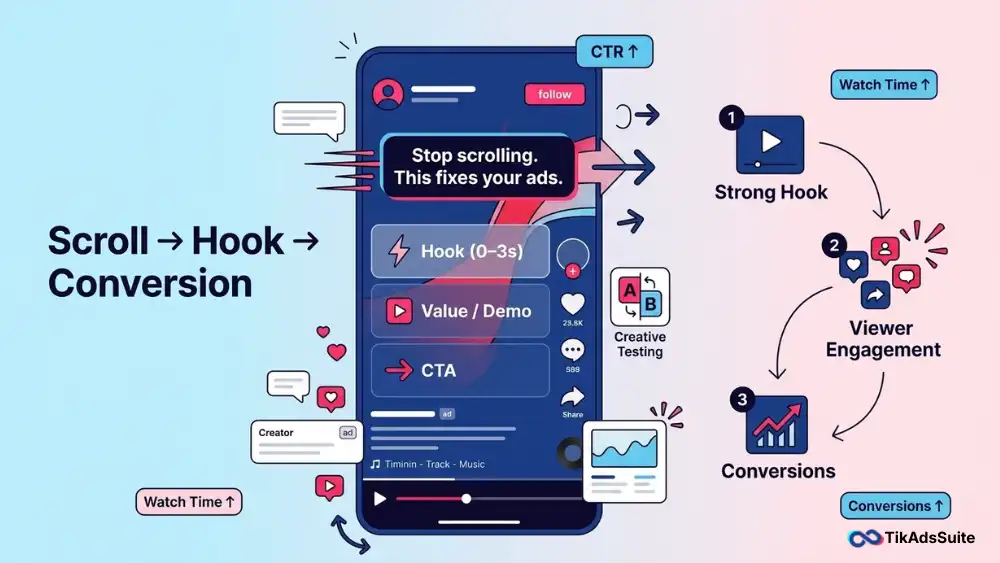
How do TikTok Video Ads convert differently?
TikTok video ads work because the platform is built around discovery, not connection. Unlike Facebook or Instagram, where users follow people they know, TikTok’s For You Page (FYP) shows content based entirely on behavior signals: watch time, replays, shares, and comments.
That changes everything about how ads perform. Your ad does not need a large following behind it. It needs to behave like content users already want to watch.
When an ad blends into the feed visually and tonally, users engage with it. When it feels like a traditional commercial, they scroll past it. TikTok’s algorithm treats ads and organic posts through the same relevance filter, which means creative quality directly determines your distribution.
According to Kantar’s Media Reactions report, TikTok was voted the world’s most attention-grabbing ad platform by both consumers and marketers globally, the only platform to appear in the top five for both groups simultaneously.
Users on TikTok are more open to discovering new brands through ads than on virtually any other major platform. That openness is your conversion advantage, but only if your creative earns it.
TikTok Video Ad Formats: Which One Is Right for Your Goal?
Not every TikTok ad format drives the same outcome. Choosing the wrong format for your objective is one of the fastest ways to burn budget. Here is how each format maps to real marketing goals.
In-Feed Video Ads (Best for Most Brands)
In-Feed ads appear natively inside the FYP scroll. They autoplay with sound on, support external links, and are the most accessible format for brands at any budget level.
This is your starting point if you are running direct response, app installs, or website traffic campaigns. They work at any spend level, and because they live inside organic content, users engage with them the same way they engage with creator posts. The minimum daily budget is $20 per ad group, making this the most scalable format for testing.
Spark Ads (Organic Reach Amplifier)
Spark Ads let you boost existing organic TikTok posts, either from your own account or from creators who grant permission. The post keeps all its original engagement metrics, comments, shares, and likes, which adds social proof that your brand cannot manufacture.
This format performs best when you have organic content already generating strong watch time or engagement. According to TikTok for Business data, Spark Ads deliver a 142% higher engagement rate and 43% higher conversion rate compared to standard In-Feed ads. If you have a creator partnership and want to amplify their content as an ad, Spark Ads are the most efficient path.
Video Shopping Ads and TikTok Shop (Highest Conversion Rates)
Video Shopping Ads connect directly to your TikTok Shop or product catalog. Users can tap a product tag inside the video and complete a purchase without ever leaving the app. That single-tap path from content to checkout removes significant friction.
According to Bloomberg reporting, TikTok set an ambitious target of $20 billion in global GMV for TikTok Shop, up from $4.4 billion the prior year, banking on rapid expansion in Southeast Asia and beyond. Brands running Video Shopping Ads with TikTok Shop integration are seeing conversion rates that outperform standard click-to-website campaigns because the purchase journey is shorter. If you sell physical products, this format should be your priority test in 2026.
TopView and Brand Takeover (Awareness at Scale)
TopView ads appear the moment a user opens TikTok. They can run up to 60 seconds and command the full screen before any feed content appears. Brand Takeover is a shorter, three to five-second version of the same placement.
These are premium, high-cost formats designed for brand launches, product announcements, or national campaigns. TopView CPMs run significantly higher than In-Feed, often $50 or above, depending on targeting. They are not the right entry point for most brands. If your goal is to reach and brand recall at scale, and your budget supports it, these formats deliver unmatched visibility.
TikTok Video Ad Specs: Sizes, Length, and Format Requirements for 2026
The most direct answer to “How long should a TikTok video ad be?” is this: 21 to 34 seconds, in a 9:16 vertical format, at 1080×1920 pixels. TikTok’s own creative effectiveness data shows ads in this length range consistently outperform shorter or longer alternatives for both completion rate and conversion.
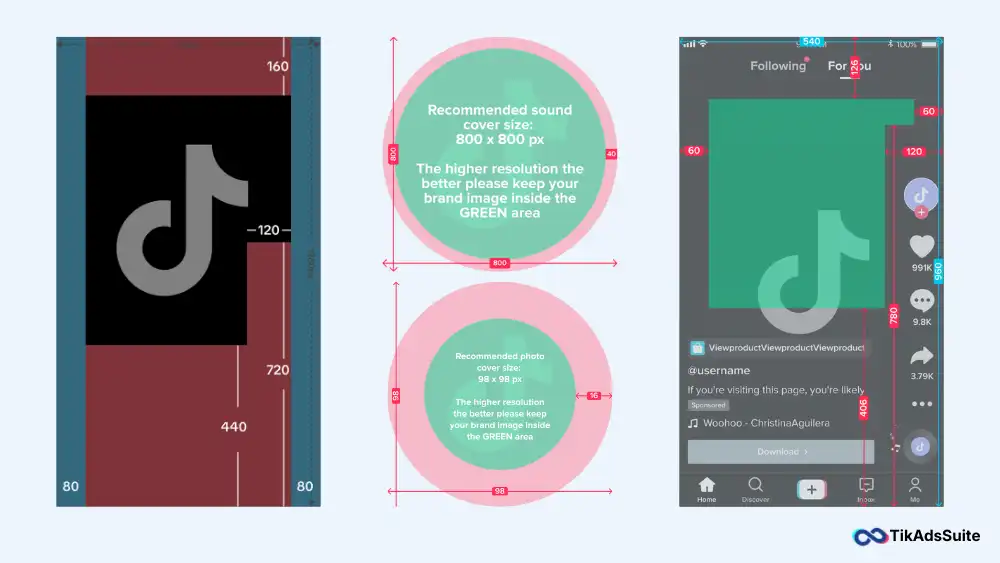
| Spec | Requirement |
| Aspect Ratio | 9:16 (vertical), 1:1 accepted |
| Resolution | 1080 x 1920 px minimum |
| File Format | MP4, MOV, AVI, MPEG |
| File Size | Up to 500MB |
| Video Length | 5 to 60 seconds (21 to 34 sec recommended) |
| Caption Limit | 100 characters (excluding hashtags) |
| Sound | Required. Sound-on environment |
| Safe Zones | Keep key visuals and text inside the center 80% |
Keep your key message, logo, and CTA inside the center safe zone. TikTok overlays its own UI elements (profile icon, share buttons, caption text) along the right side and bottom of the screen. Content placed in those areas will be obscured.
See the full guide to TikTok Ad Specs to make sure your ads meet every requirement.
How to Build a TikTok Video Ad That Stops the Scroll
Creative quality is the single biggest performance variable on TikTok. You can target perfectly and set the right budget, but if your creative does not earn attention in the first three seconds, the algorithm will stop serving it. Here is how to build ads that hold attention and move people to act.
The 3-Second Hook: Formulas That Actually Work
Your hook is not your logo. It is not your product. It is the one moment in the first three seconds that makes a user pause instead of scrolling.
According to TikTok for Business, over 63% of videos with the highest click-through rates get their key message across in the first three seconds.
These are the hook formulas we have seen consistently outperform in real campaigns:
- The bold claim hook: State a specific, surprising result upfront. Example: “This $12 serum cleared my skin in 11 days.”
- The pattern interrupt hook: Start mid-action, mid-sentence, or mid-reaction. Drop the viewer into the middle of something already happening.
- The direct address hook: Speak directly to a specific person. “If you run a Shopify store and your ads aren’t converting, watch this.”
- The curiosity gap hook: Tease an outcome without revealing how. “Here is what nobody tells you about TikTok ads.”
Your hook should never feature a logo animation, a fade-in, or a silent first second. Those are the fastest ways to lose the algorithm’s confidence in your creative.
Here are some of the best hooks you can use for inspiration.
UGC-Style vs. Branded Creative: What the Data Says
UGC-style content, meaning video that looks like it was filmed by a real person on their phone, consistently outperforms high-production branded creative on TikTok. TikTok’s creative best practices data shows that creatives shot on mobile devices have a 63% higher chance of outperforming studio-shot creatives for purchases, checkouts, and app installs.
That does not mean production quality does not matter. It means the style of production matters more than the budget behind it. Casual delivery and authentic settings signal trustworthiness to TikTok users conditioned to distrust obvious advertising.
You should test both. Start with UGC-style creative, then test one polished branded variation. Let the data decide, not your assumption about what looks professional.
How to Write a CTA That Drives Clicks, Not Just Views
Most TikTok ad CTAs fail because they are generic. “Learn more” and “Shop now” are invisible to users who have seen them a thousand times.
Your CTA should do two things: name the action and name the reward.
Compare these two versions:
- Weak: “Click the link in bio”
- Strong: “Tap below to get your first box for $1”
The second version tells you exactly what to do and exactly what you get. Place your CTA both verbally in the video (spoken or on-screen text) and in the caption. Match what you say verbally to what the button says. If the spoken audio says “tap to learn more” and the button reads “Shop Now,” you create friction that kills clicks before they happen.
How to Set Up TikTok Video Ads in Ads Manager (Step-by-Step)
Setting up your first TikTok campaign takes about 20 minutes if you have your creative ready.
Here is the full process:
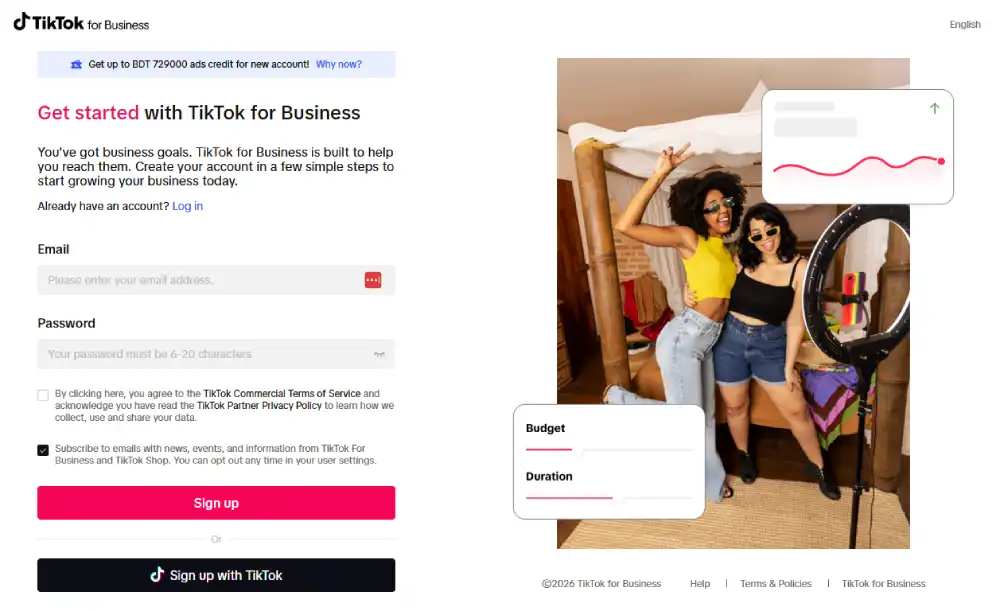
1. Create your TikTok Ads Manager account at ads.tiktok.com and complete your business profile and payment information.
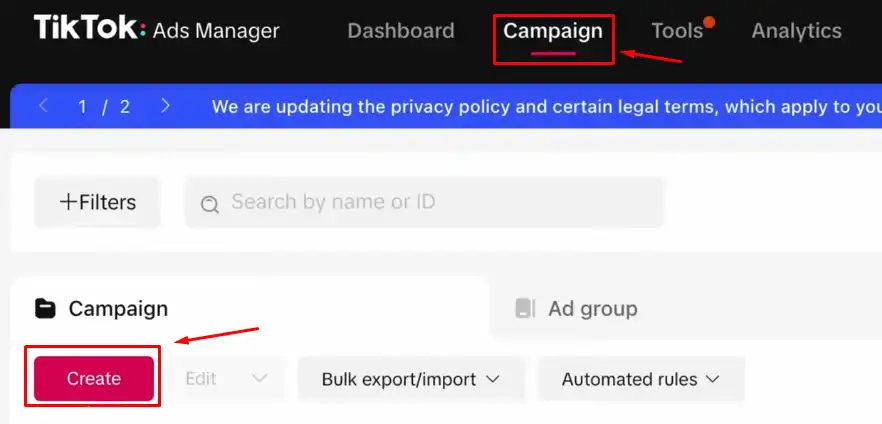
2. Click “Campaign” and select “Create.” Choose your campaign objective: Awareness, Traffic, App Installs, Lead Generation, or Conversions. Choose Conversions if your goal is sales.
3. Set your campaign budget. You can set a daily or lifetime budget at the campaign level. The minimum is $50 per day at the campaign level.
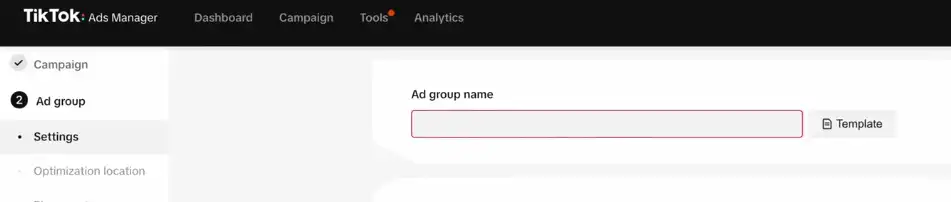
4. Create your Ad Group. Here, you define your audience: demographics, interests, behaviors, device type, and location. You can also use Custom Audiences (your customer list) or Lookalike Audiences.
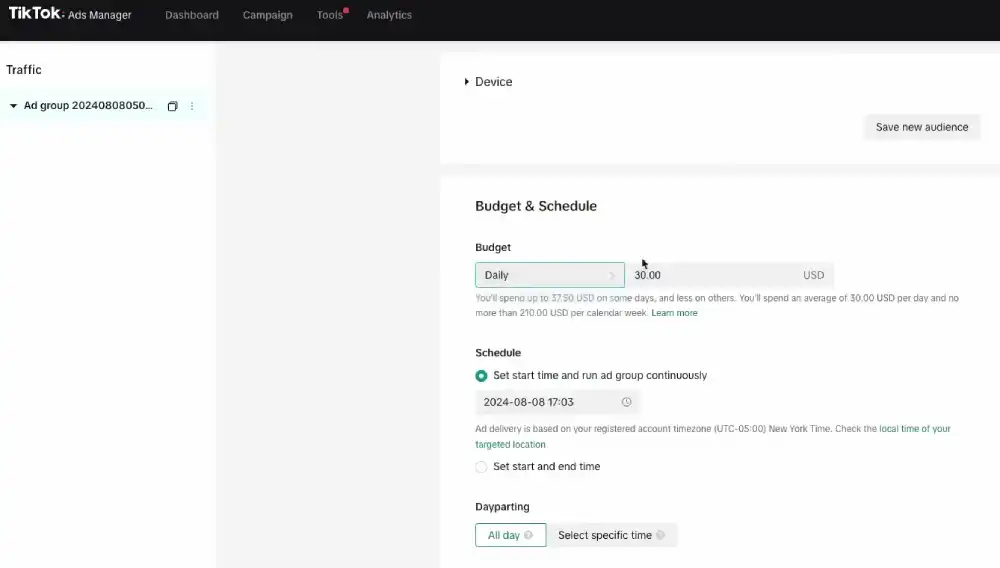
5. Set your Ad Group budget and schedule. The minimum is $20 per day per ad group. Set your start date, and either let it run continuously or define an end date.
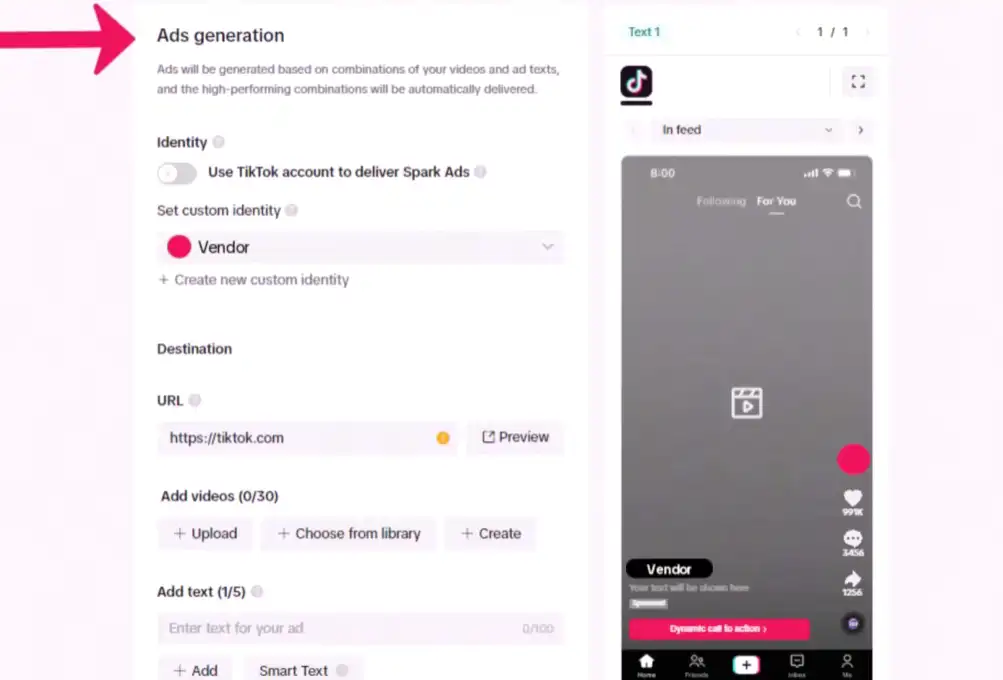
6. Upload your creative. Add your video file, write your caption (100 character limit), select your display name and profile image, choose your CTA button, and enter your destination URL.
7. Submit for review. TikTok typically reviews ads within 24 hours. Make sure your landing page is live and loads correctly before submitting.
You should name your campaigns and ad groups with a clear naming convention from day one. Include the format, target audience, and creative version in every name. This saves significant time when you start scaling and testing multiple variations.
TikTok Video Ad Costs: What to Budget in 2026
TikTok video ads cost an average of $1 to $4 per click (CPC) and $6 to $10 per 1,000 impressions (CPM) for In-Feed placements. According to Influencer Marketing Hub’s TikTok Ads benchmarks, your actual cost will vary based on industry, audience size, and how competitive your targeting parameters are.
Here is a realistic breakdown by business size:
| Budget Tier | Monthly Spend | Best Use |
| Testing | $600 to $1,500 | 2 to 3 creatives, 1 audience, In-Feed only |
| Growth | $1,500 to $5,000 | Multi-format testing, Spark Ads added |
| Scaling | $5,000 to $15,000+ | Full-funnel: awareness, retargeting, shopping |
TikTok requires a minimum of $50 per day at the campaign level and $20 per day per ad group. If you set your budget below these thresholds, your campaign will not serve.
One important note: TikTok’s algorithm needs data to optimize. Campaigns with budgets too small to generate 50 conversion events per week within an ad group will remain in the “learning phase” and underperform. If your budget is limited, consolidate your ad groups rather than spreading spend thin.
How to Test and Scale TikTok Video Ads Without Wasting Budget
Most brands test randomly. They run an ad, it underperforms, they change everything at once, and they have no idea what the actual problem was. A structured testing framework solves this.
Use this four-week testing sequence, changing one variable at a time:
Week 1: Hook testing. Run three to four versions of the same ad with different opening three seconds. Keep the offer, CTA, and landing page identical. The hook that drives the highest three-second view rate wins.
Week 2: Offer testing. Take your winning hook and test two different offer structures. For example: “$10 off your first order” versus “Free shipping on orders over $50.” Track cost per add-to-cart or cost per lead.
Week 3: CTA testing. Test two versions of your on-screen and verbal CTA using your best-performing hook and offer. Measure click-through rate and conversion rate together.
Week 4: Landing page testing. Send your best-performing ad to two different landing pages. Measure cost per conversion.
When to kill an ad: If your three-second view rate is below 25% after 1,000 impressions, the hook is failing. Pull it and replace it. Do not wait for more data.
When to scale: If your ROAS exceeds your break-even point consistently for five to seven days, increase your daily budget by no more than 20% every two days. Larger jumps reset the learning phase.
Creative fatigue on TikTok moves faster than on other platforms. According to TikTok for Business creative guidance, even the best ads will experience creative fatigue over time, and refreshing creative regularly is essential to sustaining results. Build a creative refresh cycle into your monthly workflow, not just your quarterly one.
TikTok Video Ad Performance: The Metrics That Actually Predict ROI
View count and reach tell you nothing about whether your ads are making money. Here are the metrics that actually matter.
3-Second View Rate: The percentage of users who watch your ad for at least three seconds. Anything below 25% signals a weak hook. Above 40% means your opening is working and worth investing in.
Video Completion Rate (VCR): The percentage of users who watch to the end. A strong VCR above 20% tells you the full creative is holding attention, not just the hook.
Click-Through Rate (CTR): Conversion-optimized TikTok ads average 0.84% CTR. Anything above 1.5% on a conversion campaign is a strong signal.
Cost Per Result: This is your north star metric. Define your acceptable cost per conversion before you launch, then measure everything against it.
ROAS (Return on Ad Spend): Your target ROAS depends entirely on your margins. A product with a 70% margin can tolerate a lower ROAS than one with 30%. Define your break-even ROAS before you spend.
One important attribution note: TikTok’s default last-click attribution significantly undervalues the platform’s impact on revenue. According to a Nielsen Media Mix Model study commissioned by TikTok, TikTok In-Feed Ads delivered the highest short-term ROAS and strongest long-term sales lift for CPG brands among all digital media measured, yet last-click models regularly miss this contribution. We recommend using a 7-day click attribution window as a more accurate baseline.
Why Your TikTok Video Ads Aren’t Converting (And How to Fix Them)
If your TikTok ads are generating impressions but not conversions, the problem almost always falls into one of these five areas.
1. Your hook is not holding attention. Check your three-second view rate. If it is below 25%, most users are not watching long enough to see your offer or CTA. Fix: test three to four new hooks before changing anything else.
2. Your format does not match your objective. Running a TopView for direct sales is expensive and inefficient. Using a standard In-Feed ad for product discovery without TikTok Shop integration means users have to click out of the app to buy. Fix: match format to funnel stage deliberately.
3. Your budget is too low to exit the learning phase. TikTok’s algorithm needs approximately 50 conversion events per ad group per week to optimize. If your daily budget generates fewer than that, your campaign will never stabilize. Fix: consolidate ad groups or increase the budget to at least $30 to $50 per day per ad group.
4. You are not using TikTok Shop. If you sell physical products and your ads link to an external website, you are adding friction to the conversion path. TikTok Shop removes that friction. Fix: set up TikTok Shop and test Video Shopping Ads against your standard In-Feed campaigns.
5. Creative fatigue is killing your performance. If an ad that was performing well has dropped off in the past two weeks, it is almost certainly fatigued. Fix: refresh the hook, introduce a new format variation, or rotate in a new creator. Do not increase the budget on a fatigued creative.
TikTok Video Ads in 2026: What’s Changed and What’s Working Now
TikTok’s advertising ecosystem has shifted significantly heading into 2026. Here is what is actually different and what it means for your strategy.
TikTok Symphony is changing creative production. TikTok’s AI creative suite, Symphony, includes AI dubbing, script generation, and avatar-based ad creation. Brands using Symphony tools are testing more hooks in less time. This does not replace human creative judgment, but it does lower the cost of iteration.
TikTok Shop is the biggest conversion opportunity on the platform. According to data from Charm.io cited by eFulfillment Service, global TikTok Shop GMV has surpassed $70 billion since launch and continues to accelerate. Brands that integrated TikTok Shop early are seeing significantly lower cost per conversion compared to click-to-website campaigns. The native checkout experience is a structural advantage that is still underused by most mid-size brands.
Search Ads are growing. According to Adobe’s research via Statista, 64% of Gen Z respondents in the US used TikTok as an online search engine, and 41% of all Americans have now used TikTok for search. TikTok Search Ads let you target users actively searching for specific terms inside TikTok, which represents a meaningful shift toward intent-based advertising on the platform.
Creator-led ads continue to outperform brand-produced content. According to TikTok for Business creative data, creator-partnered ads generate higher engagement and lower CPMs than brand-produced alternatives across most verticals. If you have not built a creator testing program into your ad strategy, this is the highest-leverage area to prioritize in 2026.
More helpful articles you’ll want to explore:
👉 TikTok Ads Credit: Get Free $6000 Cash Back Promo
👉 TikTok Ads for Business Coupons | 50% Off
👉 TikTok Ad Testing Strategy: A/B Testing Explained
👉 Proven TikTok Ad Copywriting Formulas That Convert
Frequently Asked Questions About TikTok Video Ads
Can small businesses run TikTok video ads?
Yes, you can run TikTok video ads with a minimum daily budget of $20 per ad group and $50 per campaign. Small businesses get the best results by starting with In-Feed ads, testing two to three creative variations, and scaling the one that performs. You do not need a large following or production budget to see results.
What is the best TikTok ad format for ecommerce?
Video Shopping Ads connected to TikTok Shop deliver the highest conversion rates for ecommerce brands because they allow users to purchase without leaving the app. If you are not yet set up with TikTok Shop, In-Feed ads with a strong CTA and a fast-loading product page are your best alternative starting point.
How long should a TikTok video ad be?
TikTok’s own creative data shows that ads between 21 and 34 seconds consistently outperform shorter or longer formats for both completion rate and conversions. Your most critical seconds are the first three. If you cannot hook the viewer immediately, length does not matter.
How do I know if my TikTok ads are actually working?
Focus on three metrics: three-second view rate (target above 25%), click-through rate (target above 1%), and cost per conversion against your break-even ROAS. Reach and impressions tell you nothing about whether you are making money. We recommend a 7-day click attribution window as a more accurate measurement baseline than last-click alone.
Do TikTok video ads work for B2B companies?
TikTok can work for B2B, but you need to adjust your expectations and strategy. The platform skews younger and leans toward consumer content, so your audience size for niche B2B targeting will be smaller. B2B brands seeing success on TikTok are using educational, behind-the-scenes, or founder-led content rather than traditional promotional ads. Lead generation campaigns work better than direct conversion campaigns in most B2B verticals.
What is the difference between a Spark Ad and a regular TikTok In-Feed ad?
A standard In-Feed ad is a new ad created inside Ads Manager. A Spark Ad boosts an existing organic TikTok post, either from your account or from a creator’s account with their permission. Spark Ads retains the original post’s engagement metrics, which adds credibility. According to TikTok for Business data, Spark Ads deliver a 43% higher conversion rate than standard In-Feed ads, making them a strong option when you have high-performing organic content to amplify.
Conclusion
TikTok video advertising in 2026 is not complicated, but it does require you to think differently than you would on any other platform. The FYP rewards content that earns attention, not content that announces itself.
The brands winning on TikTok are the ones building a repeatable creative system: strong hooks, format choices that match the funnel, structured testing that isolates variables, and budgets sized to actually generate data.
You now have the full picture. You know which formats drive which outcomes, what specs your videos need to meet, how to build a hook that holds attention in three seconds, how to structure a testing cycle that tells you what is actually working, and what to fix when your conversions stall.
TikTok video ads work when the creative earns the click, and the strategy is built to learn. That is the standard worth holding yourself to.