
TikTok’s ad formats aren’t interchangeable skins on the same ad.
Each one changes what a viewer can do, where the ad shows up, and which objectives it actually supports.
Picking the wrong format doesn’t just look worse, it can lock you out of the placement or interaction you needed in the first place.
This guide covers what each format is, TikTok’s own specs for it, and which campaign goal it actually fits.
Table of Contents
Get Up to $6000 Free TikTok Ad Credit
Key Takeaways
- TikTok runs nine distinct ad formats, and several only work with specific campaign objectives, not all of them.
- Spark Ads run through your organic post and keep all engagement attached to your real TikTok account, per TikTok’s official Spark Ads documentation.
- TopView is a premium, reservation-only placement shown the moment someone opens the app, per TikTok’s TopView specs.
- Catalog and Collection formats both pull from your product catalog automatically, so they scale across a full inventory without one ad per SKU.
- Search Ads only appear on TikTok’s Search Results Page, a placement none of the other formats reach.
Quick Answer
For most advertisers starting out, In-Feed Ads (through Spark Ads specifically) is the safest default, since it works across nearly every objective and blends into the main feed. Move to Carousel or Catalog Ads once you have a real product range to show. Reach for TopView only with the reservation budget to back a launch moment, and add Search Ads, Lead Generation, or LIVE Shopping Ads once your core campaign type is already proven.
In-Feed Ads: The Default Format
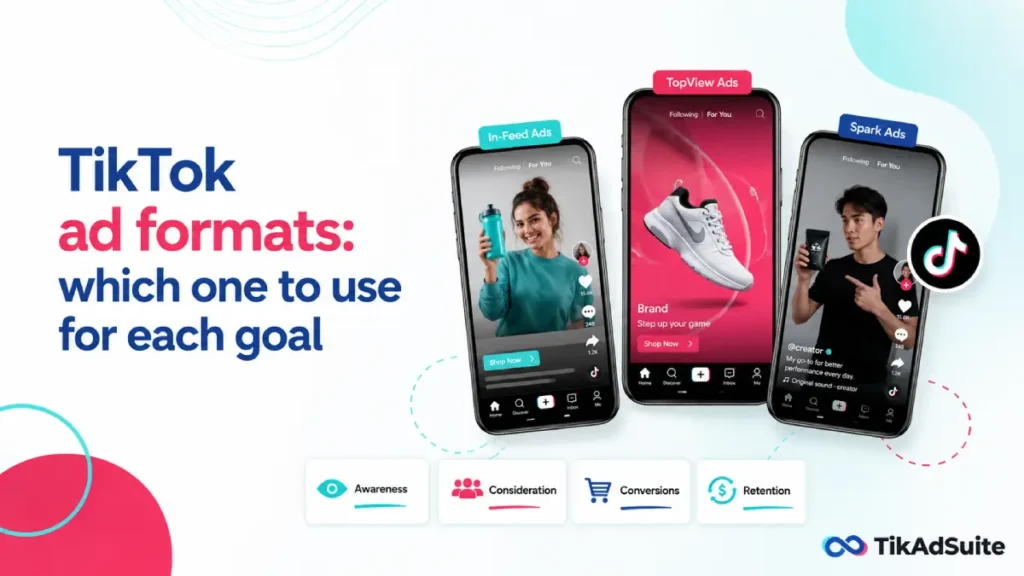
In-Feed Ads show up inside the main content stream, mixed in with organic videos rather than set apart from them.
Per TikTok’s official specs, non-Spark In-Feed video runs up to 10 minutes, in 9:16, 16:9, or 1:1, at a minimum resolution of 540x960px vertical.
File size caps out at 500MB, and TikTok requires a minimum bitrate of 516 kbps to avoid a soft, compressed look.
In-Feed is the only format that realistically supports nearly every objective TikTok offers, from Reach to Sales.
That’s why it’s the format most accounts run first.
TikTok video ads covers production and editing specifics for this format in more depth.
Spark Ads: Boosting Real Posts
Spark Ads are not a separate creative format. They’re a delivery method that runs an existing organic post, either your own or a creator’s, as a paid ad.
Per TikTok’s Spark Ads documentation, every view, comment, share, and follow gained during the promotion attaches to the original organic post, not a disposable ad unit.
That has a real practical effect. Viewers can tap through to the poster’s profile and follow the account.
They can also view the actual comment section, none of which standard In-Feed ads allow.
TikTok also tracks Spark-specific metrics non-Spark ads don’t report, including profile visits and paid follows generated by the ad.
Spark Ads vs. In-Feed Ads breaks down exactly when each one wins.
TopView: The Premium Placement
TopView is the ad a viewer sees the instant they open TikTok, before anything else loads.
Per TikTok’s TopView specs, the format runs a 3-second full-screen zoom before transitioning into the standard in-feed view.
Video runs 5 to 60 seconds, with 9 to 15 seconds recommended, in 9:16 at minimum 540x960px.
TopView is a reservation buy, not an auction.
You pay a fixed rate for guaranteed placement and volume, rather than bidding against other advertisers in real time.
That structure makes it a fit for major launches and awareness pushes with a fixed budget behind them, not always-on performance campaigns.
Carousel Ads: Multiple Products, One Placement
Carousel Ads run a sequence of images that people swipe through manually, rather than a single video.
Per TikTok’s Carousel Ads documentation, the format supports Traffic, Web Conversions, App Promotion, Lead Generation, Product Sales, and Reach objectives.
This format exists for advertisers without a strong video pipeline, or those repurposing static creative from other platforms.
It also works well for showing several products or variants in one unit instead of a separate ad for each.
TikTok Carousel Ads covers the full setup process and image specs.
Collection Ads: A Storefront Inside the Feed
Collection Ads pair a video with a product grid that opens into an Instant Storefront when tapped, without leaving the TikTok app.
This format is built for browsing, not a single hero product.
A viewer watches the lead video, then taps through to see a set of related items without a page load or app switch.
TikTok Collection Ads walks through how the storefront experience is configured.
Catalog Ads: Automated Product Advertising at Scale
Catalog Ads pull directly from a connected product catalog, rather than a manually built creative.
Per TikTok’s catalog documentation, you upload product data, images, and pricing once.
TikTok’s Dynamic Video Generator can then build creative across the entire catalog automatically, including personalized recommendations per viewer.
Catalogs connect directly through Shopify, WooCommerce, BigCommerce, and similar platforms, so the ad set updates as inventory does.
This is the right format once a store has enough SKUs that hand-building a Carousel for each one stops being realistic.
Catalog and dynamic product ads covers setup for stores connecting an existing catalog.
Search Ads: The One Placement Only This Format Reaches
Search Ads are the only TikTok format that appears specifically on the Search Results Page, rather than the main feed.
Per TikTok’s Search Ads documentation, the campaign targets keywords directly, and creative can be repurposed from existing In-Feed video or run as Carousel Image Ads.
Search Ads exist for the same reason Search campaigns exist anywhere.
They reach someone who already typed in what they want, instead of someone scrolling past it.
TikTok Search Ads covers keyword strategy and creative testing specific to this placement.
Lead Generation Ads: Capturing Contact Info Without a Landing Page
Lead Generation Ads open an Instant Form directly inside TikTok when a viewer taps the CTA, instead of sending them to an external landing page.
Per TikTok’s lead generation objective documentation, these forms load faster than a website and can pre-populate known fields.
TikTok cites that as a driver of higher submission rates.
The same objective can also redirect to a website form or to TikTok Direct Messages instead, for advertisers who need more qualifying questions than an instant form supports.
TikTok lead gen ads covers instant form setup and CRM integration options.
LIVE Shopping Ads: Driving Traffic Into a Livestream
LIVE Shopping Ads promote a live or recorded stream where viewers can browse and buy products in real time.
Per TikTok’s LIVE Shopping Ads documentation, these ads can surface in the main feed, the Shopping Center, and search results.
All three placements point back to the same stream.
This format is specific to TikTok Shop sellers running or planning a livestream, it isn’t a general-purpose format for advertisers without a shop set up.
TikTok LIVE shopping ads covers scheduling and audience setup for this format specifically.
How Format Connects to Campaign Structure
Format is a creative-level decision. It sits underneath the campaign and ad group decisions that set your objective, budget, and targeting.
TikTok’s ad campaign structure covers how campaign, ad group, and ad levels work together, and where format selection actually happens in that hierarchy.
Placement settings, where a chosen format is allowed to run, are a separate decision layer on top of format itself.
TikTok ad placement options covers automatic versus manual placement and what each format supports.
Frequently Asked Questions
What is the most common TikTok ad format?
In-Feed Ads, particularly run as Spark Ads, since the format supports nearly every campaign objective and blends into the main content stream. Most accounts run In-Feed as their default before adding other formats.
Can I use more than one ad format in the same campaign?
Yes, within an ad group you can run multiple ad formats side by side as long as they support the same campaign objective, letting TikTok’s delivery system test which performs better for that audience.
Is TopView worth it for a small budget?
Usually not. TopView is a reservation buy with a fixed cost for guaranteed placement and volume, which puts it out of reach for most small daily budgets. In-Feed or Spark Ads deliver similar reach at auction pricing instead.
Do Catalog Ads work without a large product range?
They can, but the format is built to scale across many SKUs automatically. A store with a handful of products usually gets more control from a manually built Carousel Ad instead.
What format works best for driving website leads?
Lead Generation Ads, since the Instant Form opens without leaving TikTok and can pre-fill known fields. Carousel and In-Feed ads can also drive leads by linking to an external landing page, just with an extra step for the viewer.
Wrapping Up
TikTok’s ad formats aren’t a style choice, each one supports a different set of objectives, placements, and viewer actions.
Start with In-Feed or Spark Ads for most goals, and add Carousel or Catalog once there’s a real product range.
Reserve TopView, Search, Lead Gen, and LIVE Shopping Ads for the specific jobs they’re actually built for.
From here, the format-specific guides linked throughout this page cover setup, specs, and creative strategy for each one individually.
Sources
- About Spark Ads | TikTok Ads Manager
- TikTok reservation TopView specifications | TikTok Ads Manager
- TikTok Auction In-Feed Ads | TikTok Ads Manager
- About Carousel Ads | TikTok Ads Manager
- About Search Ads Campaign | TikTok Ads Manager
- About the lead generation objective | TikTok Ads Manager
- About LIVE Shopping Ads | TikTok Ads Manager
- About catalogs | TikTok Ads Manager