
Choosing the wrong TikTok ad format costs you more than money. It costs you relevance. TikTok’s feed moves fast, and ads that feel out of place get scrolled past before the first second is up.
If you have been running In-Feed Ads and wondering why Spark Ads keep coming up in every performance conversation, or vice versa, you are not alone.
Most comparisons online define both formats and stop there. That is not enough to make a real decision.
This article walks you through how each format works, what the performance data actually shows, and exactly when to use each one based on your goal, your budget, and where your brand stands right now.
Get Up to $6000 Free TikTok Ad Credit
Table of Contents
Spark Ads vs In-Feed Ads in 30 Seconds
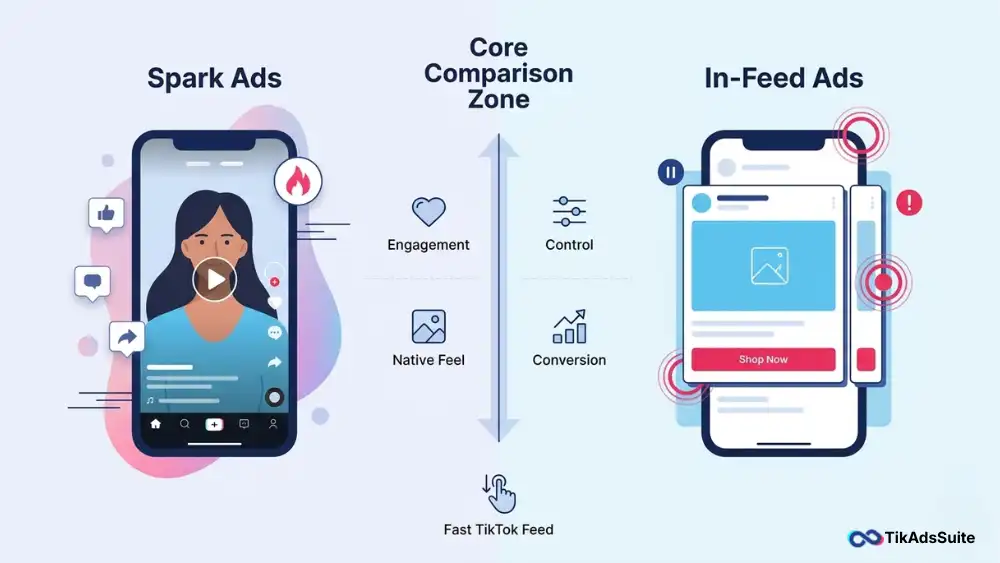
TikTok Spark Ads let you amplify existing organic posts from your own account or a creator’s account, keeping all engagement on the original post. In-Feed Ads are created directly inside TikTok Ads Manager as standalone ads with no connection to organic content. Spark Ads typically deliver higher engagement and feel more native to the feed, but only when you already have strong organic content to promote. In-Feed Ads give you more creative control and work well even without an existing TikTok presence.
What Are TikTok In-Feed Ads?
TikTok In-Feed Ads appear in the For You Page feed between organic content, matching the same vertical video format users scroll through every day. They auto-play with sound on and look exactly like a standard TikTok video at first glance.
You build In-Feed Ads entirely inside TikTok Ads Manager. You upload the video, write the copy, choose a call-to-action button, and set your targeting. The ad links out to a landing page, app store listing, or any external destination you choose.
TikTok serves In-Feed Ads based on your campaign objective. Common objectives include traffic, conversions, app installs, lead generation, and reach. The CTA button sits at the bottom right of the video, and users can like, comment, share, or follow directly from the ad.
One key limitation: engagement on In-Feed Ads does not carry over to your organic profile. Likes and comments stay on the ad itself and disappear when the campaign ends.
What Are TikTok Spark Ads?
TikTok Spark Ads are a native ad format that lets you put paid promotion behind an existing organic TikTok post. Instead of building a new creative from scratch, you boost a post that already lives on TikTok, either from your own account or from a creator’s account with their authorization.

Think of Spark Ads as TikTok’s version of a boosted post, similar to what you see on Facebook or Instagram, but built specifically for TikTok’s content ecosystem. The post keeps its original engagement, including likes, comments, shares, and follower count, which all remain visible to anyone who sees the ad.
To run Spark Ads using a creator’s content, the creator generates an authorization code inside their TikTok account. You enter that code in Ads Manager, and TikTok connects the post to your campaign. No content download or re-upload is needed.
All engagement generated during the Spark Ads campaign accumulates on the original post permanently. That means your organic content gets stronger over time, not just during the paid window.
Spark Ads vs In-Feed Ads: Side-by-Side Comparison
This is where the real decision lives. Both formats appear in the same feed placement, but they behave differently across every metric that matters.
| Feature | Spark Ads | In-Feed Ads |
| Content source | Existing organic post (own or creator) | Built from scratch in Ads Manager |
| Native feel | High uses the real TikTok post format | Moderate, labeled “Sponsored” |
| Engagement attribution | Stays on the original post permanently | Disappears when the campaign ends |
| Creator content support | Yes, with an authorization code | No |
| CTA options | Limited to post CTA + profile visit | Full CTA library (Shop Now, Download, etc.) |
| Avg CTR | Higher (up to 64% above In-Feed average per Revel Interactive) | Baseline benchmark |
| CPM | 4% lower than In-Feed Ads (per TikTok official data) | Standard benchmark CPM |
| Creative control | Limited to existing post content | Full control over copy, format, and CTA |
| Engagement carry-over | Yes, permanent | No |
| Follower growth | Yes, the drive’s profile follows | Limited |
| Best for | Awareness, UGC, brand trust, creator amplification | Direct response, conversions, A/B testing |
| Requires organic content | Yes | No |
| Objectives supported | Reach, traffic, video views, community interaction | All objectives, including conversions and app installs |
The biggest practical difference comes down to this: Spark Ads build your brand’s organic presence over time. In-Feed Ads give you full control and support every campaign objective, including lower-funnel conversions.
Performance Data: How Do the Two Formats Actually Compare?
When we look at the numbers, Spark Ads consistently outperform standard In-Feed Ads on engagement metrics. According to TikTok’s own official data published in their Business Help Center, Spark Ads deliver a 142% higher engagement rate, a 30% higher video completion rate, and a 43% higher conversion rate (CVR) compared to non-Spark Ads.
On CTR, the advantage is significant. According to an agency study by Revel Interactive, which ran head-to-head tests across multiple clients using website conversion campaigns, Spark Ads achieved a 69% higher conversion than standard In-Feed Ads on average. This aligns with what we see in practice: when users cannot easily distinguish an ad from organic content, they engage more naturally.
For CPM, the picture may surprise you. TikTok’s own official benchmark data shows Spark Ads carry a 4% lower CPM than non-Spark In-Feed Ads. The native format and higher engagement signals mean TikTok’s auction system can deliver more efficiently, not at a premium. You get better engagement and a lower cost per thousand impressions.
On view-through rates, the same Revel Interactive study found that Spark Ads saw 17% of impressions reach the 25% mark of a video, while In-Feed Ads saw only 7% hit that same threshold under identical campaign conditions.
One honest caveat: the CTR and view-rate figures come from a specific agency study running conversion-objective campaigns. Results will vary based on your vertical, creative quality, audience size, and budget. A poorly produced organic post amplified through Spark Ads will not magically outperform a well-crafted In-Feed Ad. The format gives you an advantage. The creative still has to earn attention.
Why Spark Ads Feel More Native (And Why That Matters)
The reason Spark Ads outperform In-Feed Ads on engagement is not technical. It is psychological.
When you see a TikTok post with 84,000 likes and 1,200 comments, your brain reads it as trusted content. Someone else found this worth watching. That social proof lowers resistance before you even hit play. In-Feed Ads start with zero engagement on a fresh post, which signals “this is an advertisement” immediately.
This is the core answer to the search query around TikTok Spark Ads vs In-Feed Ads native feeling tips. The native feel is not a design trick. It is social validation made visible.
Spark Ads carry the original creator’s username, profile photo, and engagement history. If you are amplifying content from a TikTok creator with 500,000 followers, the ad inherits that creator’s credibility. Users are more likely to follow through on a CTA when they already associate the face in the video with content they enjoy.
There is also the comment section. Spark Ads keep real comments from the original post visible. Users read those comments and form opinions before the video even finishes. That behavior simply does not exist in standard In-Feed Ads.
For brands trying to build trust in a crowded category, this distinction matters more than any CPM difference.
When to Use Spark Ads (Best Use Cases)
Spark Ads work best when you already have content worth amplifying.
Here is where you should default to them:
- UGC amplification: A customer or creator posted authentic content about your product. Spark Ads let you put a budget behind that post without recreating it. The authenticity stays intact.
- Creator whitelisting: You are running an influencer campaign and want the creator’s content to reach beyond their organic audience. Spark Ads give you targeting control while the creator’s identity stays front and center.
- Brand awareness and follower growth: If your goal is to grow your TikTok account and build a long-term audience, Spark Ads feed engagement back to your profile. Every view, like, and follow from the campaign builds your account’s credibility.
- Organic and paid hybrid strategy: You post consistently, and some videos gain early organic traction. Spark Ads let you accelerate that momentum with paid reach before the algorithm window closes.
- Testing before scaling: If an organic post is already performing well without spending, Spark Ads are a lower-risk way to scale because the content has already proven itself to a real audience.
The one requirement: you need existing content. Either from your own TikTok profile or from a creator who grants you authorization. If you do not have that, In-Feed Ads are the starting point.
When to Use In-Feed Ads (Best Use Cases)
In-Feed Ads are the right choice when you need full control, when you are starting from scratch, or when your campaign goal sits below the awareness stage.
- Direct response campaigns: If you are driving product purchases, sign-ups, or app installs, In-Feed Ads support conversion objectives that Spark Ads do not. You get full CTA flexibility and pixel-based tracking built in.
- Product catalog and dynamic ads: If you run a product catalog on TikTok Shop or use dynamic ad templates, In-Feed is the format that supports this natively.
- A/B creative testing: You need to test five different video hooks against each other. In-Feed Ads let you create multiple ad variations in one campaign without needing five separate organic posts.
- Brand-new accounts without organic content: If your TikTok account is new or you have not built an organic content library, In-Feed Ads get you running immediately.
- Full landing page and URL control: You need to send traffic to a specific URL with UTM parameters, or to an external destination that TikTok does not natively support in Spark Ads’ limited CTA options.
- Retargeting: When you are re-engaging users who visited your website or watched a previous ad, In-Feed Ads connect cleanly to your Custom Audiences for precise retargeting.
If your primary metric is ROAS or CPA, start with In-Feed Ads. Add Spark Ads once you have content worth amplifying.
Can You Run Spark Ads and In-Feed Ads Together?
Yes, and in many cases you should. The two formats are not competitors inside a campaign. They serve different parts of the funnel well.
A simple hybrid approach looks like this: use Spark Ads at the top of the funnel to build awareness, grow your following, and earn trust through creator or UGC content. Then run In-Feed Ads to the same audience with a direct conversion message.
Users who have already engaged with your Spark Ads content are warm. They recognize your brand. A conversion-focused In-Feed Ad shown to that warm audience performs significantly better than showing the same ad cold.
You can also run both simultaneously to the same audience and let TikTok’s algorithm allocate budget based on performance. Some audiences respond better to native content. Others click through on direct response ads. You do not always know in advance which group is larger.
The budget allocation we recommend as a starting point: put 60% toward Spark Ads for awareness if you have strong content, and 40% toward In-Feed for conversion. Adjust based on your cost-per-result after the first two weeks of data.
Which TikTok Ad Format Should You Use? A Simple Decision Guide
Use this framework to make the call based on where you are right now:
If you have strong organic content or a creator partnership: Use Spark Ads. The social proof and native feel will outperform a cold In-Feed creative in almost every awareness and engagement scenario.
If your primary goal is conversions, installs, or direct sales: Use In-Feed Ads. You need conversion objectives, full CTA control, and pixel tracking. Spark Ads do not support all of these.
If you are brand new to TikTok with no content library: Start with In-Feed Ads. Build creative, test what resonates, then shift toward Spark Ads once you have posts worth amplifying.
If you want to scale a creator campaign: Use Spark Ads with creator authorization. This is the cleanest way to run influencer content as a paid ad without losing authenticity.
If your goal is growing your TikTok following: Use Spark Ads. Engagement and follow-up from Spark campaigns stay on your profile. In-Feed Ad engagement disappears.
If you want to run A/B creative tests at scale: Use In-Feed Ads. You can test multiple creatives simultaneously without needing separate organic posts for each variation.
If your budget is tight and you want the most efficient CPM entry point: Spark Ads are the better choice here. TikTok’s own data shows Spark Ads carry a 4% lower CPM than standard In-Feed Ads, which means your budget goes further per thousand impressions.
More helpful articles you’ll want to explore:
👉 TikTok Ads Credit: Get Free $6000 Cash Back Promo
👉 TikTok Ads for eCommerce: Full Funnel Strategy That Actually Works
👉 How to Advertise on TikTok Shop: A Complete Beginner’s to Advanced Guide
👉 TikTok Ads Campaign Types: Complete Overview With Examples
Frequently Asked Questions
Are Spark Ads more expensive than In-Feed Ads?
No. According to TikTok’s official Business Help Center data, Spark Ads have a 4% lower CPM than standard non-Spark Ads. The higher engagement rate and conversion rate mean you typically get more return per dollar spent when the source content is strong. Cost per result is often lower with Spark Ads, even though CPM is similar or slightly better.
Do Spark Ads work without a creator?
Yes. You can run Spark Ads using posts from your own TikTok business account without involving any third-party creators. The creator authorization feature is only needed when you want to amplify someone else’s content. If your brand account has posts with strong organic performance, you can turn those into Spark Ads directly through TikTok Ads Manager.
What is the minimum budget for TikTok Spark Ads?
According to TikTok’s official Budget and Bidding FAQ, TikTok requires a minimum budget of $50 USD at the campaign level and $20 USD per day at the ad group level. These minimums apply to Spark Ads and In-Feed Ads equally. Most advertisers find they need $500 to $1,000 USD in total test spend before drawing meaningful conclusions from the data.
What is the difference between Spark Ads and regular TikTok ads?
Spark Ads boost an existing organic TikTok post, keeping all engagement on the original content. Regular TikTok ads, specifically In-Feed Ads, are built fresh inside Ads Manager with no connection to any organic post. The practical difference is that Spark Ads preserve social proof and feel native to the feed, while In-Feed Ads give you more control over creative, CTA, and campaign objectives.
Can you use Spark Ads for a creator’s content without them knowing?
No. To run Spark Ads using a creator’s post, the creator must generate an authorization code inside their own TikTok account and share it with you. TikTok requires explicit creator consent before any third-party advertiser can promote their content. The creator retains full ownership of the post throughout the campaign.
Which TikTok ad format is better for a small business with no TikTok following?
In-Feed Ads are the better starting point for a small business without an existing TikTok presence or content library. You do not need a following to run them, and they support all conversion objectives, including traffic, leads, and purchases. Once you build a library of content and identify which posts resonate with your audience, you can layer in Spark Ads to amplify your best organic performers.
Conclusion
TikTok Spark Ads and In-Feed Ads are not interchangeable, and picking the wrong one for your goal is a real performance problem.
We have covered how each format works, what the engagement, conversion rate, and completion rate data actually show, why the native feel of Spark Ads changes user behavior, and how to choose based on your goal, your content, and your budget.
The clearest takeaway from everything we looked at: Spark Ads win on trust, engagement, and CPM efficiency when you have the right content to boost.
In-Feed Ads win on control, flexibility, and lower-funnel performance when you need direct results.
Neither format is universally better. The better format is whichever one matches what you are trying to achieve right now.
If you have strong organic content or a creator relationship, test Spark Ads this week. If you are building from scratch or optimizing for\conversions, In-Feed Ads are your foundation. The data tells you when to switch.