
You’ve got a budget to place, and two platforms competing for it. TikTok promises cheap reach and viral upside. Facebook promises a mature system that already knows how to find your buyer. Neither pitch tells you which one actually fits your business.
Most comparisons online don’t help much either. One site quotes a $13 CPM, another quotes $6, and a third is still running a TikTok user count that’s years out of date. You end up with more numbers and less clarity.
This guide clarifies every TikTok Ads vs Facebook Ads number, so that you can clearly understand which platform is best for you and your company.
Here’s what you’ll get:
- Current audience numbers for TikTok and Facebook, each with a source and a date
- What Facebook (Meta) ads actually cost in 2026, from one verified benchmark instead of five conflicting ones
- The real minimum budget for each platform, and where TikTok’s rule is firm versus where Meta’s is a recommendation
- How targeting works now that both platforms lean heavily on automation
- A straight framework for choosing between them based on your funnel stage
By the end, you’ll know which numbers to trust, and which platform actually fits where your business is right now.
Get Up to $6000 Free TikTok Ad Credit
Table of Contents
Key Takeaways
- TikTok’s own reporting puts its US audience above 200 million people in 2026. That replaces the 135 million figure still circulating on older sites.
- Meta last disclosed a Facebook-only user count of 3.07 billion, as of December 31, 2023. It has since shifted to reporting combined Family Daily Active People, which reached 3.56 billion in March 2026.
- Triple Whale’s 2025 benchmark of nearly 35,000 brands puts median Meta Ads CPM at $14.19, with a median CPA of $38.19 and a median ROAS of 1.86. That data spans Facebook and Instagram together.
- TikTok’s official minimum is $50 a day at the campaign level and $20 a day at the ad group level. Meta does not publish one universal minimum. It recommends starting with enough to run for more than seven days.
- Both platforms now automate most targeting. TikTok has Smart+. Meta has Advantage+ audience expansion. Neither is purely manual anymore.
- Pew Research found 37% of US adults use TikTok and 71% use Facebook, as of its November 2025 survey.
Quick Answer
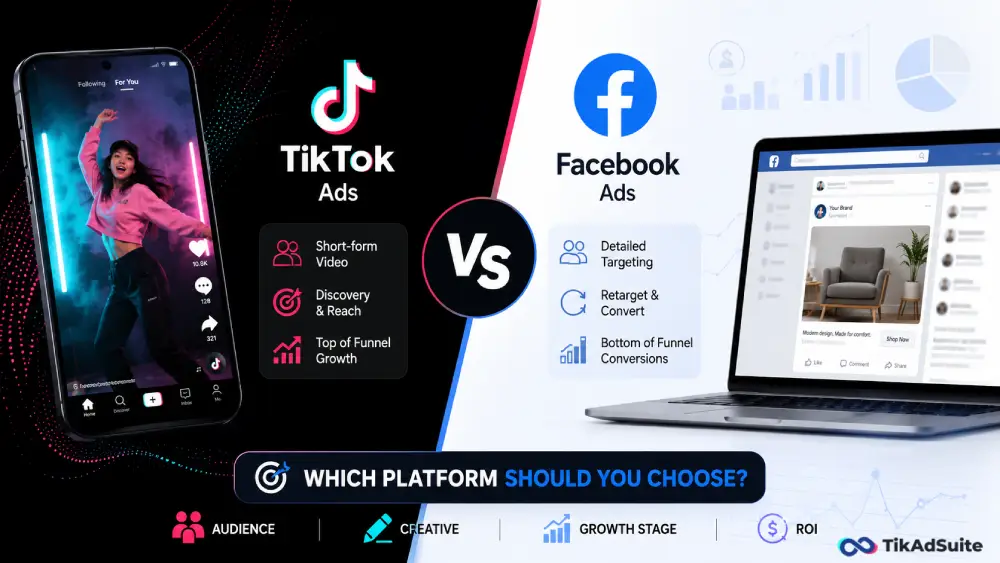
Consider TikTok when you need discovery, creator-led creative, or access to a large younger audience at a lower entry cost. Consider Facebook (Meta) when you need broader age coverage, a mature pixel with retargeting history, or catalog-based advertising. Many businesses eventually run both, using each for a different job in the funnel.
Who’s Actually on TikTok and Facebook Right Now
TikTok’s newsroom said that its US joint venture supports more than 200 million Americans. TikTok repeated that figure again in March 2026 at NewFronts.
That’s a big correction from the 135 million figure still quoted on older articles. That older number traces back to a TikTok announcement from years earlier.
Facebook’s numbers are harder to pin down, because Meta changed how it reports them. The last time Meta broke out a Facebook-only monthly active user count was December 31, 2023. That figure was 3.07 billion.
Since then, Meta mostly reports a combined number across Facebook, Instagram, Messenger, and WhatsApp. That metric is called Family Daily Active People. It hit 3.56 billion, per Meta’s Q1 2026 earnings.
So if you see “Facebook has 3.07 billion users” presented as a fresh 2026 stat, it isn’t. It’s a Facebook-only figure from two years earlier.
Pew Research Center’s most recent survey, published in November 2025, found that 37% of US adults use TikTok and 71% use Facebook. The age breakdown tells a more useful story than the headline numbers alone:
| Age group | TikTok (US adults) | Facebook (US adults) |
|---|---|---|
| 18–29 | 63% | 68% |
| 30–49 | 44% | 80% |
| 50–64 | 30% | 74% |
| 65+ | 12% | 57% |
Source: Pew Research Center, Americans’ Social Media Use 2025.
Facebook reaches a wider age range across the board. TikTok is still stronger with adults under 30, but its 30-to-49 adoption is no longer small.
What Facebook (Meta) Ads Actually Cost
TikTok doesn’t publish a universal CPM for its auction ads. Neither does Meta, technically, but Meta’s advertising ecosystem is large enough that third parties can build reliable benchmarks from real ad spend.
The most cited current benchmark comes from Triple Whale’s analysis of nearly 35,000 ecommerce brands running Meta Ads. That dataset covers Facebook and Instagram placements together, not Facebook in isolation.
Its headline figures:
- Median CPM: $14.19
- Median CPA: $38.19
- Median conversion rate: 1.6%
- Median ROAS: 1.86
Triple Whale also reports that Meta’s median CPM rose 20% year over year in 2025 compared with 2024. Auction competition is getting more expensive across the board.
For TikTok, be skeptical of any article that hands you a clean CPM range. TikTok’s own auction pricing depends on your market, objective, audience, creative quality, and competition at that exact moment. A number that looks accurate in one industry can be off by a wide margin in another.
You can check where your own account stands using TikTok’s CPM benchmarks or model different budget scenarios with a CPM calculator.
One more thing worth repeating: a lower CPM doesn’t mean a better result. CPM prices impressions, not sales. Judge both platforms on cost per outcome, meaning cost per lead or cost per purchase, not on CPM by itself.
How Much Money Do You Need to Start?
TikTok and Facebook (Meta) handle minimums very differently.
TikTok’s rule is firm. Campaigns need at least $50 a day at the campaign level. Ad groups need at least $20 a day. That’s from TikTok’s own budget documentation, and it applies to every campaign type.
Hitting that floor keeps a campaign eligible to run. It doesn’t guarantee it’ll learn fast. TikTok’s own budget guidance ties a realistic testing budget to your target cost per action, with the right multiplier depending on your campaign objective. There’s no single dollar figure that fits every account. You can rough out a starting number with our TikTok ad budget planner before you commit spend.
Meta doesn’t publish one universal minimum at all. Meta’s own pricing page recommends starting with enough budget to run the campaign for more than seven days. That’s a starting recommendation, not a hard rule tied to a specific objective.
What this means in practice: TikTok tells you the floor. Meta tells you a reasonable starting point and leaves the rest to your objective and audience size. Neither number tells you what it actually costs to get real results. That depends on your target cost per action, which you’ll only know once you’ve run some data through the system.
For TikTok specifics by campaign type, our guide to minimum TikTok ad budgets breaks it down further.
Fast Comparison: TikTok Ads vs Facebook Ads
| Factor | TikTok Ads | Facebook (Meta) Ads |
|---|---|---|
| US audience | 200M+ (TikTok, 2026) | 71% of US adults use Facebook (Pew, 2025) |
| Global reach | Not officially disclosed | 3.07B Facebook-only MAU, last reported Dec 2023 |
| Median CPM | No official benchmark, varies widely | $14.19 (Triple Whale, 2025 data) |
| Median ROAS | Not comparably published | 1.86 (Triple Whale, 2025 data) |
| Minimum daily budget | $50 at campaign level, $20 at ad group level (official) | No universal minimum; recommends starting with enough to run 7 days |
| Targeting | Manual controls plus Smart+ automation | Manual controls plus Advantage+ automation |
| Creative formats | Native vertical video, UGC, Spark Ads | Image, video, carousel, collection across Facebook and Instagram |
| Best suited for | Discovery, younger audiences, lower entry cost | Broader age reach, retargeting, catalog-based ads |
Creative: What Actually Fits Each Platform
TikTok’s feed rewards content that feels native to it. A real person on camera, a fast hook, and a casual tone tend to hold attention better than a heavily produced brand spot.
That’s why UGC-style creative works well on TikTok. It’s a strong default. It’s not a guaranteed winner for every product or audience, and treating it as one oversimplifies what actually drives performance.
Worth separating two things people mix up: UGC and Spark Ads. UGC is a creative style. Spark Ads is a delivery format that lets you run an existing organic post as a paid ad, keeping its engagement attached to the original post.
You can run a polished brand video as a Spark Ad. You can run UGC-style content through a standard, non-Spark placement. They’re not the same choice. Our breakdown of Spark Ads versus non-Spark ads covers when each setup makes sense.
Facebook supports a wider default format mix: image, video, carousel, and collection ads, and that spend runs across both Facebook and Instagram placements. Both apps also run algorithmic recommendations now, including Reels, so the old line between “Facebook is social, TikTok is discovery” has blurred.
A creative built for one platform’s feed usually needs real changes, not just a resize, before it works on the other. Build separately, even when the underlying offer stays the same.
[IMAGE: SIDE-BY-SIDE — A native TikTok-style vertical video frame next to a Facebook carousel ad frame, showing the visual contrast in format and pacing]
Does TikTok or Facebook Have Better Ad Targeting?
Both platforms now automate most of the targeting decision. That makes the old “algorithm vs. data” framing outdated.
TikTok still gives you real controls: location, interests, behaviors, custom audiences, and lookalikes. Alongside that, its Smart+ system can automate targeting and optimization while still letting you set guardrails or switch to manual control.
Facebook’s targeting runs through Meta’s Advantage+ audience system. It uses your audience suggestions and customer signals as a starting point, then expands delivery beyond those suggestions when it predicts better performance. That’s a real shift from a few years ago, when advertisers manually built detailed interest stacks.
Neither platform is purely manual anymore. What still differs is the data behind each system. Meta’s edge comes from a mature ecosystem for first-party event data: the Pixel, Conversions API, and catalog-based advertising. TikTok’s Smart+ system can automate audience selection and optimization while still allowing manual overrides, which suits advertisers who want speed without giving up all control.
Our guide to TikTok audience targeting covers when to use manual settings and when to hand more control to Smart+.
Retargeting and eCommerce: Where Each Platform Fits
TikTok’s discovery-first design still suits products with strong visual appeal. But calling TikTok purely “top of funnel” undersells where it’s gone.
TikTok Shop and improved event tracking through the Events API give the platform a fuller path from first view to purchase, not just cold discovery.
Facebook’s advantage for retargeting comes from Meta’s mature ecosystem for first-party event data: the Pixel, Conversions API, and catalog-based advertising for automated sales campaigns. If you’re running cart abandonment or dynamic catalog ads, that tooling is more built out than TikTok’s equivalent.
Setting up your TikTok pixel closes part of that gap for TikTok-specific retargeting. For a store with substantial, consistent conversion volume already flowing through its measurement setup, Facebook (Meta) can generally make more use of those accumulated signals for optimization and retargeting. That’s a function of signal volume, not how long the account has existed.
Is TikTok or Facebook Better for B2B Marketing?
Neither platform was built for B2B first.
TikTok can make sense for B2B when the product can be explained visually, or through creator- or founder-led content. Whether it generates qualified leads at scale depends heavily on your market, sales cycle, and offer.
Facebook can support B2B when layered with interest and job-function targeting. For reaching specific job titles, seniority levels, or company sizes, LinkedIn’s ad targeting offers professional targeting dimensions, like job title, seniority, company, and industry, that are particularly useful for B2B campaigns. It’s outside the scope of this comparison, but worth a look if lead quality matters more than reach.
Which Platform Should You Choose?
Four things drive this decision: your audience’s age range, your budget, your creative capacity, and where you sit in the funnel.
Lean toward TikTok if:
- Your customer base skews under 35
- You can produce native, fast-turnaround video consistently
- You’re entering a new market with no existing pixel data
- You want a lower entry point for top-of-funnel testing
Lean toward Facebook (Meta) if:
- Your audience spans a wider age range, especially 30 and older
- You have a pixel with real conversion history
- Retargeting and catalog-based ads matter to your business
- You need mature reporting and attribution tools
Run both if:
- Your budget can support platform-specific creative for each
- You want one platform generating new demand and the other converting warmer traffic
Frequently Asked Questions
Is TikTok cheaper than Facebook advertising?
There’s no reliable universal answer. TikTok doesn’t publish a platform-wide CPM, and third-party benchmarks vary widely by market and objective. Meta’s 2025 median CPM across Facebook and Instagram was $14.19, per Triple Whale. Compare CPM alongside CPC, conversion rate, and cost per acquisition rather than relying on CPM alone.
Which platform has better ad targeting?
Neither is purely manual anymore. Meta’s Advantage+ audience expands targeting automatically using your suggestions and customer signals. TikTok’s Smart+ does something similar while still allowing manual control. Meta has a deeper edge in first-party retargeting, built on a decade-plus of pixel and conversion data.
Can I use the same ad creative on both platforms?
The core message can carry over. The execution usually needs real changes: a different opening, pacing, and framing for TikTok, and a more polished, value-forward structure for Facebook’s feed. Rebuild the creative for each platform rather than resizing the same file.
What’s the minimum budget to start?
TikTok requires at least $50 a day at the campaign level and $20 a day at the ad group level, with no exceptions. Meta doesn’t publish one universal minimum. It recommends starting with enough to run for seven days, with the right budget depending on your objective.
Which platform is better for eCommerce?
Both, at different stages. TikTok drives discovery well on visually compelling products, especially through TikTok Shop. Meta’s Pixel, Conversions API, and catalog-based advertising are more mature for retargeting and running automated sales campaigns off a large product catalog.
Does TikTok work for B2B advertising?
It can, when the product suits visual or creator-led explanation, but it’s rarely a standalone lead-generation channel. Facebook can support B2B with the right targeting layered on. LinkedIn offers professional targeting, like job title and company size, that’s especially useful for B2B campaigns.
Wrapping Up
The platform that wins isn’t the one with the lower CPM or the bigger headline user count. It’s the one that matches where your buyer actually is.
TikTok’s current US audience has crossed 200 million people. Meta’s combined Family Daily Active People figure sits at 3.56 billion, though that spans Facebook, Instagram, Messenger, and WhatsApp together, not Facebook alone. These aren’t directly comparable numbers, so don’t lean on either one as a tiebreaker.
Match the platform to your funnel stage instead. TikTok for discovery and creator-led creative. Facebook (Meta) for broader audience coverage, retargeting, and mature conversion infrastructure.
If you’re setting up your first TikTok campaign and want to skip the trial-and-error account setup, TikTok Ads gets you into Ads Manager with the structure already in place.
Track everything by cost per outcome, not cost per impression. Both platforms change their tools, minimums, and automation often enough that this comparison is worth rechecking every few months.