
You launched five TikTok ads. Two flopped, one did okay, and you cannot say why. That guessing is exactly what a real TikTok ad testing strategy removes from your account.
Most advertisers treat testing like a coin flip. They swap creatives, change audiences, and hope something sticks.
A proper testing system replaces hope with proof, so every dollar you spend teaches you something you can use again.
Here is what you will walk away with:
- How A/B testing and split testing actually work inside TikTok Ads Manager
- Testing methods beyond simple A/B, including multivariate and champion vs challenger
- Real examples of creative, audience, and hook tests you can copy
- The exact metrics that signal creative fatigue and when to swap an ad
- How to read results without crowning a fake winner
By the end, you will have a repeatable system, not a one-time fix.
Get Up to $6000 Free TikTok Ad Credit
Table of Contents
Key Takeaways
- A TikTok ad test compares two or more versions of one element so you learn what your audience responds to, instead of guessing.
- TikTok’s native Split Test tool is built to run an accurate A/B test with a 90% confidence rate, and it only names a winner when results are statistically significant.
- Test one variable at a time. If you change the hook and the audience together, you cannot tell which change moved the result.
- Your account hierarchy decides where you test: audiences at the ad group level, creatives at the ad level.
- Creative fatigue shows up in the data before sales drop. Watch frequency, CTR, and watch time so you swap ads on time.
What Is a TikTok Ad Test?
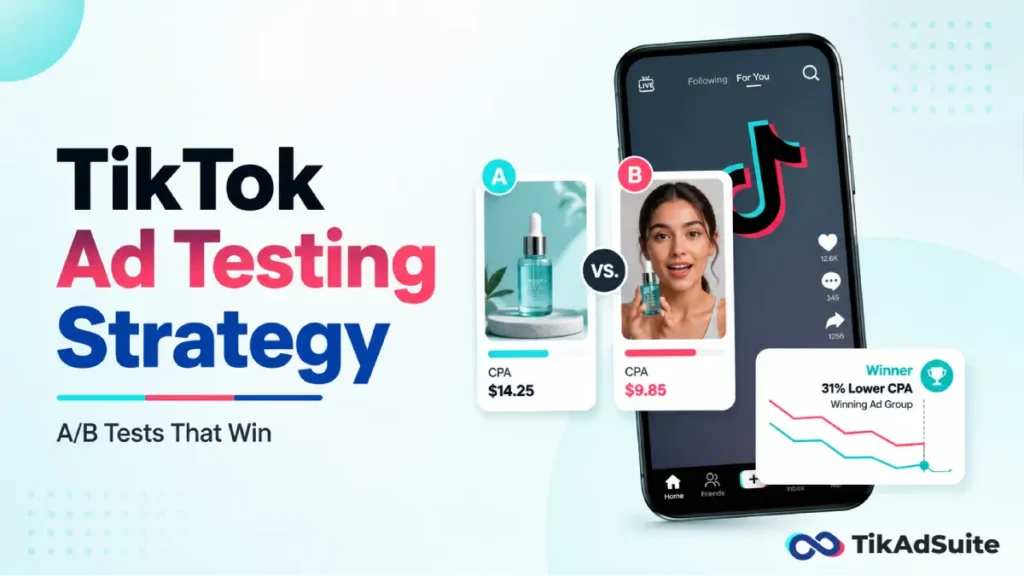
A TikTok ad test is a controlled experiment. You change one thing, keep everything else the same, and measure which version performs better. That single change might be the hook, the audience, the budget setting, or the call to action.
The goal is clean data. When only one variable differs, the result points to one clear cause. That is the whole point of TikTok testing: turn opinions into evidence you can act on.
Good testing also compounds. Each winning ad becomes the new benchmark to beat. Over months, that loop of testing TikTok creatives and audiences builds an account that gets cheaper and stronger, not one that resets every week.
The Account Hierarchy That Makes Testing Work
You cannot test well until you know where each test belongs. TikTok organizes every ad account into three levels: the campaign, the ad group, and the ad.
This TikTok ads account campaign ad group ad hierarchy is official, and it controls your whole setup.
Here is what each level does and where it fits into testing:
| Level | Controls | What you test here |
| Campaign | Objective and overall budget | The goal itself, like Traffic vs Conversions |
| Ad group | Audience, placement, bid, schedule | Different audiences and targeting |
| Ad | The actual video, text, and CTA | Creatives, hooks, and messaging |
Settings flow downward. A campaign-level objective applies to every ad group and ad inside it. So you test audiences by building separate ad groups, and you test creatives by adding different ads inside one ad group.
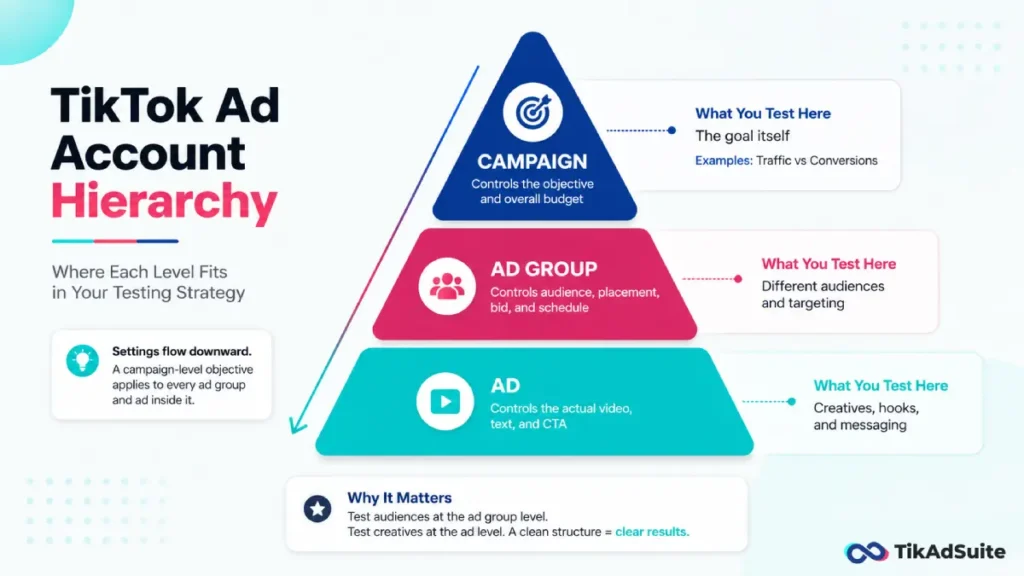
A clean structure makes your results easy to read, which is half the battle. If you want a deeper setup walkthrough, our guide on TikTok ads campaign structure breaks down each level in detail.
A/B Testing on TikTok: The Native Split Test Tool
A/B testing and split testing mean the same thing here. You compare version A against version B and let the data pick. TikTok built this directly into Ads Manager, so you do not need outside software for a clean test.
When you turn on Split Test during campaign creation, TikTok splits your audience into two equal, non-overlapping groups.
Group A sees one version, Group B sees the other. That separation stops your two ads from competing for the same users, which is what ruins most manual tests.
The native tool lets you split-test these variables one at a time:
- Targeting: broad vs narrow audiences, interests, or locations
- Placement: automatic vs manual placements
- Creative: different videos, formats, hooks, or CTA copy
- Bidding and Optimization: different bid and optimization setups
- Budget Strategy: how spend is allocated across the test
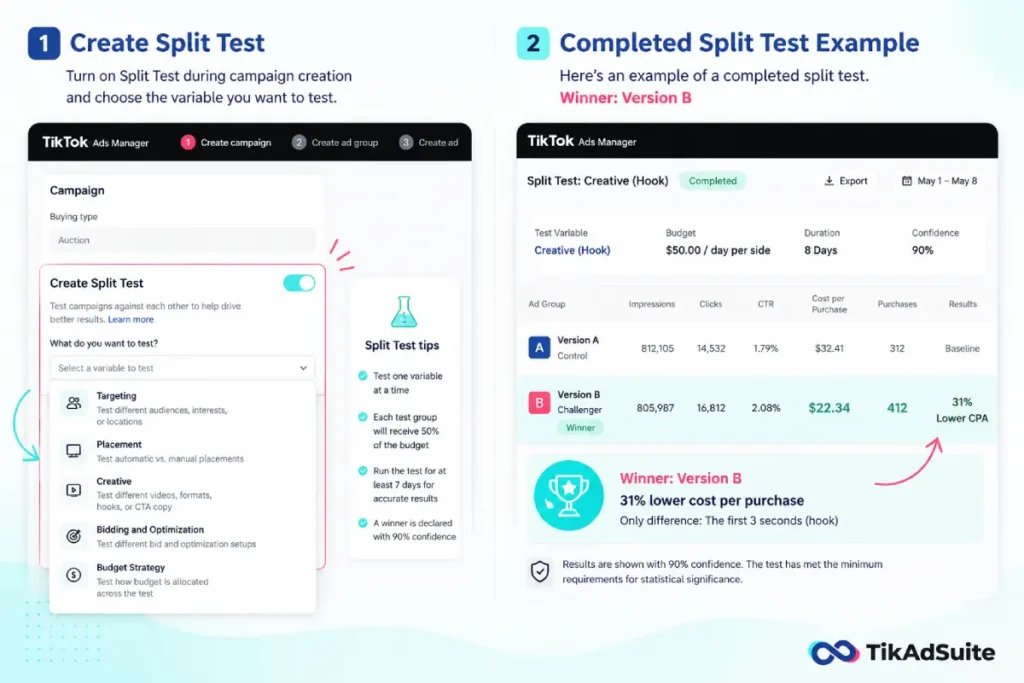
To launch one, open TikTok Ads Manager, click Create, pick your objective, then flip on the Create Split Test toggle before you build your ad group.
Set the test to run for at least seven days so the system gathers enough data to call a real winner.
A Real A/B Testing Example You Can Copy
Picture a skincare brand selling a $29 serum. Their best ad opens with a calm shot of the bottle. They suspect a bolder opening would stop more thumbs, so they run a split test.
The setup is simple. Version A keeps the calm bottle shot. Version B opens with a person saying, “I stopped using three products for this one.” Everything else stays identical: same body, same offer, same audience, same budget.
After eight days, Version B drives a 31% lower cost per purchase. The only difference was the first three seconds. That is a clean, trustworthy result, and the brand now uses that hook style as its new control. To go deeper on openings that stop the scroll, see our breakdown of high-performing TikTok ad hooks.
We ran this split test on a $34 vitamin C serum at $50 a day per side. Version A opened with the founder holding the bottle and talking to the camera. Version B opened with a fast before-and-after montage in the first two seconds.
Same body footage, same offer, same broad 18-to-34 audience. After eight days, Version B came in at a $19 cost per purchase versus $26 for Version A, about 27% cheaper. The only thing we changed was the opening, which is what made the read trustworthy.
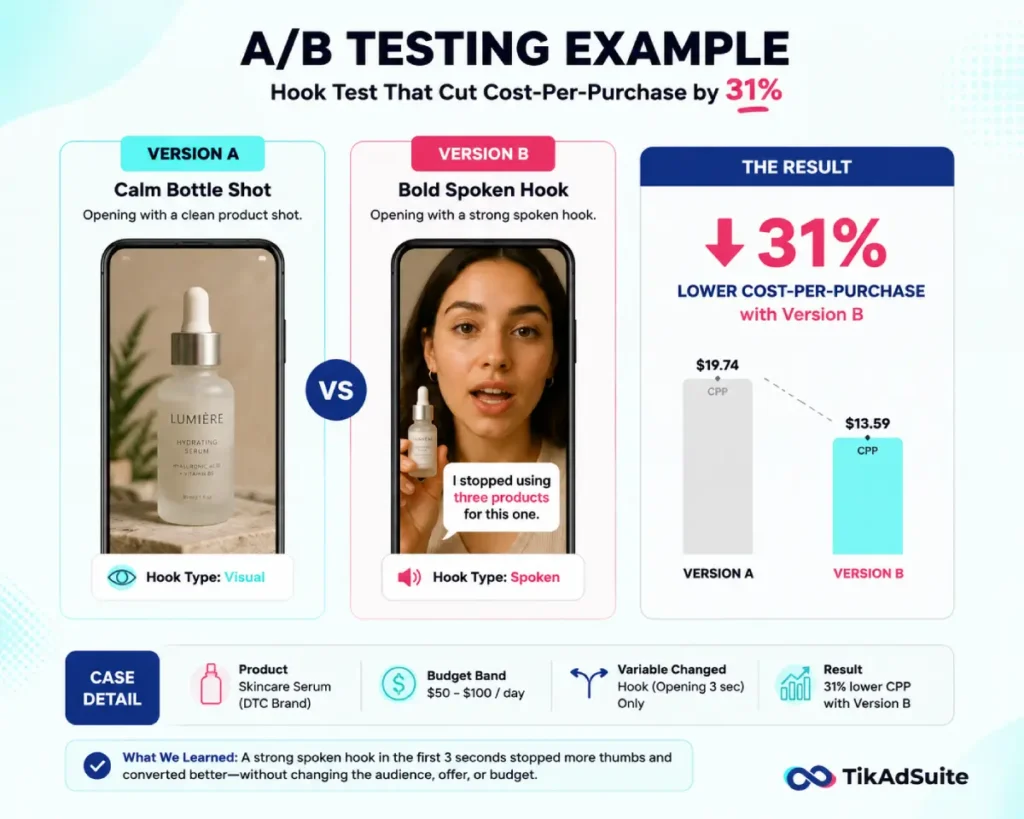
Notice what made this work. One variable changed. The audience never saw both ads. The test ran long enough to trust. Break any of those rules and the “winner” becomes a guess wearing a costume.
Testing Methods Beyond Simple A/B
A/B testing is the foundation, not the whole house. As your account grows, you need more ways to learn faster. Here are the main TikTok marketing test methods worth knowing.
Multivariate testing compares more than two versions at once. You might run four hooks against the same body to find the strongest opener quickly. It needs more budget because each version still needs enough data to be trusted.
Champion vs challenger is an ongoing loop. Your best ad is the champion. Every new test sends one challenger against it. If the challenger wins, it becomes the new champion. If it loses, you keep the champion and try again.
Holdout and incrementality testing answer a bigger question: are your ads actually causing sales, or would those people have bought anyway? You hold a portion of your audience back from seeing ads, then compare. This is how you measure true lift, not just clicks.
Modular creative testing breaks an ad into parts and tests the parts. You lock one body and one CTA, then test five hooks against them. This is the fastest, cheapest way to scale creative testing, which we will unpack next.
TikTok Ads Creative Testing, Step by Step
Creative is the single biggest lever on TikTok. The platform rewards fresh, native-feeling video, so creative testing matters more here than on most channels. Your structured framework starts with the hook.
Build a modular system. Film one strong body and one CTA. Then script and shoot five different hooks: a visual shock, a bold text question, an ASMR sound, a relatable problem, and a result reveal. Combine each hook with the same body to create five distinct ads.
You can produce these variations fast with an editor like CapCut, which makes swapping the first three seconds simple without reshooting the whole video.
Speed matters because TikTok creative burns out quickly, and you always want the next batch ready.
Here is the cadence we run: Five fresh hooks against one proven body every Monday, a full seven-day read, then the strongest hook becomes the challenger against our current champion the following week.
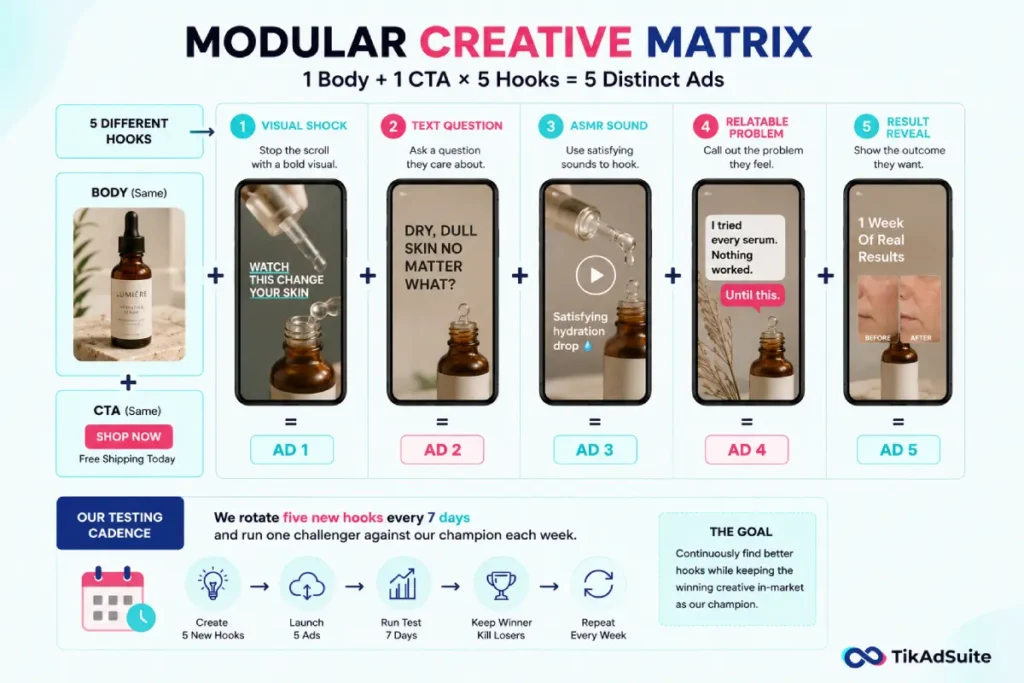
Run the variations, find the winning hook, then test new bodies against it. This loop never ends, and that is the point.
For a full system you can plug in, study our TikTok creative testing framework, and for native, trust-building footage, our guide on using UGC in TikTok ads pairs well with hook testing.
How to Read Results Without Crowning a Fake Winner
A winner is only real when the numbers are stable and significant. The most common testing mistake is calling a result on day two with twelve clicks of data. That is noise, not insight.
Give every test enough volume and time. TikTok’s split test waits for statistical significance before it names a winner, and you should hold yourself to the same standard for any manual test. Small samples lie.
Funding matters too. Each version needs enough impressions and conversions to be trusted, which takes daily budget.
New accounts can stretch their testing dollars with TikTok ad credit so early experiments reach significance instead of stalling halfway.
Tie your decision to your real goal, whether that is cost per purchase or cost per lead, and check it against your TikTok ad benchmarks before you scale.
We saw this testing two audiences in separate ad groups: a broad 18-to-34 group against a narrow skincare-interest group, $70 a day each. The broad group looked worse on day two, then overtook the narrow one by day eight once it cleared the learning phase. Reading it early would have crowned the wrong winner.
What Does Test Stand for on TikTok?
In TikTok advertising, “test” is not an acronym. It simply means running a controlled experiment, like an A/B test or split test, to find what performs best. There is no hidden meaning behind the word in Ads Manager.
You may see the term used differently outside of ads. In comment sections, some users type “test” to check whether their comment posts or their account is restricted. That usage is unrelated to advertising.
For marketers, just read “test” as “experiment.” When someone says they are testing TikTok ads, they mean comparing versions to learn what works, then scaling the winner.
How Long Should a TikTok Split Test Run?
TikTok recommends setting your split test schedule to at least seven days, so the system collects a useful sample before it names a winner. Ending sooner usually means deciding on noise.
New ad groups also pass through a learning phase first. Per TikTok’s official guidance, performance volatility typically starts to decline after about 25 results or 7 days, whichever comes first.
Reading results before that point gives you numbers that have not settled yet. Most performance tests run cleanly in the 7 to 14 day range, and you should avoid editing budgets or pausing a version mid-test, since that breaks the data split.
Frequently Asked Questions
What metrics should I watch to know if my TikTok ads creative is fatigued and when to swap it?
Watch frequency, click-through rate, and watch time together. A common swap trigger is frequency climbing past 3 for prospecting audiences while engagement falls. Industry analysis from Search Engine Land notes that a strong ad’s engagement usually drops about 20% to 30% week over week as it nears the end of its run, with rising CPM and a falling hook rate confirming the slide. Swap the creative when those signals appear together, instead of waiting for ROAS to collapse first.
What is the difference between A/B testing and split testing on TikTok?
There is no real difference. Both compare versions of an ad to find the better performer. TikTok uses “split test” for its native tool, while “A/B test” is the broader industry term. The key feature is audience separation, so each group sees only one version and the data stays clean.
Can I test more than two ads at once?
Yes, but be careful with budget. You can run several ads inside one ad group, or use multivariate testing to compare multiple versions. Each version still needs enough impressions and conversions to be trusted. Splitting a small budget across too many versions starves every test and produces results you cannot rely on.
Which variable should I test first?
Start with creative, especially the hook. On TikTok, the first three seconds decide whether anyone watches, so the hook moves results more than almost anything else. Once you have a winning creative, test audiences at the ad group level, then bidding and placement. Testing in that order gives you the biggest wins earliest.
Do I have to pay for TikTok’s split testing tool?
No. The Split Test feature is built into TikTok Ads Manager at no extra cost. You only pay for the ad spend that runs through the test. The tool itself handles audience separation and the statistical check that names a winner, which is the part you would otherwise pay outside software to do.
Putting Your Testing System to Work
The single most valuable habit you can build is this: change one variable, give it enough budget and time, then scale the winner and test again. That loop is your whole strategy in one sentence.
Start with your hooks, because that is where TikTok hides the biggest wins. Use the native split test tool so your data stays clean, and keep a fresh creative ready before fatigue sets in.
The advertisers who win are not the ones with the best single ad. They are the ones with the best testing system.
Open Ads Manager, pick one thing to test this week, and let the data decide. That is how good accounts quietly turn into great ones.