
Getting app installs is straightforward. Getting users who actually open the app, complete onboarding, and come back the following week is a different problem entirely.
Most app promotion campaigns chase the easier number and then wonder why retention looks poor three weeks later.
TikTok’s App Promotion objective is designed to handle both ends of that problem, but only if you choose the right optimization type, handle iOS and Android setup differently, and build creative that moves someone from watching a 15-second video to downloading your app.
In this guide, you will learn:
- How TikTok’s App Promotion objective works
- The difference between MAI, AEO, and VBO, and when each one makes sense
- How iOS and Android campaigns differ in setup and measurement
- What creative formats perform best for app ads
- The metrics that actually tell you whether a campaign is working
Get Up to $6000 Free TikTok Ad Credit
Table of Contents
Key Takeaways
- TikTok’s App Promotion objective offers three optimization types: Mobile App Install, App Event Optimization, and Value-Based Optimization
- App Event Optimization goes beyond installs to target users likely to complete specific in-app actions like purchases or subscriptions
- iOS and Android campaigns require different setups due to Apple’s SKAdNetwork requirements
- According to a meta-analysis conducted with Adjust, TikTok drives 19% more assisted app installs compared to other major platforms in North America, with cost per install running up to 65% lower across select app categories
- Creative that shows the app in actual use consistently outperforms generic promotional content
Quick Answer
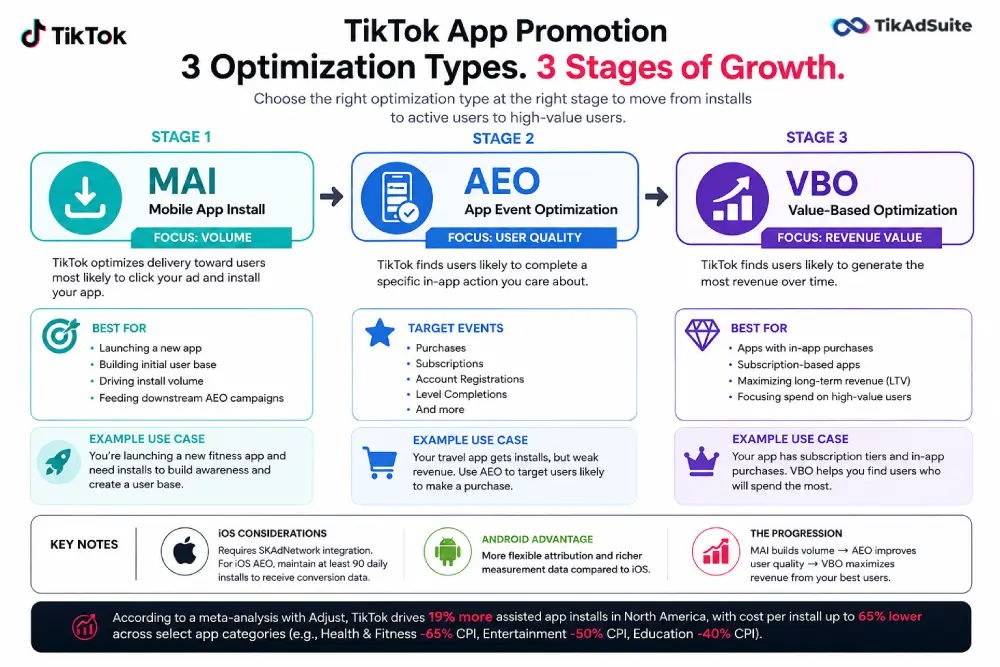
TikTok ads for app promotion use a dedicated App Promotion campaign objective with three optimization options: Mobile App Install (MAI) for volume-focused install campaigns, App Event Optimization (AEO) for targeting users who complete specific in-app actions, and Value-Based Optimization (VBO) for maximizing revenue from high-value users. iOS campaigns require SKAdNetwork integration, while Android campaigns offer more flexible attribution. Each optimization type suits a different stage of your app’s growth.
Why TikTok Works for App Promotion
TikTok’s short-form video format is naturally suited to app discovery. A 15-second video can show your app’s interface, demonstrate a core feature, or capture a real use case in the time it takes to read two sentences of a text ad. Users do not need to imagine what the app does because they can see it working.
The performance data backs this up. According to a TikTok meta-analysis, TikTok drives 19% more assisted app installs than other major advertising platforms in North America, with US figures at 15% higher and Canada at 24% higher. The same analysis found that TikTok consistently delivers lower cost per install across app categories compared to other platforms, with health and fitness apps seeing 65% lower CPI, entertainment apps 50% lower, and education apps 40% lower.
That cost efficiency matters because app marketing budgets rarely go as far as advertisers want them to. Getting more installs at a lower cost per install means more budget available for retention-focused campaigns downstream.
TikTok’s App Promotion Objective: The Three Optimization Types
When you select App Promotion as your campaign objective in TikTok Ads Manager, you choose how TikTok optimizes ad delivery. According to TikTok’s official App Promotion documentation, the three available options are Mobile App Install, App Event Optimization, and Value-Based Optimization. Each one targets a different type of user and fits a different stage of growth.
Mobile App Install (MAI)
MAI is the most direct option. TikTok optimizes delivery toward users most likely to click your ad and install your app from the App Store or Google Play. This is the right starting point when you are launching a new app, building an initial user base, or need install volume to feed downstream AEO campaigns.
MAI works best when your app has strong organic retention. If a large share of users install and never open the app past day one, install volume alone is not solving your LTV problem. That is where AEO becomes useful.
App Event Optimization (AEO)
AEO goes beyond the install event. Rather than finding users likely to download your app, it finds users likely to complete a specific action inside it. According to TikTok’s AEO documentation, those target events include purchases, subscriptions, account registrations, and level completions, among others.
A travel app that generates high install volume but weak customer lifetime value, for example, can use AEO to set Purchase as the key event.
TikTok then focuses on delivery to users with a demonstrated tendency toward that specific action rather than just those likely to install and leave.
When an AEO campaign launches, it enters a learning phase where TikTok collects conversion signal data before optimizing delivery.
Avoid making significant changes to bid, budget, or creative during this period. For iOS AEO campaigns specifically, TikTok recommends maintaining at least 90 daily app installs to prevent Apple’s SKAdNetwork from withholding conversion data, which would make campaign performance unreliable to measure.
Value-Based Optimization (VBO)
VBO targets the highest-spending users rather than optimizing for a single event. Instead of finding people likely to make one purchase, it finds people likely to generate the most revenue over time.
This is the right choice for apps with subscription tiers, in-app purchases, or spending behavior where not all users carry equal value.
VBO needs a solid base of historical conversion data to function properly. It is generally the third stage: MAI builds volume, AEO refines user quality, and VBO concentrates spend on your most valuable segment.
iOS vs Android: What Changes in Your Campaign Setup
iOS and Android app promotion campaigns are not set up the same way, and treating them identically is one of the more common mistakes in app campaign management.
For iOS, TikTok supports Apple’s SKAdNetwork (SKAN) framework, including SKAN4, which allows advertisers to use conversion values for campaign reporting while respecting Apple’s privacy requirements.
The tradeoff is that conversion data is less granular than Android, and lower install volumes can result in null conversions being reported, which makes optimization harder to act on.
Android campaigns offer more flexibility. Attribution windows are configurable. AEO Every (which optimizes for multiple purchase events per user rather than just the first) is available on Android only, and data returns are less constrained by privacy frameworks.
If you are running app promotion campaigns for the first time with a cross-platform app, starting your testing on Android gives you cleaner performance data before scaling to iOS.
Creative That Works for App Promotion
App promotion creative has one job that most other ad creative does not: it needs to show someone what they are downloading before they commit to the install. That specificity changes how you should approach the format.
These content types perform consistently across app categories:
- In-app screen recordings: Show the actual interface with a voiceover or text overlay. This removes the guesswork about what the app does and who it is actually built for.
- Problem-solution structure: Open with a frustration the viewer likely recognizes, then show the app resolving it in real time. This works well for productivity, finance, and fitness apps where the problem is concrete.
- Real user testimonials: Short clips of actual users describing a specific outcome they got. Specificity matters here. “I paid off $4,000 in three months using this” converts better than “this app changed my life.”
- Tutorial-style walkthroughs: Demonstrate one core feature in 15 seconds or less. Users who understand how to use your app before downloading it tend to become higher-quality installs.
For producing multiple creative variations quickly, CapCut supports screen recording overlays and text-on-screen templates that suit app demo content without needing a production crew.
For a structured method for testing which format works best for your specific app, the TikTok creative testing framework guide covers how to isolate creative variables and produce data you can actually act on.
Key Metrics for App Promotion Campaigns
Standard metrics like CTR and CPM give you a surface-level read.
For app promotion, these tell you more:
| Metric | What It Tells You |
| Cost Per Install (CPI) | Efficiency of your MAI campaigns |
| Day 1 / Day 7 Retention Rate | Quality of users being acquired |
| Cost Per In-App Event | Efficiency of AEO campaigns |
| Install-to-Action Rate | How many installs reach your target event |
| ROAS from In-App Purchases | Return from VBO campaigns |
Watching CPI alone is a trap. A low CPI paired with a poor install-to-action rate means you are acquiring users cheaply who do not do anything valuable inside the app. The stronger signal comes from pairing CPI with your target in-app event rate.
Retention is also worth tracking beyond day one. The Adjust meta-analysis referenced above found that TikTok-acquired users show an 8% lower uninstall rate compared to users acquired through other platforms, which suggests that better-matched creative and targeting produce more engaged users downstream.
For a deeper look at reading performance data across your app campaigns, the TikTok ads metrics guide covers which signals in TikTok Ads Manager are worth acting on and which ones tend to mislead.
Common Mistakes in App Promotion Campaigns
Starting with AEO before MAI has enough volume. AEO needs to install data to optimize from. Launching AEO on a fresh account or new app with minimal install history produces a slow, unpredictable learning phase.
Build an install volume with MAI first, then shift to AEO once you have enough data to support it.
Underfunding the learning phase. TikTok recommends budgeting at a minimum of 10 to 20 times your historical CPA during the learning phase. Starting with a budget too small to generate meaningful conversion signals stretches the learning phase and delays useful optimization.
Running identical creative across iOS and Android. What resonates with one audience does not automatically transfer to the other. Test creative separately for each platform rather than assuming results will carry over.
Tracking installs without post-install data. If you only measure what happens inside TikTok Ads Manager and never connect post-install data from a mobile measurement partner, you have no way to verify whether your campaign is actually acquiring users who matter to your business.
For guidance on layering audience signals to improve user quality at the top of the funnel, the TikTok ad targeting options guide covers how to combine demographic, interest, and behavioral targeting for app campaigns.
FAQ
What is the difference between MAI and AEO on TikTok?
MAI optimizes for app downloads, targeting users most likely to install your app. AEO targets users likely to complete a specific action after installing, such as making a purchase or finishing registration. Use MAI to build install volume early on, and switch to AEO once you want to prioritize user quality over raw install numbers.
Do I need a mobile measurement partner to run TikTok app promotion ads?
You do not need one for basic MAI campaigns. For AEO and VBO campaigns, a mobile measurement partner is strongly recommended because it lets you track what users do after installing the app. Without that data, you cannot evaluate whether your campaign is acquiring users who generate real long-term value.
Can I run app promotion ads for both iOS and Android in the same campaign?
You can, but separating them gives you cleaner data and better control. iOS campaigns work within Apple’s SKAdNetwork constraints, which limit attribution granularity. Android campaigns have more flexible tracking. Running them together makes it harder to optimize creative and budget independently for each platform.
How do I know if my AEO campaign is out of the learning phase?
TikTok’s delivery stabilizes once your campaign has accumulated enough conversion events for the algorithm to identify patterns. Avoid editing bids, budgets, or creatives until delivery normalizes. Campaigns with higher daily budgets and broader targeting typically exit the learning phase faster than tightly constrained ones.
What budget should I start with for a TikTok app promotion campaign?
For MAI campaigns, aim for a daily budget that generates at least 20 to 50 installs per day to give the algorithm enough signal to optimize delivery. For AEO, budget at a minimum of 10 to 20 times your target cost per in-app event during the learning phase. Starting below these thresholds typically extends the learning period and delays reliable performance data.
Wrapping Up
TikTok’s App Promotion objective gives you real precision over who you acquire and what you pay for them.
MAI builds volume, AEO targets users who take specific in-app actions, and VBO focuses spend on the users most likely to generate revenue. Each stage builds on what came before.
Creative that shows your app in action, metrics that go beyond install count, and separate setups for iOS and Android are the three decisions that separate campaigns that work from ones that just spend budget.
Set up your campaigns through TikTok for Business and connect a mobile measurement partner before launch. Together, those two steps give you the signal you need to optimize every campaign that follows.