
Food has always been one of TikTok’s best-performing content categories, and that is not a coincidence.
A sizzling pan, a slow pull of melted cheese, or a barista pouring latte art triggers the same reward response in the brain as watching the dish actually arrive at the table.
Restaurants and cafes have a built-in creative advantage on this platform that most other businesses simply do not have.
The challenge is converting that natural engagement into paying customers. That is where TikTok ads come in. Organic food content can go viral and drive foot traffic one week, then disappear the next.
Paid campaigns give you consistent, targeted reach so the right people see your content at the right time, whether you are launching a new menu item, filling seats during a slow midweek period, or building awareness for a new location.
In this guide, you will learn:
- Why does food content perform differently on TikTok than on other platforms
- Two verified real-world examples of F&B brands using TikTok ads effectively
- Which ad formats work best for restaurants and cafes
- How to build campaigns around menu launches, promotions, and UGC
- The mistakes that keep restaurant TikTok ads from converting
Get Up to $6000 Free TikTok Ad Credit
Table of Contents
Key Takeaways
- According to Toast’s restaurant marketing research, 36% of TikTok users have visited or ordered food from a restaurant after seeing a TikTok video about it
- Konesso, a specialty coffee brand, achieved an 80.4% increase in revenue and a 77.6% increase in transactions using authentic TikTok-native content in paid campaigns, verified by TikTok for Business
- Food content’s visual and sensory appeal gives F&B brands a natural engagement advantage, but that advantage only converts when paired with a clear campaign objective
- Spark Ads that boost genuine customer content outperform polished brand ads in most restaurant and cafe campaigns
- Menu launch campaigns and seasonal promotions respond well to a short, high-spend burst model rather than always-on low-budget delivery
Quick Answer
TikTok ads work for restaurants and cafes by pairing food’s natural visual appeal with targeted paid delivery to local audiences. Spark Ads that boost authentic customer or staff content are the most effective format for most F&B businesses. Lead generation and Traffic objectives work well for reservations and online orders. The best-performing content shows food being prepared, plated, or enjoyed rather than a traditional promotional video.
Why Food Content Has a Natural Advantage on TikTok
Most industries have to earn TikTok engagement. Food earns it by existing.
The platform’s algorithm prioritizes content that drives watch time and repeat views. Food content, specifically the preparation, the texture, the pour, and the reveal, is one of the most naturally rewatchable content categories on the entire platform.
#food has accumulated hundreds of billions of views. Users discover new restaurants through their For You feed the same way a previous generation discovered them through word of mouth.
What makes this useful for paid campaigns is that the starting engagement bar is lower. A restaurant ad built around 15 seconds of a genuinely appetizing dish already has more in common with organic content than most categories can achieve, which means TikTok’s algorithm distributes it more efficiently, and your cost per result reflects that.
According to Toast’s restaurant TikTok marketing research, 36% of TikTok users have visited or ordered food from a restaurant after seeing a TikTok video about it.
That is a direct purchase action triggered by content, not by search intent, which makes TikTok fundamentally different from every other restaurant marketing channel.
TikTok Restaurants and Cafes Case Study: Konesso
Konesso is a specialty coffee and tea webshop based in Poland, built for genuine coffee connoisseurs. On TikTok, their account focuses on authentic, expertise-driven content that showcases the people behind the brand alongside professional brewing tips.
Rather than running standard promotional campaigns, Konesso tested a hypothesis: would non-sales content, content that built brand love rather than pushed product, outperform typical conversion ads?
They ran a campaign using TikTok’s Smart+ format, which allowed high-performing organic content to be used directly within paid campaigns.
The creative strategy deliberately moved away from sales-led hooks in favor of content that felt native to TikTok. Broad geographic targeting across Poland was the only audience restriction.
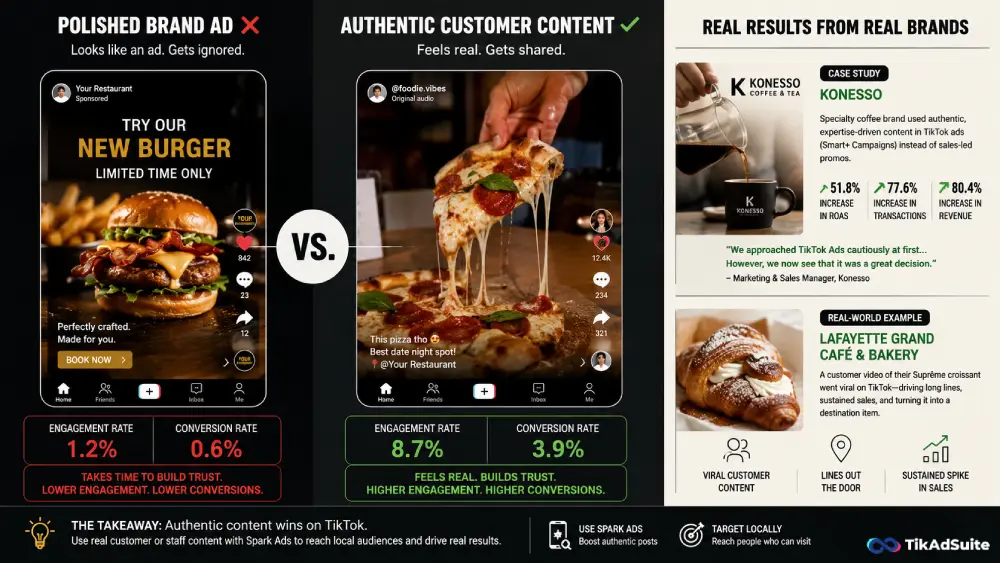
The results, verified directly by TikTok for Business, were significant. The campaign delivered a 51.8% increase in ROAS, a 77.6% increase in the number of transactions, and an 80.4% increase in revenue. Konesso’s Marketing and Sales Manager summed it up directly: “We approached TikTok Ads quite cautiously at first and didn’t have high expectations regarding sales or ROAS. However, we now see that it was a great decision.”
The Konesso case is a clean demonstration of what consistently works for F&B brands on TikTok: authenticity and platform-native content outperform polished advertising every time.
TikTok Restaurants and Cafes Case Study: Lafayette Grand Café & Bakery
In early 2022, Manhattan’s Lafayette Grand Café & Bakery released a pastry called the Suprême croissant. They did not run a conventional marketing campaign. The croissant found its way onto TikTok through customer videos, and the content spread organically across the platform.
The result, as documented by CloudKitchens, was lines forming outside the café and a sustained spike in sales that outlasted the initial viral moment. The Suprême croissant became a destination item.
The lesson for paid campaigns is clear: when real customers film and share food content, it converts better than anything produced in-house. The discovery mechanism is credible, the content feels earned, and the social proof is visible in the comments and engagement.
TikTok ads built around that kind of content, through Spark Ads or a creative that replicates the organic feel, are the format that most restaurant and cafe campaigns should default to.
The Best TikTok Ad Formats for Restaurants and Cafes
Spark Ads: The most powerful format for most F&B businesses. When a customer films your food and posts it organically, you can boost that post as a Spark Ad to reach a targeted local audience while keeping all of the original engagement intact. The content looks nothing like an ad because it was not originally built as one. For more on when Spark Ads outperform In-Feed ads, the Spark Ads vs In-Feed Ads guide covers the decision points clearly.
In-Feed Ads: Work well for menu launches, limited-time offers, and event promotion. The format supports Traffic, Lead Generation, and Conversion objectives. For driving online orders, pairing In-Feed ads with a Traffic objective and a direct link to your ordering platform keeps the conversion path short.
Lead Generation Ads: Suited to reservation-based restaurants, catering inquiries, and event bookings. A native TikTok lead form captures name, contact details, and a qualifying question like party size or preferred date without requiring users to leave the app.
Content That Actually Converts for F&B Brands
The content types that generate the highest engagement and lowest cost per result for restaurant and cafe campaigns share one characteristic: they show the food, not the brand.
Preparation and process content: Behind-the-scenes footage of dough being stretched, sauce being reduced, or coffee being pulled converts because it builds anticipation and demonstrates craft. This content rewards watch time naturally, which improves TikTok’s delivery efficiency.
The reveal moment: The finished dish appearing, a lid being lifted, or a drink being passed across the counter. Short and visually specific. This format works particularly well as the hook for longer conversion ads.
Staff-led content: A barista explaining the origin of a single-origin bean. A chef is walking through a new seasonal menu item. Staff content builds the human connection that turns a first-time visitor into a regular.
According to TikTok for Business, content that shows the people behind the brand builds trust that accelerates the conversion process, a principle that applies as strongly to food as it does to any other category.
Customer reactions: First-bite reactions, unboxing a delivery order, or filming inside the space. This is the category most suited to Spark Ads because the content already exists if your product is good. For a full guide on how to incorporate this type of content into paid campaigns, the how to use UGC in TikTok ads guide covers the approach and authorization process.
Sound design also matters more in food content than in most other categories. ASMR elements, sizzling, pouring, and crunching, are among TikTok’s highest-engagement audio formats. The best music for TikTok ads guide covers how to choose audio that works with food content rather than competing with it.
Building Campaigns Around Menu Launches and Seasonal Promotions
Restaurant and cafe campaigns rarely benefit from the always-on, steady-budget approach that works for ecommerce or lead generation.
Menu launches and seasonal promotions respond better to a burst model: higher spend concentrated over a shorter window to build awareness quickly before organic word-of-mouth takes over.
A practical burst campaign structure for a menu launch:
- Run In-Feed ads with a Traffic or Reach objective for 5 to 7 days ahead of the launch
- Switch to a Conversion or Lead Gen objective from the launch date for reservations or online orders
- Set up a retargeting ad group for users who watched at least 50% of the launch video but did not convert
Front-load spend in the first three days to maximize reach during the peak interest window. Local geographic targeting keeps the budget focused on people who can actually visit, rather than a broader audience that engages but never converts.
For targeting structure and how to separate cold and warm audiences within the same campaign, the TikTok ads audience segmentation guide covers the three-tier model that applies cleanly to restaurant campaign cycles.
Common Mistakes Restaurant Owners Make on TikTok Ads
Running polished ads when authentic content exists: If customers are already filming your food and posting it, that content will almost always outperform a professionally produced ad. Use what you have before investing in production.
Targeting too broadly: A restaurant serving a single neighborhood does not need city-wide reach. Tight geographic targeting keeps your CPM lower and your conversion rate higher by showing the ad only to people who can realistically visit.
Ignoring the hook entirely: The first two seconds of a restaurant ad carry the same weight as every other TikTok ad. A slow pan across a dining room loses viewers before the food even appears. Open on the food, the steam, the pour, or the pull. The TikTok ad hooks guide covers formats that stop the scroll in content-heavy environments like food.
No clear call to action: Engagement without direction does not pay the bill. Every ad needs one specific next step. Order online. Reserve your table. Visit us this weekend. Vague CTAs produce low conversion rates regardless of how strong the creative is.
FAQs
Do TikTok ads work for small independent restaurants and cafes?
Yes. TikTok’s minimum budgets are accessible for independent operators, and the content types that perform best, phone-shot food preparation, staff introductions, and customer reaction clips, require no production budget. The platform’s algorithm distributes based on content relevance, not account size, which means a small cafe can reach a large local audience without competing on spend alone.
What TikTok ad objective should a restaurant use?
For foot traffic and awareness, Reach and Traffic objectives work well. For online orders and reservations, Conversion or Lead Generation objectives are more appropriate. For most independent restaurants and cafes starting out, Traffic, paired with a direct link to your ordering platform, is the most straightforward entry point.
How do I turn a customer’s TikTok video into an ad?
Through Spark Ads. You contact the creator, request a Spark Ads authorization code through TikTok’s creator authorization process, and use that code to boost the organic post as a paid ad. The post stays on the creator’s profile with all existing engagement intact, and your paid delivery extends its reach to your targeted local audience.
How much should a restaurant spend on TikTok ads?
Start with enough daily budget to run one focused ad group for two weeks at TikTok’s minimum. For a single local campaign, a testing budget of $300 to $500 over two weeks produces enough data to evaluate whether the channel works for your specific market and offer before scaling.
Wrapping Up
Food does not need to be sold on TikTok. It needs to be seen. The platform’s format already works in your favor as long as the content shows something real, sounds like something real, and points viewers toward one clear action.
The Konesso results and the Lafayette example both point to the same conclusion: authenticity drives performance in F&B TikTok campaigns more reliably than production quality or ad spend.
Show the process, feature the people, let the food speak, and build the campaign structure around that content rather than trying to force it into a format it was never designed for.
Start your campaigns through TikTok Ads Manager and use CapCut to edit your content into short, hook-first clips that feel native to the platform from the first frame.