
A pretty drone shot of a turquoise bay still gets views. It rarely gets the booking on its own.
Travelers now use TikTok to plan, not just to dream. They want to know the route, the real cost, the catch, and who to trust before they pay. A hotel, tour operator, or tourism board that answers those questions in its ads moves from gallery to guide.
The nine tactics below show how to do that with TikTok ads, from itinerary videos and local creators to search placements, Instant Pages, and countdown offers. Each one comes with the ad setup that runs it.
Get Up to $6000 Free TikTok Ad Credit
Table of Contents
Quick Answer
TikTok tourism marketing works best when your videos help people plan a trip: day-by-day itineraries, honest costs, local voices, and clear safety or timing details. Pair that content with ad tools that catch people while they plan, such as search placements, Spark Ads from local creators, fast Instant Pages, and catalog-based Travel Ads for hotels and flights. In the US, TikTok GO also lets people book hotels and tours inside the app.
Key Takeaways
- Useful beats pretty: Videos that teach people how to get around a place give viewers a reason to save and book.
- Search is a real channel: People search TikTok for trip ideas, so check your search placement settings and keyword lists.
- Local voices earn trust: A creator who knows the area, run as a Spark Ad, sounds like advice rather than a sales pitch.
- Off-peak is an opening: Use ads to fill quieter months with value-focused offers.
- Speed matters on mobile: A slow booking page wastes ad spend, so give people a fast first stop before checkout.
1. The Itinerary Drop (Search Intent Strategy)
A ready-made itinerary is one of the strongest tourism marketing tactics on TikTok because it removes the hardest part of a trip: planning. Travelers face too many choices, and a clear plan makes yours the easy one to follow.
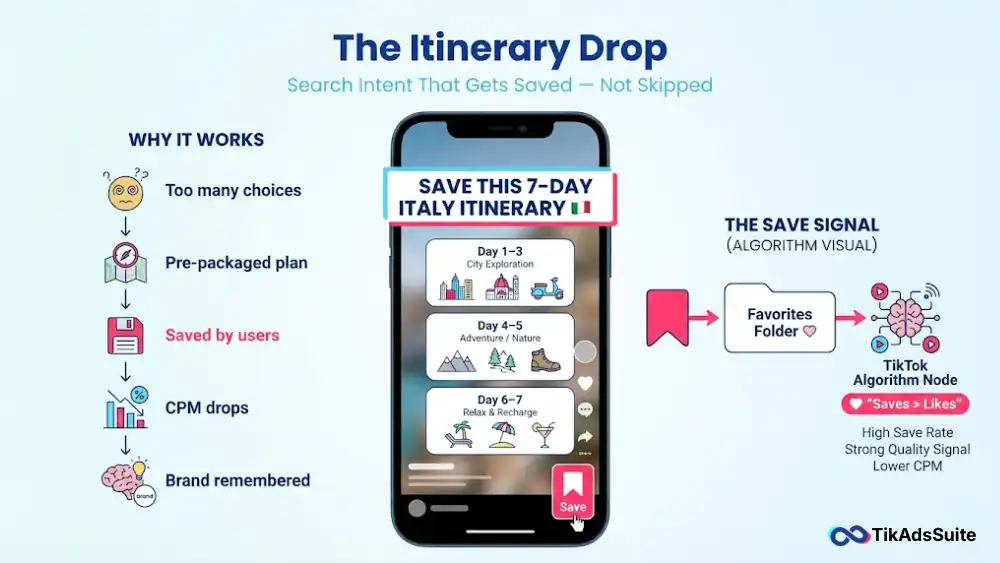
The tactic: Create a video series built around a save-worthy plan, such as a 7-day trip to your destination.
- Days 1 to 3: City highlights and food.
- Days 4 and 5: Nature or adventure.
- Days 6 and 7: Rest, with your property or tour as the anchor.
Why it works: A saved itinerary stays in the viewer’s Favorites, so your brand is there again when they sit down to book.
The ad setup:
- Objective: Traffic or Sales, depending on whether you track bookings on your site.
- Keywords: Itinerary, travel guide, and things to do in your destination, added to a Search Ads Campaign, which targets chosen keywords on the TikTok search results page.
2. The Cost Ledger (Radical Transparency)
A cost breakdown video tells people exactly what a trip to your destination costs, which answers their biggest worry before they ask. Hidden fees and vague prices make travelers hesitate, and a clear ledger removes that doubt.
The tactic: Produce a video that lists the real cost of a short trip.
- Visual: A receipt or a simple spreadsheet on a green screen.
- Script: Walk through flights, lodging, food, and activities with your own current prices, then show the total.
- Hook: Think your destination is too expensive? Here is what a long weekend really costs.
Why it works: It qualifies your audience. People outside the budget scroll on, and people inside it feel they can trust you because nothing is hidden.
Tool tip: Need to know if budget travel is trending for your destination? Use the TikTok Trend Tracker to see if users are searching for luxury or cheap keywords related to your city, and adjust your ad copy accordingly.
3. The Don’t Go Here (Negative Hook)
A negative hook stops the scroll because it sounds like a warning, not an ad. A beautiful sunset looks like every other travel video, while a warning makes people want the rest of the story.
The tactic: Open with a warning, then pivot to your answer.
- Hook: Don’t visit [your destination] in [busy month] unless you like long lines.
- The pivot: Show the quieter time, route, or place your business offers, and why it solves the problem.
Why it works: The viewer stays to learn what to avoid. Once they stop, you show your selling point. Keep the warning true, because a hook that misleads will hurt trust and reviews.
4. Spark Ads with Local Guides (Not Influencers)
A local guide who explains your area’s history and hidden spots earns more trust than a creator who only takes selfies. Travelers want inside knowledge, and a guide sounds like someone who has it.
The tactic: Find a local creator who already makes educational content about your region.
- The partnership: Pay them to make a hidden gems video that features your tour, hotel, or attraction.
- The ad: Run that post as a Spark Ad. TikTok’s Spark Ads creation guide explains that the creator generates an authorization code from the video’s Ad settings in the TikTok app, and you can batch authorize up to 20 video codes at a time in Ads Manager.
Why it works: An ad from a known local account feels like a tip from a friend. An ad from a big brand account feels like a pitch.
If you sell hotels, attractions, or tours in the US, creators have one more reason to feature you. TikTok GO, announced on May 12, 2026, lets people in the US book hotels, attractions, and tours inside TikTok through partners such as Booking.com, Expedia, Viator, GetYourGuide, Tiqets, and Trip.com, and creators can earn commissions on those bookings.
5. The Shoulder Season Arbitrage
Shoulder season ads target value-minded travelers in the quieter months between peak and off-peak, when you have rooms or seats to fill. Peak season often brings more competition for the same travelers, while the shoulder months leave empty capacity.
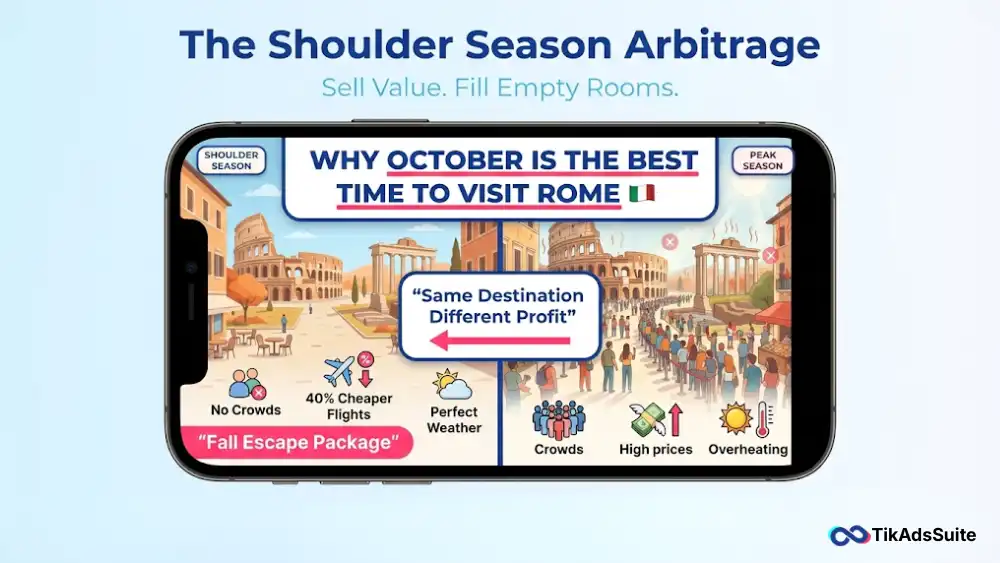
The tactic: Speak to the value traveler with off-peak messaging.
- Creative angle: Why [shoulder month] is a great time to visit [your destination].
- Selling points: Smaller crowds, your own lower rates, and the weather you can honestly promise.
- The offer: A seasonal package with a clear extra, such as a free room upgrade or an included tour.
Why it works: You solve the traveler’s problem (crowds and cost) and your own (empty rooms) at the same time.
6. Automatic Search Placement and Search Ads
TikTok search ads put your offer in front of people who are already looking for trip answers. Those searchers are filtering options, not just dreaming, so they sit closer to a booking.
TikTok’s Automatic Search Placement is the feature formerly called the Search Ads Toggle; it shows your in-feed ads on search results pages, is on by default for new campaigns, uses your existing creative and targeting rather than keyword bids, and lets you add negative keywords to keep ads away from search terms that do not fit.
The tactic: Use both tools for different jobs.
- Automatic Search Placement: Leave it on for your main campaigns, then review the search terms your ads showed for and add poor matches as negative keywords.
- Search Ads Campaign: Build keyword lists around specific trip questions, for example:
- Is [destination] safe for solo travelers?
- Best family resorts in [region]
- Hotels in [city] with a balcony
Why it works: When your ad answers the exact question someone typed, it meets them at the moment they are choosing.
7. Instant Pages for Mobile Speed
A TikTok Instant Page gives travelers a fast first stop between your ad and your booking engine. Many travel sites are heavy, with complex date pickers that load slowly on a phone.
The tactic: Use TikTok Instant Pages as a bridge.
- The flow: Ad, then Instant Page, then your booking engine.
- Content: Treat the page like a mini-brochure. Show room types or tour options, the top things to do nearby, and a clear Check Availability button.
According to TikTok’s Instant Pages overview, these pages load up to 11 times faster on TikTok than a standard web page and work with the Traffic, Website conversions, Reach, and Video views objectives.
Why it works: Fewer people leave while a page loads. The people who click through to your slower booking engine have already seen the details and are more ready to book.
Tool tip: Unsure whether your ad and landing page tell the same story? Use the TikTok Ad Creative Audit Tool to check if your ad visuals match your destination page, so the jump from ad to page feels natural.
8. The Solo Traveler Safety Angle
Safety ads answer the first question many solo travelers ask: will I feel safe there? Speaking to that worry directly can win a loyal group of guests.
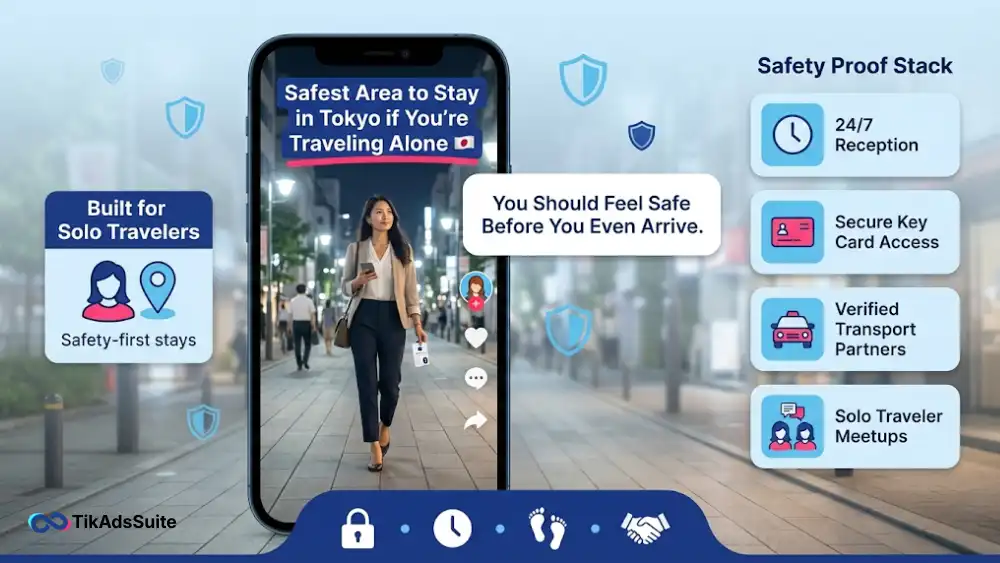
The tactic: Create ads that address safety concerns head-on.
- Visual: A solo traveler walking through a well-lit area or using your secure key card.
- Script: The best area to stay in [city] if you are traveling alone.
- The promise: Show only what you truly offer, such as round-the-clock reception, trusted transport partners, or solo traveler meetups.
Why it works: You answer the main objection before it is raised, which builds trust fast.
9. Flash Sale Urgency Countdowns
A countdown ad gives travelers a reason to book today instead of someday. Many people delay a booking until a clear deadline pushes them to act.
The tactic: Add a countdown to a limited-time offer.
- The offer: A two-day sale on a package or route you can truly discount.
- The mechanism: TikTok’s Countdown Sticker adds a timer to a single video ad that stays on screen for the whole ad, switches from days to hours, minutes, and seconds when less than 72 hours remain, and lets viewers set a reminder or add the deadline to their calendar.
- Retargeting: Show the offer to people who watched at least half of your itinerary video (tactic 1) but did not book. Per TikTok’s engagement audience guide, video ad audiences can be built from 25%, 50%, 75%, or 100% views, with lookback windows from 7 to 180 days.
Why it works: Nobody likes paying more next week for the same trip. A visible deadline gives people a reason to decide now.
Technical Setup: Structuring the Campaign
A tourism campaign on TikTok needs a clear campaign structure so each tactic gets its own budget and results you can read.
Campaign level
- Objective: Sales (website), so TikTok optimizes for bookings tracked by your pixel.
- Budget: Turn on campaign budget optimization so spend moves to the best ad group, such as solo travel versus family trips.
Ad group level
- Targeting: Start broad on age and let the creative find the right travelers.
- Location: Target your feeder markets. A Florida resort, for example, might target New York and Chicago during the winter.
- Interests: Travel-related categories that fit your offer, such as adventure travel or luxury stays.
Ad creative level
- Format: full-screen vertical video.
- Sound: Keep it on, with a vlog-style voiceover.
- CTA: Book Now or Check Availability.
If you sell many hotels, rooms, or routes, look at catalog ads too. TikTok’s Travel Ads overview describes them as catalog-based ads powered by Smart+ that promote hotels, flights, and destinations, with destination catalogs still in beta.
Tool tip: Need to work out the return on your flash sale campaign? Use the TikTok ROI Calculator to enter your average booking value and ad spend, and find your break-even CPA.
More helpful articles you’ll want to explore:
- TikTok Ads Credit: How the Cash Back Promo Works
- TikTok Ads Troubleshooting Guide: How to Fix Low CTR and Boost Performance
- TikTok Ads for Travel Companies: Proven Strategies to Turn Views Into Bookings
FAQ: TikTok Tourism Marketing
How does TikTok marketing work for the travel industry?
TikTok marketing for the travel industry works by meeting people while they look for trip ideas, then giving them a quick path to book. TikTok’s Travel Ads announcement cites its own research: 84% of users watch travel content at least once a month, 66% of US users in an April 2024 survey called TikTok their most helpful source of travel inspiration, and users are 2.6x more likely to book an experience after searching on the platform.
Is TikTok useful for tourism marketing in Asia?
Yes, for many brands. In a Humans of TikTok post on travelers from August 2024, TikTok says almost 3 in 4 APAC users have made a travel booking after seeing content on TikTok. That makes it worth testing for hotels and tours that sell to travelers from markets like Japan, Thailand, and Vietnam.
How far in advance should I advertise?
Match your ads to how far ahead your guests usually book, which you can see in your own booking data. Run inspiration content, like itinerary videos, early in that window, and save flash sale ads with a countdown for the last weeks before the travel dates.
Can I target people who are in my destination right now?
You can target by location, which helps tours, restaurants, and attractions reach people near them. A tour operator in Paris, for example, can show people in Paris an ad that offers a plan for tomorrow. Check the location options in your ad group before you launch.
What is a good CPA for travel ads on TikTok?
A good CPA depends on your average booking value and margin, so there is no single number. Work out the most you can pay for one booking and still profit, then use that as your target. A luxury stay can carry a higher CPA than a day tour, and high-ticket trips may start with lead forms first.
Do I need professional video production?
No. Polished TV-style commercials often feel out of place on TikTok. Clear phone footage that feels real and in the moment fits the feed better, as long as the light, sound, and framing are good.
Wrapping Up
The tourism brands that win bookings on TikTok treat viewers as planners. Travelers already like the idea of a vacation; what they need is proof that your trip is doable, affordable, and safe.
Cost ledgers prove the price, itineraries make planning easy, and search placements catch people while they compare. Together they turn your account from a brochure into a booking path.
Your action plan:
- Research: Search for your destination on TikTok. Note the questions people ask in the comments of popular videos.
- Create: Film a cost ledger video that breaks down a weekend trip to your property or tour.
- Launch: Set up a search campaign around the exact questions you found.
- Scale: Partner with a local guide and run their video as a Spark Ad.
People are already planning trips on TikTok. Give them the plan, and make your business part of it.