
A good plate of food stops thumbs. That part is easy for a restaurant or cafe on TikTok. The hard part is turning a view into a booked table, a pickup order, or a walk-in on a slow Tuesday night.
Organic videos can spike one week and fade the next. Paid ads give you steady reach to people who live or work close enough to visit, and they let you choose the action you want from each viewer.
Below, we cover which objective fits each restaurant goal, how to set up local targeting, the ad formats that suit food, content ideas that sell, a menu launch plan, and how to measure visits that happen offline. For other business types, see our overview of TikTok ads by sector.
Get Up to $6000 Free TikTok Ad Credit
Table of Contents
Quick Answer
TikTok ads for restaurants work best when you show real food videos to people near your location and match the campaign objective to the action you want. Use Reach for awareness, Traffic to send people to your menu or ordering page, Lead generation for bookings and catering requests, and Sales for online orders tracked with the TikTok Pixel.
Spark Ads, which run existing posts from your account or from a customer, fit food content well because they look like normal videos in the feed. Start small, test a few clips, and keep the ones that bring orders or visits.
Key Takeaways
- Pick one objective per campaign based on the action you want: Reach, Traffic, Lead generation or Sales.
- Target the zip codes, city or DMA your diners really come from, but don’t make the area so small that ads barely deliver.
- Run real customer and staff videos as Spark Ads before you pay for polished production.
- Run short bursts around menu launches, then retarget people who watched the launch video.
- Track offline visits with a promo code that only appears in the ad.
Why TikTok Ads Fit Restaurants and Cafes
TikTok ads fit restaurants because people already use the app to find new things to try, and food is easy to show in a few seconds. TikTok’s food advertising guide cites TikTok research in which 72% of users said they try new products or brands more often since joining, and it suggests an 80/20 content mix where most posts give value or entertainment. It also points restaurants to location targeting and local creators.
People often pick where to eat on their phone, close to mealtime. A short clip answers what the dish looks like, how big the portion is, and what the room feels like, all before anyone opens a menu.
Ads work the same way. A clip that looks like a normal post sits comfortably in the feed, while a slow, glossy brand video can feel like an interruption.
Pick the Right Objective for Each Restaurant Goal
Pick the objective by the one action you want people to take after they see the ad. TikTok Ads Manager groups its advertising objectives into awareness (Reach), consideration (Traffic, Video views, Community interaction) and conversion (App promotion, Lead generation, Sales).
For a restaurant or cafe, the goals map like this:
- More locals know you exist: Reach shows your ad to as many people as possible in your area.
- People open your menu or ordering page: Traffic sends visitors to a page on your website.
- Table bookings, catering or private events: Lead generation collects contact details with a form inside TikTok.
- Online orders on your own site: Sales, with the TikTok Pixel or Events API installed so purchases are tracked.
- More followers who see future posts: Community interaction grows your account.
If your orders happen on a delivery app you don’t control, you may not be able to install the Pixel there. In that case, Traffic to your menu page plus an ad-only promo code is the simpler setup.
Set Up Local Targeting That Reaches Real Diners
Set your ads to show only where your diners actually come from. TikTok’s location targeting help page lists options such as country or region, state, county, city, DMA and zip or postal code, and the levels you can use depend on the market.
Some rules on that page change how you plan a local campaign:
- You can add up to 3,000 locations to one ad group, where available.
- You can’t exclude locations or zip codes, so build the list from the areas you want.
- Very small areas can lower impressions and clicks and may raise your cost per action.
- For Canada, you enter only the first three characters of a postcode.
- TikTok finds people located in or regularly in the area, so accuracy isn’t guaranteed.
For a single cafe, start with the zip codes or city districts within an easy trip: walking distance for a coffee shop, a short drive for a dinner spot. A restaurant group with branches in several cities can give each city its own ad group, budget and creative, so one busy branch doesn’t eat the whole budget.
The Best TikTok Ad Formats for Restaurants and Cafes
Spark Ads, In-Feed ads and Lead Generation ads are the three TikTok ad formats that cover almost every restaurant goal. Here’s when each one fits.
Spark Ads: The strongest fit for most food businesses. When a customer films your food and posts it, you can run that post as a Spark Ad to reach local people while its likes and comments stay on the original. The Spark Ads creation guide explains the steps: the creator opens the video, taps the three-dot menu, picks Ad settings and taps Generate to get a post code, and you add that code in Ads Manager under the TikTok posts tab. One catch: you can’t edit the caption after the post is authorized, so ask the creator to fix typos first. If you’re not sure which format to start with, compare Spark and In-Feed ads side by side.
In-Feed Ads: Work well for menu launches, limited-time offers and events, where you want full control of the video, caption and link. For online orders, pair them with the Traffic objective and a direct link to your ordering page so the path stays short.
Lead Generation Ads: Suit reservation-based restaurants, catering and event bookings. A form inside TikTok collects contact details and one qualifying question, such as party size or preferred date, without sending people out of the app.
Content That Actually Converts for F&B Brands
The restaurant ads that sell show the food first and the brand second. Open on the dish, the pour or the steam within the first three seconds, and end with one clear next step.
Clips worth filming for a restaurant or cafe:
- Preparation and process: Dough being stretched, a sauce reducing, an espresso shot pulling. It builds anticipation and shows craft.
- The reveal moment: A lid lifting, a burger cut in half, a drink sliding across the counter. Short and specific, and a strong hook for longer ads.
- Staff-led clips: A barista explaining a new bean or a chef walking through a seasonal dish. Faces build the trust that turns a first visit into a regular.
- Customer reactions: First bites, unboxing a delivery order, or a walk through the dining room. These are ideal for Spark Ads, and you can see how to use UGC in ads with the right permissions.
- Menu previews and specials: A teaser for a new item or a weekend special, posted a few days before it launches.
- Local creators: Smaller food creators in your city may cost less than big names and already reach people nearby.
Sound matters more in food clips than in most categories. The sizzle, the crunch and the pour do a lot of the selling, so pick music for TikTok ads that sits under those sounds instead of drowning them out.
Example: A Coffee Brand That Ran Organic-Style Ads
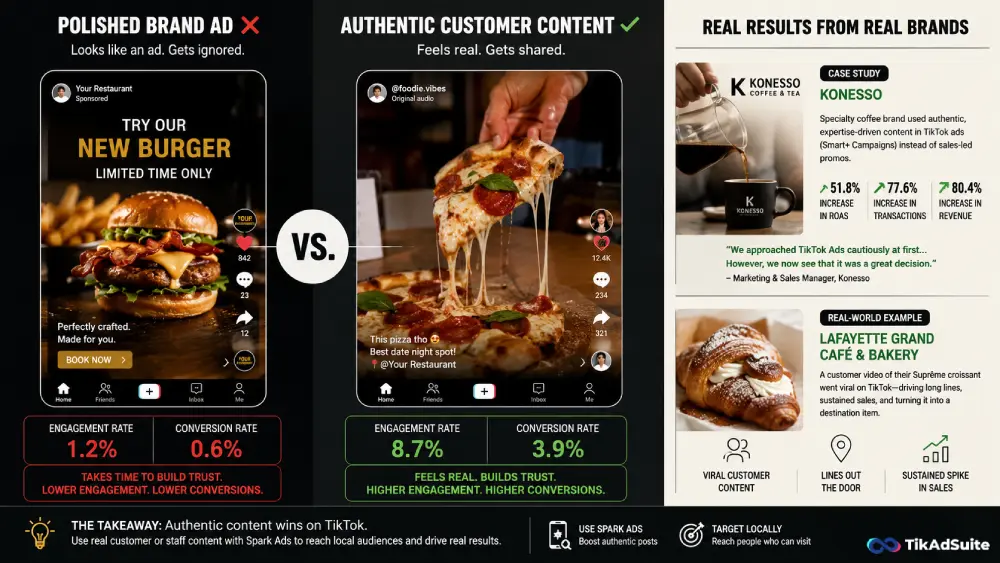
Konesso is not a restaurant, but its campaign shows what happens when a food and drink brand runs ads that look like normal TikTok posts. The Konesso success story describes a Polish online shop for coffee and tea that ran a Smart+ campaign that mixed its best-performing organic videos with TikTok-made creative, with broad targeting limited to Poland, and reports a 51.8% increase in ROAS, 77.6% more transactions and 80.4% more revenue.
Keep the context in mind. Konesso sells online, so each sale is easy to tie back to an ad, while a restaurant’s walk-ins are not. The results also come from one brand in one market, so your numbers will differ.
What carries over to a restaurant or cafe is the creative approach: content that teaches or entertains, made by real people, and then put behind paid reach.
Building Campaigns Around Menu Launches and Seasonal Promotions
Menu launches and seasonal promotions suit a short burst more than a slow, always-on campaign. You want a lot of local people to hear about the new item in the same week, so word of mouth has something to build on.
A simple burst plan for a menu launch:
- Five to seven days before launch, run In-Feed or Spark Ads with the Reach or Traffic objective to build interest.
- From launch day, switch to Lead generation for bookings or Sales for online orders.
- Add a retargeting ad group for people who watched the launch video but didn’t act.
For step 3, TikTok’s engagement audiences can include people who watched 2 seconds, 6 seconds, or 25% to 100% of a video ad, can look back up to 180 days, and need at least 1,000 people before you can target them. A small local launch may not reach that size in the first few days.
Keep the location targeting tight for every step, and keep cold and warm viewers in separate ad groups. Audience segmentation for TikTok shows how to split them cleanly.
Measure Visits, Orders, and Bookings
Measure each TikTok restaurant campaign against the action you picked, not against views. A clip with a million views and no new tables is still a weak ad for a restaurant.
Each result needs its own way to count it:
- Walk-ins and dine-in visits: Put a promo code in the ad that appears nowhere else, then count how often staff take it at the register.
- Online orders on your site: Install the TikTok Pixel and Events API so Ads Manager can report purchases and return on ad spend.
- Bookings and catering: Count the leads your form collects, then check how many turned into real bookings or catering orders.
- Creator posts: Give each creator a unique code or tracked link to see which partnership drove visits.
Review results after about two weeks of steady spend, then move budget to the ads and areas that produced real visits or orders.
Common Mistakes Restaurant Owners Make on TikTok Ads
Each of these slips is common, and each has a simple fix.
Running polished ads when real content exists: If customers already film your food and post it, start with those videos as Spark Ads before you pay for a production shoot.
Targeting too broadly or too narrowly: A neighborhood cafe doesn’t need a whole state. But a single tiny area can also hurt, since small areas can lower delivery and raise cost per action. Aim for the area people will actually travel from.
Ignoring the hook: The first few seconds decide whether people keep watching. A slow pan across an empty dining room loses viewers before the food appears. Open on the food, the steam or the pour, and study a few strong TikTok ad hooks before you film.
No clear call to action: Engagement doesn’t pay the bills. Give every ad one next step, such as order online, book a table or visit this weekend.
Judging ads by views: Views are cheap. Count codes, orders and bookings instead.
FAQs
Do TikTok ads work for small independent restaurants and cafes?
Yes, they can. The content that suits food best, such as phone-shot prep clips, staff intros and customer reactions, needs no production budget, and location targeting keeps your spend on people who can actually visit. Start with one ad group and a few clips, then keep what brings orders or visits.
What TikTok ad objective should a restaurant use?
Use Reach for awareness, Traffic to send people to your menu or ordering page, Lead generation for bookings and catering, and Sales for online orders on your own site with the Pixel installed. If your orders run through a delivery app you don’t control, Traffic or Reach is the easier start, since neither needs tracking on that app.
How do I turn a customer’s TikTok video into an ad?
Ask the customer for a Spark Ads post code. They open the video, tap the three-dot menu, choose Ad settings and tap Generate, then send you the code. You add it in Ads Manager under the TikTok posts tab. The post stays on their profile and keeps its likes and comments.
How much should a restaurant spend on TikTok ads?
Start at the platform minimums and test before you scale. TikTok’s daily budget rules say campaign budgets must be more than $50 and ad group daily budgets more than $20. For example, one ad group at just over $20 a day for 14 days comes to a little over $280, which gives you two weeks of results on a few videos in one area.
Can I target people within a few miles of my restaurant?
You can get close. In markets that support it, you can pick the zip or postal codes, city or DMA around your location instead of a whole region. Choose the areas your guests really travel from and avoid very small ones, since tiny areas can limit delivery and raise costs.
Wrapping Up
On TikTok, good food does most of the selling once the right people nearby see it and know what to do next.
Pick the objective that matches the action you want, target the areas your guests really come from, run real food videos as ads, and judge every ad by codes, orders and bookings rather than views.
Set up your first campaign in TikTok Ads Manager and use CapCut to cut your footage into short, hook-first clips that look at home in the feed.