
A clothing store, a mortgage broker and a mobile game can all run ads in the same TikTok Ads Manager account. The auction is the same for all three. What they should set up, what they are allowed to say and what a good result looks like are not.
That is why copying another brand’s TikTok playbook so often fails. A setup built for a quick checkout breaks when the buyer needs weeks to decide, and a targeting choice that is normal for a fashion brand can be blocked for a housing or credit ad.
Here are the four things that change by industry, a short playbook for 17 business types, and the policy rules that trip advertisers up.
Table of Contents
Get Up to $6000 Free TikTok Ad Credit
Quick Answer
TikTok ads by industry differ in four ways: the objective you pick, the format that fits how your customer buys, the ad policy rules your category falls under, and the results you should expect. Shops that sell in one session usually run Sales campaigns. Apps use App promotion, while service, B2B and finance brands often use Lead generation. Regulated industries such as finance, health, alcohol and gambling face extra rules, and housing, job and credit ads aimed at the US or Canada must be declared as a Special Ad Category.
Key Takeaways
- Pick the objective by what your customer does next: buy, install or contact you.
- Budget rules change with the goal. TikTok suggests more budget, measured in multiples of your cost per result, for shallow events than for purchases.
- Housing, employment and credit ads in the US and Canada lose age, gender and zip code targeting.
- Finance, health, weight loss, alcohol and gambling ads need extra disclosures, age limits, licenses or certification.
- The public industry benchmarks quoted here come from ecommerce brands. Service and B2B brands should build their own baseline.
- Results swing a lot by category, so compare your account to your own industry, not to an all-brand average.
How Objectives and Formats Change by Industry
The biggest change from one industry to the next is the campaign objective, because it tells TikTok which action to find people for. TikTok’s objective guide sorts every objective into three groups:
- Awareness: Reach.
- Consideration: Traffic, Video views, Community interaction and Branded Mission.
- Conversion: App promotion, Lead generation and Sales.
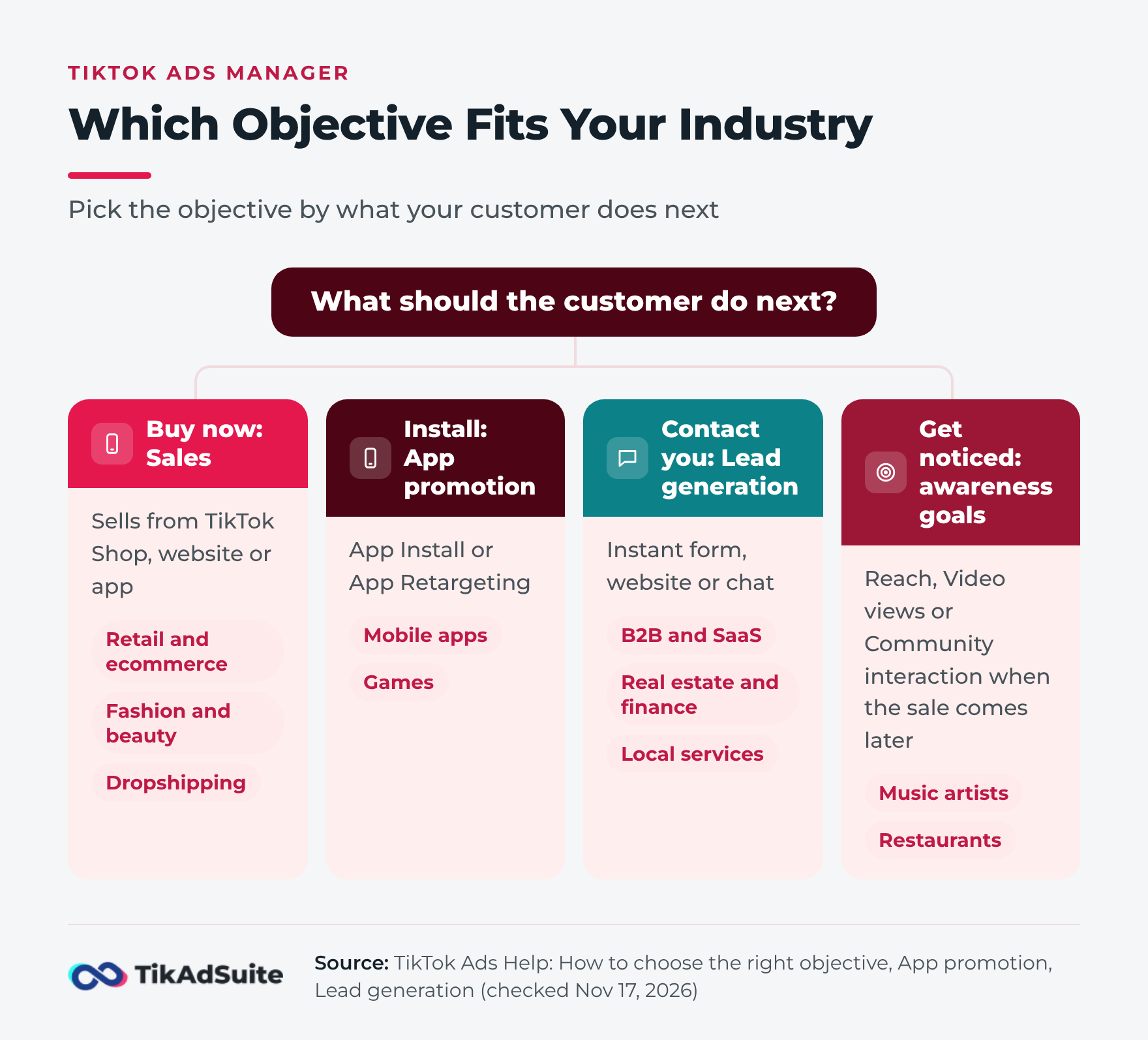
Your industry decides which conversion objective fits. The same guide says the Sales objective sells products from your TikTok Shop, website and app, which suits retail, fashion, beauty and dropshipping brands where people buy in one visit.
Apps and games have their own path. TikTok’s App promotion page splits it into App Install, which sends people to Google Play or the Apple App Store, and App Retargeting, which reaches people who already have the app.
Service businesses, B2B companies, real estate and finance brands rarely close a sale inside TikTok. For them, the Lead generation objective opens an instant form where people leave their contact details, or it sends them to your own site or to a chat.
The right format depends on how people buy:
- Product sellers need the product on screen in the first seconds, shown in use.
- Considered purchases (software, electronics, travel) need a person explaining the problem the product solves. Travel brands can see this in these tourism marketing tactics.
- Local and service brands do well with real staff and real places, plus an offer that gives people a reason to reach out now.
To see what already works in your category, the Top Ads dashboard in Creative Center lets you filter winning ads by region, industry and campaign objective, per TikTok’s Top Ads help page. TikTok also runs separate industry pages for agencies, automotive, CPG, education, gaming, health, retail and travel on its industry solutions hub.
How Budget and Testing Time Change by Industry
Budget needs change with the event you optimize for, not with the size of your company. TikTok’s budget best practices recommend these minimums per ad group:
- Deep conversions such as add to cart or purchase: 10 times your current CPA, or 200 USD if you have no CPA yet.
- App installs: 20 times your current CPA, or 200 USD with no CPA.
- Shallow events such as page views, and other high funnel goals: 50 times your current cost per result, or 100 USD with no CPA.
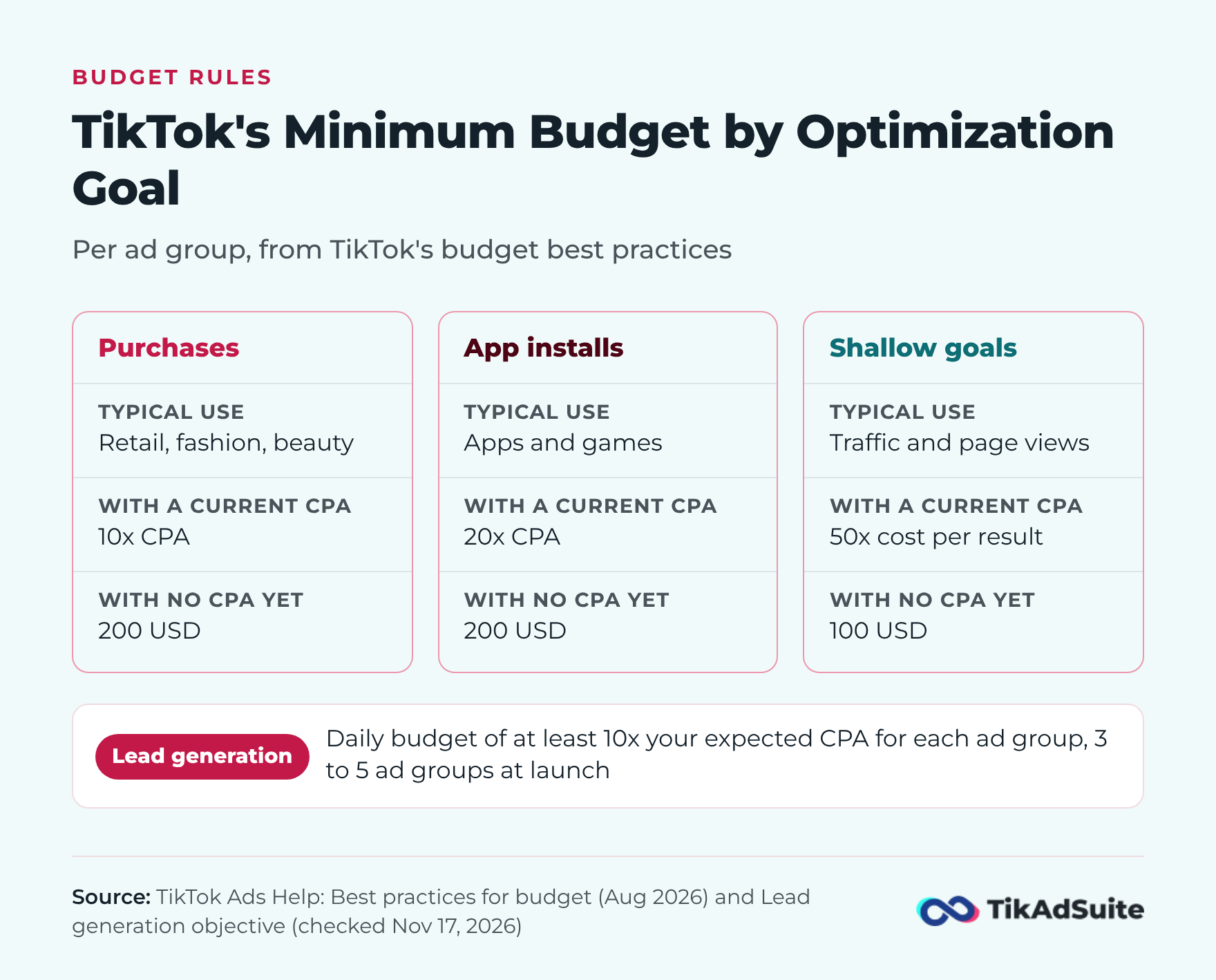
Lead-based industries follow a similar rule. TikTok’s lead generation page recommends a daily budget of at least 10 times your expected cost per action for each ad group, and launching with 3 to 5 ad groups.
Example figures: if you expect a lead to cost $40, that rule points to about $400 a day per ad group. If your purchase CPA is $15, the purchase rule points to about $150 a day per ad group. Plug in your own costs before you plan a test.
Testing time changes too. A shop with a short buying cycle gets purchase data within days. A B2B brand may see leads in week one but no closed deals for a month or more, so judge it on lead quality and cost per qualified lead before revenue. For budget floors at the campaign and ad group level, see the minimum budget for TikTok ads.
Ad Policy Limits by Industry
Some industries can advertise on TikTok only with extra steps, and a few cannot advertise at all. Alcohol, financial services, gambling, healthcare and weight management each have their own TikTok ad policy, covered below, and most of the requirements differ by market.
Before you build a campaign in a regulated category, check three things: whether your market allows it, what age limit applies, and which licenses or disclaimers TikTok expects.
Housing, Employment and Credit in the US and Canada
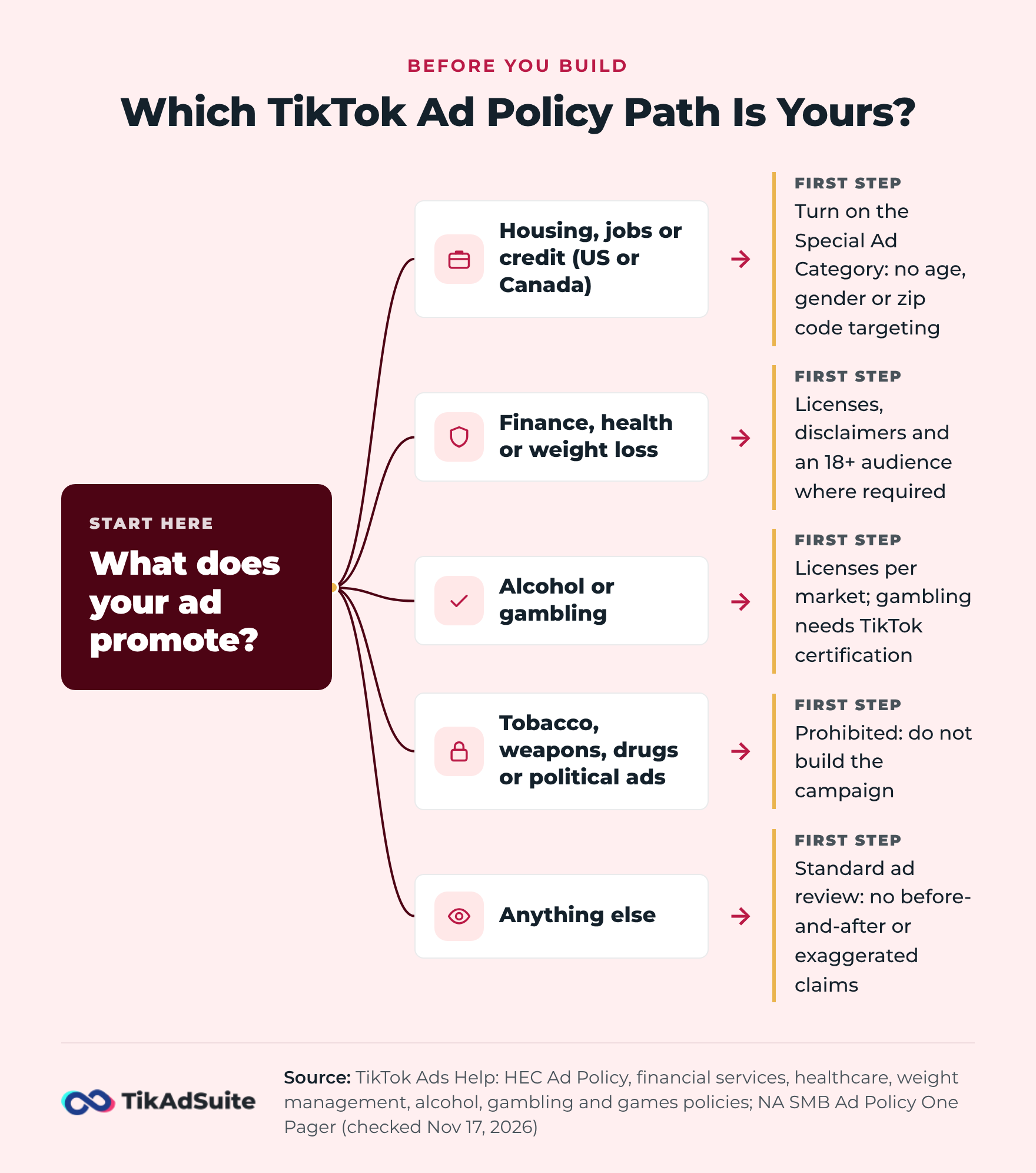
Housing, job and credit ads have their own rules in North America. TikTok’s HEC ad policy says advertisers based in the United States, or targeting the United States or Canada, must use the Special Ad Category toggle when they run these ads. Those ads cannot target by age, gender, zip code, or marital or parental status.
The policy reads these categories broadly. Housing covers rental and sale listings, realtor services, mortgage loans and homeowners insurance. Employment covers jobs, gig listings, internships and recruiting. Credit covers credit cards and personal, educational, business and auto loans.
More options disappear once the category is on. TikTok’s list of Special Ad Category targeting restrictions says lookalike audiences, interest keywords, hashtag targeting, automatic targeting and targeting expansion are not allowed. You turn the category on when you create or edit a campaign, per TikTok’s Special Ad Category setup page.
Finance, Health and Weight Loss
Financial services carry the longest rule list. TikTok’s financial services policy requires licensing, proper disclaimers and an audience aged 18 or older. For the US and Canada, it may allow cryptocurrency ads but does not allow complex speculative investments such as penny stocks and binary options, or initial coin offerings.
Health brands face market-by-market checks. Over-the-counter medicines, pharmacies, medical institutions and medical devices may be allowed if they meet each market’s requirements, while ingestible hemp is not allowed, according to TikTok’s healthcare and pharmaceuticals policy.
Weight loss and fitness offers have a separate rule. The weight management policy bans exaggerated or harmful weight loss and muscle gain claims and restricts any such claim to audiences aged 18 or older.
Alcohol, Gambling and Prohibited Categories
Alcohol brands need licenses for each market they target. TikTok’s alcohol policy also asks ads to state the drink’s alcohol content and strength and to carry a responsible drinking message, and it does not allow anyone under 25 to appear in the ad.
Gambling goes through certification first. Under the gambling and games policy, advertisers must prove their licenses, ads run only where gambling is legal, and they may never be shown to minors.
Some categories are closed to advertising in general. TikTok’s ad policy summary for North American small businesses lists adult products, tobacco, counterfeit goods, drugs, weapons and political ads among the trades it prohibits.
One rule hits beauty, health and fitness brands hardest. The misleading and false content policy does not allow before-and-after result comparisons or ads that promise or exaggerate what a product does. For a full walkthrough of the rules, see this TikTok ads policy update.
TikTok Ad Benchmarks by Industry
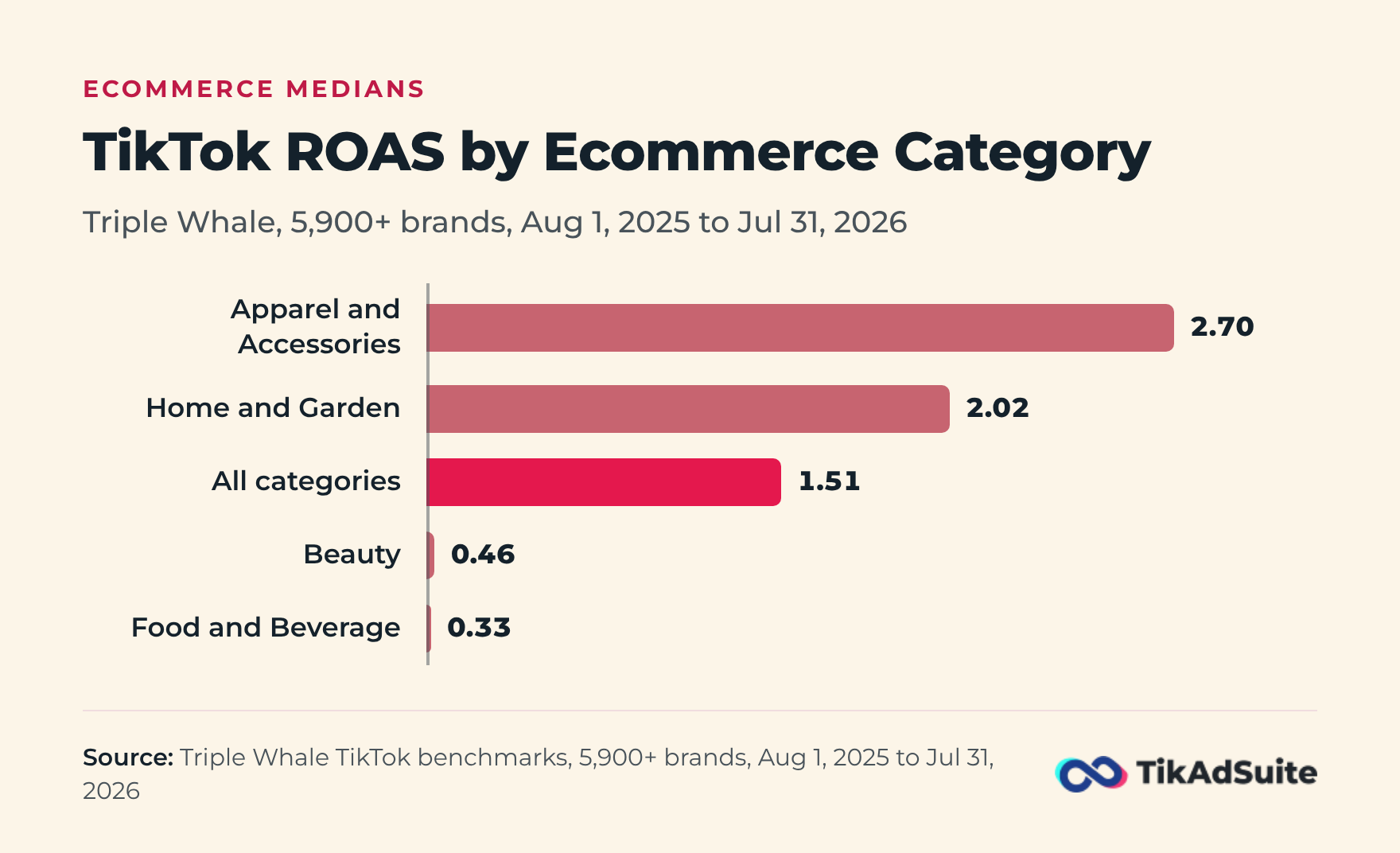
The most detailed dated TikTok benchmark set by industry that we found covers ecommerce categories only. Triple Whale’s TikTok benchmarks review more than 5,900 brands from August 1, 2025 to July 31, 2026, and put the overall median CPM at $4.08, CPA at $17.07, conversion rate at 1.56% and ROAS at 1.51.
The spread between categories is wide. These are the highs and lows Triple Whale reports for the same period:
| Category | What stood out (Triple Whale medians) |
|---|---|
| Apparel and Accessories | Highest conversion rate (2.08%), CTR (0.74%), ROAS (2.70) and average order value ($73.79) |
| Electronics | Highest CPA ($28.90), linked to a longer consideration cycle |
| Home and Garden | Highest CPM ($4.61), but ROAS of 2.02 |
| Beauty | Low CPM ($3.92) but ROAS of 0.46 |
| Health and Wellness | CPM of $3.67, CPA of $11.17, conversion rate of 0.80% |
| Food and Beverage | ROAS of 0.33 and average order value of $30.19 |
| Sports and Outdoors | Lowest CPM ($3.46) |
Two points help you read these numbers. They come from ecommerce brands that use Triple Whale, so they say little about B2B, finance, real estate or local services. And for low ROAS categories such as beauty and food, Triple Whale points to cheaper repeat purchases and notes that last-click tracking may undercount their later sales.
If your industry is not in the table, run your first campaigns, record your own CPM, cost per result and conversion rate, and use those as your baseline. More metric ranges sit in the TikTok ad benchmarks breakdown.
TikTok Ads by Industry: What Changes for Each Business Type
Each entry below names the objective that usually fits, the format that suits the buyer, and the rule or number that matters most. Start with the closest match to your business.
eCommerce and Retail
Online stores fit the Sales objective, which can send people to a TikTok Shop, a website or an app. Show the product in use within the first seconds and test several creatives at once. The TikTok ads for ecommerce setup and these winning ecommerce campaigns go further.
Dropshipping
Dropshippers test many products before one sells, so speed of testing matters more than brand building. Keep each test on the Sales objective and judge products on cost per purchase, not on views. See TikTok ads for dropshipping for a low-cost test plan.
Fashion Brands
Fashion stands out in the Triple Whale data above, with the highest median ROAS of any category. Try-on clips, outfit ideas and creator content match how people browse. Read TikTok ads for fashion brands for creative ideas.
Beauty and Personal Care
Beauty ads get low-cost reach in the same study, but one of the lowest median ROAS figures. The policy risk is high too: before-and-after results and exaggerated claims are not allowed, so show texture, routine and honest reviews instead.
SaaS and Software
Software buyers often need weeks, so the ad’s job is a trial or a demo request. Use Lead generation for demo requests, track trial sign-ups on your site, and put a person on camera explaining one problem. TikTok ads for SaaS covers the education-first approach.
Technical, Specs-Heavy Products
Electronics had the highest median CPA in the Triple Whale study, linked to longer research before purchase. Show the product solving one clear problem rather than listing specs, and plan for retargeting. See TikTok ads for tech products.
B2B Companies
B2B ads tend to work when they collect qualified leads rather than chase instant sales. Use Lead generation with an instant form, ask a few qualifying questions, and connect leads to your CRM. The TikTok ads for B2B companies guide covers targeting and creative.
Agencies Managing Client Accounts
Agencies run many industries at once, so the risk is applying one client’s settings to another. Check each client’s category against TikTok’s industry policies before launch. TikTok ads for agencies covers account structure and reporting.
Fitness and Gyms
Gyms need local reach and a clear offer such as a free class. Weight loss and muscle gain claims fall under the weight management rules covered earlier, so keep claims realistic and aimed at adults. See TikTok ads for gyms.
Restaurants and Cafes
Restaurants sell to people who live or work nearby, so location targeting and one dish or offer per ad usually work better than general brand videos. Reach or Traffic can work when a visit happens offline. Read TikTok ads for restaurants for campaign ideas.
Local Service Businesses
Plumbers, salons and clinics need calls and bookings, which fits Lead generation with a short instant form. Show real staff and real jobs, and target only the area you serve. TikTok ads for local businesses explains the setup.
Real Estate
Listings, realtor services and mortgage ads count as housing ads. In the US and Canada, that means the Special Ad Category with no age, gender or zip code targeting. See TikTok ads for real estate for creative that works within those limits.
Travel Companies
Trips are often booked weeks after the first view, so retargeting people who watched or clicked matters more here. TikTok lists travel as one of its own industry verticals. TikTok ads for travel companies covers the booking window.
Music Artists
Artists want streams and followers, not purchases, so Community interaction or Video views usually fits better than Sales. Measure saves, follows and streams. Read TikTok ads for music artists for release campaigns.
Affiliate Marketers
Affiliate offers draw close review, so the landing page must match the ad and every claim must hold up. Mismatched prices or discounts between ad and page break TikTok’s misleading content rules. See TikTok ads for affiliate marketing.
App Promotion
Apps run App promotion, either App Install or App Retargeting. According to TikTok’s budget guide, install campaigns need 20 times your current CPA, and real-money game apps also need gambling certification. TikTok ads for app promotion covers cost per install.
Finance and Credit
Banks, lenders and fintech apps face the strictest setup. According to TikTok’s financial services and HEC policies, that means an 18+ audience, licenses and disclaimers, and in the US and Canada the Special Ad Category for any credit offer. Use Lead generation and plan creative around clear terms, not promised returns.
Once you know your closest match, build a media plan with the TikTok campaign planner and match budget and timeline to your sales cycle.
Mistakes When You Copy Another Industry’s Playbook
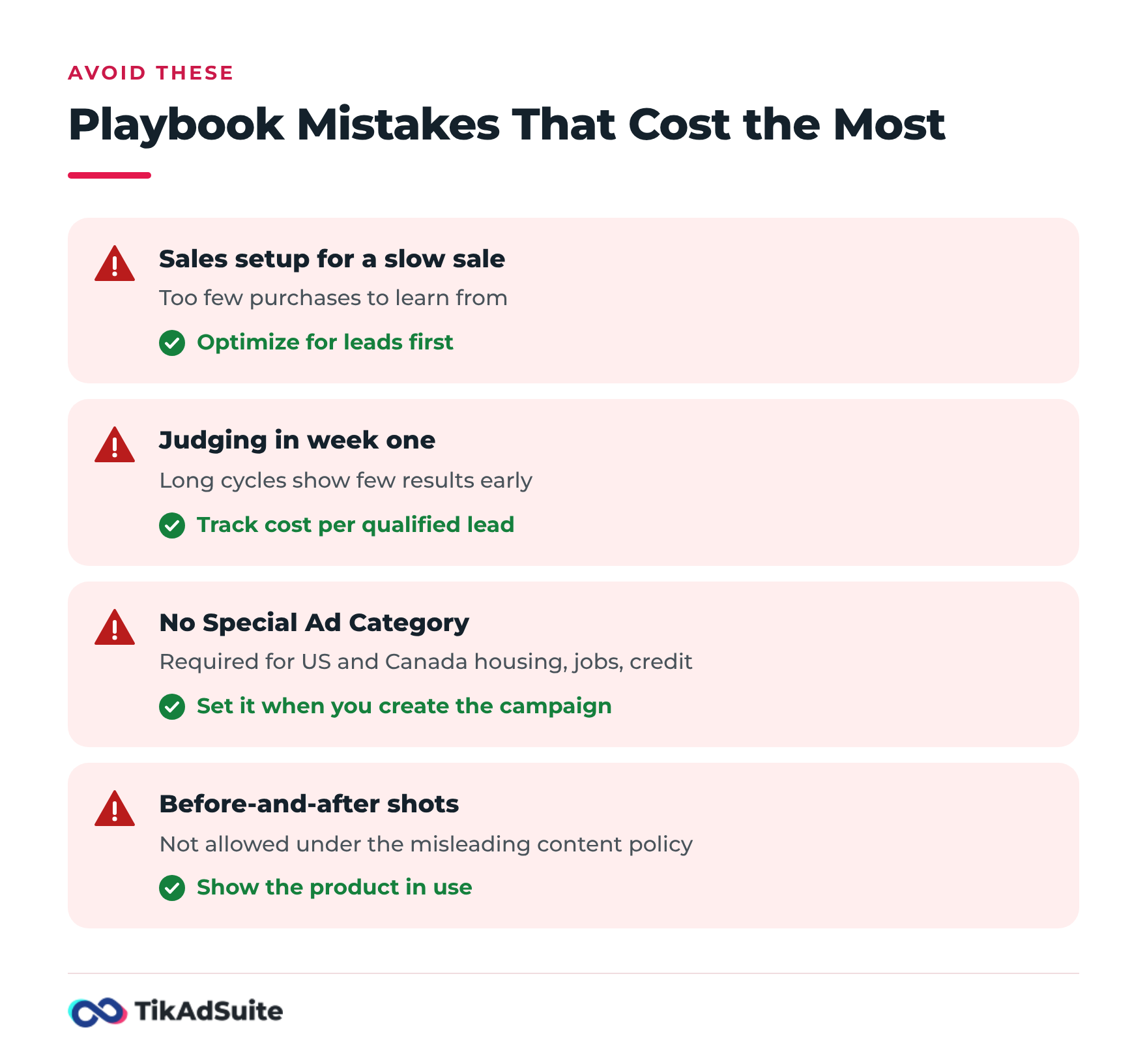
Most industry mistakes come from settings that worked somewhere else. These are the ones that cost the most:
- Using a Sales setup for a slow sale. A B2B or real estate account optimizing for purchases has too few events to learn from. Optimize for leads first.
- Judging too early. A long sales cycle shows few results in week one. Judge by cost per qualified lead before revenue.
- Skipping the Special Ad Category. Housing, job and credit ads aimed at the US or Canada must be declared. Fix it at campaign setup, not after a rejection.
- Copying beauty or fitness creative with before-and-after shots. TikTok’s misleading content policy does not allow them in any industry.
- Comparing your results to the wrong average. An all-brand ecommerce median says little about a lead campaign. Build your own baseline.
Frequently Asked Questions
Which industries are restricted in TikTok ads?
TikTok has extra ad rules for alcohol, financial services, gambling and games, healthcare and pharmaceuticals, and weight management, and political ads are not allowed. Rules differ by market and can include licenses, disclaimers, age limits or certification. Housing, employment and credit ads aimed at the US or Canada must also be declared as a Special Ad Category.
Do TikTok ads work for B2B companies?
TikTok ads can work for B2B companies when the campaign aims for qualified leads instead of instant sales. Use the Lead generation objective with an instant form or your own site, give each ad group at least 10 times your expected cost per lead per day, and judge results on lead quality over several weeks.
Can you run alcohol or gambling ads on TikTok?
Only in markets where they are legal and only with the required licenses. According to TikTok’s alcohol policy, alcohol ads must show the drink’s strength, carry a responsible drinking message and not feature anyone under 25. Gambling advertisers must pass TikTok’s certification process, and their ads may not reach minors.
What is the average TikTok CPM by industry?
Triple Whale’s study of more than 5,900 ecommerce brands from August 2025 to July 2026 found an overall median CPM of $4.08. According to Triple Whale, category medians ranged from $3.46 for Sports and Outdoors to $4.61 for Home and Garden. Those figures do not cover B2B or local services.
Do housing and job ads need a special setting on TikTok?
Yes. Advertisers in the US, or targeting the US or Canada, must turn on the Special Ad Category for housing, employment or credit ads. It removes age, gender and zip code targeting, plus lookalike audiences and interest keywords.
Wrapping Up
TikTok ads work across many industries, but the setup does not travel well from one to the next. Match your objective to what your customer does next, check your category’s ad policy before you build, and compare your results only with businesses that sell like you do.
Then pick the closest entry in the industry list above and start a small, clean test.