
Tech products present a specific challenge on TikTok. They are often complex, frequently expensive, and sold to buyers who research carefully before committing. None of those characteristics sound like natural fits for a platform built on 15-second videos and impulse-driven discovery.
And yet tech and electronics brands spend more on TikTok advertising than any other industry. There is a reason for that, and it is not that they are wasting money.
The brands getting results understand something the struggling ones do not: TikTok does not close the sale on tech products. It starts a conversation.
It puts a product in front of someone who did not know they needed it, shows it working in a context that feels real, and creates the kind of low-pressure discovery moment that no comparison shopping page or product description can replicate.
In this guide, you will learn:
- Why TikTok’s format suits consumer tech despite the complexity
- Two verified case studies of tech brands driving significant results
- The content formats that consistently perform for hardware and gadgets
- How to translate technical specifications into content that converts
- Which campaign objectives and targeting strategies fit tech products best
Get Up to $6000 Free TikTok Ad Credit
Table of Contents
Key Takeaways
- Tech and electronics brands spend more on TikTok advertising than any other industry, allocating $2.004 billion, according to Statista data
- Electronics achieves the highest CTR of any ecommerce vertical on TikTok at 0.73%, according to Triple Whale’s 2025 full-year benchmark report
- SharkNinja’s TikTok Shop Brand Day in May 2025 produced an 818% surge in sales and a 6,212% increase in livestream views, driven by a combination of short-form content and live shopping
- Dremel’s Blueprint tool campaign generated a 1,200% increase in social traffic compared to all of 2024 and a 100% sellout rate at major retailers
- Electronics accounts for 28% of TikTok Shop sales in the US, making it the second-largest category on the platform by revenue
Quick Answer
TikTok ads work for tech products by using video to demonstrate what a product does in a way that no product page or text description can. Demo-driven content, unboxing videos, and problem-solution formats consistently outperform specification-led ads for consumer tech. The most effective campaign structure pairs awareness-stage content with retargeting campaigns that capture users who engaged but did not convert, accounting for the longer consideration cycle typical of higher-priced technology products.
Why TikTok Works for Consumer Tech
Consumer tech buying starts with discovery, not search. Someone does not look up a product they have never heard of. They encounter it through a friend, a review, or increasingly a TikTok video, and then they go looking.
TikTok accelerates that discovery phase in a way no other paid channel matches. The platform’s algorithm surfaces content based on behavioral signals, not follower counts, which means a compelling 15-second demo of a new gadget can reach millions of people who had no idea the product existed and no prior interest in the brand behind it.
This is backed by the investment patterns of the industry itself. According to Electroiq, tech and electronics brands allocate $2.004 billion to TikTok advertising, the highest of any category, ahead of cosmetics, fashion, and retail. The category has committed this level of spend because the returns are there. (source)
Triple Whale found that electronics earned the highest CTR among all ecommerce verticals at 0.73%, with ROAS for electronics typically ranging from 2:1 to 3:1. These are platform averages. Brands running strong demo-led creative with proper funnel structure outperform both figures consistently.
Case Study: SharkNinja’s TikTok Shop Brand Day
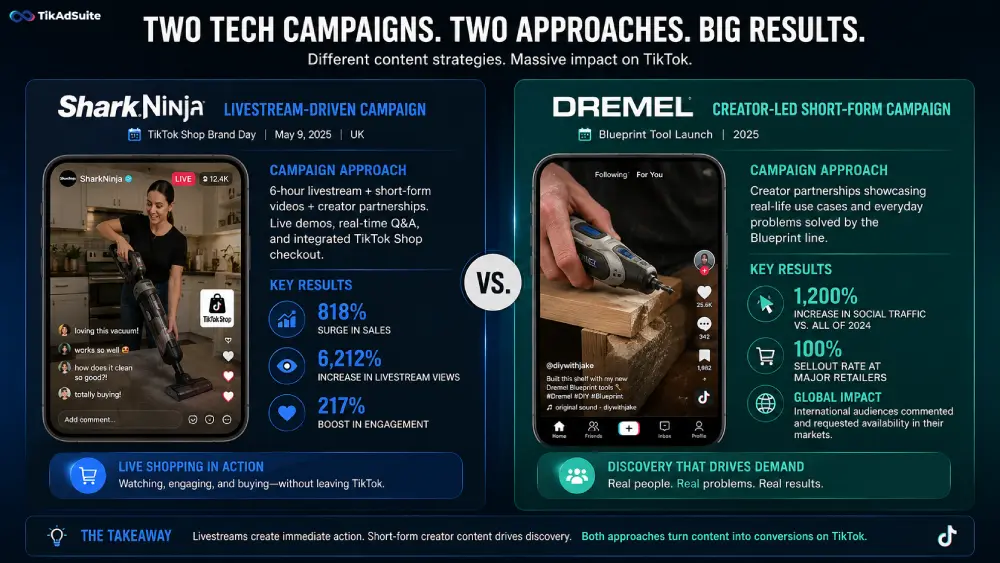
On May 9, 2025, SharkNinja executed a TikTok Shop Brand Day in the UK that became one of the most documented electronics successes on the platform.
The campaign combined a six-hour livestream with short-form video content and strategic creator partnerships. The livestream format lets customers watch products working in real time, ask questions directly, and purchase without leaving TikTok. The short-form content ran alongside it to drive awareness and feed traffic into the live session.
According to Influencer Marketing Hub’s analysis, the results were significant: an 818% surge in sales, a 6,212% increase in livestream views, and a 217% boost in engagement. (source) The campaign demonstrated that live shopping formats, which remove the consideration delay by letting viewers see products in action and purchase immediately, are particularly well-suited to electronics.
The SharkNinja model is not only for enterprise brands. The mechanics, live demonstration, real-time Q&A, and integrated checkout are available to any seller on TikTok Shop. For a full breakdown of how live shopping ads work on the platform, the TikTok live shopping ads guide covers the setup and format options.
Case Study: Dremel Blueprint
Dremel ran a TikTok creator campaign to launch their Blueprint line of compact tools, partnering with creators who made content around real use cases: a busy parent hanging frames, someone fixing furniture, and a first-time DIY project. The content was specific, relatable, and showed the product solving a recognizable problem.
According to Popular Pays, the campaign produced a 1,200% increase in social traffic and a 100% sellout rate at major retailers day after day.
The brand described experiencing a sense of virality they had never encountered before, with international audiences commenting and requesting availability in markets where the product was not yet sold.
The Dremel case illustrates the discovery-first nature of TikTok for tech products. Buyers were not searching for a compact power tool. They encountered one solving a problem they recognized, and the purchase followed.
Content Formats That Perform for Tech Products
Demo-first videos: The most effective tech ad on TikTok shows the product working before it names the product. Open with the output, not the specs. A before-and-after clip of a tool completing a task, or a 10-second screen recording of software doing something impressive, earns more attention than a product shot with a price tag.
Unboxing and first-impression content: The #TechTok community has built an entire content culture around unboxing. First-reaction content for gadgets and electronics performs strongly because it replicates the experience of hearing from a trusted peer rather than watching a brand advertisement. Creator-led unboxing content run as Spark Ads extends this reach while preserving the organic feel.
Problem-solution structure: The format that consistently works across tech verticals: identify a frustration the viewer recognizes in the first two seconds, then show the product resolving it. This structure works because it leads with relevance rather than brand identity, which earns more watch time and produces stronger engagement signals.
Comparison content: Tech buyers compare before they commit. Content that directly addresses the “why this over the alternative” question, presented honestly rather than as a sales pitch, builds the credibility that moves a viewer from interest to purchase intent. The TikTok ad hooks guide covers opening formats that earn attention in tech-adjacent content environments.
Translating Specs Into Content That Converts
The most common mistake in tech advertising on TikTok is leading with specifications. Battery life in hours, processor speeds, megapixel counts, and refresh rates; these numbers mean nothing to a viewer who has not yet decided they care about the product.
Specifications need to be translated into experiences before they appear in ad creative.
A 48-hour battery life becomes “you can take it on a weekend trip without the charger.” A 4K sensor becomes footage that actually shows what it captures. ‘
Noise cancellation becomes a creator putting on headphones and visibly tuning out a chaotic environment.
Every spec has an equivalent human experience. Find that experience first, build the creative around it, and let the spec appear as supporting evidence, not as the opening argument.
Campaign Objectives for Tech Products
Tech products typically require more than one campaign objective running in sequence, because the consideration period is longer than an impulse purchase category.
Awareness and Traffic objectives work at the top of the funnel, reaching cold audiences with demo and discovery content. This is where most tech brands start, and where the SharkNinja and Dremel examples found their initial reach.
Conversion and Retargeting campaigns work further down the funnel, capturing users who engaged with awareness content but did not purchase. Because tech buyers research before committing, a retargeting campaign that reaches someone one to three days after they watched a demo video often converts at a significantly lower cost than a cold audience campaign.
For products above a certain price point, a two-stage campaign structure is often more efficient than running conversion campaigns to cold audiences directly.
Building awareness at scale first and retargeting engaged users second produces a better cost-per-acquisition for most consumer tech. The TikTok ads funnel guide covers how to structure full-funnel campaigns for higher-consideration products.
Targeting Tech Products
Consumer tech audiences on TikTok cluster around predictable interest signals. The #TechTok community is active and identifiable through interest-based targeting categories, including technology, consumer electronics, gaming, and home automation.
Lookalike audiences built from existing customer lists tend to perform well for established tech brands because the profile of a past tech buyer, demographic, behavioral, and interest-based, is replicable across TikTok’s broader audience.
For newer products or brands with limited customer data, broad interest targeting paired with compelling demo content often outperforms narrow interest stacks by giving the algorithm enough room to find efficient delivery.
Age and gender targeting are worth considering for specific product categories. Gaming peripherals skew younger and predominantly male. Smart home devices skew toward 25-to-44-year-old homeowners.
Wearables span broadly. Match your targeting to what your actual customer data shows rather than defaulting to platform-wide averages.
For a structured approach to separating cold discovery audiences from warm retargeting audiences within the same campaign structure, the TikTok ads audience segmentation guide covers the three-tier model that applies particularly well to tech’s longer consideration cycle.
Common Mistakes in Tech Product TikTok Ads
Leading with the product name instead of the problem. Opening an ad with a logo or brand name before demonstrating value gives a viewer no reason to keep watching. Start with the problem or the outcome.
Running single-stage campaigns for higher-priced products. A $200 gadget does not convert from one cold impression the same way a $25 item does. Build a two-stage structure: awareness first, retargeting second.
Ignoring creative fatigue. Tech buyers who spend time on TikTok will see your ad multiple times. Creative that does not rotate loses performance faster than most categories because tech-engaged users recognize repeated content quickly. Plan for multiple creative variations before launch, not after performance drops.
Focusing on platform specs instead of use cases. Spec-first creative underperforms consistently in consumer tech. Translate every specification into a human experience before it appears on screen.
FAQs
Do TikTok ads work for high-ticket tech products?
Yes, but the campaign structure needs to account for the longer consideration cycle. High-ticket tech products respond better to a two-stage approach: awareness campaigns to cold audiences followed by retargeting campaigns to engaged users. Single-stage conversion campaigns to cold audiences typically produce higher CPAs for products above $100.
What TikTok ad objective works best for consumer electronics?
For driving discovery, Reach and Traffic objectives work well at the awareness stage. For direct conversion, the Conversion objective paired with a well-structured retargeting campaign produces the strongest results. For products sold directly through TikTok Shop, Video Shopping Ads, and Live Shopping combine awareness with immediate checkout in a single format.
Should tech brands use influencers or produce their own TikTok ads?
Both work, and the strongest campaigns typically combine both. Creator-led content provides authenticity and reach within established tech communities. Brand-produced content gives you tighter control over messaging and product representation. Using creator content as Spark Ads gives you the authenticity of organic content with the precision of paid targeting.
How do I measure TikTok ad performance for tech products?
Track CTR and video completion rate at the awareness stage. For conversion campaigns, cost per acquisition and ROAS are the primary metrics. For tech products specifically, also track view-through conversions with a longer attribution window, because tech buyers often research for several days after first encountering a product before purchasing.
Wrapping Up
TikTok works for tech products when the content leads with experience rather than specification, the campaign structure accounts for a longer buying decision, and the creative volume stays high enough to avoid fatigue among a tech-engaged audience that notices repetition quickly.
SharkNinja and Dremel both succeeded by letting the product work on screen before asking for the sale.
That discipline, showing value before claiming it, is what separates TikTok tech ads that drive real results from the ones that burn through budget and deliver confusion.
Build your campaigns through TikTok Ads Manager and use CapCut to produce the multiple demo-driven creative variations your campaign needs to stay fresh beyond the first two weeks.