
Most TikTok ad campaigns fail not because of bad creative, but because of bad structure. You are asking a cold stranger to buy from you in 15 seconds. That is not a funnel. That is a gamble.
The real problem is simple: a single campaign cannot do the job of three. Cold audiences need awareness. Warm audiences need trust. Hot audiences need a clear offer. When you compress all three into one campaign, none of them work properly.
A properly built TikTok ads funnel changes all of that. It gives each stage of the buyer journey its own objective, its own creative, and its own audience. The result is a system that compounds over time instead of burning budget on cold traffic that was never ready to convert.
This article walks you through every stage of the funnel, from reaching cold audiences at the top to closing high-intent buyers at the bottom.
You will also learn how the TikTok ads learning phase affects each stage, what Deep Funnel Optimization actually does, how to split your budget correctly, and which mistakes are quietly killing your ROAS.
Table of Contents
Get Up to $6000 Free TikTok Ad Credit
What is a TikTok ads funnel?
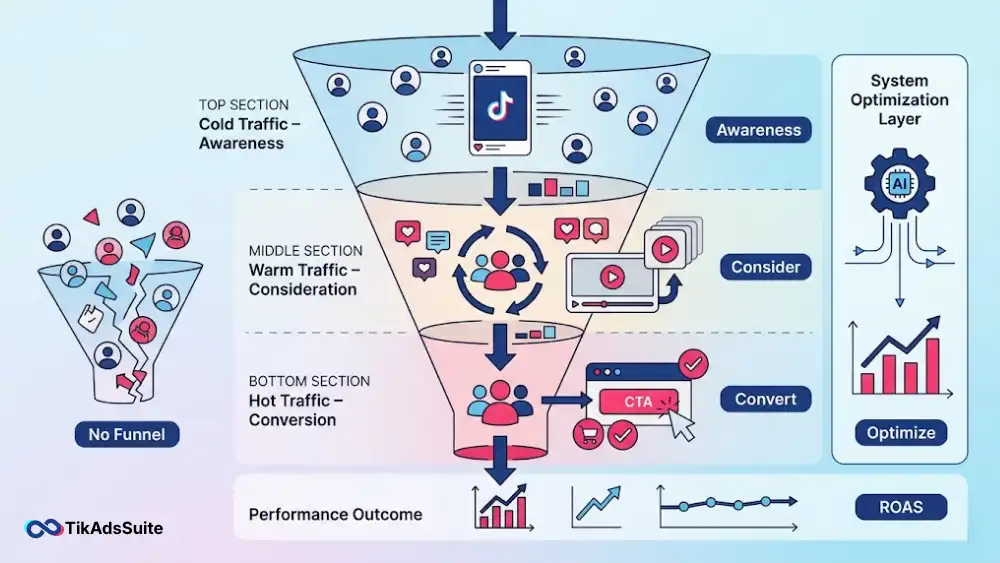
A TikTok ads funnel is a multi-stage advertising system that moves potential customers from first awareness through to purchase. Unlike single campaigns, it uses different ad objectives, creatives, and audiences at each stage: TOFU, MOFU, and BOFU. This approach builds trust progressively and maximizes ROAS over time, but only when each stage runs with the correct campaign objective and audience signal.
Why Single TikTok Campaigns Fail to Convert Cold Audiences
Running one conversion campaign at cold audiences is one of the most common reasons TikTok ad accounts burn budget without results.
When you send cold traffic straight to a purchase campaign, you are asking TikTok’s algorithm to find buyers inside an audience that has never heard of you. The algorithm needs conversion signals to optimize.
Cold audiences also convert at a much lower rate than warm ones. When you skip the awareness and consideration stages, you are starting from a position of zero trust and zero recognition.
The creative mismatch makes it worse. The content that works on cold audiences is broad storytelling and entertainment. The content that works on warm audiences is testimonials, product demos, and direct offers. One campaign cannot serve both at the same time.
The fix is to stop asking one campaign to do three jobs. That is what the funnel solves.
What Is a TikTok Ads Funnel Strategy and How Does It Work in 2026?
A TikTok ads funnel strategy is a structured advertising approach that maps specific campaign objectives, creatives, and audiences to each stage of the buyer journey. It runs awareness, consideration, and conversion as separate campaigns working in sequence, not as a single campaign doing everything at once. Each stage feeds the next, and the full system delivers better ROAS than any standalone campaign can.
In 2026, TikTok’s advertising ecosystem supports the complete funnel natively inside Ads Manager. You can run Reach, Video Views, Traffic, Lead Generation, and Shop Purchases objectives without patching together outside tools.
Here is how the three stages break down:
- TOFU (Top of Funnel): Reach cold audiences with awareness-focused creative and broad targeting. Objective: Reach or Video Views.
- MOFU (Middle of Funnel): Retarget users who engaged with your TOFU content. Objective: Traffic or Lead Generation.
- BOFU (Bottom of Funnel): Convert warm audiences who visited your site or engaged with your brand. Objective: Conversions or Shop Purchases.
Two features separate the 2026 TikTok funnel from earlier versions: TikTok Search Ads as a mid-funnel intent bridge, and Deep Funnel Optimization for higher-quality bottom-funnel delivery. Both give you more control over where the algorithm allocates budget and which users it targets.
Top of Funnel (TOFU): How to Reach Cold Audiences at Scale
TOFU is where you introduce your brand to people who have never heard of you. The goal at this stage is not conversion. It is attention, reach, and the first signal of interest. You are building an audience that your MOFU and BOFU campaigns will later retarget.
Which Ad Formats and Objectives to Use at TOFU
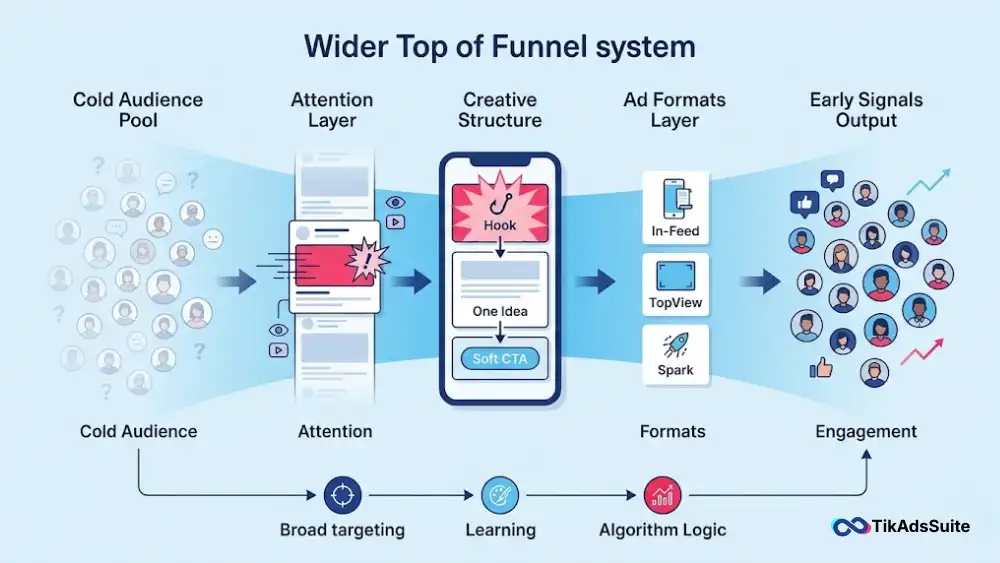
At TOFU, use Reach or Video Views as your campaign objective. These objectives tell TikTok’s algorithm to prioritize delivery over conversion, which is exactly what you need when targeting cold audiences at scale.
The top-performing TOFU ad formats in 2026 are:
- In-Feed Ads with a strong hook in the first two seconds
- TopView Ads for brand awareness at scale (higher CPM, higher visibility)
- Spark Ads that amplify organic posts from your own account or creator partners
Start with broad, interest-based targeting and let creative performance data guide the algorithm. You do not need heavy audience restrictions at TOFU. The creative itself acts as the targeting signal.
How to Write and Structure Creative for Cold Audiences
Cold audiences have no reason to stop scrolling for you. Your creative has to earn attention in the first two seconds, or it is already over.
Structure your TOFU creative this way:
- Open with a pattern interrupt: a surprising visual, a bold claim, or a problem the viewer instantly recognizes.
- Keep the body focused on one idea. Do not pitch the product yet.
- Close with a soft call to action: “Learn more” or “See how it works.”
According to TikTok’s own Creative Advertising Guide, ads that look and feel like native content, fun, spontaneous, and human are the ones that perform best on the platform. Keep your production style raw, direct, and human. Your TOFU content should look like it belongs on TikTok, not like a brand ad.
Middle of Funnel (MOFU): Turning Warm Viewers Into Interested Buyers
MOFU is where most advertisers either skip entirely or set up incorrectly. This stage targets people who engaged with your TOFU content but are not yet ready to buy. Your job here is to build consideration and reduce friction. You are not closing yet. You are deepening the relationship.
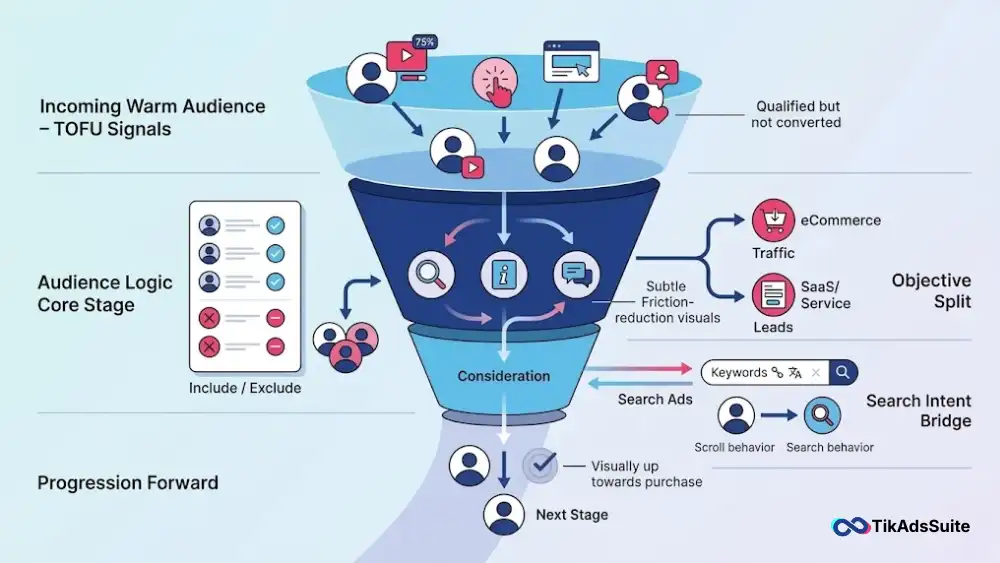
The right objective at MOFU depends on your business model. For eCommerce, Traffic works well. For service businesses and SaaS, Lead Generation tends to outperform.
How to Build MOFU Retargeting Audiences and Exclusion Logic
Your MOFU audience should come from users who have already shown a clear signal of interest. Inside TikTok Ads Manager, build custom audiences from:
- Users who watched 75% or more of your TOFU video ads
- Users who clicked your TOFU ad but did not convert
- Users who visited your website but did not purchase
- Users who engaged with your TikTok profile in the last 30 to 60 days
Exclusion logic is as important as inclusion. Always exclude your BOFU audience from MOFU campaigns. Without exclusions, your budget bleeds into the wrong segment, and the algorithm receives conflicting signals about what you want it to optimize for.
How TikTok Search Ads Work as a Mid-Funnel Intent Bridge
TikTok Search Ads give you a direct line to users who are actively searching on the platform after seeing your TOFU content. That shift from passive viewing to active search is a strong mid-funnel intent signal.
You can run Search Ads alongside your standard MOFU retargeting. Target keywords aligned with the consideration stage: product comparisons, how-it-works queries, and brand-name searches.
This bridges the gap between passive brand exposure and active purchase intent. Most competitors are not using this yet, which makes it a genuine structural advantage for your funnel right now.
Bottom of Funnel (BOFU): Converting High-Intent Audiences Into Customers
BOFU targets the smallest, warmest audience in your funnel. These users have watched your content, visited your site, and engaged with your brand across multiple touchpoints. They know who you are. They are ready to convert.
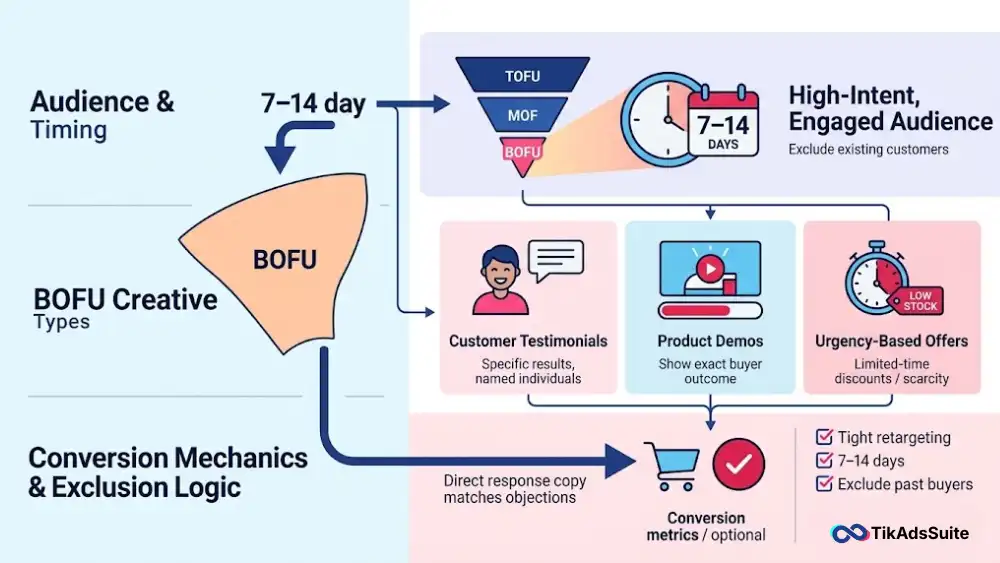
Set your BOFU campaign objective to Conversions or Shop Purchases. TikTok will optimize toward users most likely to complete your conversion event within this retargeted pool.
BOFU creative is completely different from TOFU. You do not need to introduce the brand. You need to close.
Use:
- Customer testimonials with specific results and named individuals
- Product demos showing the exact outcome the buyer receives
- Urgency-based offers such as limited-time discounts or low-stock callouts
- Direct response copy that matches the exact objection your buyer has at this stage
Keep your BOFU audience window tight: 7 to 14 days for most eCommerce brands. Users who engaged more than 14 days ago are significantly less likely to convert. Always exclude existing customers so you are not spending BOFU budget on people who have already bought.
If your TOFU and MOFU stages are set up correctly, BOFU should convert at a meaningfully higher rate than any standalone cold campaign you have run before.
How the TikTok Ads Learning Phase Affects Each Stage of Your Funnel
The TikTok ads learning phase is the period during which TikTok’s algorithm collects data to identify which users are most likely to complete your campaign objective. During this phase, performance is inconsistent, and cost-per-result is typically higher than it will be once the campaign stabilizes.
Every campaign enters the learning phase at launch, after significant budget changes, or after major edits to targeting or creative.
Here is how the learning phase affects each funnel stage differently:
- TOFU campaigns exit the learning phase fastest. Video Views and Reach are high-volume events that most accounts hit within a day or two.
- MOFU campaigns take longer. Traffic and Lead Generation events occur less frequently, so you need both a sufficient budget and audience size to generate enough optimization events within the 7-day window.
- BOFU campaigns are the hardest to stabilize. Purchases are the rarest event. Brands generating fewer than 10 to 20 purchases per week will struggle to exit the learning phase on a Purchase objective.
If your BOFU purchase volume is too low to exit the learning phase, switch your optimization event temporarily to a higher-funnel proxy: Add to Cart or Initiate Checkout. Once you consistently generate enough events, shift the objective back to Purchase.
Avoid making frequent changes to campaigns still in the learning phase. Each significant edit resets the learning cycle and extends the instability window.
What Is TikTok Deep Funnel Optimization and When Should You Use It?
TikTok Deep Funnel Optimization (DFO) is an advanced campaign feature in TikTok Ads Manager that lets you optimize toward deeper, higher-value conversion signals rather than just the initial purchase event.
Instead of optimizing for who is most likely to buy once, DFO shifts the algorithm toward users who are more likely to repeat purchase, generate higher order values, or qualify more deeply in your sales pipeline.
DFO requires server-side event tracking via TikTok’s Web Events API to pass deeper funnel signals back to the platform accurately.
You should use DFO when:
- Your business has high variance in customer lifetime value, such as SaaS with multiple plan tiers or eCommerce with a wide average order value range
- You want TikTok to find customers who spend more or stay longer, not just users who convert once
- You have sufficient data volume: according to TikTok’s DFO setup documentation, the DFO toggle activates automatically once you have posted back more than 50 attributed deeper funnel events in the past 14 days per ad group
In a two-week test published in TikTok’s case study with Stepful, an ad group using Deep Funnel Optimization achieved a 61% decrease in Cost Per Qualified Lead.
Results from a single case study will vary by industry, audience size, and budget, but the consistent outcome across TikTok’s published DFO cases is that the feature shifts the algorithm toward quality over volume.
If your BOFU campaigns are generating purchase volume but low retention or low lifetime value, DFO is the next optimization layer worth testing.
How to Allocate Your Budget Across the TikTok Ads Funnel
There is no universal budget split that works for every business. The right allocation depends on your brand’s awareness level, current retargeting pool size, and conversion volume at each stage.
That said, here is a starting framework we have seen perform consistently across eCommerce and service businesses:
| Funnel Stage | Budget Allocation | Primary Goal |
| TOFU | 50 to 60% | Build awareness, grow retargeting pools |
| MOFU | 20 to 30% | Drive consideration, capture intent signals |
| BOFU | 15 to 20% | Convert warm audiences at maximum ROAS |
New or low-awareness brands should weigh more toward TOFU: 60 to 70% at the top. Without a large enough retargeting pool, your MOFU and BOFU audiences will be too small for consistent delivery.
Established brands with strong organic presence and large custom audiences can shift budget down the funnel, increasing MOFU and BOFU allocation to 35 to 40% combined.
The core principle is this: your retargeting stages can only perform as well as your TOFU investment allows. If you cut TOFU to save money, you shrink the pool that feeds everything below it. The whole system slows down. Review your allocation every 30 days and adjust based on actual audience sizes inside Ads Manager.
How to Measure Your TikTok Funnel: KPIs and Attribution by Stage
Each funnel stage has its own KPIs. Measuring TOFU by ROAS is the wrong metric. Measuring BOFU by CPM is equally wrong. Match the metric to the objective at each stage.
| Funnel Stage | Primary KPIs | Secondary KPIs |
| TOFU | CPM, Video View Rate, 2-second view rate | Profile visits, follows |
| MOFU | CTR, Cost per Landing Page View, Engagement Rate | Time on site, pages per session |
| BOFU | ROAS, CPA, CVR, Cost per Purchase | Add to Cart rate, Checkout rate |
Attribution is TikTok’s most significant measurement problem. TikTok is a view-through platform. Most purchases influenced by TikTok are never credited to TikTok under last-click attribution models.
As Northbeam’s attribution research shows, traditional click-based attribution consistently undercredits TikTok’s true impact because the platform drives discovery and purchase intent long before a user ever clicks an ad.
To measure your funnel accurately, you need three things working together:
- TikTok Pixel with all standard events firing correctly on your site
- TikTok Web Events API for server-side data, which is more reliable after iOS 14 signal loss
- A third-party attribution tool, such as Northbeam, Triple Whale, or Rockerbox to see TikTok’s true contribution across the full buyer journey
Do not kill your TOFU campaigns because they are not generating direct purchases. Do not shut down MOFU because it is not directly converting. Measure each stage against its own objective and let the full-funnel data tell the complete story.
TikTok Ad Funnel Examples
The framework above is easier to trust once you see it running in real accounts. These three examples come from TikTok for Business’s own published case studies. No composite numbers, no guesses.
Liquid I.V. ran the full TOFU-to-BOFU structure.
The hydration brand built a full-funnel In-Feed campaign across Reach, Traffic, Product Sales, and Conversions. Then it layered TikTok Shop Ads on top to blend on-site conversions with direct Shop purchases.
The In-Feed campaign alone delivered $1.36 in incremental ROAS. Adding Shop Ads pushed that to $2.32, a 71% lift.
A Geo Lift study also found something bigger. TikTok had actually driven nearly 90% more conversions than last-click attribution gave it credit for. 62% of those extra orders landed on platforms like Amazon, not TikTok itself. That’s the same attribution gap this guide covered earlier, showing up in a real account.
Steve Madden used Search Ads as the mid-funnel bridge.
The footwear brand split ad groups by product category: sandals, heels, sneakers. It mixed branded and non-branded keywords, added cost-cap bidding, and used creator-aligned creative that felt native to search results.
Within one month, that setup delivered:
- $4.08 incremental ROAS
- 54% lower cost per acquisition than its non-search campaigns
- $0.63 average cost per session
StriVectin used Search Ads to grow its customer base, not just cut costs.
The skincare brand paired branded and category keywords with full-funnel targeting over a two-month test.
The result: a 78% lift in ROAS, a 188% increase in new customers, and a 46% reduction in CPA.
None of these brands treated Search Ads or Shop Ads as a standalone tactic. Each one plugged it into a funnel where awareness and retargeting were already doing their jobs. Same sequencing this guide just walked through. Someone else’s ad account proving it out.
TikTok Ads Funnel Mistakes That Kill ROAS (and How to Fix Them)
These are the mistakes we see most consistently inside underperforming TikTok ad accounts.
- Skipping MOFU entirely. Most accounts run TOFU and BOFU and ignore the middle. The result is a BOFU campaign retargeting an audience that was never warmed up properly. Add a consideration layer before you ask for the sale.
- Using the same creative across all three stages. Your TOFU ad is designed to interrupt cold attention. Your BOFU ad is designed to close a warm buyer. They should look and feel completely different. Reusing TOFU creative at BOFU is one of the fastest ways to collapse your conversion rate.
- Editing campaigns too often during the learning phase. Every significant change to budget, targeting, or creative resets the learning cycle. Give each campaign at least 7 days and a sufficient volume of optimization events before making decisions.
- Not excluding converted customers from BOFU. Serving purchase ads to people who have already bought wastes budget and delivers a poor experience. Exclude all purchasers from every active ad set at all times.
- Setting BOFU audience windows too wide. A 180-day retargeting window at BOFU pulls in users who engaged months ago and are no longer in-market. Tighten your BOFU window to 7 to 14 days for most product categories.
- Ignoring creative fatigue. TikTok audiences exhaust creative faster than most other platforms. Industry practitioners and platform data consistently show that when ad frequency climbs above 2.5 impressions per user over a 7-day window, CTR drops and CPM rises as TikTok’s algorithm deprioritizes the creative. Rotate creative every 7 to 14 days at every funnel stage.
FAQs
What is a TikTok ads funnel?
A TikTok ads funnel is a structured advertising system that moves users through three stages: awareness, consideration, and conversion. You use TOFU campaigns to reach cold audiences, MOFU to build trust and consideration, and BOFU to convert warm buyers. Each stage runs a different campaign objective, targets a different audience, and uses different creative to match where the user is in the buying journey.
How long does the TikTok ads learning phase last?
The TikTok ads learning phase lasts up to 7 days. According to TikTok’s official Learning Phase FAQ, achieving 50 conversions is the most significant indicator of passing the learning phase. If your campaign cannot hit that threshold on a Purchase objective, switch to a higher-funnel proxy event like Add to Cart to help the algorithm collect data faster.
How much should I spend on TikTok ads to see results?
There is no fixed minimum that guarantees results. Most eCommerce brands running a full TikTok ads funnel start with $50 to $100 per day distributed across all three stages combined. Your actual budget requirement depends on your average order value, your target cost per acquisition, and how quickly you need to accumulate enough optimization events to exit the learning phase at BOFU.
What is TikTok Deep Funnel Optimization, and how is it different from a standard conversion campaign?
TikTok Deep Funnel Optimization (DFO) lets you optimize campaigns toward deeper, higher-value conversion signals rather than the initial purchase alone. A standard conversion campaign optimizes for whoever is most likely to buy once.
DFO shifts the algorithm toward users more likely to repeat purchase, convert at a higher order value, or qualify more deeply in your sales pipeline. You need server-side event tracking via TikTok’s Web Events API and more than 50 attributed deeper funnel events in the past 14 days per ad group for the feature to activate automatically.
How do I build a TikTok retargeting audience for MOFU?
Inside TikTok Ads Manager, go to Custom Audiences and build your MOFU audience from users who watched 75% or more of your TOFU video ads, clicked your ads without converting, or visited your website in the last 30 to 60 days.
Always exclude your BOFU audience from MOFU campaigns so each segment receives the right message for its stage. Your audience segment needs at least a few thousand users for TikTok to deliver the campaign consistently.
What KPIs should I track for each stage of my TikTok funnel?
You should track CPM and Video View Rate at TOFU, Click-Through Rate and Cost per Landing Page View at MOFU, and ROAS, Cost per Purchase, and Conversion Rate at BOFU. Avoid judging TOFU performance by ROAS or BOFU performance by CPM.
Each stage has its own objective, and applying the wrong metric at the wrong stage leads to premature campaign decisions. Use a third-party attribution tool alongside TikTok’s native reporting to see the accurate full-funnel picture.
Conclusion
A single TikTok campaign is not a strategy. It is a one-shot bet on an audience that was probably not ready. When you build a proper TikTok ads funnel, you replace that bet with a system. TOFU creates awareness, MOFU builds consideration, and BOFU converts buyers at the lowest possible cost.
What separates high-performing accounts from struggling ones is almost always structure, not creative. You can have the most compelling ad on TikTok and still waste your budget if it lands in front of the wrong person at the wrong stage. The funnel solves that problem by ensuring every dollar reaches the right audience with the right message at the right moment.
Using Deep Funnel Optimization points the algorithm toward users who matter most to your business long-term, not just whoever converts cheapest in the short term. Getting your budget allocation right at each stage ensures the whole system grows over time rather than collapsing under its own inefficiency.
None of this is complicated in concept. It requires commitment to structure over shortcuts. Build the funnel properly, measure each stage against its own objective, give the algorithm the data it needs, and the results will come.