
Real estate advertising has always been about reaching the right person before the competition does. TikTok has shifted that race significantly.
The platform is now where buyers begin their search, where sellers research agents, and where neighborhoods get discovered before anyone visits a Zillow listing.
What makes TikTok different from traditional real estate marketing is the format. A 15-second property walkthrough can show a buyer what a home feels like in a way that no photo grid or PDF brochure ever could.
And TikTok’s algorithm distributes that content to people whose browsing behavior signals homebuying intent, not just people who already follow you.
This guide covers everything real estate businesses need to run effective TikTok ad campaigns, from housing-specific compliance requirements to the content formats that generate qualified leads.
In this guide, you will learn:
- Why TikTok’s format suits high-consideration purchases like real estate
- The compliance rules specific to housing ads on TikTok
- Which ad formats work best for property promotion and lead generation
- How to segment audiences for buyer, seller, and investor campaigns
- What creative approaches drive real estate leads at every funnel stage
Get Up to $6000 Free TikTok Ad Credit
Table of Contents
Key Takeaways
- According to the NextGen Homebuyer Report, 40% of Gen Z and 30% of Millennials now use social media for homebuying research, making TikTok a primary discovery channel for a growing share of buyers
- Real estate ads on TikTok fall under Special Ad Categories due to Fair Housing Act requirements, which restrict certain demographic targeting options
- Lead Generation ads are the most practical objective for most real estate campaigns, capturing buyer and seller inquiries directly inside TikTok
- Property walkthrough content, neighborhood showcases, and agent credibility videos are the three content formats that drive the strongest real estate performance
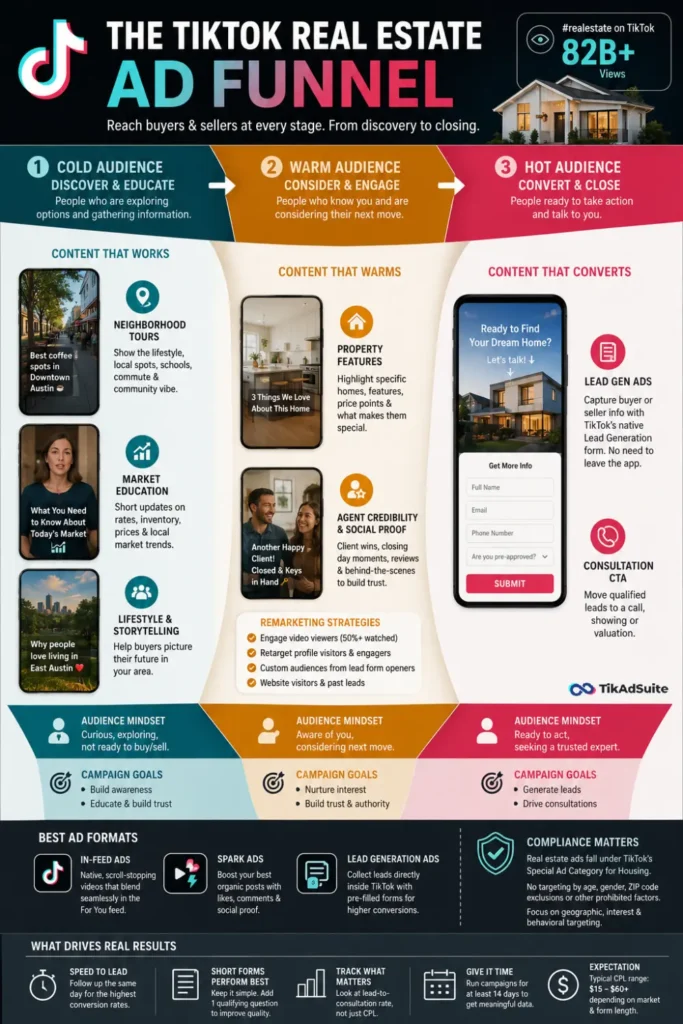
- #realestate on TikTok has accumulated over 82 billion views, reflecting the size of the audience already engaged with property content on the platform
Quick Answer
TikTok ads work for real estate by combining video-first property content with precise geographic and interest-based targeting. Lead Generation ads capture buyer and seller inquiries directly inside TikTok without requiring a separate landing page. Housing ads fall under TikTok’s Special Ad Categories, which means certain demographic targeting options are restricted to comply with fair housing regulations. Real estate businesses that combine property showcase content with agent credibility videos and neighborhood tours see the strongest lead quality at the lowest cost per lead.
Why TikTok Fits Real Estate Specifically
Most advertising channels reach people who are actively searching for a property. TikTok reaches people earlier in the process, before they have opened a portal, before they have shortlisted an agent, and often before they have decided which neighborhood they want to be in.
This discovery-stage advantage matters in real estate more than in almost any other category because homebuying is a high-consideration, long-cycle decision.
A buyer who discovers your content three months before they are ready to purchase is far more valuable than one who sees your ad the week they go under contract. TikTok builds that early relationship through content.
According to TikTok for Business’s real estate lead generation guide, behind-the-scenes content and day-in-the-life videos help potential clients get to know agents personally before they make contact, building trust that accelerates the conversion process once they are ready to act.
The demographic alignment supports this. Research from the NextGen Homebuyer Report found that 40% of Gen Z and 30% of Millennials now use social media specifically for homebuying research. (source) These two generations represent the largest active homebuying cohorts in the current market, and TikTok is the platform where a significant share of their research begins.
The Compliance Requirement Every Real Estate Advertiser Must Know
Real estate is one of the industries where TikTok’s ad targeting options work differently from most other categories. This is not a platform quirk. It is a legal requirement.
Housing ads are governed by the Fair Housing Act in the United States and equivalent legislation in other markets. To comply, TikTok classifies real estate advertising under its Special Ad Categories for housing. When your campaign falls under this category, certain demographic targeting options become unavailable.
You cannot target or exclude based on zip code in ways that could constitute redlining, and some age and gender-based filters are restricted.
This does not mean you lose all targeting capability. Geographic targeting at the city, metro, and regional level is still available, as are interest-based targeting, behavioral signals, and custom audiences built from your own data.
What it means is that your targeting strategy needs to be built around intent signals and geographic relevance rather than demographic exclusions.
Before launching any real estate campaign, select the appropriate Special Ad Category at the campaign creation stage in Ads Manager. Failing to do so while running housing-related ads can trigger policy violations and ad rejections.
For a full breakdown of the current policy framework, the TikTok ads policy update guide covers the restricted category compliance process in detail.
The Best Ad Formats for Real Estate Campaigns
Lead Generation Ads
For most real estate campaigns, Lead Generation is the right objective. According to TikTok’s official platform guidance, lead gen ads capture buyer and seller information directly inside the app through a native form, removing the friction of redirecting users to an external landing page.
For real estate, the lead form should capture name, phone number, email, and one qualifying question such as timeline, budget range, or whether the user is buying, selling, or both. Shorter forms produce higher volume. Longer forms with a qualifying question produce fewer but more filtered leads.
A practical setup for a buyer-focused campaign: a 15-second property tour video as the ad creative, a lead form that asks for name, contact details, and “Are you pre-approved?”, and a follow-up sequence that begins on the same day of form submission. Speed of follow-up is the single biggest variable in real estate lead conversion, regardless of the ad platform.
For a full breakdown of how lead gen ads work structurally, the TikTok lead gen ads guide covers form setup, question formats, and delivery optimization.
In-Feed Ads and Spark Ads
In-Feed ads work well for property showcases, neighborhood content, and brand-building videos that introduce your agency to cold audiences. The format sits natively in the For You feed alongside organic content, which suits the authentic, walkthrough-style video that performs best in real estate.
Spark Ads, which boost existing organic TikTok posts as paid ads, are particularly valuable for agents who already publish content.
A neighborhood walkthrough video that gets 50,000 organic views can be amplified with Spark Ads to reach a targeted local audience while retaining all existing likes, comments, and engagement.
That social proof carries weight with prospective clients evaluating agent credibility. The Spark Ads vs In-Feed Ads guide covers when to choose each format.
Content That Works for Real Estate Ads
The creative approach for real estate TikTok ads differs from standard product advertising. You are not selling a consumable item with a clear price point. You are building enough trust for someone to make the largest financial decision of their life, or at a minimum, pick up the phone to talk to you.
These content formats consistently produce the strongest results:
Property walkthroughs shot like organic content: Polished virtual tours belong on a website. TikTok property content works best when it feels like a real person showing you around. Phone footage, natural light, and a voiceover pointing out specific features perform better than drone shots and professional edits in most campaigns.
Neighborhood-first storytelling: Buyers do not just buy a property. They buy into an area. Videos that show local coffee shops, school proximity, commute routes, and community feel reach buyers who are still deciding on location, which is the majority of active buyers. This content also ranks well in TikTok’s search feature, where users increasingly search location-based terms.
Market update content: Short, direct videos covering current rates, inventory levels, or price trends in a specific area position the agent as a knowledgeable local authority. According to TikTok for Business, educational content helps potential clients learn about the buying process while building a personal connection, making it particularly effective for generating leads from first-time buyers.
Client milestone content: Closing day videos, before-and-after renovation reveals, and genuine client reactions build social proof in a format that feels human rather than promotional. These work especially well as Spark Ads because the original post already carries authentic engagement.
Audience Segmentation for Real Estate Campaigns
Real estate audiences segment naturally into three groups, each requiring different messaging and creative.
Active buyers are ready to transact. They respond to specific property features, financing angles, and urgency-driven CTAs. Target this group with detailed property ads, lead gen forms with pre-approval questions, and conversion objectives.
Pre-contemplation buyers are browsing without a committed timeline. They respond to market education content, neighborhood storytelling, and credibility-building. Reach and video view objectives work well here. The goal is brand recall when they become active.
Sellers require a completely different message. They respond to sold price data for comparable properties, agent track record content, and specific market timing information. Running a separate campaign with seller-focused creative, distinct from your buyer campaigns, produces better results than mixing messages meaningfully.
For a structured approach to building these segments inside TikTok Ads Manager, the TikTok ads audience segmentation guide covers how to separate cold, warm, and high-intent audiences into distinct ad group structures.
Budget and Performance Expectations
Real estate is a higher-ticket category, and cost per lead reflects that. Based on 2026 industry benchmarks, cost per lead for real estate TikTok campaigns typically ranges from $15 to $60 for standard residential properties, with luxury and high-value segments running higher depending on market competitiveness and lead form length.
Cost per lead is not the most meaningful metric on its own. A lower CPL from a broad, unqualified form often produces worse economics than a higher CPL from a form with one qualifying question. Track lead-to-consultation rate alongside CPL to evaluate true campaign efficiency.
Start with a daily budget that allows for 20 to 50 lead form views per day to give the algorithm enough signal to optimize delivery. As the campaign finds its footing, increase the budget gradually rather than in large jumps to protect performance stability.
FAQs
Do real estate ads on TikTok fall under a special category?
Yes. Housing ads are classified under TikTok’s Special Ad Categories due to Fair Housing Act compliance requirements. This restricts certain demographic and geographic exclusion targeting options. You must select the housing Special Ad Category at campaign creation. Failing to do so while running housing-related ads can result in policy violations.
What is the best TikTok ad objective for real estate lead generation?
Lead Generation is the most practical objective for most real estate campaigns. It captures buyer or seller contact information through a native in-app form without requiring users to leave TikTok. This reduces friction significantly compared to sending traffic to an external landing page, particularly on mobile.
What kind of TikTok content works best for real estate ads?
Property walkthroughs filmed in an organic style, neighborhood storytelling videos, and short market update content consistently outperform polished production content in real estate TikTok campaigns. Authenticity and local specificity both outperform high production value when it comes to generating trust with prospective buyers and sellers.
Can a solo real estate agent run TikTok ads effectively?
Yes. TikTok’s minimum budgets are accessible for solo agents, and the content types that perform best, walkthrough videos, local area tours, and agent credibility content, can all be produced on a phone. The platform’s algorithm distributes content based on relevance, not follower count, which means a new account can achieve meaningful reach with the right creative.
How long should I run a real estate TikTok ad campaign before evaluating results?
Run campaigns for at least 14 days before drawing conclusions. Real estate has a longer consideration cycle than most consumer categories, which means lead quality and conversion data take longer to develop. Evaluating a real estate campaign after 72 hours produces misleading conclusions about what is working.
Wrapping Up
TikTok gives real estate businesses something most other channels do not: consistent access to buyers and sellers at the stage when they are still forming preferences, not just executing a search.
The combination of video-first content, geographic targeting, and native lead generation makes it a genuinely effective channel for building a pipeline of qualified contacts.
The compliance requirements specific to housing ads are non-negotiable, but they do not limit your ability to run effective campaigns.
They just redirect the strategy toward intent-based and geographic targeting, which is where the highest-quality real estate leads come from anyway.
Start with one campaign objective, one clearly defined audience segment, and content that shows a real property or a real local area. The data from that first run will tell you exactly where to take the strategy next.
Set up your campaigns through TikTok for Business and make sure your account is fully verified before launching your first housing ad.