
TikTok’s ad rules changed in several practical ways over the past year. New campaigns now need a linked TikTok account, business checks carry more weight, and posts that promote a brand need the right disclosure setting.
Missing one of these rarely ends in anything dramatic. It usually means a rejected ad, a post with less reach, or a campaign stuck in review while your budget waits.
Below, you’ll find what changed and when, the rules behind the most common rejections, and a short checklist to run before you launch.
Get Up to $6000 Free TikTok Ad Credit
Table of Contents
Quick Answer
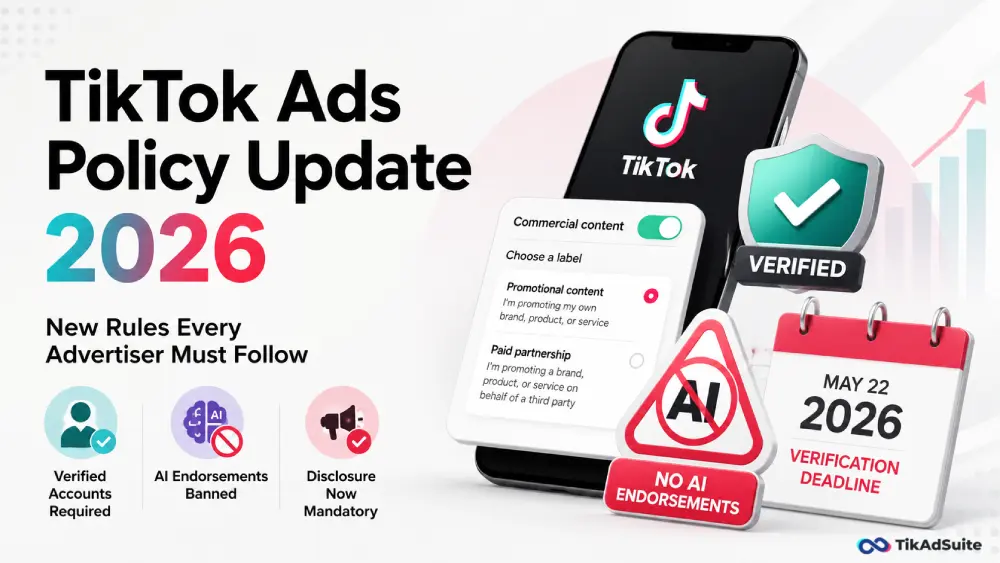
TikTok’s ads policy is the set of rules every paid ad must pass before it runs: what you can sell, what you can claim, how your video and landing page must look, and where you can show the ad. The biggest recent changes are that new campaigns must be linked to a TikTok account starting January 2026, Business Verification is checked when you open an ad account, paid political ads are still banned, and branded posts need the Commercial Content Disclosure setting turned on.
Key Takeaways
- Custom Identity is being phased out, so plan every new campaign around a real TikTok account linked through Business Center or Ads Manager.
- Some campaign types are exempt from the linking rule, including TikTok Shop sales campaigns and campaigns with Smart Creative turned on.
- Business Verification is asked for when you create an ad account and again once your spend reaches a set level.
- Posts that promote a brand need the Commercial Content Disclosure setting, and a notice about undisclosed content needs a fast reply.
- The Ads Policy and the Branded Content Policy are two separate checks. A Spark Ad has to pass both.
- Paid political ads are not allowed on TikTok, in any market.
What Changed in TikTok Ads Policy Recently
The main TikTok ads policy changes since 2024 touch five areas: ad identity, business checks, political ads, commercial disclosure and AI labels. Here they are in date order, with the official page each one comes from explained in the sections below.
| When | What changed | Who it affects |
|---|---|---|
| May 2024 | TikTok starts auto-labeling AI content that carries C2PA Content Credentials | Anyone uploading AI images or video made in other tools |
| September 2025 (page update) | TikTok updates its Commercial Content Disclosure rules for advertisers | Brands and creators posting promotional content |
| January 2026 | New campaigns must be linked to a TikTok account as Custom Identity is phased out | Advertisers who ran ads under a custom name and avatar |
| January 2026 | TikTok publishes its F.I.R.S.T. framework for moving brands to a verified presence | Brands setting up Business Center |
| July 2026 (page update) | Paid political ads stay banned; government bodies can advertise on limited topics after certification | Political, government and cause advertisers |
| September 2026 (page update) | Business Verification is required at ad account creation and at a spend threshold | Every new advertiser |
A page update month shows when TikTok last changed that help article. It is not always the day the rule started, so check the page itself before a big launch.
If you were searching for new buttons, menus or reports inside TikTok Ads Manager, that is a different topic from policy. Policy decides what may run; the Ads Manager interface decides how you set it up.
Why Did TikTok Update Its Advertising Policies?
TikTok tightened its ad rules for three reasons: disclosure law, AI content and advertiser identity.
On disclosure, the U.S. rules come from the FTC Endorsement Guides, which apply Section 5 of the FTC Act to paid and gifted endorsements. Other markets have their own disclosure rules, so TikTok gives brands one built-in way to label commercial posts instead of leaving it to captions.
On AI, synthetic faces and voices became cheap to make. Labels help viewers tell what is real, which protects both users and the brands whose names get copied.
On identity, tying every campaign to a real TikTok account and a verified business makes it harder for bad actors to hide behind a made-up name. TikTok’s Business Verification page, last updated in September 2026, says advertisers verify their business details when they create an ad account and again once spend reaches a set threshold. For honest advertisers, it also means ads build up a real profile with followers and comments instead of disappearing after the campaign ends.
What Are the Key Changes to TikTok’s Ad Policy?
Three changes affect how most campaigns are built: account linking, AI labels and commercial disclosure. Each one adds a step you should finish before you upload creative.
Linked TikTok Account Required: Custom Identity Is Being Phased Out
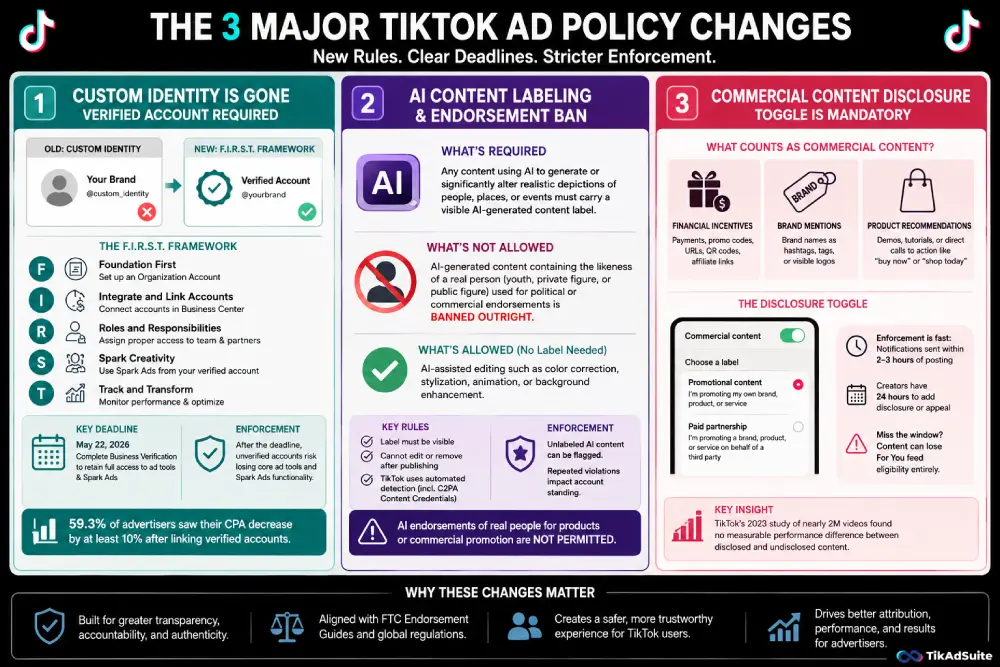
Custom Identity let advertisers show any brand name and avatar on an ad without a real TikTok account behind it. According to TikTok’s Custom Identity help page, starting January 2026 all new campaigns must be linked to a TikTok account.
The same page lists campaign types that are exempt from the linking rule:
- Branded Mission campaigns
- Sales campaigns for TikTok Shop
- Campaigns with Smart Creative turned on
- Manual campaigns that use a catalog
- Campaigns placed only on Pangle or Global App Bundle
You can still run your own uploaded videos, posts from the linked account, or posts a creator has authorized. Before linking, TikTok suggests turning on Show through ads only, so new ad videos do not appear on your organic profile.
You can link the account in Business Center, which TikTok recommends because access is managed in one place, or directly in Ads Manager with Connect Account during campaign setup. An account linked directly is only available to the person who linked it, which can cause trouble when a team member leaves.
TikTok’s F.I.R.S.T. framework post from January 22, 2026 reports that 59.3% of advertisers saw their cost per acquisition drop by at least 10% after linking accounts, and it breaks the move into five steps:
- Foundation first: set up an Organization Account as your official brand presence.
- Integrate and link accounts: approve linking in Business Center so the account can run Spark Ads and ad delivery.
- Roles and responsibilities: give your team and partners the right access.
- Spark creativity: run organic posts as Spark Ads under your brand identity.
- Track: review the results, then adjust what you run next.
Keep that figure in context: it comes from a TikTok Spark Ads backend test run in September 2025, and TikTok itself warns that past results do not predict future ones.
If your business account is not set up yet, start by learning how to create a TikTok business account and get it verified.
AI-Generated Content Labels
TikTok asks creators to label realistic AI-generated content, and it can add a label on its own. In a May 2024 newsroom post, TikTok said it had required labels on realistic AI content for over a year and would start auto-labeling AI images and videos made in other tools when they carry C2PA Content Credentials.
What this means for ads:
- If your video uses an AI avatar, a cloned voice or a realistic AI scene, expect it to be labeled, either by you or by TikTok.
- Files exported from AI tools may carry Content Credentials, so skipping the label does not hide the AI part.
- Showing a real person who never agreed to endorse your product is a serious risk under both ad rules and consumer law, whether the clip is AI-made or edited.
Labels and ad review are separate steps. Check the ad policy for your target market before you build a campaign around AI people, and read up on using AI avatars in ads before you commit budget.
Commercial Content Disclosure
Any post that promotes a brand, product or service should have the Commercial Content Disclosure setting turned on. TikTok’s disclosure help page for advertisers says the setting adds a label, such as Paid partnership, so viewers can tell paid content from organic posts. For the U.S., the page points to the FTC Endorsement Guides and notes that exact legal rules vary by country.
TikTok looks at three signals when it decides a post is commercial:
- Financial incentives, such as payments or discount codes
- Brand mentions
- Product recommendations
A post with a brand mention and a product recommendation can be flagged even with no clear payment. When TikTok thinks a video holds undisclosed branded content, it sends an in-app notice, and the creator disclosure page gives 24 hours to respond before the video can lose For You feed eligibility. Losing that eligibility cuts organic reach. Only the original poster can appeal.
This matters most for Spark Ads, because the ad runs on a creator’s original post. Sort out the disclosure with the creator before you request the Spark Ads code. The setup steps are covered in Spark Ads vs non-Spark Ads.
TikTok Ads Policy vs. Branded Content Policy: What’s the Difference?
The Ads Policy covers paid ads you run in TikTok Ads Manager. The Branded Content Policy covers organic posts that promote a brand because of a connection between the creator and that brand, such as payment, free products or an affiliate deal.
Mixing them up is a common reason for confusing rejections. A creator post can follow the Branded Content Policy and still fail as an ad. A paid ad can pass review and still lose organic reach if the original post lacks disclosure.
| Check | Ads Policy | Branded Content Policy |
|---|---|---|
| Covers | Paid ads in Ads Manager | Organic posts with a brand connection |
| Main question | Can this product, claim and landing page run as an ad? | Is the brand connection clearly disclosed? |
| What goes wrong | Ad rejected or account reviewed | Post labeled, or kept out of the For You feed |
| Applies to Spark Ads | Yes, to the paid version | Yes, to the original post |
Treat Spark Ads as two checks. First, confirm the original post has the right disclosure. Then confirm the ad itself meets the Ads Policy for your product, claims and landing page.
Which Products and Industries Are Prohibited or Restricted on TikTok Ads?
Some products can never be advertised on TikTok, and others are allowed only in certain countries or after extra checks. TikTok’s North America ad policy one pager lists these as generally prohibited:
- Adult sexual products, services and entertainment
- Casinos and gambling games
- Cigarettes and tobacco products
- Counterfeit goods and piracy
- Drugs and drug paraphernalia
- Police and military gear
- Weapons and weapon parts
- Animals, animal parts and animal products
- Political ads
- Unsuitable businesses and unacceptable business practices
Political ads have their own policy page. TikTok’s politics, government and elections policy, last updated in July 2026, says it does not allow paid political advertising. Government bodies can still advertise on limited topics, such as tourism or public health and safety, after working with a TikTok sales representative and completing certification.
Restricted products are a different group. They can run only when they meet local rules, and those rules change from country to country. A product that runs in the USA may need extra approval in the UAE or Japan, so check the ad policy for each market you target. For the approval steps in regulated industries, see the TikTok ads requirements for restricted categories.
What Creative, Claim, and Landing Page Issues Get TikTok Ads Rejected?
Most rejections come from claims you can’t prove, a landing page that doesn’t match the ad, or content TikTok doesn’t allow. TikTok’s own guide to ad policy for creatives names these common causes:
- Exaggerated or misleading claims about how a product performs
- An ad that promises one thing while the landing page shows another
- Prohibited or restricted products
- Sexually suggestive scenes or shocking images
- Third-party logos or other intellectual property you have no right to use
- Political, religious or culturally sensitive material
Claims need the most care. Absolute claims like number one in the world, before and after images that promise unrealistic results, and unfair comparisons with competitors are all flagged in TikTok’s North America one pager. If your product is in health, fitness or finance, keep proof of every claim ready.
Your landing page is reviewed too. Per the same one pager, it must work on mobile, must not be expired or under construction, must not download files on its own, and must not ask for personal details before showing the main content. The product, brand, offer and display name should match the ad exactly.
Music is another common problem. Use sounds you have the right to use in ads, such as tracks from TikTok’s Commercial Music Library, and learn how to avoid copyright strikes before you reuse a trending sound.
For a longer list of causes and fixes, see why TikTok ads get rejected.
How Does TikTok’s Ad Review and Appeal Process Work?
Every TikTok ad is reviewed before it can run. According to TikTok’s Ad Review FAQ, most ads are reviewed within 24 hours, though some take longer. TikTok’s creative policy guide adds that review checks the ad content, the landing page and the target audience.
If your ad is rejected, the reason shows in Ads Manager. Here is how to handle it:
- Open the rejected ad in Ads Manager and read the rejection reason.
- Find the exact part that caused it: a claim, a frame in the video, the landing page or the targeting.
- If it is a real problem, fix it and resubmit. Editing an ad sends it back into review.
- If you think the rejection is wrong, appeal through Business Support or open an Advertiser Support ticket and ask for a re-review.
TikTok does not publish a fixed time for appeals, so plan launches with a buffer of a few days. For a full walkthrough, see how to appeal TikTok ad rejections.
What Happens to Your Account After Repeated Policy Violations?
One rejected ad is normal and does not put your account at risk on its own. A pattern of rejections is the real warning sign, because TikTok reviews accounts as well as single ads.
If you see several rejections in a short time, stop launching new ads and audit what is already live:
- Pull every active ad and check it against the current policy, not the one you read last year.
- Pause anything with claims you can’t prove or landing pages that changed since approval.
- Check that every Spark Ad still runs on a post with the right disclosure.
- Contact TikTok Business support about account-level problems instead of resubmitting the same ad again and again.
TikTok Shop sellers face a separate system for store rules. If you sell through Shop, read about TikTok Shop violation points as well.
TikTok Ads Compliance Checklist Before You Launch
Run through this list before you submit a new campaign:
- Account linked. The campaign runs from a linked TikTok account, not Custom Identity, unless it is one of the exempt types.
- Business verified. Your ad account has passed Business Verification, or you know your deadline.
- Product allowed. Your product is not on the prohibited list and meets local rules in every target country.
- Claims proven. Every claim is true and you can show proof if asked.
- Landing page checked. It loads on mobile, matches the ad’s product and offer, and asks for no personal details before the main content.
- Disclosure on. Branded posts and Spark Ad source posts have the Commercial Content Disclosure setting turned on.
- AI labeled. Realistic AI people, voices or scenes are labeled, and no real person appears to endorse you without consent.
- Music cleared. All audio is licensed for ads.
- Policy reread. You checked the current policy page, not your notes from an earlier campaign.
FAQs
What is TikTok’s ads policy?
TikTok’s ads policy is the set of rules every paid TikTok ad must follow. It covers which products can be advertised, what you can claim, how the video and landing page must look, and where the ad can run. Every ad is reviewed against it before it goes live.
What changed in TikTok’s advertising policy recently?
The biggest change is that new campaigns must be linked to a TikTok account starting January 2026, as Custom Identity is phased out. Business Verification is also checked when you open an ad account and again at a spend threshold, and branded posts need the Commercial Content Disclosure setting.
Are political ads allowed on TikTok?
No. TikTok does not allow paid political advertising. Government bodies can advertise on limited topics, such as tourism or public health and safety, after certification with a TikTok sales representative.
Is AI-generated content allowed in TikTok ads?
AI content can be used, but realistic AI people, voices or scenes should be labeled, and TikTok can label some AI content on its own using Content Credentials. Never use an AI version of a real person to endorse your product without their consent.
Do I have to use the disclosure toggle on every ad?
Turn on the Commercial Content Disclosure setting for every post that promotes a brand, product or service. For Spark Ads, the original creator post should carry the disclosure before you run it as an ad.
What happens if my TikTok ad violates a policy?
The ad is rejected and the reason appears in Ads Manager. You can fix and resubmit it, or appeal through Business Support if you think the decision is wrong. Several rejections in a short time are a sign to audit all your live ads.
Wrapping Up
TikTok’s recent policy changes are mostly about who is behind an ad and how clearly it is labeled. Link a real TikTok account, finish Business Verification, turn on disclosure for branded posts and label realistic AI content.
Do those steps before launch and most rejections become easy fixes instead of lost days. Recheck the official policy pages every few months, since TikTok updates them without much notice.
If you are setting up your TikTok presence from scratch or moving off Custom Identity, TikTok for Business gives you the account setup, verification steps and Business Center access you need.