
You want to run more TikTok ads. But getting someone on camera, writing a script, filming, and editing takes time you don’t always have. That’s the problem AI avatars are built to solve.
TikTok’s own platform now lets you drop a digital human into your ad, one that speaks, gestures, and presents your product, without a single camera or production crew.
Major brands are already using it. Some are seeing results they weren’t getting from traditional creative.
Here’s what you’ll learn in this guide:
- What TikTok AI avatars are and how they actually work
- The difference between stock and custom avatars
- Real brand examples with verified results
- Step-by-step instructions for getting started in Symphony Creative Studio
- Where AI avatars perform well and where they fall short
- How disclosure rules work and why they matter
By the end, you’ll know whether AI avatars are worth testing in your own campaigns and how to set them up if they are.
Get Up to $6000 Free TikTok Ad Credit
Table of Contents
Key Takeaways
- TikTok launched AI avatars as part of its Symphony suite in 2024, and the tools have been expanding steadily since. Stock avatars are available to all TikTok for Business users through Symphony Creative Studio.
- There are two types: stock avatars, which use pre-licensed actors, and custom avatars, which replicate your brand spokesperson or a creator’s likeness. Custom avatars are available to select advertisers by request.
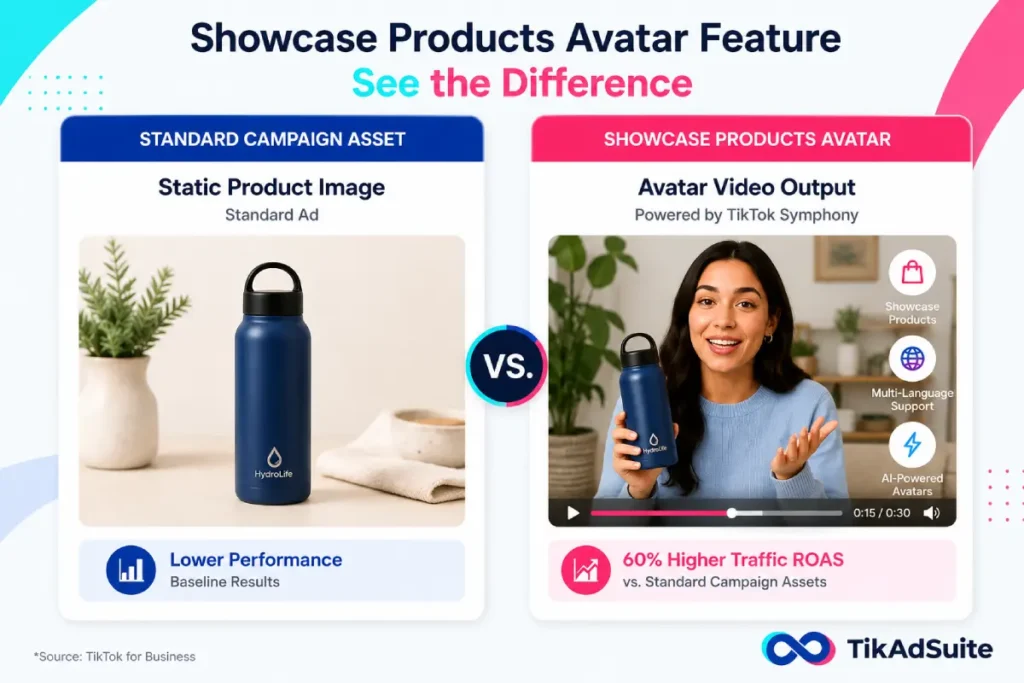
- According to TikTok for Business, American Eagle saw 60% higher traffic return on ad spend (ROAS) using the Showcase Products avatar feature compared to standard campaign assets.
- All videos made with Symphony Digital Avatars are automatically labeled “AI-generated” by TikTok. You do not need to add this label yourself.
- AI avatars are most effective for product demos, multilingual campaigns, and rapid creative testing. They work less well in categories where audience trust depends on real human faces.
Quick Answer
TikTok AI avatars are synthetic digital humans powered by the Symphony Creative Studio platform. Brands use them to create spokesperson-style video ads without filming real people. You choose a stock avatar or build a custom one, input a script, and TikTok generates a short video where the avatar speaks and interacts with your product. All output is auto-labeled as AI-generated.
What Are AI Avatars in TikTok Ads?
An AI avatar in a TikTok ad is a digitally generated human figure that can speak, gesture, and interact with products on screen. It looks and behaves like a real presenter, but no one was filmed to create it.
TikTok built this capability into its Symphony AI suite, which launched at TikTok World 2024. Symphony is TikTok’s central creative AI platform, and Digital Avatars are one of its flagship tools.
The feature was designed to help brands produce TikTok-native content faster and at scale, without needing a creator, a camera, or a production budget for every ad variant.
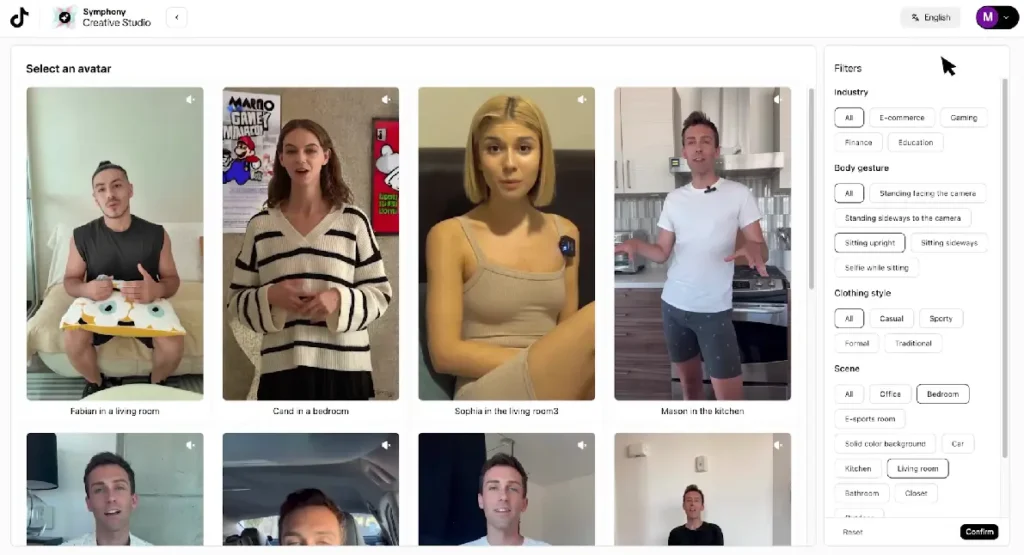
The avatars are built on AI models trained on footage of real, consenting actors. They can deliver voiceovers in over 30 languages, display a range of body positions and gestures, and be placed against various background scenes.
From a viewer’s perspective, they look like a person talking to the camera, which is exactly the format TikTok’s algorithm rewards.
Stock Avatars vs. Custom Avatars: What’s the Difference?
TikTok offers two distinct avatar types, and the choice between them has real implications for your brand strategy.
Stock Avatars are pre-built digital presenters created from footage of professional actors. TikTok holds the usage rights, so you get immediate access without any setup process.
You pick from a library of options sorted by category, including industry (e-commerce, gaming, finance, education), body position (standing, sitting, selfie-style), and scene (office, street, bedroom, kitchen, solid color background, and more).
Stock avatars can speak in over 30 languages, which makes them immediately useful for any brand running multilingual campaigns. The trade-off is that your competitors can use the same faces. If brand distinctiveness matters to you, stock avatars have a ceiling.
Custom Avatars solve that. They are built from your own footage of a real person; a brand spokesperson, your CEO, or a partnered creator.
Only the person being replicated can initiate the process. Once created, the custom avatar can be shared across your TikTok for Business account and used by invited team members.
Custom avatars are not available to all advertisers by default. Access is granted to select customers, and you’ll need to contact your TikTok sales representative to request it.
There are also geographic restrictions: custom avatar creation is currently unavailable in the UK, EU, Texas, and Illinois due to local regulations.
The practical split is straightforward. If you need to move fast and you’re testing a new creative angle, stock avatars get you there in minutes.
If you’re building a recognizable brand voice and have a face people already associate with your brand, a custom avatar is worth pursuing.
How to Set Up AI Avatars in Symphony Creative Studio
Getting started with stock avatars is simpler than most advertisers expect.
Here’s how it works:
- Log in to TikTok for Business and navigate to Symphony Creative Studio from your Ads Manager dashboard.
- Click the Avatars tab on the Creative Studio homepage.
- Choose your avatar from the stock library. Filter by industry, body gesture, and scene to narrow your options.
- Input your script in the text field. You can select a language from over 30 available options.
- Choose the avatar’s voice and customize its position, scale, and on-screen style.
- Add any finishing elements: music, text overlays, stickers, before exporting.
- Download the final video or push it directly to TikTok Ads Manager for launch.
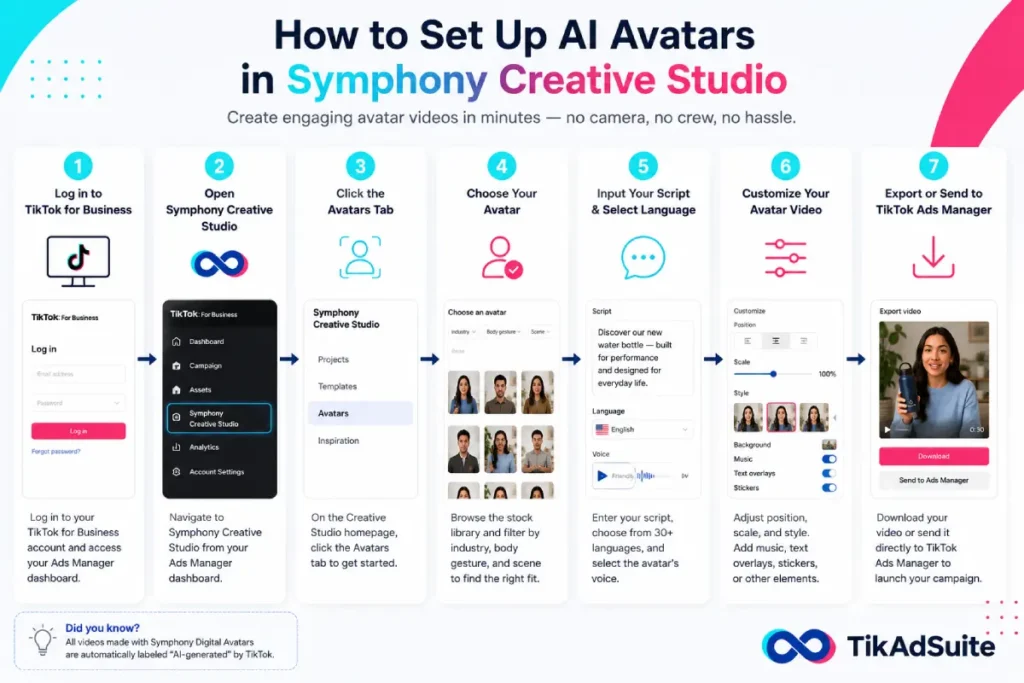
The whole process can take under 15 minutes for a straightforward product voiceover video. If you’re editing or iterating, CapCut for Business integrates with TikTok workflows and can help you refine your output before publishing.
For custom avatars, the process involves an additional identity verification step. The person whose likeness will be used must log into Creative Studio personally, verify their identity via camera, and record consent footage.
After that, the avatar is generated and can be shared with brand team members via their TikTok Business ID.
What Is Showcase Products and How Does It Use Avatars?
Showcase Products is a specific Symphony feature that combines a static product image with a Digital Avatar to create a short demo video.
You upload one product photo, select an avatar, and TikTok generates a five-second clip showing the avatar interacting with your product.
There are three modes:
- Holding: The avatar holds your product toward the camera; works well for beverages, electronics, beauty items, and packaged goods.
- Clothing: The avatar appears to try on your garment: useful for fashion and apparel brands that want virtual try-on content without a photoshoot.
- App: The avatar holds a phone displaying your app screen; designed for mobile apps and digital products.
This is TikTok’s answer to a real operational problem. Product demos normally require a model, a set, a photographer or videographer, and editing time. Showcase Products collapses that into a product image and a few clicks.
It won’t replace hero creative. The output is five seconds long, the avatar interaction is simplified, and there’s no narrative or story.
But for product-forward ads where your goal is to show what the item looks like in use, it’s a fast and cost-efficient option.
Real Brand Examples Using TikTok AI Avatars
Here are verified examples of brands that have used Symphony Digital Avatars in paid campaigns.
American Eagle
American Eagle was one of the first retail brands to adopt Showcase Products at scale. According to TikTok for Business, the brand achieved 60% higher traffic ROAS from Showcase Products compared to its standard campaign assets.
The tool lets the brand generate virtual try-on content without organizing model shoots for every product variant; a significant production cost reduction at scale.
Vodafone
Vodafone Germany used stock avatars across ongoing campaigns as part of their Symphony Creative Studio adoption. According to TikTok for Business, the telecom used stock avatars to maintain brand uniformity and cost-effectiveness across their campaigns.
Earlier campaigns from the brand demonstrated results, including a 45% lower cost per lead in the premium segment compared to non-avatar campaigns, per data reported by Fashionbi.
Danone’s Alpro Brand (via WPP)
After WPP integrated Symphony Digital Avatars into WPP Open, its AI marketing platform, Danone’s Alpro brand in Europe became the first named launch partner using the integrated tools.
The partnership, announced at Cannes Lions 2025, gives WPP agency teams access to Symphony AI Dubbing, Digital Avatars, and Generate and Remix features inside their existing workflow.
This is a signal that avatar-based creative is moving from experimental to standard for enterprise advertisers.
YOOX
Fashion platform YOOX was among the brands TikTok highlighted as early testers of Showcase Products.
Like American Eagle, the brand’s use case centered on fashion try-on content, generating model-style demo videos without the cost of styling and shooting individual SKUs.
What Results Can You Realistically Expect?
This is where some caution is worth applying. The headline numbers from American Eagle are genuinely strong.
But those results came from an early-adopter brand in fashion retail, a category where virtual try-on content is directly relevant to the buying decision.
Not every vertical will see the same lift. AI avatars produce spokesperson-style video, which means they’re most effective when your product benefits from a human presenter.
Think skincare demos, tech explainers, fitness products, and consumer goods. They’re less suited to content categories where authenticity and social proof are the primary conversion drivers.
TikTok’s internal research found that 58% of TikTok users say they are more likely to trust brands after learning about them from TikTok creators.
That’s a meaningful benchmark. An AI avatar is not a creator in the sense TikTok users understand the term. The visual format may feel similar, but it lacks the personal relationship and social proof that creator content carries.
Where AI avatars genuinely shine is in creative volume. If you’re running TikTok ads for eCommerce and you need 10 ad variants this week instead of 2, avatar-based creative gets you there without proportional production cost.
That kind of creative testing velocity matters more than ever on TikTok, where ad creative fatigue sets in faster than on most other platforms.
AI Dubbing: The Feature That Makes Avatars More Powerful
Symphony AI Dubbing is a separate but closely related tool. It translates your video’s original voiceover into multiple languages, including automatic lip-sync adjustment, so your avatar appears to be speaking the dubbed language naturally.
The dubbing tool supports over 10 languages. When combined with avatar videos, it means one piece of creative can become a localized ad for multiple markets; without re-recording, without hiring voice talent in each country, and without reshooting.
For brands running global campaigns or targeting diaspora communities in a single market, this is a meaningful capability.
A US-based beauty brand could use a single avatar video to reach English, Spanish, and Mandarin-speaking audiences with separate language versions of the same creative.
The limitation worth knowing: automated lip-sync is not yet perfect. In some cases, the mouth movements can look slightly mismatched to the dubbed audio.
For native speakers watching closely, it may be noticeable. Testing your dubbed outputs before scaling spend is worth the extra step.
Does TikTok Require You to Label AI Avatar Ads?
Yes; but you don’t have to do anything yourself. TikTok automatically applies an “AI-generated” label to all content created through Symphony Creative Studio, including Digital Avatars. The label appears on the video so viewers know the content was synthetically produced.
This matters for two reasons.
First, TikTok’s Community Guidelines require disclosure of AI-generated content that features realistic visuals or audio.
Second, TikTok integrated C2PA Content Credentials in early 2025, making it the first major platform to automatically detect and label AI content through embedded metadata, so even if you tried to skip the label, the platform’s detection systems could flag the content anyway.
Content labeled as AI-generated is not penalized in distribution, provided it follows TikTok’s Community Guidelines.
The label does not automatically reduce reach. What affects reach is content quality, watch time, engagement, and ad performance signals; the same factors that govern any TikTok ad.
One brand-related risk to avoid: hiding that content is AI-generated. One fitness account gained 26 million views using a hyper-realistic AI avatar while deleting comments that mentioned AI.
Once the audience discovered the deception, the account rapidly lost trust. Transparency is both the compliant approach and the strategically sound one.
Are There Third-Party AI Avatar Tools That Work With TikTok?
Yes. Beyond TikTok’s native Symphony tools, several third-party platforms offer AI avatar creation designed for TikTok ad content.
Creatify and Arcads are the two most commonly used. Both allow you to input a script, select an avatar persona based on age, gender, accent, and energy level, and receive a video that simulates a first-person product testimonial or UGC-style review.
These are sometimes called “AI UGC” tools; they generate content that mimics the look and feel of user-generated creator video.
The difference from Symphony’s stock avatars is meaningful. Third-party tools are often optimized specifically to replicate UGC style, which tends to feel more native on TikTok than a polished spokesperson format. Symphony’s stock avatars lean more toward professional presenter territory.
Neither approach replaces real creator content for brand-new creative territory. They work best when you already have a winning angle; from organic posts or earlier paid tests; and need to scale variants quickly without production overhead.
If you’re using AI tools for TikTok ad creation, consider the two approaches as complementary rather than competitive.
Symphony avatars for product demos and spokesperson content. Third-party UGC-style tools for testimonial-format ads and social proof angles.
When Should You Use AI Avatars in TikTok Ads?
Use AI avatars when:
- You need product demo content and don’t have a model or creator available.
- You’re launching a multilingual campaign and need localized versions quickly.
- You want to test multiple creative angles before committing to full production.
- You’re selling in a category where a human presenter adds value: skincare, tech, wellness, fashion.
Skip AI avatars when:
- Your product depends on real-world proof: food quality, material feel, performance results.
- Your audience is buying from a specific creator’s recommendation and community trust matters more than the product presentation itself.
- You’re in a category with high authenticity expectations, like luxury or community-driven brands.
The right framing is that AI avatars are a production efficiency tool first and a creative tool second. They let you do more with fewer resources.
Whether that translates to better results depends entirely on your product category and what your audience actually responds to.
Check your TikTok ad metrics closely after testing. Watch time, click-through rate, and conversion rate will tell you quickly whether avatar content is working for your specific audience.
FAQs
Can small businesses use TikTok AI avatars?
Yes. Stock avatars in Symphony Creative Studio are available to all TikTok for Business users, including small businesses. You need a TikTok for Business account to access them, and there’s no minimum ad spend to get started. The tools are free to use inside Symphony Creative Studio, though running the output as a paid ad requires a campaign budget.
Do TikTok AI avatar ads perform as well as UGC ads?
It depends on the category and execution. American Eagle’s 60% ROAS improvement shows strong results are possible. But UGC ads, particularly those featuring real creators with established audiences, typically outperform generic avatar content on trust-related metrics. AI avatars are best treated as a cost-efficient supplement to your creator content, not a replacement for it.
What languages do TikTok Symphony avatars support?
Stock avatars in Symphony Creative Studio can speak in over 30 languages. The AI Dubbing feature, which translates and lip-syncs existing videos, supports over 10 languages. TikTok continues to expand language support across both features.
Is there a cost to use TikTok Digital Avatars?
Symphony Creative Studio is free to access with a TikTok for Business account. Stock avatar video generation within Creative Studio does not carry a separate fee for most users, though access to custom avatar features and usage at scale may have different terms depending on your account type. Contact your TikTok representative for specifics on custom avatar access pricing.
Can I use a creator’s likeness as a custom avatar without their involvement?
No. TikTok requires that only the person whose likeness will be used can initiate the custom avatar creation process. They must personally log in, verify their identity, and give explicit consent through the Symphony Creative Studio workflow. Using someone’s likeness without this process violates TikTok’s terms.
Will using an AI avatar label hurt my ad’s reach?
No. TikTok’s official guidance confirms that turning on the AI-generated content setting does not affect distribution, provided the content complies with Community Guidelines. Reach is determined by content quality, engagement signals, and ad performance, not by whether the content is labeled AI-generated.
Wrapping Up
AI avatars in TikTok ads are a production tool that solves a real problem: creating enough high-quality video content to stay competitive without spending hours filming for every new ad variation.
The technology is already working for brands like American Eagle and Vodafone. The access is broad; any TikTok for Business user can start using stock avatars in Symphony Creative Studio today.
And the disclosure rules are handled automatically, so you don’t need to worry about compliance overhead.
The honest starting point is to test it on a product category where a human presenter makes sense, compare the results against your existing creative, and let the data guide the next step.
If you don’t have a TikTok for Business account yet, set one up here and you’ll have access to Symphony Creative Studio from day one.