
You spent time filming. You edited the video. You wrote a caption. Then you hit publish at the wrong time and watched it flatline.
Timing on TikTok is not a minor detail. The algorithm uses early engagement velocity to decide whether to push a video to a wider audience.
Post when your audience is asleep, and you lose that window before anyone even sees it. Post at the right moment, and the same video can multiply its reach within hours.
This guide pulls from verified 2026 data across millions of posts to give you a clear, actionable posting schedule for your business.
Here is what you will walk away knowing:
- The best days and time windows to post on TikTok in 2026, backed by large-scale studies
- Why mid-week afternoons outperform all other slots for most business accounts
- How B2B and B2C schedules differ and why treating them the same is a costly mistake
- How to use TikTok’s native analytics to find the exact window that fits your audience
- When timing matters less than you think, and what to prioritize instead
The data is clear. The windows are specific. Let’s get into it.
Get Up to $6000 Free TikTok Ad Credit
Table of Contents
Key Takeaways
- According to Sprout Social’s 2026 analysis of nearly 2 billion engagements, the best times to post on TikTok are Tuesdays through Thursdays between 2 p.m. and 6 p.m. local time.
- Buffer’s study of 7.1 million TikTok posts found that Sunday at 9 a.m. and Monday at 1 p.m. are among the top-performing slots for engagement, offering a useful contrast to weekday patterns.
- The first 60 minutes after you post determine roughly 80% of a video’s initial distribution. If your audience is not active in that window, the algorithm treats the video as low-interest.
- Weekends are the worst days to post for most business accounts, with Saturdays and Sundays showing the lowest average engagement in Sprout Social’s 2026 data.
- Timing advice only works as a starting point. Your TikTok Analytics follower activity tab is the only source that reflects your actual audience, not an aggregate of millions of unrelated accounts.
What Are the Best Times to Post on TikTok for Business in 2026?
The short answer: Tuesdays, Wednesdays, and Thursdays between 2 p.m. and 6 p.m. local time.
That comes directly from Sprout Social’s 2026 analysis, which examined close to 2 billion engagements across 307,000 global social media profiles between November 2025 and February 2026. It is the most comprehensive dataset currently available for TikTok timing. (source)
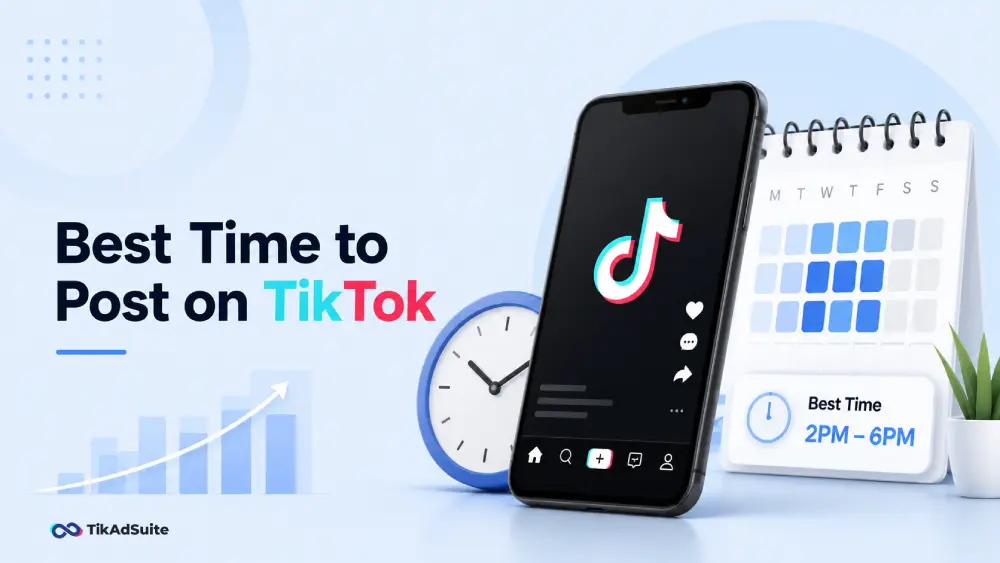
The reason those hours work is behavioral. Short-form video demands active, sound-on attention. That is different from text-based platforms users can scan during a meeting. By mid-to-late afternoon, most users hit a productivity wall.
They reach for TikTok as a mental reset before their day ends. That behavioral shift is what powers engagement in the 2 p.m. to 6 p.m. window.
Here is a day-by-day breakdown based on that data:
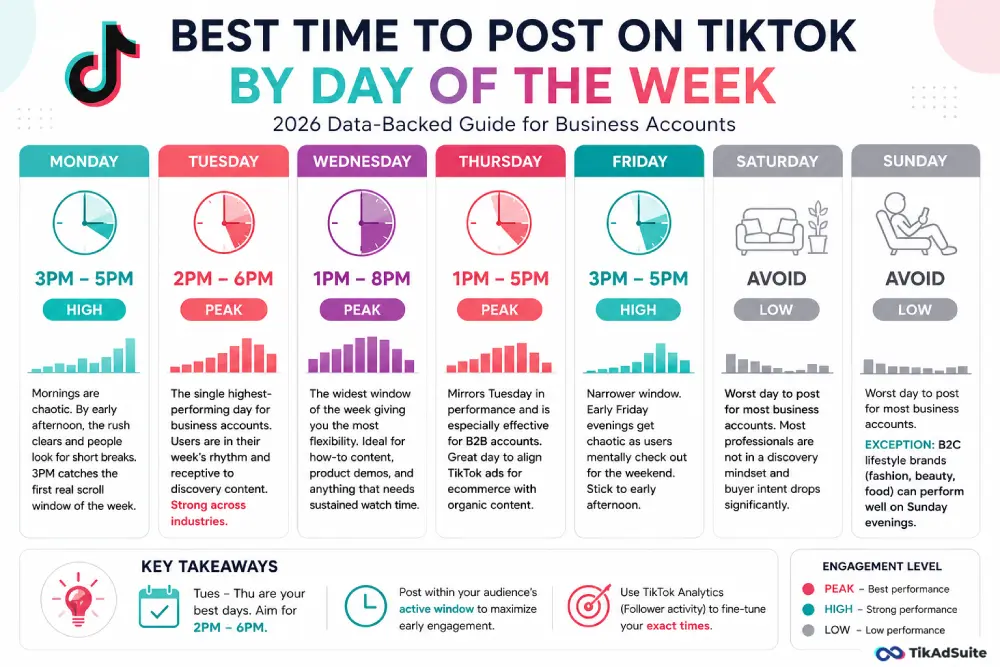
| Day | Best Posting Window (Local Time) | Engagement Level |
| Monday | 3 p.m. to 5 p.m. | High |
| Tuesday | 2 p.m. to 6 p.m. | Peak |
| Wednesday | 1 p.m. to 8 p.m. | Peak |
| Thursday | 1 p.m. to 5 p.m. | Peak |
| Friday | 3 p.m. to 5 p.m. | High |
| Saturday | Avoid | Low |
| Sunday | Avoid | Low |
Wednesday stands out as the widest engagement window, with a seven-hour span of strong activity. If you can only commit to one post per week, Wednesday afternoon is your safest bet.
Does Posting Time Still Matter in 2026?
Yes, but not in the way it used to.
TikTok’s algorithm no longer uses a strictly chronological feed. Instead, it measures how quickly a video earns engagement after it goes live.
Likes, shares, comments, and watch-through rate in the first 60 minutes send signals that tell the algorithm whether to push the content to a wider audience.
If you post at 2 a.m. and your audience is asleep, the video earns little early engagement. The algorithm interprets that silence as low interest and limits distribution.
The same video posted at 3 p.m. on a Tuesday, when thousands of your followers are actively scrolling, gets a completely different outcome.
That said, timing matters differently depending on your content type. For trending or feed-based content, the launch window is critical.
For evergreen educational content, such as tutorials, product reviews, or how-to videos, timing matters far less.
Users will find that content through TikTok’s search function days or weeks later. If your content strategy includes trending TikTok keywords, building for search means you do not need to chase the perfect time slot every single post.
Best Time to Post by Day of the Week
Monday
The best time to post on Monday is 3 p.m. to 5 p.m. Monday mornings are chaotic for most working adults. By early afternoon, the initial rush has cleared, and people are looking for short breaks. The 3 p.m. slot catches users during the first real scroll window of the week.
Tuesday
Tuesday runs from 2 p.m. to 6 p.m. as a peak window. This is the single highest-performing day for business accounts. By Tuesday, users have settled into their week’s rhythm and are receptive to discovery content. SocialPilot’s analysis of 700,000 TikTok posts confirms Tuesday as a consistently strong engagement day across industries.
Wednesday
Wednesday offers the widest window in Sprout Social’s data: 1 p.m. to 8 p.m. This gives you the most flexibility for scheduling. It is a strong day for how-to content, product demos, and anything that benefits from sustained watch time.
Thursday
Thursday peaks from 1 p.m. to 5 p.m. It mirrors Tuesday in performance and is especially effective for B2B accounts. Users are in a pre-weekend mindset and actively looking for tools or solutions to close out their week. If you run TikTok ads for eCommerce alongside organic content, Thursday is a strong day to align both.
Friday
Friday’s window is narrower: 3 p.m. to 5 p.m. Early Friday evenings become chaotic as users mentally check out for the weekend. Stick to the early afternoon to catch the last productive scroll window before the weekend drop.
Saturday and Sunday
Sprout Social’s 2026 data labels weekends as the worst days to post for business accounts. Most professionals are not in a discovery mindset, and buyer intent drops significantly. The exception is B2C lifestyle brands, particularly those targeting fashion, beauty, or food audiences, where Sunday evenings can still perform well.
B2B vs. B2C: Your Posting Schedule Should Not Be the Same
One of the most common mistakes business accounts make is treating all posting times as equal. A SaaS company and a fashion brand do not share the same audience behavior, and their schedules should reflect that.
For B2B businesses (software, agencies, consultants, professional services):
Your audience uses TikTok to learn, not just to be entertained. They scroll during work breaks or commutes. The strongest windows for B2B accounts are:
- Weekday mornings: 7 a.m. to 9 a.m. for commute-window content
- Weekday afternoons: 12 p.m. to 2 p.m. for lunch-break discovery
- Tuesday and Wednesday: consistently the highest B2B engagement days
WebFX data confirms that B2B audiences engage most during weekday afternoons between 2 p.m. and 5 p.m. If you are running TikTok ads for B2B companies, aligning your organic posting schedule with paid timing can improve overall account-level performance signals.
For B2C businesses (fashion, beauty, food, gadgets, apparel):
Your audience shops based on emotion and impulse. They convert when their stress is low, and they have time to browse. The best windows for B2C accounts are:
- Weekday evenings: 7 p.m. to 10 p.m. for relaxed browsing and impulse discovery
- Sunday evenings: 5 p.m. to 9 p.m. for the pre-week planning mindset
- Wednesday afternoons: strong mid-week window for product discovery content
The Sunday evening window is particularly strong for lifestyle product demos and recipe-style content. Users in a weekend-reset mode are receptive to product ideas that feel aspirational but practical.
How Industry Changes Your Ideal Posting Time
Not all businesses benefit equally from the same windows. SocialPilot’s study of 700,000 posts identified clear industry-level variations worth knowing:
- Restaurants and food brands: 2 p.m. to 5 p.m., Monday to Thursday. Users are planning meals or deciding where to eat.
- Retail and eCommerce: Evenings work best, particularly 7 p.m. to 10 p.m. on weekdays when purchase intent peaks.
- Education and nonprofits: Wednesdays and Thursdays between 11 a.m. and 6 p.m., aligning with student activity windows between classes.
- Tech and software: Weekday mid-mornings, 9 a.m. to 11 a.m., when professionals are in a research-ready mindset.
- Fitness and wellness: Early mornings (6 a.m. to 8 a.m.) and Sunday evenings perform well as users plan their health routines.
If you run TikTok ads for restaurants and cafes, posting organic content just before your paid ads run in those same windows can reinforce brand recall in the algorithm.
What the 60-Minute Rule Means for Your Schedule
Here is the mechanic that makes timing so important: the first 60 minutes after you publish determine roughly 80% of a video’s early distribution, according to timing research published in 2026.
The algorithm watches your video’s response rate, not just raw views. If 10,000 people see a video and 200 engage with it, that is a 2% response rate.
If 1,000 people see it and 200 engage, that is a 20% response rate. The second video gets pushed to a wider audience faster.
Posting when fewer people are active can actually improve your response rate in some niches, because less competition in the feed means the users who do see it are more likely to engage. Early mornings between 5 a.m. and 6 a.m. sometimes outperform evening slots for this reason.
The practical takeaway: aim for 30 minutes before the start of a peak window. If you are targeting the 2 p.m. to 6 p.m. Tuesday slot, publish at 1:30 p.m. to let the early engagement build before the peak hits.
Does Posting Frequency Matter as Much as Timing?
Yes. Consistency in posting frequency affects how the algorithm treats your account, separate from individual video timing.
A business that posts three to five times per week, even at imperfect times, will generally outperform an account that posts one highly optimized video per month. The algorithm favors accounts that signal regular activity and audience engagement over time.
If you are building an organic content strategy that runs alongside paid activity, your TikTok ads algorithm understanding matters here. Organic posting frequency influences account health signals, which can affect paid ad performance on the same account.
A realistic starting point for most business accounts: two to three posts per week, scheduled within your peak windows, with at least 24 hours between posts to avoid your own content competing against itself.
How to Find Your Actual Best Posting Time
Every large-scale study aggregates millions of accounts across hundreds of industries and time zones. That data is a useful baseline, not a personalized prescription. Your audience has its own behavior pattern.
Here is how to find it:
- Go to your TikTok Business Account. Navigate to Analytics, then Follower Activity.
- Look at the hours graph. Find the two to three hours where follower activity is consistently highest across multiple days.
- Note which days of the week show the highest overall peaks. These are your priority posting days.
- Schedule your next five posts for 30 minutes before the start of your highest activity window.
- After two weeks, compare the performance of those posts against your previous schedule.
This process takes about 10 minutes and gives you data that is specific to your account. No third-party study can replicate it. If you have not yet set up a business account, the TikTok business account setup guide walks through the full process, including how to unlock analytics.
Should You Use a Scheduler Tool?
If you are running a business account with a consistent posting schedule, yes. Manually publishing every post at a specific time is not sustainable, especially if your peak window is in the middle of your workday.
Scheduling tools let you batch-record content and queue posts in advance. This removes the friction of remembering exact windows and lets you focus on content quality instead of clock-watching.
Tools like Tailwind offer TikTok scheduling alongside analytics that can help you identify your best-performing time slots over time.
The one caveat: scheduling should not replace your native TikTok analytics. Use both. Schedulers optimize your workflow; native analytics tell you what is actually working.
FAQ: TikTok Posting Times for Business
What is the single best time to post on TikTok for business in 2026?
Based on Sprout Social’s 2026 analysis of nearly 2 billion engagements, Tuesday between 2 p.m. and 6 p.m. local time is the top-performing window for business accounts. Wednesday afternoons are a close second and offer a wider engagement window. Use these as your starting point, then refine based on your own analytics data.
Is Sunday a good day for businesses to post on TikTok?
For most business accounts, no. Sprout Social’s 2026 data marks Sunday as the worst day to post. The exception is B2C lifestyle brands, particularly food, fitness, and home content, where Sunday evening between 5 p.m. and 9 p.m. can perform well as users mentally prepare for the week ahead.
Does it matter if I post in my time zone or my audience’s time zone?
Always post in your audience’s time zone. If your customers are in New York and you are based in London, schedule your posts to go live during New York’s peak windows, not your local time. Most scheduling tools let you set a target time zone so you never have to do the math manually.
How often should a business post on TikTok?
Three to five times per week is a strong target for most businesses. Posting once per day can work, but only if you can maintain quality. The algorithm penalizes recycled or low-effort content, and posting multiple times within a three-hour window causes your own videos to compete against each other.
Do TikTok ads follow the same timing rules as organic posts?
Not exactly. Organic content relies on posting at peak activity windows to earn early engagement velocity. Paid ads can be scheduled to run during specific hours using TikTok Ads Manager, which gives you more control. For guidance on when to run your paid campaigns, the best time to run TikTok ads article covers the specific differences between ad scheduling and organic timing.
What if I can only post once per week?
Prioritize Wednesday between 1 p.m. and 3 p.m. local time. Sprout Social’s data shows this as the widest sustained engagement window of the week. Make that one post high quality: strong hook in the first three seconds, clear message, and optimized caption with relevant keywords.
Making Your Posting Schedule Work
The data points to a clear answer: mid-week afternoons, specifically Tuesday through Thursday between 2 p.m. and 6 p.m. local time, are the best times to post on TikTok for most business accounts in 2026.
That finding is consistent across Sprout Social’s 2 billion engagement dataset and SocialPilot’s 700,000-post study.
But the schedule is only half the equation. A video posted at the perfect time with a weak opening will still underperform.
The first three seconds determine whether anyone watches past the hook. If your content is not stopping the scroll, no amount of timing optimization will fix it.
Start with the mid-week afternoon window. Use your native analytics to refine it within two weeks. Then focus your energy on the part of the content that timing cannot fix: the creative itself.
If you want to take the next step on the content side, the TikTok ad hooks guide is a practical place to start.