
A silent ad is a dead ad. But a copyrighted ad is a banned account.
In the high-velocity world of TikTok advertising, audio is not just an accessory; it is the primary driver of engagement.
According to recent platform data, 88% of TikTok users say sound is essential to their experience, and videos that utilize trending audio see a massive 66% lift in engagement compared to those without.
However, this reliance on sound has created a minefield for advertisers. The distinction between Personal Use and Commercial Use is the most misunderstood concept in social media marketing.
Get Up to $6000 Free TikTok Ad Credit
While a teenager can dance to the latest Taylor Swift hit without consequence, a brand doing the same is committing intellectual property theft.
The platform’s automated Content ID system scans millions of uploads daily, and for advertisers, the penalty is severe: immediate ad rejection, account suspension, or legal action from rights holders.
If you are a media buyer or brand owner asking how to succeed in avoiding copyright strikes on TikTok ads, you must move beyond simply picking a song.
You need a forensic understanding of licensing, incidental audio, and the specific tools that vet your creative before it ever hits the feed.
This comprehensive guide will break down the Commercial Music Library (CML), the hidden dangers of remix culture, and the exact workflow to ensure your creative assets are 100% compliant and un-mutable.
Table of Contents
Key Takeaways
- Silence Kills Performance: Ads with no sound or generic stock music have a significantly lower conversion rate than those with native-style commercial audio.
- Whitelisting is the only Loophole: The only legal way to use a pop song is to pay for a Spark Ad usage right or obtain a direct license, which can cost $5,000+.
- Visual Copyright: It’s not just audio. Wearing a Mickey Mouse shirt or showing a Netflix clip on a TV screen in your ad can also result in a visual copyright strike.
Part 1: The Anatomy of a Copyright Strike
To master avoiding copyright strikes on TikTok ads, you must first understand the mechanism of detection.
1. The Automated Content ID System
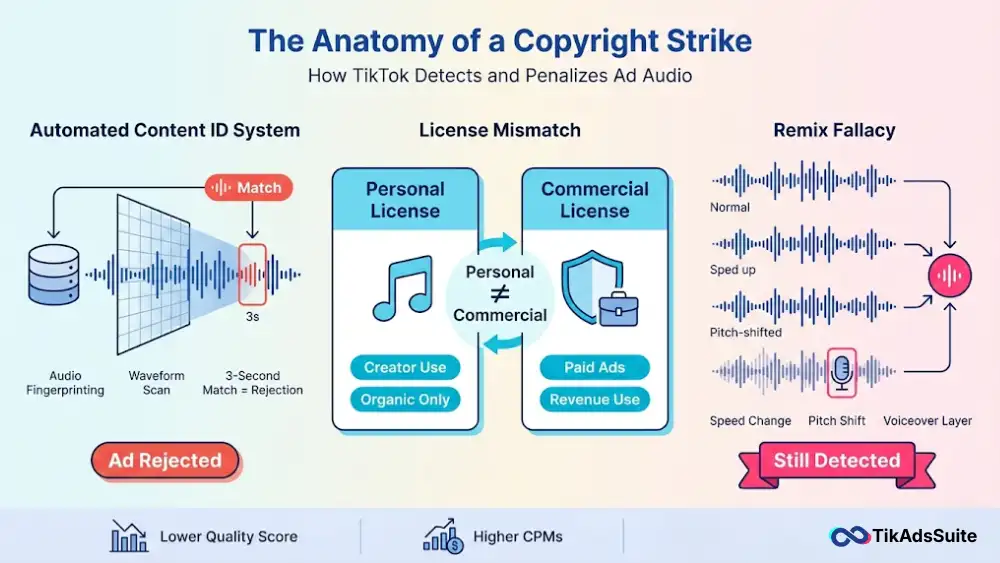
TikTok uses an audio fingerprinting technology similar to YouTube’s Content ID. When you upload an ad, the system scans the audio waveform against a massive database of copyrighted tracks.
- The Match: If even 3 seconds of your audio match a protected file, the ad is automatically rejected.
- The Penalty: Repeated violations lower your Ad Account Quality Score, leading to higher CPMs (Cost Per Mille) and eventual suspension.
2. Commercial vs. Personal Licenses
Most creators operate under a Personal Sync License that TikTok pays for globally. This allows them to use major label music.
- The Ad Gap: This license explicitly excludes Commercial Use. When you put paid spend behind a video, you are using the music to generate revenue. This requires a Commercial Sync License, which TikTok does not cover for popular tracks.
3. The Remix Fallacy
Many advertisers believe that if they speed up a song or change the pitch, they are avoiding copyright strikes on TikTok ads.
- Reality: Modern AI detection can identify a song even if it is sped up by 200% or layered under voiceovers. Attempting to trick the system is the fastest way to get a permanent ban for Circumvention of Systems.
Part 2: 4 Strategies for 100% Compliance
You don’t have to sacrifice creativity for safety. Here is the compliant workflow for high-performing ads.
Strategy 1: The Commercial Music Library (CML)
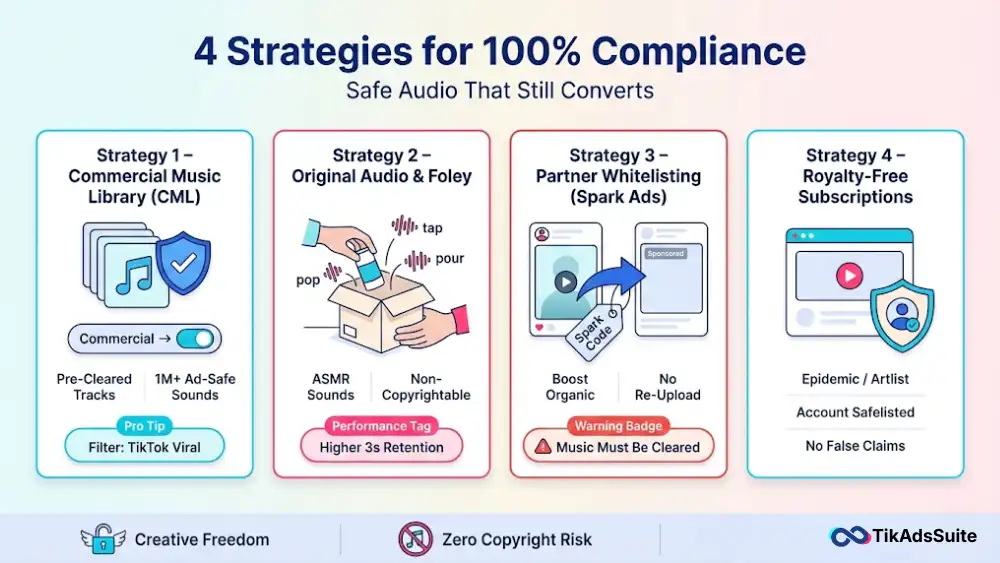
TikTok provides a database of over 1,000,000 tracks that are pre-cleared for advertising.
- How to Access: In the video editor, tap Add Sound > Commercial Sounds.
- The Trick: Don’t use the default generic tracks. Filter by TikTok Viral within the Commercial tab to find royalty-free beats that sound modern and trending.
Strategy 2: Original Audio & Foley
The safest audio is the one you make.
- Technique: Use ASMR (Autonomous Sensory Meridian Response). The sound of unboxing, tapping a product, or pouring liquid is not copyrightable.
- Impact: ASMR ads often have higher retention rates because they feel tactile and immersive. 71% of users decide to keep watching within the first 3 seconds, and distinct audio cues like pops and clicks help hook them faster than generic music.
Strategy 3: Partner Whitelisting
If you must use a creator’s video that contains a specific sound:
- The Process: You do not download and re-upload their video. Instead, you get their Spark Ad Code.
- The Logic: When you run a Spark Ad, you are boosting the organic post. However, you must still check if the music in that organic post is cleared for commercial boosting. If the creator used a Drake song, you generally cannot boost it with paid spend.
Strategy 4: Royalty-Free Subscription Platforms
Use external libraries like Epidemic Sound or Artlist.
- Integration: Platforms like Epidemic Sound allow you to safelist your TikTok account directly in their dashboard. This tells their copyright bots to ignore your specific account, preventing false claims and allowing you to use full-length tracks for up to 10 minutes.
Tool Tip: Not sure if a sound is safe? Use the TikTok Sound Finder. This tool allows you to paste a TikTok audio URL, and it will instantly tell you if the track is listed in the Commercial Music Library or if it is restricted to personal use only.
Part 3: The Visual Copyright Danger Zone
Avoiding copyright strikes on TikTok ads isn’t just about music. Visual infringement is rising in 2026.
1. Logos on Clothing
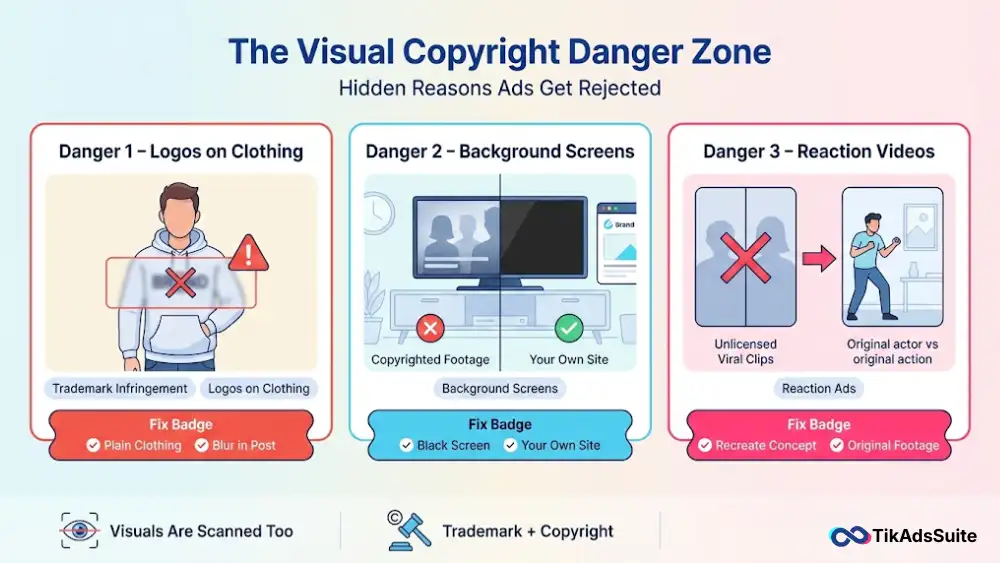
If your actor is wearing a Nike hoodie in your ad for a skincare product, TikTok can reject it for trademark infringement.
- Fix: Use plain clothing or blur logos in post-production.
2. Background Screens
If a TV in the background is playing a clip of The Office or a football game, that footage is copyrighted.
- Fix: Ensure all screens in the background are black or showing your own website.
3. Reaction Videos
Dueting or Reacting to a viral video is popular organically, but risky for ads. You cannot use someone else’s viral clip in your commercial without their written consent.
- Fix: Always recreate the concept with your own actors rather than using the original footage.
Tool Tip: Before you launch, audit your visuals. Upload your video file to the TikTok Ad Creative Audit Tool. It scans for unsafe visual elements like visible third-party logos or potential trademark violations that could trigger a rejection.
Part 4: What to Do If You Get a Strike
Even with caution, mistakes happen. Here is your crisis management protocol.
Step 1: The Appeal
If you own the rights (e.g., you bought a license but TikTok flagged it anyway):
- Action: Submit a Counter-Notification via the Ads Manager. Attach your PDF license file from the music provider (e.g., Epidemic Sound).
- Timeline: Appeals usually resolve in 24-48 hours.
Step 2: The Mute Edit
If you do not own the rights:
- Action: Do not argue. Delete the ad immediately.
- Recovery: Re-edit the video using a track from the CML and re-upload as a new campaign ID. Never try to re-upload the exact same file; the hash of the file is already flagged.
Tool Tip: If you are worried that your account is on the verge of suspension, use the TikTok Ad Account Health Checker. It reviews your history of violations and gives you a Risk Score out of 100, advising you on whether you should pause ads to let your account cool down.
Useful article for you:
👉 TikTok Ads Credit: Get Free $6000 Cash Back Promo
👉 UGC Ads Guide: How to Brief TikTok Creators for Better Ad Performance
👉 How to Use CapCut for TikTok Video Edits Step by Step
👉 CapCut for Business: The Ultimate Guide for Advertisers
FAQ: TikTok Ad Copyright & Strikes
How to avoid copyright strikes on TikTok?
To avoid copyright strikes, Advertisers must strictly use audio from the Commercial Music Library (CML) or use Original Audio (voiceovers/ASMR). Never use popular radio songs, even if they are trending, as they are not licensed for commercial use. Additionally, ensure no background trademarked logos (like Disney or Nike) are visible in your video footage.
How strict is TikTok with copyright?
TikTok is extremely strict regarding commercial copyright. Their system is automated and scans every frame and audio wave. According to their transparency reports, millions of videos are removed annually for IP violations. For advertisers, a single violation often results in immediate ad rejection, and repeated violations lead to a permanent ban of the Business Manager account. (Source: TikTok Transparency Center).
Does TikTok give copyright strikes?
Yes. TikTok operates on a strike system. If your content is flagged for copyright infringement, you will receive a formal Strike notification in your inbox. While TikTok does not publicly disclose the exact number for a permanent ban, typically 3 strikes within a 90-day period will result in the permanent suspension of your account.
How does TikTok detect copyright?
TikTok uses a proprietary automated content identification system similar to YouTube’s Content ID. It analyzes the audio waveform of your upload and compares it against a massive database of copyrighted files submitted by rights holders (Universal, Sony, Warner). It also uses visual recognition to detect copyrighted video clips (e.g., movies, sports broadcasts) used within your content.
How to remove content violation on TikTok?
If you receive a violation:
Check the Reason: Go to Account Updates to see if it was Audio or Visual.
Appeal: If you have the legal right to use the content, click on the notification and select Submit an Appeal. You must provide proof (e.g., a licensing agreement or proof of original ownership).
Delete: If you do not have rights, delete the video immediately to prevent further algorithmic penalties.
What is the 3 second rule on TikTok?
In the context of copyright, the 3-Second Rule is a myth. Many creators believe using less than 3 seconds of a song falls under Fair Use. This is false for commercial advertising. Using even 1 second of a copyrighted track in an advertisement without a license is a violation and can trigger a strike.
How many seconds of copyrighted video can I use on TikTok?
For commercial ads, the answer is zero seconds. There is no safe duration for using copyrighted material (music or video) in a paid advertisement. Fair Use is a complex legal defense that generally applies to criticism or education, not selling products. To be safe, use 0% unauthorized copyrighted material.
Conclusion: Safety is a Feature, Not a Bug
Successfully avoiding copyright strikes on TikTok ads is not just about following the law; it is about building a sustainable business asset.
An ad account with a clean history gets cheaper CPMs, faster approval times, and better support.
By building your creative workflow around the Commercial Music Library and utilizing tools like the TikTok Ad Creative Audit Tool, you ensure that your brand’s voice is never silenced by a takedown notice.
Your Action Plan:
- Audit: Check your current active ads. If any use Trending Audio from the pop charts, pause them immediately.
- Source: Bookmark the TikTok Sound Finder tool to vet all future audio choices.
- Create: Film a batch of ASMR-style ads that rely on product sounds rather than music, removing copyright risk entirely.
- License: If you need music, sign up for a verified partner like Epidemic Sound and whitelist your ad account today.
Play it safe, play it loud.