
Organic TikTok content and paid TikTok Ads aren’t two separate marketing tracks.
The strongest accounts treat organic as the testing ground that tells paid where to spend.
A post that performs organically has already proven something an ad brief can only guess at.
Real viewers, not a targeted audience, chose to watch, like, and share it.
This guide covers how to build an organic posting strategy, and how to use it to find creative worth turning into a paid Spark Ad.
Table of Contents
Get Up to $6000 Free TikTok Ad Credit
Key Takeaways
- A blended content mix outperforms betting on one format, roughly 70% evergreen and 30% trend-driven content, since the median TikTok trend now lasts about five days.
- Posting time matters most for algorithm-fed content, search-style evergreen posts are far less time-sensitive since viewers find them through search rather than the main feed.
- Content that already performs organically is a stronger candidate for a paid Spark Ad than an untested ad brief, since it’s already proven with a real audience.
- TikTok’s own Spark Ads format keeps all engagement from the paid boost attached to the original organic post, per TikTok’s official documentation.
- Keyword-optimized captions and on-screen text carry real ranking weight in TikTok’s search results, which extends how long organic content keeps working after it’s posted.
Quick Answer
Organic TikTok content strategy works best when it’s built to feed paid ads, not run alongside them as a separate effort. Post a mix of evergreen and trend content on a consistent schedule, track what actually outperforms your account’s baseline engagement, then boost those specific posts as Spark Ads instead of guessing at new ad creative from scratch. The organic post has already been tested with a real audience; an ad brief hasn’t.
Why Organic Content Should Inform Paid Creative
Every ad brief starts as a guess. An organic post that already performs has already been tested, for free, against a real audience.
That’s the practical case for treating organic as the first stage of ad creative development, not a separate marketing channel with its own goals.
Once a post clears its account’s normal engagement baseline, usually by a meaningful margin rather than a small bump, it’s a candidate.
That candidate is a stronger Spark Ad starting point than a brand-new brief.
Spark Ads covers exactly how that promotion works.
Engagement gained during the paid boost stays attached to the original organic post rather than a disposable ad unit.
Building the Organic Content Mix
Not every post needs to chase a trend, and not every post should be evergreen either.
The right mix depends on what each format is actually good at.
Trends vs. evergreen content breaks down the tradeoff in detail.
Trends deliver a fast visibility burst but fade in days, while evergreen content compounds slowly through search discovery.
A roughly 70% evergreen, 30% trend split captures both benefits: quick reach from trends, and durable traffic from content that keeps answering a real question months later.
| Trend content | Evergreen content | |
|---|---|---|
| Typical lifespan | About 5 days (median) | Months, sometimes longer |
| Discovered through | Main feed, algorithm-fed | TikTok search, long after posting |
| Posting time sensitivity | High, timing genuinely affects reach | Low, findability matters more than timing |
| Best for | Fast visibility bursts | Compounding, durable traffic |
| Recommended mix | ~30% of posting volume | ~70% of posting volume |
TikTok content types covers the specific formats to build that mix from, and how to weight them by goal: reach, engagement, or conversion.
When to Post for Maximum Reach
The table above covers which content type needs precise timing and which doesn’t, this section covers the actual windows to use.
Best times to post on TikTok for business breaks down the specific posting windows that perform best for algorithm-fed, trend-style content, based on data from over 2 million posts.
Building a posting calendar around those windows matters most for the 30% of content that’s trend-driven, since evergreen posts can go up on a looser schedule without losing much reach.
Making Content Findable Through Search
Roughly half of US TikTok users now use the platform as a search engine, which changes what “organic reach” actually means beyond the main feed.
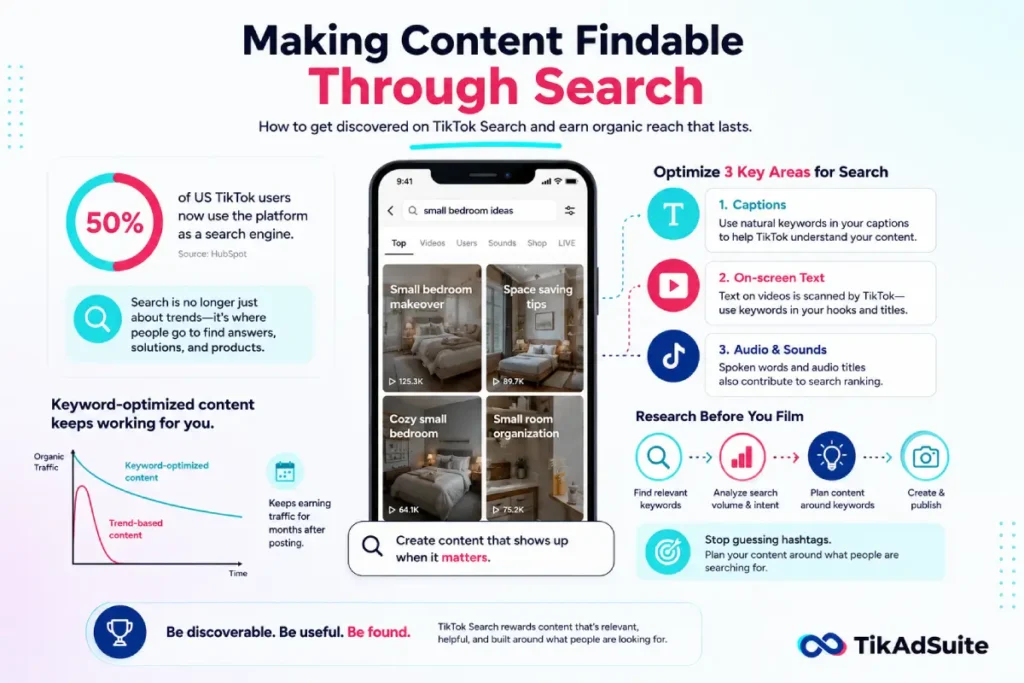
Trending TikTok keywords covers how captions, on-screen text, and audio each carry different ranking weight in TikTok’s search results.
It also covers how to research keywords before filming instead of guessing at hashtags after.
Keyword-optimized content tends to keep earning organic traffic for months after posting, well past the lifespan of a trend-based post.
From Organic Winner to Paid Spark Ad
The practical workflow ties the pieces above together. Post a consistent mix, track what clears baseline engagement by a real margin, then boost the winners.
A post that performs organically has already answered the two hardest questions in ad creative.
Does the hook actually stop a scroll, and does the content hold attention past it.
That’s real signal an ad brief alone can’t provide, however good the creative team is.
Once a post is confirmed as a strong candidate, run it through Spark Ads rather than building new creative from scratch for the same message.
Frequently Asked Questions
Should organic TikTok content and paid ads be managed separately?
No, the strongest results come from connecting them directly. Organic content acts as free creative testing, and Spark Ads let a business scale whatever already proved itself with a real audience instead of guessing at new ad creative.
How do I know if an organic post is ready to become a paid ad?
Look for engagement meaningfully above the account’s normal baseline, not just a small bump. TikTok’s own average engagement rate ran around 3.70% in 2025, per Socialinsider’s benchmark data, a useful reference point, though your own account’s history matters more than any platform-wide average. A post that clearly outperforms typical results for that specific account is a stronger signal than raw view count alone.
Does posting time matter for evergreen TikTok content?
Less than it does for trend-driven content. Evergreen posts are typically found through TikTok’s search function rather than the main feed, so they keep earning views well after the original posting window has passed.
What’s the ideal split between trend and evergreen content?
A common benchmark is roughly 70% evergreen and 30% trend-driven content. Trends deliver a fast but short-lived visibility burst, while evergreen content builds traffic more slowly but keeps working for months.
Why do keywords matter more than hashtags on TikTok now?
Because a large share of TikTok users now search the platform directly, similar to a search engine. Keyword-optimized captions and on-screen text carry real ranking weight in those results, while hashtag trends tend to fade within days.
Wrapping Up
Organic content and paid ads aren’t competing priorities on TikTok, organic is where the testing happens before any ad budget gets spent.
Post a real mix of evergreen and trend content, and track what actually outperforms baseline.
Boost those specific winners as Spark Ads instead of building new creative from an untested brief.
From here, the guides linked throughout this page cover content mix, timing, and keyword strategy, plus the Spark Ads mechanics that turn an organic winner into a paid campaign.
Sources