
The TikTok ads algorithm is a machine learning system that predicts which ads will generate the best user experience and advertiser results at the same time. It ranks ads by your bid and by how relevant each ad is to each viewer, then keeps learning from the views, clicks and conversions your ads produce.
Most advertisers treat TikTok like a black box. You set a budget, launch a creative and wait. Sometimes it works, but often it doesn’t, and it’s hard to tell why.
The system isn’t random. It tries your ads on different people first, then moves spend toward the ones that get results. Once you know what it reacts to, you stop working against it, and your ad CPM rates stop climbing for no clear reason.
Get Up to $6000 Free TikTok Ad Credit
Table of Contents
Quick Answer: How the TikTok Ads Algorithm Works
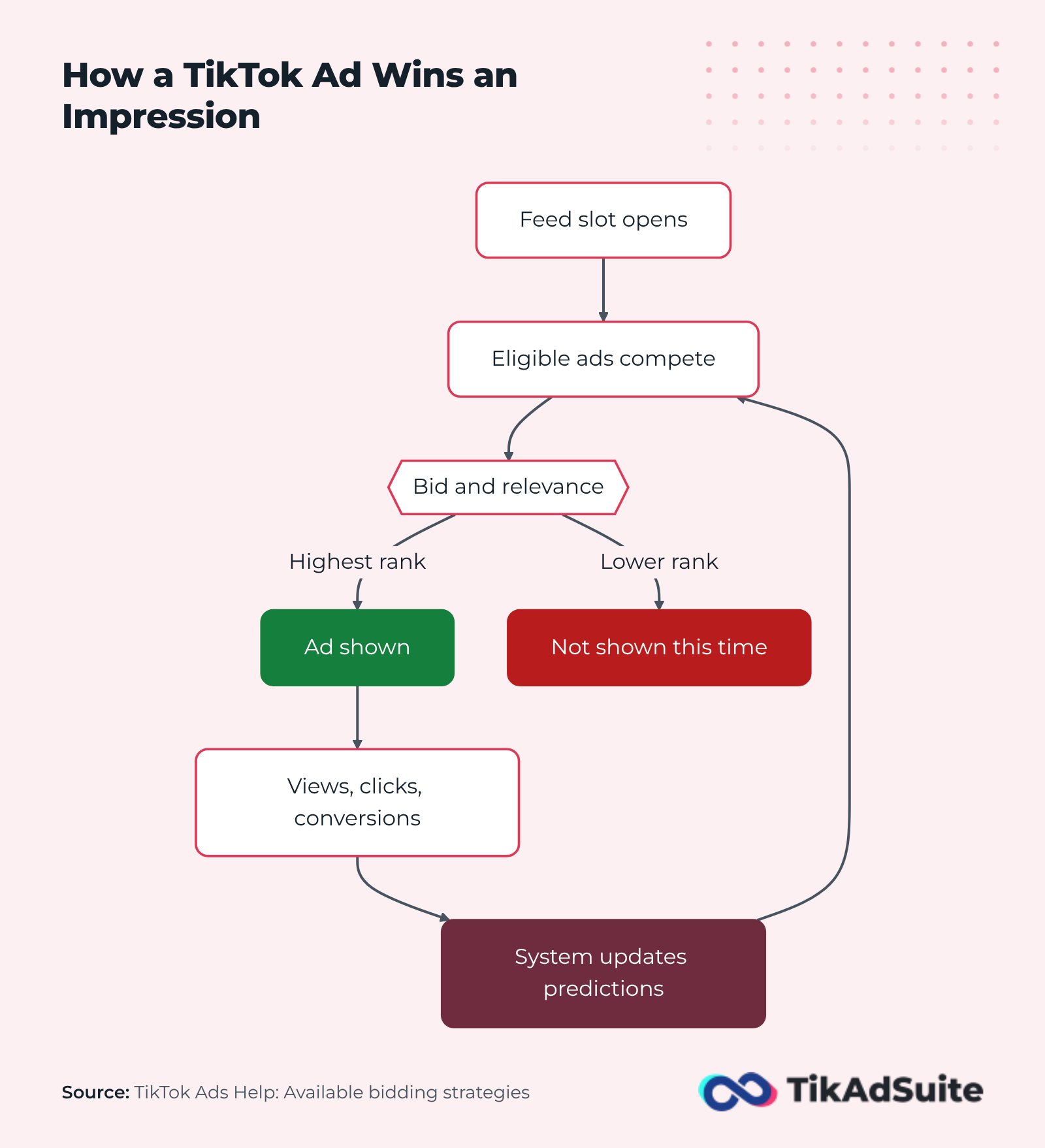
The TikTok ads algorithm runs an auction for every ad slot. TikTok’s bidding strategies page says it ranks ads by how much advertisers bid and how relevant the ads are to users, so a strong creative can beat a higher bid.
New campaigns then go through a learning phase while the system figures out who responds. According to TikTok’s Learning Phase page, results usually get steadier after about 25 campaign results or 7 days. Clear creative, a broad enough audience and clean conversion data help it learn faster.
What Is the TikTok Ads Algorithm?
The TikTok ads algorithm is the automated decision system that controls which paid ads get shown, to whom, at what cost, and how often.
It is not a manual process, and no person at TikTok picks who sees your ad. A model makes that call each time an ad slot opens, based on what it predicts each ad will do for that viewer and for you.
Knowing how it makes that call helps you decide what to change when results dip.
How It Differs From a Highest-Bid Auction
In a plain auction, the highest bid wins. TikTok adds relevance to the mix: the ranking weighs your bid together with how relevant your ad is likely to be to each person.
That means your ad doesn’t compete on price alone. An ad with a lower bid but a better predicted response can win impressions over a bigger spender. This changes how you should set up your TikTok ads and judge the results.
Why It Wants Several Creatives
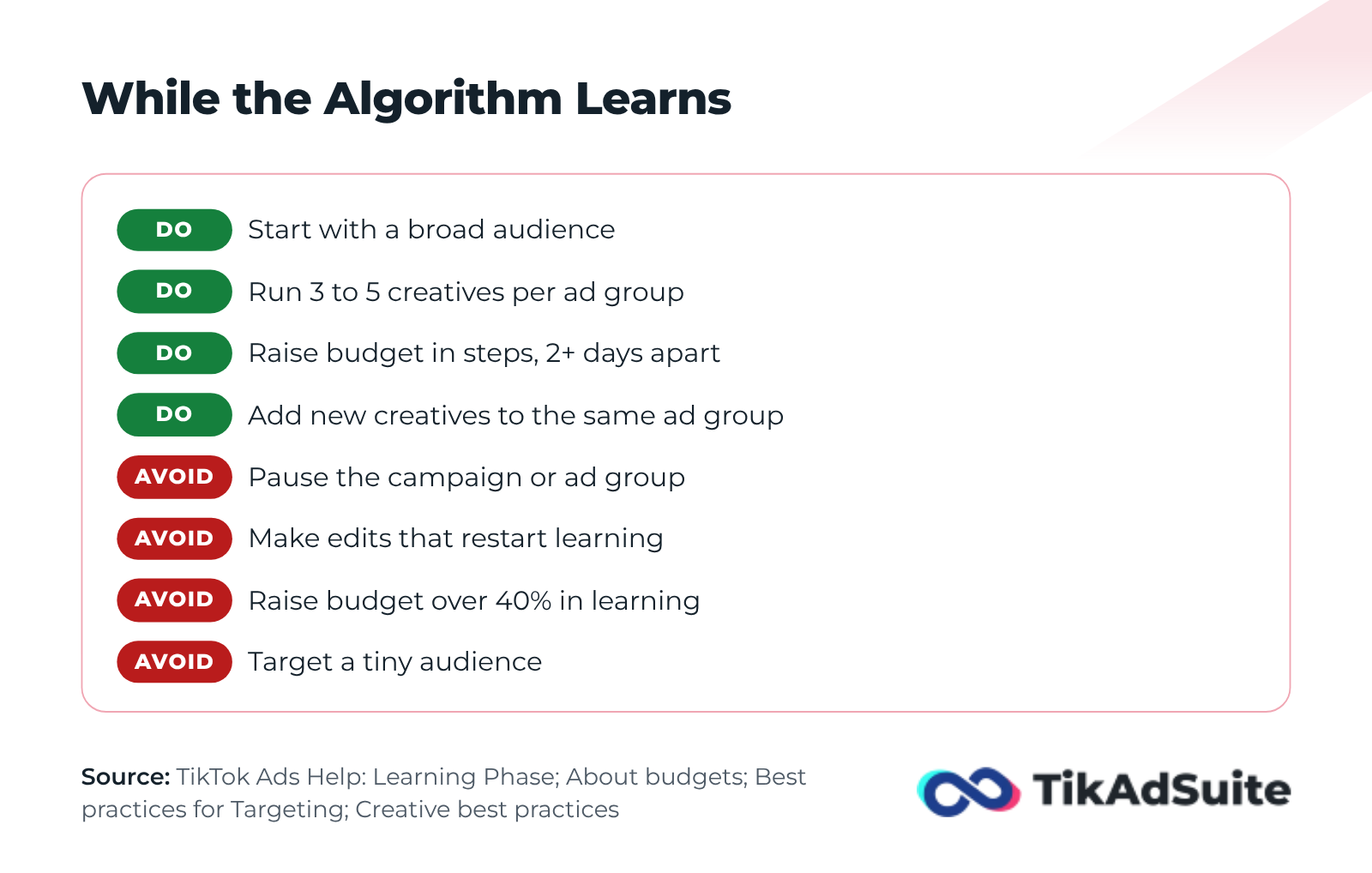
The system learns faster when it has real choices. TikTok’s creative best practices suggest 3 to 5 different creatives per ad group and 3 to 5 ad groups per campaign, and say creatives with big differences help most during the ad group’s exploration stage.
So two creatives with the same budget and audience can end up with very different costs. Delivery shifts toward the one that gets the better response, which is why you may see one ad take most of the spend.
How the TikTok Ad Auction Works
Each time a feed slot opens, eligible ads compete for it, and the winner gets the impression. Your bid strategy tells TikTok how to bid for you in that auction.
Bid Strategies and Billing
According to TikTok’s bidding strategies page, Ads Manager offers two bid strategies today:
- Target cost per result: a goal-based strategy. The system aims for the cost per result you set, though the actual cost can land a little above or below it.
- Maximum Results: a spend-based strategy that tries to get the most results your budget allows, without aiming at a target cost.
Older guides call these Cost Cap and Maximum Delivery, the names used in TikTok’s bidding blog. How you pay is a separate choice: the same bidding page lists oCPM (optimized cost per thousand impressions), CPC, CPM and CPV.
That page also carries a useful warning. Conversion campaigns often swing before they pass the learning phase, and this may lead to high CPMs, so early cost spikes are not always a sign that something is broken.
Why Bid Alone Does Not Win the Auction
Because relevance is part of the ranking, raising your bid can’t fully make up for an ad people skip. If your CTR is low, the usual fix is a better creative, not a bigger bid.
A higher bid can help you reach more people, as TikTok notes. It just works best on top of an ad that already holds attention.
Signals the Algorithm Learns From
The TikTok ads algorithm learns from how people react to your ads and from the data you send back. TikTok doesn’t publish exact weights, but its help pages point to three areas you control.
Audience Size
The system needs room to explore. TikTok’s targeting best practices warn that an audience set too narrow may make it hard for ad groups to exit the learning phase, and can raise the risk of creative fatigue.
Narrow targeting still has a place, for example when you only serve a few zip codes. Just test it rather than starting there.
Creative Attention
The first seconds decide whether anyone keeps watching. TikTok’s creative guidance says to put your hook in the first 6 seconds and to show your main message in the first 3 seconds for better recall.
Ads that people watch, like or click give the system more positive signals to work with. Ads that people swipe past give it very little.
Post-Click Results
For conversion campaigns, the algorithm learns from the events your pixel or Events API sends after a click. If those events are missing or wrong, the system optimizes toward the wrong people.
A slow or confusing landing page also cuts conversions, which means fewer results for the system to learn from. Keep the page fast on mobile and make sure it matches what the ad promised.
TikTok Ads Delivery Phases: How the Algorithm Tests and Scales
Every new campaign starts in a learning phase, settles once it has enough results, and later needs fresh creative. Only the first stage is an official TikTok term, but thinking in these three steps helps you know what to touch and when.
The Learning Phase
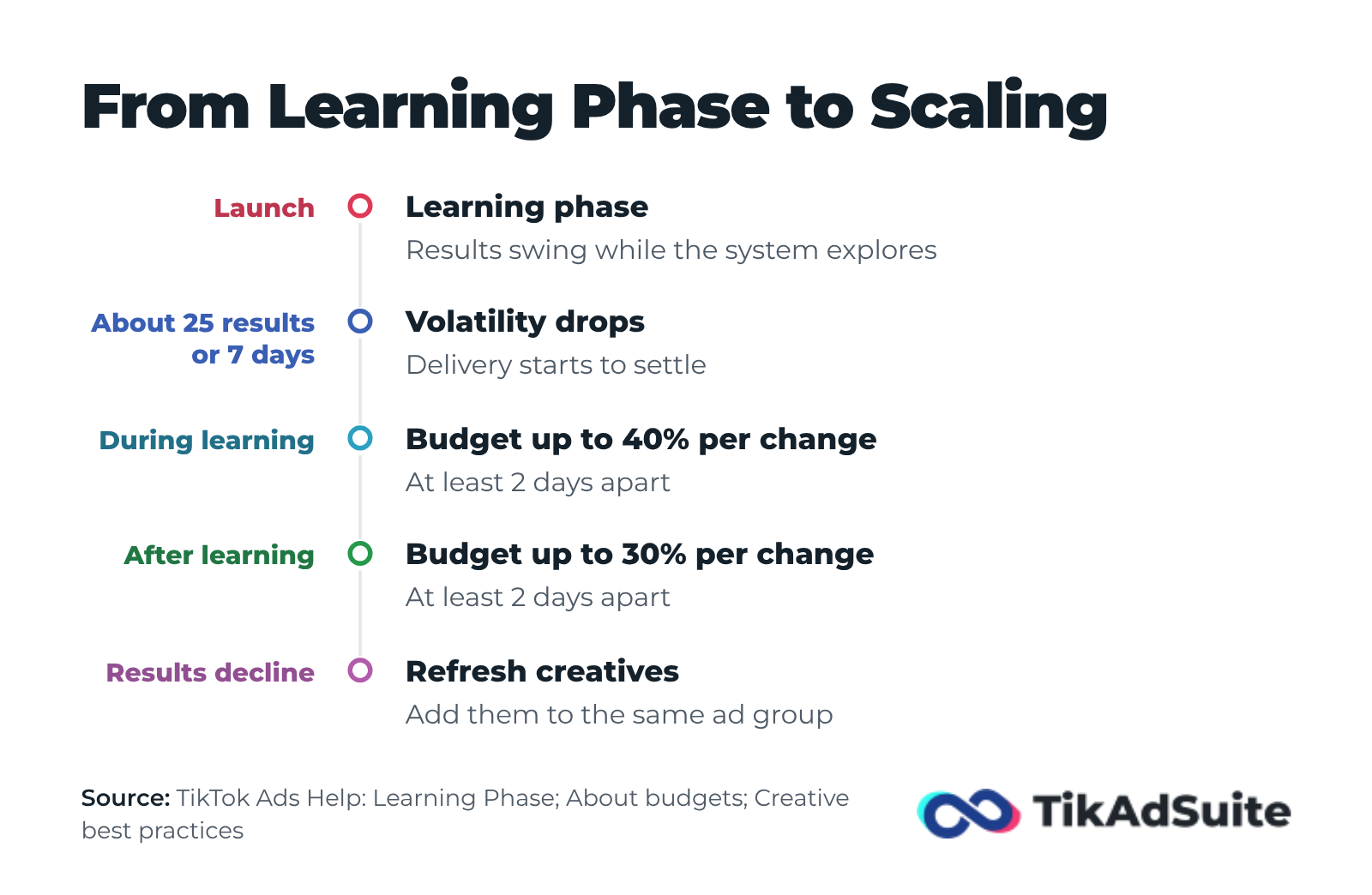
The learning phase is the period when TikTok’s ad system works out the best users for your campaign, and results may swing while it explores. According to TikTok’s Learning Phase page, volatility usually starts to drop after about 25 campaign results or 7 days.
The Learning Phase page lists three things to avoid while you wait:
- Pausing campaigns or ad groups
- Edits that restart the learning phase
- Unreasonable budgets or creative volumes
After Learning: Scaling Budgets Safely
Once results settle, you can start raising the budget, but in steps. TikTok’s budget page says to raise the budget by no more than 40% per change while a campaign is learning, and by no more than 30% per change after it exits, with changes no more often than every two days.
Big jumps make the system look for many new people at once, which can bring back the swings you just waited out.
Creative Fatigue and Refresh
Even a strong ad wears out. TikTok’s creative best practices suggest refreshing when results show a steady decline, and adding the new creatives to the existing ad group instead of starting a new ad group, so the group keeps its history.
If you’d rather automate this, TikTok’s Smart Creative tests different videos for 3 to 5 days using no more than 10% of the ad group’s budget, then swaps out videos that show signs of fatigue.
Recent Changes That Affect Ad Delivery
Several recent changes affect how campaigns are set up and how much the system decides for you.
One Sales Objective
TikTok merged the Website Conversions and Product Sales objectives into a single Sales objective. TikTok’s Sales objective page notes that the merged objective is rolling out in phases, so some accounts may still see the old names.
GMV Max for TikTok Shop Ads
If you sell through TikTok Shop, campaign choice is now mostly automated. Starting July 2025, TikTok made GMV Max the default campaign type for TikTok Shop Ads and the only one it supports for new Shop ads, according to TikTok’s GMV Max migration page. Existing campaigns in the older formats keep running.
Upgraded Smart+
Smart+ now combines manual and automated setup in one flow. TikTok’s Smart+ upgrade page says you can pick full automation, partial automation or fully manual control for Traffic, Sales, Lead Generation and App Promotion, though the feature may not be available to every account yet.
New Bid Strategy Names
Ads Manager now uses the names Target cost per result and Maximum Results. Older tutorials that mention Cost Cap or Maximum Delivery describe similar strategies under the earlier labels.
Labels for AI-Made Creative
If you use AI to make ads, disclose it. TikTok’s misleading content policy requires the AIGC label or a clear disclaimer on significantly edited or AI-generated content, and says undisclosed AI content will be rejected or restricted.
How to Optimize for the TikTok Ads Algorithm
You work with the algorithm by giving it good creative, enough room and clean data. Here is how to set up campaigns that match how the system scores and delivers ads.
Creative Strategy Aligned to Algorithm Signals
Your creative is your main lever. If you’re wondering how to make a good TikTok ad, start with the signals the system reacts to: a strong hook, a clear message and a reason to act.
TikTok’s creative best practices describe a simple structure that sells:
- Hook: grab attention in the first 6 seconds with movement, on-screen text or a direct line.
- Main message: state what you offer in the first 3 seconds for better recall.
- Selling points: show what makes the product worth buying.
- Call to action: tell viewers exactly what to do next.
Test 3 to 5 creative variations per ad group, as TikTok’s guidance suggests, and make them truly different from each other.
Broad Targeting First, Then Refinement
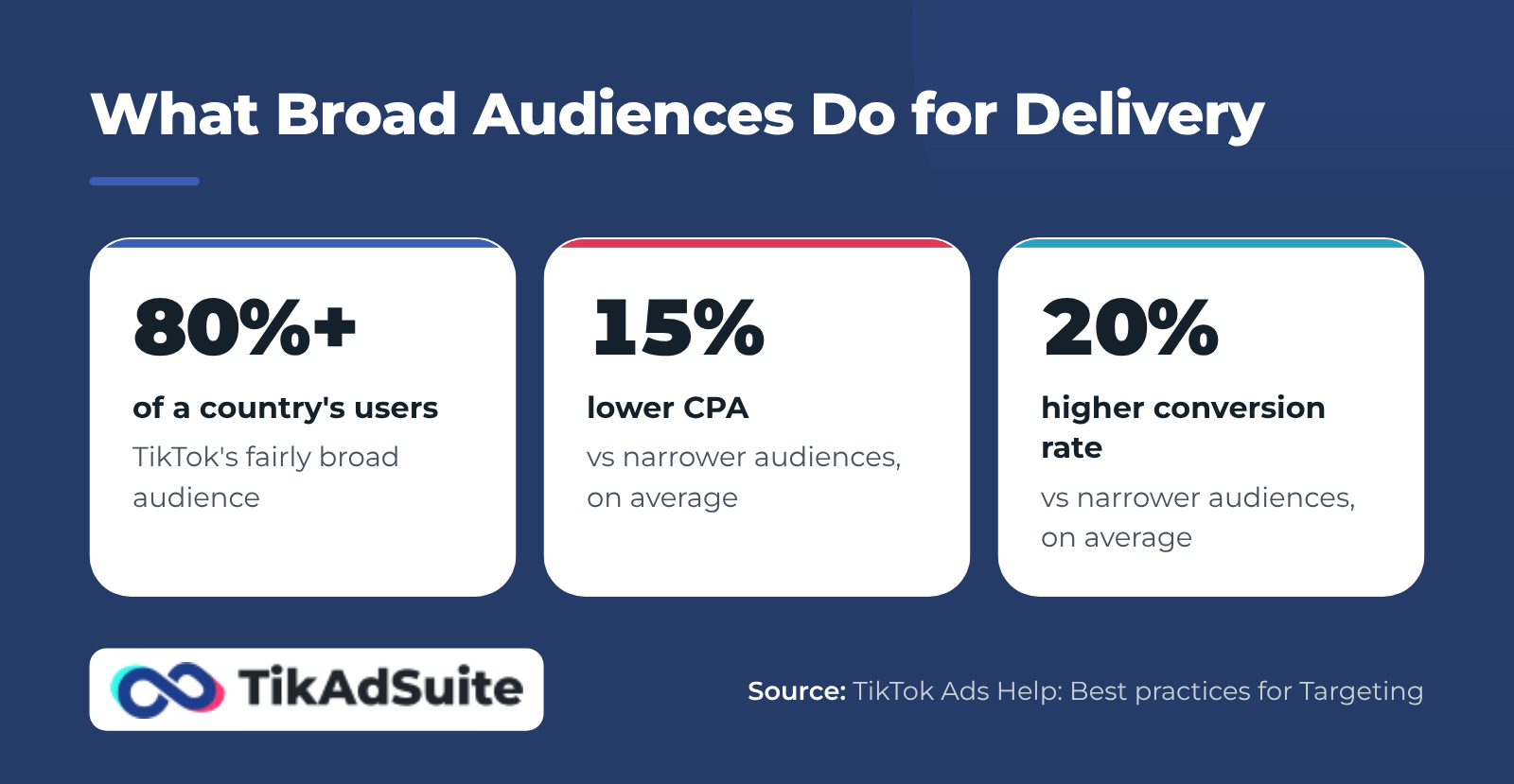
The algorithm performs better with room to explore. According to TikTok’s targeting best practices, a fairly broad audience covers more than 80% of the potential users in a country, and these audiences average 15% lower CPA and 20% higher conversion rates than narrower ones.
Once your pixel records steady weekly conversions, layer in retargeting, lookalikes and other refinements on top of what already works.
Bidding and Budget Strategy
Match your bidding strategy to your goal and stage:
- Maximum Results fits when you want volume and are still learning what a result costs.
- Target cost per result fits once you know the cost per result you can afford.
TikTok’s bidding best practices give two budget rules of thumb. With Maximum Results, set a daily budget of 10 times your average daily CPA from the past 7 days to pass the learning phase. With Target cost per result, set the budget to at least 10 times your CPA bid.
Also respect the floor. According to TikTok’s budget page, daily budgets must be more than $50 per campaign and more than $20 per ad group.
Pixel Setup and Event Tracking as Algorithm Fuel
Your TikTok Pixel is the main feedback link between your website and the algorithm. Each conversion event tells TikTok who converted and, when you pass a value, how much they spent.
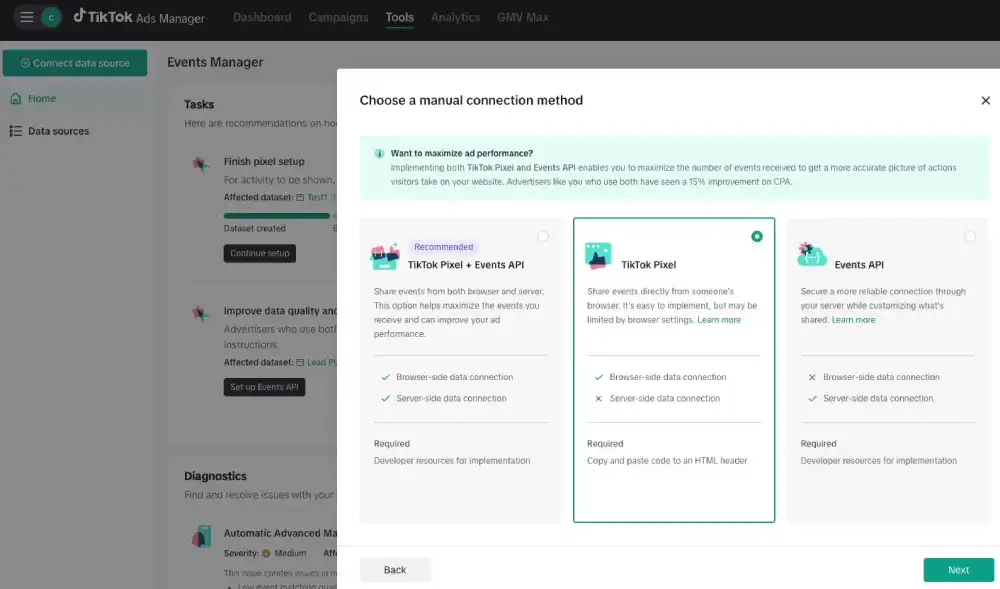
Set up events that follow your funnel. TikTok’s standard events guide lists parameters such as content_ids, currency and value that you can pass with each event:
- ViewContent
- AddToCart
- InitiateCheckout
- Purchase (with value and currency)
Passing purchase values opens up value-based optimization. For web campaigns, TikTok’s value-based bidding comparison describes two choices: Highest Value, which aims to spend the full budget on higher-value purchases, and Minimum ROAS, which tries to stay above a return you set.
If your pixel misses events or fires them twice, the algorithm makes decisions with bad data. Getting your TikTok Pixel set up correctly is a check you can make before you change anything else.
Common Mistakes That Kill Algorithm Delivery
The most common reason TikTok ads underperform is a campaign that never clears the learning phase. TikTok’s Learning Phase page names the usual causes: pausing, edits that restart learning, and budgets or creative volumes that don’t fit the goal.
Other frequent causes of weak delivery:
- The audience is too small. TikTok’s targeting guidance warns that narrow audiences can struggle to exit learning. Widen your targeting or turn on Smart Targeting, which TikTok recommends when you use audiences or interest targeting.
- The ad was killed too early. Results swing during learning, so judging an ad after a day or two often throws away what the system was still learning.
- The creative doesn’t hold attention. A slow hook or a message that comes too late gives the system little to work with. The fix is a new creative, not a higher bid.
- Nobody checks how the video performs. Use Video Insights in TikTok Ads Manager, which TikTok’s creative guidance points to, to see how each video performs before you decide what to change.
- Budget jumps are too big. Raising spend past the 40% or 30% limits on TikTok’s budget page can bring back unstable results.
TikTok Ads vs. Organic FYP Algorithm: What’s Different
The paid ads algorithm and the organic For You algorithm are related, but they serve different goals. Ads compete in an auction for advertiser results, while the For You feed ranks videos for each viewer’s interest.
TikTok’s newsroom post on For You recommendations explains the organic side. It weighs user interactions, video information and device and account settings, and a strong signal such as finishing a longer video counts more than a weak one. Follower count is not a direct factor.
| Factor | Paid Ads Algorithm | Organic FYP Algorithm |
|---|---|---|
| Primary objective | Results for the advertiser’s goal | Videos each viewer is likely to enjoy |
| Bid input | Required; ranked with relevance | Not applicable |
| Content source | Ad creatives, including Spark Ads from organic posts | All eligible uploaded videos |
| Main signals | Bid, relevance, and conversion events from your pixel | Interactions, video information, device and account settings |
| Follower count | Not part of the auction | Not a direct factor |
| Speed of distribution | Can grow quickly with budget | Grows as viewers respond |
One practical takeaway: a post that already does well organically can make a good ad. Running it as a Spark Ad starts you with a creative people have already shown they like.
Organic success doesn’t promise paid results, though. A video can go viral because it’s funny, while an ad needs a clear reason to buy and a clear call to action.
FAQs
What is the TikTok ads learning phase?
The learning phase is the period after launch when TikTok’s ad system works out who responds to your campaign, so results can swing. According to TikTok’s Learning Phase page, volatility usually drops after about 25 campaign results or 7 days.
How does TikTok decide which ads to show?
TikTok runs an auction for each ad slot and ranks ads by how much advertisers bid and how relevant each ad is to the viewer. A well-made ad with a lower bid can win over a weaker ad with a higher bid, which is why creative quality matters so much.
Why are my TikTok ads not spending?
Common causes are a budget that is too low for your goal, an audience that is too narrow, a target cost set too low, or a creative people skip. Daily budgets must be more than $50 per campaign and $20 per ad group according to TikTok’s budget page, so check that yours clear both.
Does pausing a TikTok campaign reset the learning phase?
TikTok lists pausing campaigns or ad groups as one of the actions that can stop a campaign from exiting the learning phase. If results are poor, it is usually better to add new creatives to the same ad group than to pause and restart.
How much can I raise my TikTok ad budget at once?
According to TikTok’s budget page, you should raise the budget by no more than 40% per change during the learning phase and no more than 30% per change after it, and wait at least two days between changes so the system can adjust.
How often should you refresh TikTok ad creatives?
Refresh based on results rather than a calendar. TikTok suggests refreshing when delivery shows a steady decline, and adding new creatives to the existing ad group instead of making a new one, so the ad group keeps what it has learned.
Wrapping Up
The TikTok ads algorithm isn’t something you outsmart. It ranks ads by bid and relevance, explores during the learning phase, and then puts more spend behind what works.
Your job is to feed it well. Give it 3 to 5 distinct creatives, an audience broad enough to explore, budgets that change in measured steps, and a pixel that reports real conversions.
Do that consistently, and your campaign decisions stop feeling like guesses.