
TikTok ads usually cost less per 1,000 impressions than Facebook and Instagram ads. A cheaper view is not the same as a cheaper customer, though, so the better platform is the one whose audience is ready for your offer right now.
Most teams weigh TikTok against other ad platforms with two questions in mind: where should the next ad dollar go, and what are competitors already running? Both have answers you can check before you spend.
Below you’ll find dated cost numbers, the TikTok Ads Manager rules that change the math, and a short routine for seeing what rivals already run.
Table of Contents
Get Up to $6000 Free TikTok Ad Credit
Quick Answer
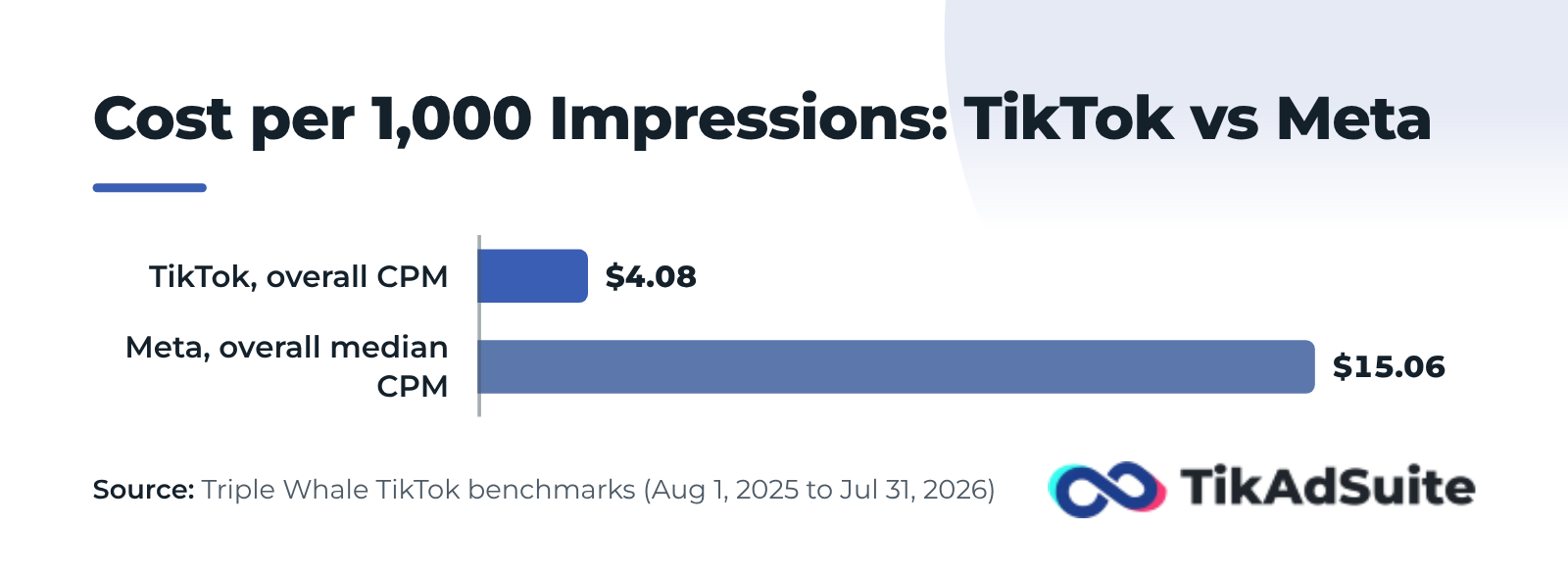
TikTok is cheaper to show ads on, but not always cheaper to sell on. Triple Whale’s TikTok benchmarks for August 1, 2025 to July 31, 2026 put TikTok’s overall CPM at $4.08, against $15.06 for Meta, which that page calls an overall median.
Use TikTok to reach new people who are still browsing, Meta to follow up with people who already know you, and Google Search to catch people typing a need. Test with a real budget: TikTok’s budget page says a daily budget must be more than $50 per campaign and more than $20 per ad group.
Key Takeaways
- According to Triple Whale, TikTok’s CPM was $4.08 against Meta’s $15.06, yet TikTok’s conversion rate fell 36.79% to 1.56% in the same August 2025 to July 2026 window.
- Choose a platform by what the buyer is doing at that moment: scrolling, comparing or searching.
- According to TikTok’s help pages, Ads Manager has fixed daily minimums and a learning phase of about 25 results or 7 days, so tiny tests often end before they show anything.
- TikTok’s Commercial Content Library and Creative Center are free places to start competitor research.
- Creator posts and paid ads work together, because Spark Ads run an organic post as an ad and keep the engagement on that post.
How TikTok Ads Compare With Facebook, Instagram and Google
TikTok, Meta (Facebook and Instagram) and Google reach people at different moments, so each one tends to do a different job inside the same plan.
| Platform | Where the ad shows | What the viewer is doing | Usual job |
|---|---|---|---|
| TikTok | Full-screen video in the For You feed | Scrolling for fun, finding new things | Reach new buyers, test hooks and offers |
| Facebook and Instagram | Feeds, Stories and Reels | Checking accounts and interests they already follow | Retarget and build on known audiences |
| Google Search | Results page for a typed query | Looking for an answer or product now | Catch demand that already exists |
The split isn’t strict. Plenty of brands run all three, and the same person behaves differently on each app.
What matters is judging each platform on the job you gave it. A TikTok campaign built to find new viewers shouldn’t be graded only on same-day sales, and a search campaign shouldn’t be graded on reach.
If Instagram is the main alternative you’re weighing, TikTok vs. Instagram advertising goes through that pair in more depth.
Is TikTok Advertising Cheaper Than Facebook Ads?
TikTok advertising is cheaper than Facebook ads on impressions, but not always on sales. In Triple Whale’s data from over 5,900 brands, TikTok’s overall CPM was $4.08 from August 1, 2025 to July 31, 2026, down 28.48% from the year before.
According to Triple Whale, Meta’s figure is $15.06, and the same page calls it an overall median. Since one number is an overall figure and the other a median, read the gap as a direction, not an exact ratio.
The low CPM doesn’t carry through to every number. Triple Whale’s overall TikTok figures for that window:
| Metric | TikTok, Aug 2025 to Jul 2026 | Change vs prior year |
|---|---|---|
| CPM | $4.08 | Down 28.48% |
| CPA | $17.07 | Down 31.36% |
| Conversion rate | 1.56% | Down 36.79% |
| ROAS | 1.51 | Up 5.85% |
In plain terms, people saw ads for less money and each sale cost less on average, but a smaller share of clicks turned into buyers.
For a small advertiser, cheaper reach helps when you need fresh eyes on a product. It doesn’t promise a lower cost per sale for your store. Check these three things before you move money:
- Your own cost per purchase or lead on each platform, over the same dates.
- Whether your product sells on impulse or needs research first.
- Whether you can make new short videos for each test, since TikTok ads are video first.
These benchmarks describe ecommerce brands that use Triple Whale. Your account can land well above or below them.
How TikTok Ads Manager Compares on Targeting, Bidding and Budgets
TikTok Ads Manager works like other self-serve ad tools, with campaigns, ad groups and ads, but a few of its rules change how you should set up a fair test.
Budgets and the Learning Phase
According to TikTok’s budget page, a daily budget must be more than $50 per campaign and more than $20 per ad group. The same page advises raising a budget by no more than 40% per change during the learning phase and 30% after it, with at least two days between changes.
The learning phase page says results usually start to steady after about 25 campaign results or 7 days.
That affects the comparison. According to Triple Whale, TikTok’s overall CPA was $17.07, so 25 results at that cost come to about $427 in spend. A test that stops after a day or two tells you very little about TikTok or any other platform.
Targeting
TikTok’s targeting best practices say fairly broad audiences, meaning over 80% of the potential users in a country, get 15% lower CPA and 20% higher conversion rates on average than narrower ones.
Location targeting covers countries, regions, states, provinces, metro areas, cities and zip codes, according to TikTok’s location targeting page. That page also says TikTok does not support excluding locations or zip codes, so you pick the places you want instead.
For lookalike audiences, TikTok needs a source audience of at least 1,000 people and offers three sizes: Narrow, Balanced and Broad.
Objectives and Bidding
TikTok has merged its Website Conversions and Product Sales objectives into one Sales objective, rolling out in phases, according to its Sales objective page. That page also lists a Search campaign that shows ads on TikTok’s search results page.
For bids, TikTok’s bidding strategies page lists two options. Target cost per result aims for the cost per result you set, and Maximum Results spends your budget to get as many results as it can.
If you’re moving a campaign over from another platform, match your old objective and bid settings to these names first. Copying settings across without that step is a common reason tests look worse than they are.
Where TikTok Fits in a Multi-Platform Funnel
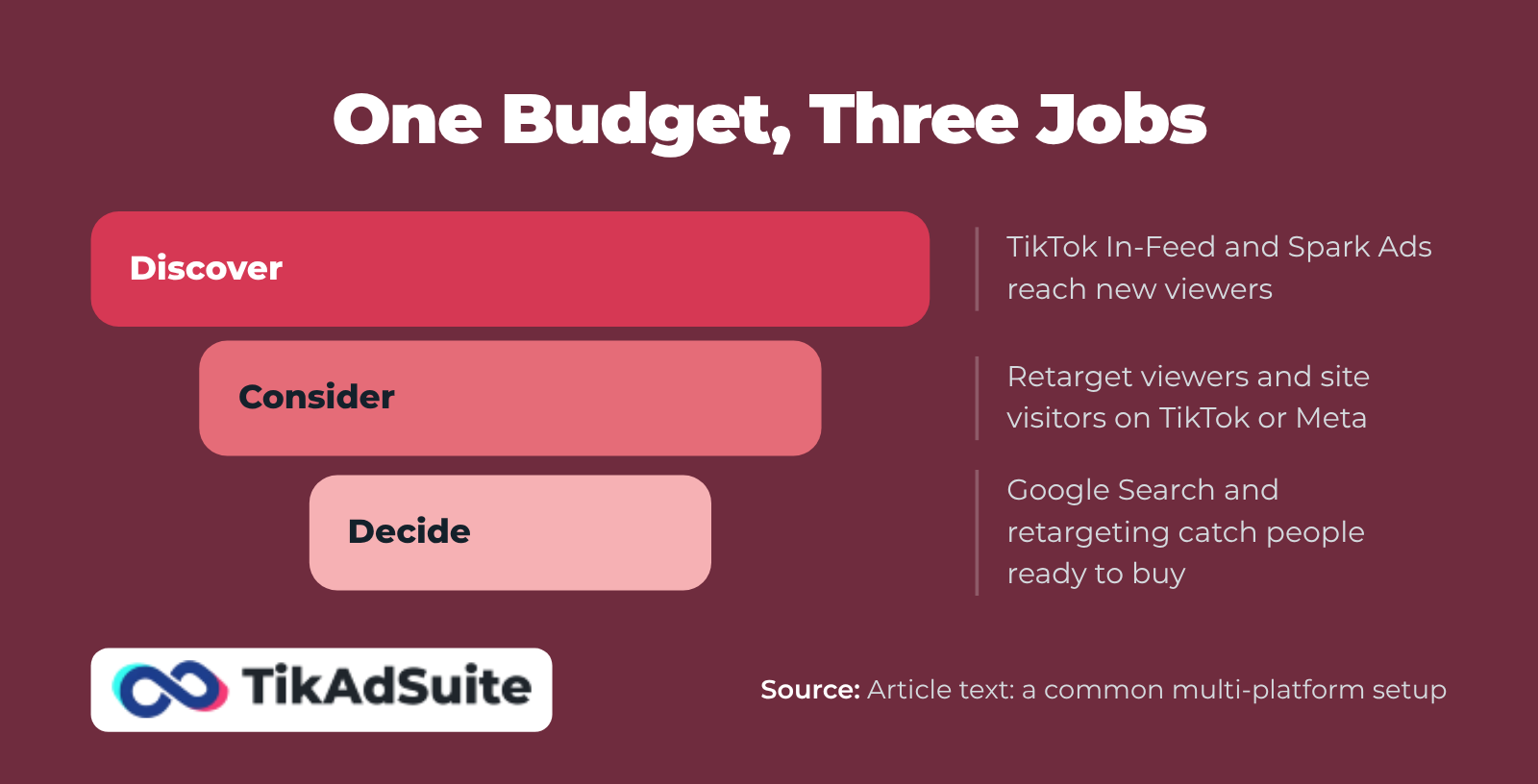
In most multi-platform plans, TikTok sits at the top of the funnel, where people first meet a brand, and other platforms help close the sale later.
TikTok’s ads funnel covers how to build top, middle and bottom of funnel (TOFU, MOFU and BOFU) stages inside TikTok itself.
A common setup works like this. TikTok video ads find new viewers. People who watch or click go into retargeting lists. Meta or Google ads then follow up when those people search or come back to your site.
TikTok can retarget too, so this handoff is a choice, not a rule. Track each platform on its own job, or a discovery campaign judged on last-click sales alone will look weaker than it is.
How to Research What Competitors Are Running
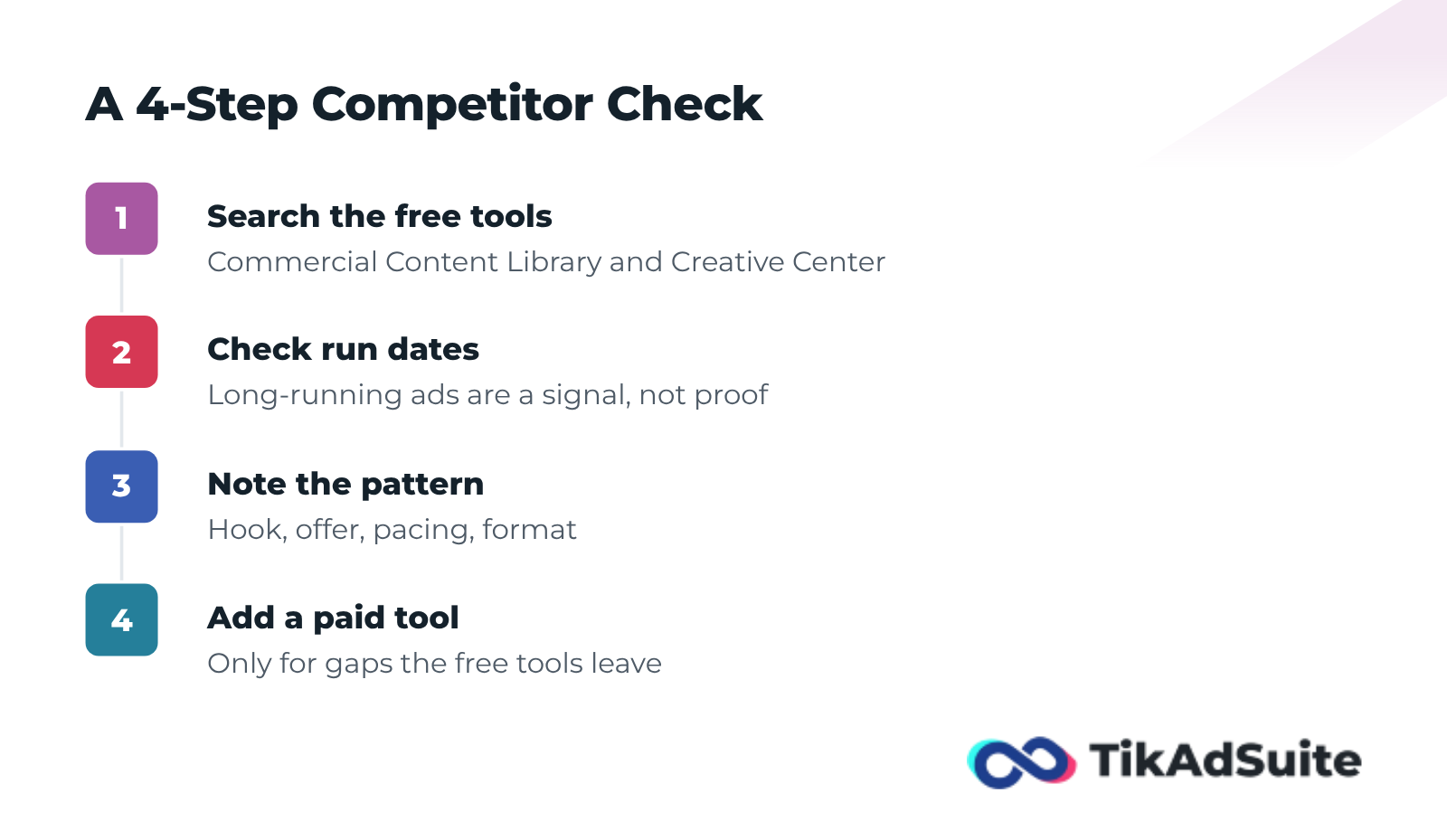
The fastest way to research competitors is to look at ads that are already live and, more to the point, ads that have stayed live.
An ad that’s been running for weeks or months is a signal, not a guess. Advertisers rarely keep paying for creative that loses money, though a long run can also mean nobody has checked it yet.
TikTok’s Commercial Content Library
TikTok’s Commercial Content Library is a searchable database of paid ads and other commercial content that anyone can open. When TikTok opened it in July 2023, its newsroom post said the library shows the ad creative, the dates an ad ran, main targeting settings such as age and gender, and how many people were served the ad.
The same post said only data from Europe was available at that time. A competitor that advertises only in the US may not show up, so check the library’s current regions before you rely on it.
A TikTok Ad Library walkthrough covers the search steps and how to read the results.
Beyond TikTok’s Own Tools
TikTok’s Creative Center and Commercial Content Library are free and official, which makes them the right first stop.
Paid tools go further for some jobs, such as long creative archives or one view across several platforms. TikTok competitor spy tools covers when one is worth paying for on top of the free options.
Influencers or Ads: A False Choice
Influencer content and paid ads aren’t competing budgets on TikTok, because Spark Ads let you run your own or a creator’s organic post as an ad.
TikTok’s Spark Ads page says views, comments, shares, likes and follows gained while the post is boosted are attributed to the organic post. To boost a creator’s post, you need their permission.
When you browse competitor ads, note how many look like creator posts rather than studio spots. That tells you which style your market already accepts.
TikTok influencers vs. TikTok ads compares the two budgets in more detail.
Mistakes to Avoid When Comparing Ad Platforms
Most bad platform calls come from comparing numbers that were never comparable. Watch for these:
- Comparing CPM alone. A cheap impression can still lead to an expensive sale. Compare CPA and ROAS too.
- Mixing date ranges. Pull every platform’s numbers for the same days, with the same attribution window if you can.
- Ending tests too early. According to TikTok’s learning phase page, delivery steadies after about 25 results or 7 days, so a three-day test is mostly noise.
- Copying settings across platforms. Objective and bid names differ, and a copied setup often runs on the wrong goal.
- Copying a rival’s ad word for word. Take the pattern behind it (hook, offer, pacing), not the script.
- Using someone else’s benchmark as your target. Industry averages describe many accounts, not yours.
Frequently Asked Questions
Is TikTok advertising cheaper than Facebook ads?
Usually per impression, not always per sale. According to Triple Whale’s August 2025 to July 2026 data, TikTok’s overall CPM was $4.08 against $15.06 for Meta. Your cost per sale depends on your product, offer and audience, so compare your own CPA on both platforms over the same dates before you move budget.
How does TikTok Ads Manager compare with other ad platforms?
TikTok Ads Manager uses the familiar campaign, ad group and ad setup. According to TikTok’s budget page, daily budgets must be more than $50 per campaign and $20 per ad group. It can’t exclude locations, and it offers two main bid strategies: Target cost per result and Maximum Results.
Can I see a competitor’s exact ad spend on TikTok?
Not from TikTok’s own tools. TikTok’s launch post for the Commercial Content Library lists the ad creative, run dates, targeting settings and the number of people served, and it does not mention spend. Spend figures from third-party tools are estimates, not numbers confirmed by TikTok.
Does the TikTok Ad Library cover US advertisers?
When TikTok opened the Commercial Content Library in July 2023, it said only data from Europe was available. A competitor that runs ads only in the US may not appear there, so check the library’s current coverage and use the Creative Center for wider inspiration.
Should a small business run TikTok ads or work with influencers?
Many brands do both. A common approach is to brief a creator for natural-looking content, post it, and then boost the posts that do well with Spark Ads. The engagement from the boost stays on the original post, and you need the creator’s permission first.
How do I know if a competitor’s ad is actually working?
How long it runs is the best public signal you have. Advertisers rarely keep paying for creative that loses money, so an ad still live after weeks or months is a fair sign it earns its keep. It isn’t proof, because some ads simply get left running.
Wrapping Up
Pick platforms by the job each one does, not by the lowest CPM. TikTok is strong at low-cost reach, and the numbers that decide whether it pays are your own CPA and ROAS after the learning phase.
Before you build anything, spend an hour in TikTok’s free research tools to see what your market already runs. Then test one offer at a time, with a budget big enough to get past the learning phase.