
If you have been running video-only campaigns on TikTok and wondering why your cost per acquisition keeps climbing, there is a format worth your attention.
TikTok Carousel Ads place multiple images inside a single in-feed placement, letting users swipe through each card at their own pace.
That shift from passive viewing to active swiping changes how users interact with your brand, and how the algorithm evaluates engagement.
This guide covers what TikTok Carousel Ads are, how they work technically, and what you actually need to do to get results in 2026.
In this guide, you will learn:
- What TikTok Carousel Ads are and how they show up in the feed
- Current specs and technical requirements from official TikTok documentation
- How to structure your slides for stronger conversions
- Creative formats that are working right now
- Common mistakes that quietly kill performance
By the end, you will have a practical roadmap for launching carousel campaigns that go beyond just looking good.
Get Up to $6000 Free TikTok Ad Credit
Table of Contents
Key Takeaways
- Standard Carousel Ads use one shared caption, one CTA, and one destination URL across all slides. Only catalog-powered VSA carousels allow unique product links per card.
- Music is required for every TikTok carousel ad. For campaigns running on both TikTok and TikTok Pangle, upload your own track rather than relying on the Commercial Music Library.
- Keep your carousel between 3 and 7 slides. Based on practitioner data, engagement drops noticeably after the seventh card for most campaigns.
- TikTok’s text recognition may index on-image text for search distribution. Including relevant keywords on your slides could help your ad surface in TikTok search results beyond the For You Page feed.
- Collage Carousel, TikTok’s newest format, shows a hero image alongside three product thumbnails in a single frame. As of Q2 2026, it is available in the US only.
What Are TikTok Carousel Ads?
TikTok Carousel Ads are a swipeable in-feed ad format that displays multiple images in sequence. When the ad appears in a user’s feed, they see the first card. A swipe prompt encourages them to keep going. According to TikTok for Business, the format was built as an alternative to video for advertisers who either lack video assets or want to reuse creative from other platforms.
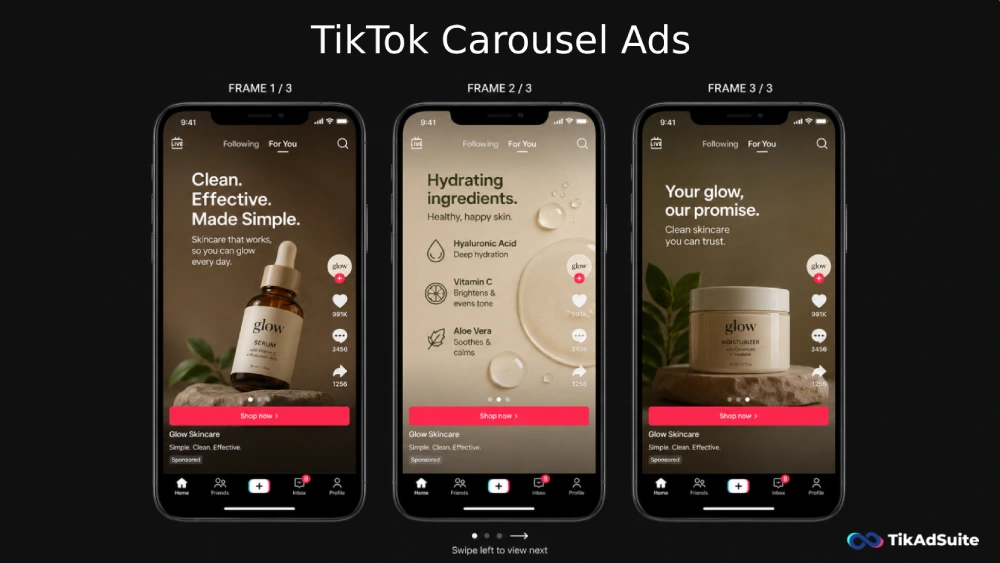
There are two types worth knowing:
Standard Carousel: You upload 2 to 35 images. All cards share one caption, one call-to-action button, and one destination URL. This is the most commonly used format and works well for storytelling, product features, and step-by-step content.
VSA Carousel (Video Shopping Ads): This is the catalog-powered version. Each product card can link to its own product page, making it better suited for eCommerce brands showcasing multiple items from a connected product feed.
TikTok Carousel Ad Specs for 2026
Get your assets right before you build. Off-spec images get rejected or render poorly, and both outcomes waste budget. The specs below are sourced directly from TikTok’s official specifications page, last updated January 2026.
Standard Carousel
| Spec | Requirement |
| Number of images | 2 to 35 |
| File formats | JPG, JPEG, PNG |
| Suggested file size | Up to 100 KB per image |
| Horizontal resolution | 1200 x 628 px |
| Square resolution | 640 x 640 px |
| Vertical resolution | 720 x 1280 px |
| Caption and CTA | One shared across all cards |
| Destination URL | One URL for all cards |
| Music | Required (CML or uploaded, max 10 MB) |
| Music duration | 2 seconds minimum |
| Music formats | MP3, WAV, M4A, FLAC |
A note on character limits: Multiple ad platform sources report a 40-character limit for the ad title and 20 characters for the ad caption in carousel placements. These limits do not appear on TikTok’s official spec page but reflect widely observed platform behavior. Write your copy short and put the key details directly on your slide images as text overlays.
Read this blog post for a detailed guideline to TikTok ad Specs.
VSA Carousel
Supports 2 to 20 images. Requires uploaded music only; CML tracks are not available for this format. Each card links to its own product page through your connected catalog.
Music and placement note: CML tracks only play on TikTok placements. If your campaigns include TikTok Pangle, using CML music will make your ad run silently there, which hurts delivery without any obvious warning in the dashboard. Upload your own track to keep audio consistent across all placements.
How TikTok Carousel Ads Work in the Feed
When a user hits your carousel, the first image loads automatically. A swipe indicator tells them more is there. Each swipe is a deliberate choice.
Someone who makes it to card four or five has actively decided to keep engaging; that level of intent is meaningfully different from someone who passively watched a few seconds of a video.
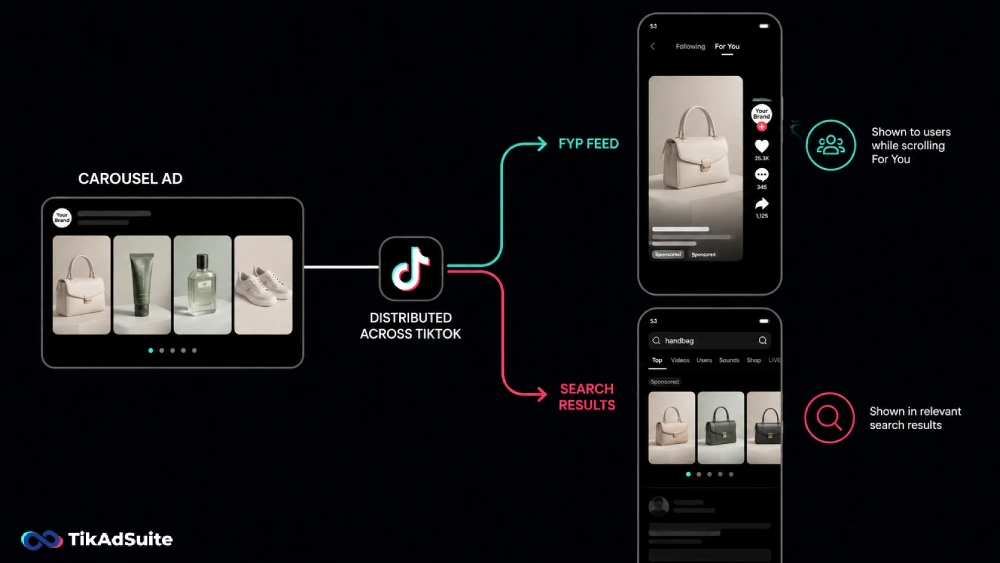
Practitioners widely report that TikTok reads the text placed directly on carousel slide images and may factor it into search distribution, similar to how the platform processes caption copy.
If you include a relevant keyword on your slide (“Best Running Shoes Under $100” on a product card, for example), your ad may surface in TikTok search results for that phrase, not just the For You Page.
TikTok has not officially documented this behavior, but it is worth building into your creative process as a low-effort potential upside.
How to Structure a TikTok Carousel Ad That Converts
Your carousel is a short visual story with a beginning, middle, and end. Every slide needs a clear job. If a card does not move the viewer forward, it should not be there.
Slide 1: The Hook
Your first card has to earn the swipe. Lead with a specific outcome or a bold visual that creates curiosity. “Cleared my skin in 14 days” over a before photo is one approach that works. A product shot on a white background usually does not.
Slides 2 through 5: Build the Case
These middle cards are where you support the hook. Product features, customer testimonials, use cases, step-by-step instructions, or side-by-side comparisons all work well here. Give each card one job, and keep the visual style consistent; mismatched design across cards makes a carousel feel cobbled together.
The Final Slide: Your CTA
Since the Standard Carousel uses a single CTA button across the entire ad, your closing slide should reinforce it visually.
A clear, low-pressure prompt like “Shop the collection,” “Get the free guide,” or “See all colors” on the final image keeps the transition to your landing page natural.
If your carousel is not converting, try putting your social proof card first. A customer review or testimonial screenshot often outperforms a product shot as an opening hook because it leads with a result rather than a product.
Creative Formats That Are Working Right Now
Knowing the format is one thing. Knowing what to put in it is another.
These approaches are producing strong engagement in 2026:
The How-To Guide: Break a process into step-by-step images. Users tend to save these carousels for later reference, and save activity signals content quality to TikTok’s algorithm, helping your ad reach a wider audience over time.
Before and After: Simple and visually satisfying. Particularly effective for beauty, fitness, home improvement, and anything where a visible transformation is the whole point. Leading with the “after” and letting the before follow on the next card creates natural curiosity.
The Product Comparison: One benefit per slide, three to five slides total. It simplifies the buying decision instead of overwhelming users with everything at once.
The Photo Dump: A set of raw, lifestyle-style photos that feel native to the feed. Polished catalog images can immediately be read as an ad, prompting users to scroll past. A looser, more natural image set blends with organic content and tends to hold attention longer because it does not announce itself as advertising.
Choosing Music That Actually Fits
Music is not background filler on carousel ads; it shapes the whole swipe experience. Some practitioners report that choosing a track with a strong beat can help transitions feel rhythmically satisfying rather than random, though TikTok has not officially confirmed automatic beat-syncing for carousel placements.
What is clear: the wrong track disrupts the experience, and the right one keeps users moving forward.
Avoid generic stock tracks. Lo-fi beats and trending sped-up audio are currently outperforming library music on carousel placements.
Use TikTok’s Trend Tracker to filter by Photo Mode content and find tracks already driving engagement for static formats.
Your two sourcing options:
- Commercial Music Library (CML): Available for standard carousel placements on TikTok only
- Uploaded audio: Works across both TikTok and TikTok Pangle (max 10 MB, MP3 format)
TikTok Smart+ and Carousel Ads
TikTok’s Smart+ automation system integrates directly with carousels. For Smart+ Catalog Ads, TikTok generates carousel ads automatically from your product feed, no manual build required.
The VSA format is especially effective for retargeting because each product card can link to its own product page, delivering more specific product details than a short video typically can in its opening seconds.
You can also save and manage carousel assets in TikTok’s Creative Library before campaign setup, then pull them directly during ad creation. For teams managing multiple live campaigns, this removes a significant amount of rebuild time.
Collage Carousel: TikTok’s Newest Commerce Format
TikTok introduced Collage Carousel in Q2 2026, and as of this writing, it is available in the US only. (Source)
Unlike a standard carousel, where users see one image at a time, Collage Carousel puts a hero image and three product thumbnails together in the same frame. Every image is clickable and linked to its own product detail page.
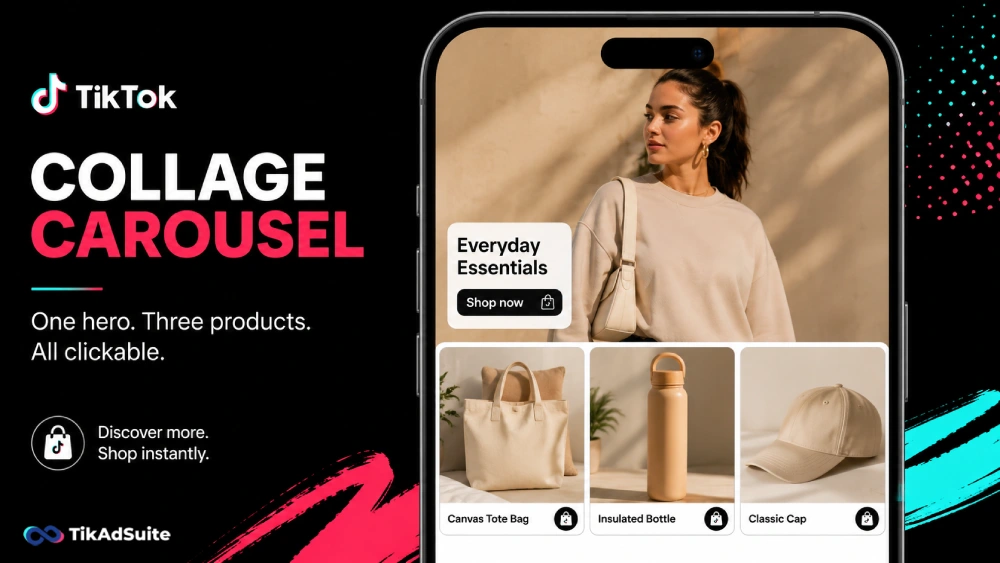
The practical difference: Users do not need to swipe to discover multiple products. Everything is visible upfront, which shortens the path from discovery to product page.
If you run an eCommerce store with a wide catalog and your audience is in the US, it is worth testing against a standard carousel to compare click and conversion rates.
[IMAGE: MOCKUP, Collage Carousel ad format showing one hero image with three smaller product thumbnails visible in the same initial frame]
Common Mistakes to Avoid
Using too many slides: Most practitioners see engagement fall noticeably after slide seven. Keep your carousel to three to seven cards unless you have a compelling sequential reason to go further.
Writing too much text: With roughly 40 characters for your title and 20 for your caption (based on widely observed platform behavior), your ad-level copy is extremely limited. Write short and move the details onto your slide images as text overlays.
Treating music as an afterthought: The wrong track disrupts the rhythm of the swipe experience. Spend a few minutes matching your audio to the visual pace of your cards before publishing.
Letting the creative run too long without a refresh: Audience fatigue hits fast on TikTok. Swapping the opening slide, rotating in new images, or changing the music track every one to two weeks extends the life of campaigns that are already working.
Frequently Asked Questions
What is a TikTok Carousel Ad?
A TikTok Carousel Ad is an in-feed format that shows multiple images in a single swipeable placement. Standard carousels share one caption, one CTA, and one destination URL across all cards. The catalog-powered VSA Carousel allows each product card to link to its own product page.
How many images can a TikTok carousel ad include?
Standard carousel ads support 2 to 35 images. VSA carousel ads support 2 to 20 images. Most practitioners recommend keeping carousels to 3 to 7 slides for the strongest sustained engagement across the full card sequence.
Do TikTok carousel ads require music?
Yes. All TikTok carousel formats require music. You can use a CML track for standard placements on TikTok, or upload your own audio file (up to 10 MB, MP3 format). Uploaded audio is the only option for TikTok Pangle placements, since CML tracks are not supported there.
Can each card in a standard carousel link to a different page?
No. Standard carousels use a single destination URL that applies to all cards. If you need per-card product links, you need the VSA Carousel format, which is catalog-powered and allows each product image to direct users to its own product detail page.
What is Collage Carousel, and who can use it?
Collage Carousel is a commerce format TikTok launched in Q2 2026. It shows one hero image and three product thumbnails in a single frame, with each image linking directly to a product detail page. As of Q2 2026, Collage Carousel is available for US advertisers only.
How do you stop TikTok carousel creative from going stale?
Swap the opening slide, rotate in new product images, or change the background music every one to two weeks. Small creative updates reset audience fatigue and extend the performance of campaigns that are already generating results.
Wrapping Up
TikTok Carousel Ads give you more storytelling flexibility and more conversion options than a single image or video placement.
Standard carousels work best when every slide has a clear purpose, and the sequence builds toward one strong call to action.
VSA carousels and the newer Collage Carousel add per-product linking for eCommerce brands that need more granular control over where users land.
Start with a three to five-slide carousel. Put your strongest visual or claim in slide one. Choose audio that matches your pacing.
Keep ad-level text tight and put the real detail on the images. Refresh your creative regularly. The specs are manageable once you know them.
What moves performance is building a slide sequence that earns each swipe, and then gives users a clear next step when they reach the end.