
Running the same ad to everyone on TikTok is the fastest way to burn budget and blame the platform. The problem is rarely the creative or the bid.
It is that cold strangers, warm browsers, and ready-to-buy customers are being shown the same message at the same time, and none of them feel like it was made for them.
Audience segmentation fixes this. It is the practice of dividing your total addressable audience into distinct groups based on where they are in the buying journey, how they behave on the platform, and what they are actually interested in.
Once those groups are defined, you can build campaigns that speak directly to each one instead of averaging across all of them.
In this guide, you will learn:
- What does audience segmentation mean in the context of TikTok ads
- The three-tier segmentation model that most high-performing accounts use
- How behavioral and interest-based segmentation differs in practice
- How to message each segment differently without rebuilding your entire creative library
- What breaks down when segmentation is skipped or done poorly
Get Up to $6000 Free TikTok Ad Credit
Table of Contents
Key Takeaways
- Audience segmentation divides your total audience by funnel stage, behavior, and intent, so each ad group delivers a relevant message
- Cold, warm, and hot audiences require different campaign objectives, messaging, and creative formats
- According to Sprout Social, users aged 25 to 34 make up 35.3% of TikTok’s global user base, making them the largest single demographic segment on the platform
- Behavioral segmentation typically outperforms interest-only targeting for conversion-focused campaigns because it reflects actual intent rather than assumed affinity
- Poor segmentation creates audience overlap, inflated CPMs, and misleading performance data
Quick Answer
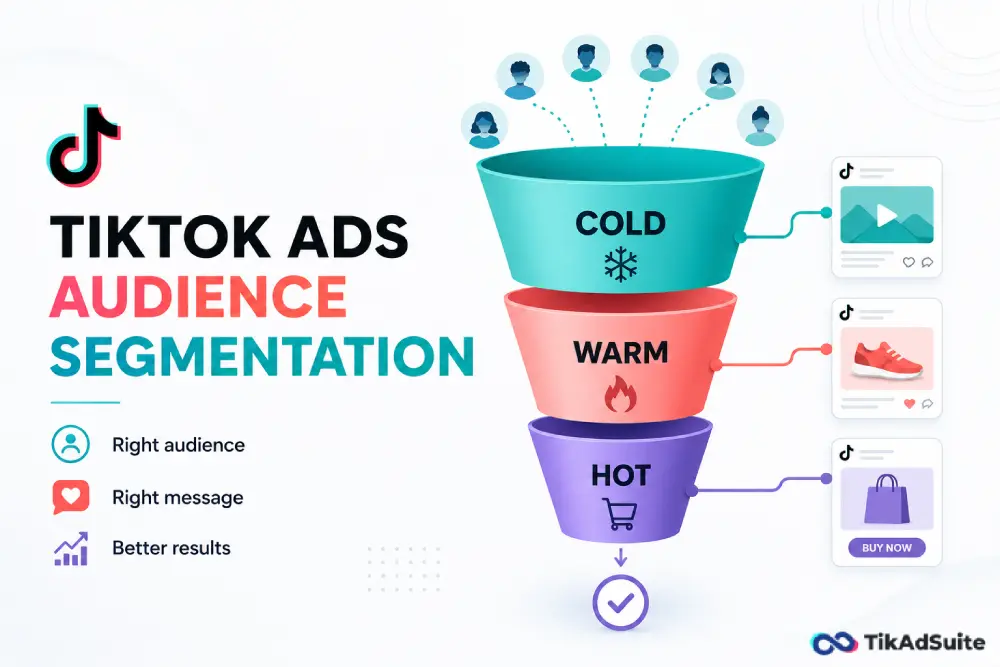
TikTok ads audience segmentation means structuring your campaigns around distinct audience groups based on funnel stage and behavior, rather than targeting everyone with the same ad. The most practical model divides audiences into three tiers: cold audiences who have no awareness of your brand, warm audiences who have engaged but not converted, and hot audiences who are closest to purchasing. Each tier uses different campaign objectives, ad formats, and messaging.
Why Segmentation Matters More on TikTok Than Other Platforms
TikTok’s algorithm is built around content relevance, not just demographic matching. This means that how your audience behaves on the platform, what they watch, what they skip, and what they engage with is more predictive of ad performance than basic demographic filters alone.
According to Sprout Social’s TikTok statistics report, TikTok has reached 1.99 billion users globally, with users aged 25 to 34 making up 35.3% of the platform’s total audience, representing the largest single age segment. The same report notes that 55% of Gen Z users engage with brand content on TikTok at least once per day, and the platform’s average session length sits at 9 minutes and 42 seconds.
Those numbers matter for segmentation because they tell you that your audience is large, behaviourally engaged, and exposed to brand content regularly. An undivided audience of this scale gets diluted quickly without a structure for reaching each group with precision.
The Three-Tier Segmentation Model
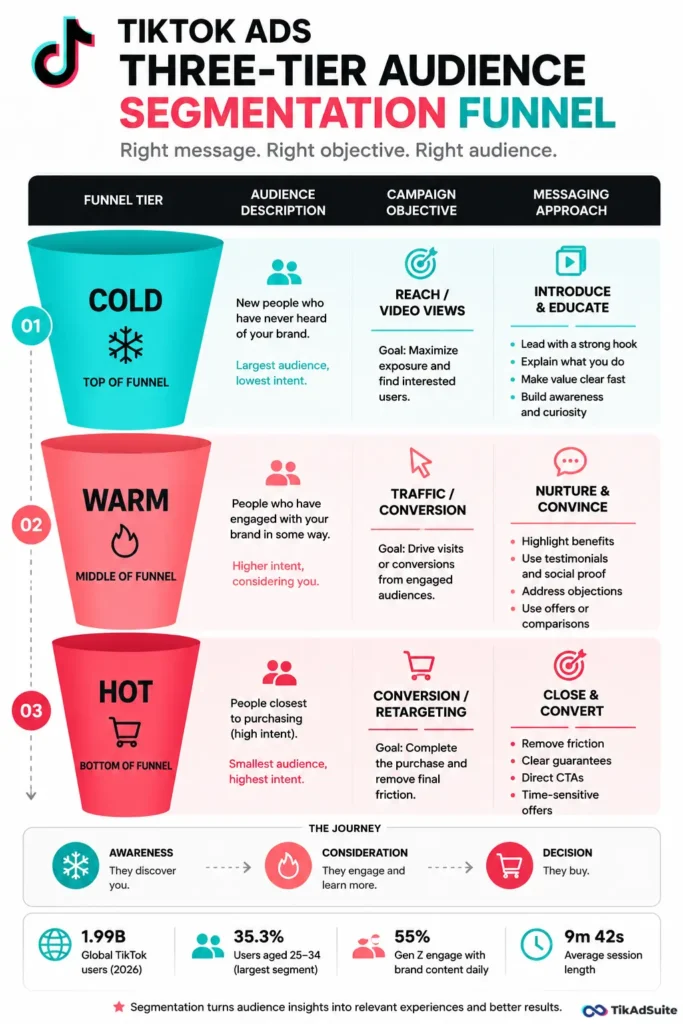
Most high-performing TikTok ad accounts organize their audiences into three tiers that mirror the funnel. Each tier has its own campaign objective, messaging approach, and creative format.
Tier 1: Cold Audiences
Cold audiences have never encountered your brand before. They are the largest pool and the hardest to convert directly, but they are where sustainable growth comes from over time.
For cold audiences, the campaign objective is typically Reach or Video Views. The goal is exposure, not conversion.
Creative should introduce what your brand does, lead with a strong hook that earns attention in the first three seconds, and make the value proposition immediately clear without assuming any prior knowledge.
Interest-based and broad demographic targeting are the right tools at this tier. You are casting wide enough to find people who might care, then letting TikTok’s algorithm narrow delivery to those who engage.
Tier 2: Warm Audiences
Warm audiences have already interacted with your brand in some way. They have watched a video, visited your landing page, engaged with your organic content, or clicked an ad without converting. They know who you are, which changes the conversation completely.
For warm audiences, the campaign objective shifts to Traffic or Conversion. Messaging can move past the introduction stage and address the reason someone did not act the first time.
This is where testimonials, specific product benefits, limited-time offers, and comparison-style creative tend to work well because they speak to someone who is already considering the decision.
Custom audiences built from video viewers, website visitors, and engagement data are the targeting tools for this tier. The TikTok custom audiences vs lookalike audiences guide covers how to build and apply these audience types in Ads Manager.
Tier 3: Hot Audiences
Hot audiences are the smallest group and the closest to converting. These are users who have added something to a cart, visited a pricing page, spent significant time on a product page, or triggered a high-intent event without completing the purchase.
For hot audiences, the campaign objective is Conversion, and the messaging should remove whatever friction is stopping them.
Clear guarantees, direct CTAs, and time-sensitive offers work at this tier because you are not building awareness or interest. You are closing a decision that is already close to being made.
Retargeting is the core mechanism here. The TikTok retargeting guide covers how to set up retargeting segments based on specific actions and website events.
Behavioral vs Interest-Based Segmentation
Interest-based segmentation targets users based on content categories they engage with on TikTok. Behavioral segmentation targets users based on specific actions they have taken, such as watching a full video, clicking an ad, visiting a URL, or purchasing a product.
Both are useful, but they serve different purposes at different funnel stages.
Interest targeting is the right starting point for cold audiences because it is the broadest signal you have for finding people likely to care about your product.
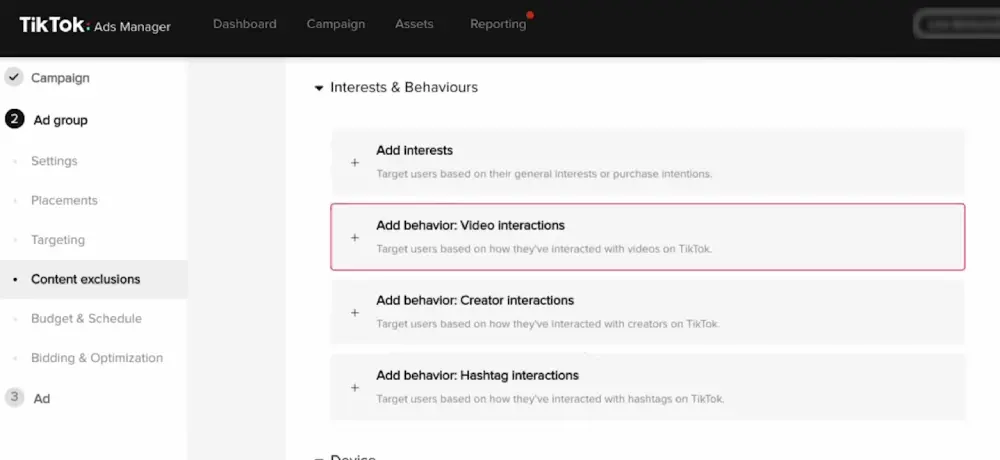
Behavioral targeting becomes more powerful as you move toward warm and hot audiences because it reflects what someone has actually done rather than what they are generally interested in.
A user who watches fitness content is a potential customer for a gym app. A user who watched 75% of your gym app demo ad, clicked through to the pricing page, and then left is a different kind of potential customer.
These two people should never see the same ad, but they do on accounts without proper segmentation.
For a full breakdown of the targeting signals available at each stage, the TikTok ad targeting options guide covers every filter and when each one applies most effectively.
Common Segmentation Mistakes That Drain Budget
Running all three tiers in the same ad group. Mixing cold, warm, and hot audiences under the same campaign means your budget is distributed unpredictably across groups with completely different conversion probabilities. Keep tiers separated with clear targeting, objectives, and budget distinctions.
Skipping audience exclusions. If someone has already purchased, they should be excluded from your conversion campaigns. Running acquisition ads to existing customers inflates your CPM and misreads your true acquisition cost. Exclusion lists are part of segmentation, not optional additions.
Building segments too narrow too early. Highly specific interest stacks on cold audiences reduce the pool fast enough to make delivery unstable and CPMs unaffordable. Start broader at the cold tier, let performance data show you who responds, then narrow from there.
Never updating segment definitions. A warm audience list built three months ago includes people who were warm then. Some have since converted, some have gone cold, and some are ready to purchase right now. Segment definitions need to be refreshed regularly to stay accurate.
Understanding how your current segments are actually behaving is what makes continuous improvement possible. The TikTok ads audience insights guide covers how to use TikTok’s reporting tools to analyze who is engaging and where they are in the funnel.
FAQs
What is audience segmentation in TikTok ads?
TikTok ads audience segmentation means splitting your target audience into groups based on funnel stage, behavior, and intent. You then run a separate campaign for each group, with its own objective and message. This way, people who have never heard of you see different ads from people who are about to buy.
What are the three audience tiers in TikTok ads?
The three tiers are cold, warm, and hot. Cold audiences don’t know your brand yet, so use Reach or Video Views with interest or broad targeting. Warm audiences have engaged but haven’t bought, so retarget video viewers and site visitors with Traffic or Conversion objectives. Hot audiences are close to buying, so use Conversion campaigns that retarget specific high-intent actions.
How many audience segments should I start with?
Start with three segments, one each for cold, warm, and hot. Adding more before you have enough conversions in these three spreads your data too thin for TikTok to optimize well. Put each tier in its own ad group with its own budget.
Does TikTok audience segmentation work for small budgets?
Yes, but you need to prioritize. On a small daily budget, running all three tiers at once can leave each one underfunded. Put your budget into the tier closest to your immediate goal, such as warm retargeting if you need sales, and add other tiers as your budget grows.
What is the difference between interest-based and behavioral targeting on TikTok?
Interest-based targeting reaches people based on the kinds of content they engage with on TikTok. Behavioral targeting reaches people based on specific actions, such as finishing a video, clicking an ad, visiting a page, or buying. Interest targeting works best for cold audiences. Behavioral signals are stronger for warm and hot audiences.
What is the difference between a custom audience and a segmented audience?
A custom audience is a specific list built from your own data, such as website visitors or video viewers, that you create in TikTok Ads Manager. A segmented audience is the broader strategy of grouping people by funnel stage. Custom audiences are one of the tools you use to build those segments.
Wrapping Up
Audience segmentation is not a TikTok-specific concept, but it becomes especially powerful on a platform where behavioral signals are this rich and content relevance drives distribution.
Cold, warm, and hot audiences are not just different people. They are different conversations, and treating them as the same one is where most accounts quietly lose performance.
Build your three tiers, match your objectives and messaging to each, and exclude converted users from acquisition campaigns.
Those decisions alone separate accounts that compound results over time from ones that keep optimizing creative without ever fixing the structure underneath.