
Your front desk phone rings less than it used to. Most people who join a gym now find it while scrolling, not searching. That shift is exactly why TikTok has become one of the more useful channels for fitness businesses, and also why it’s easy to get wrong.
This guide walks through what TikTok actually offers gyms, trainers, and fitness product brands: the ad formats worth using, two verified case studies (one gym, one apparel brand), targeting options that really exist, and the budget numbers TikTok itself publishes.
Here’s what you’ll get:
- The ad formats and campaign types that fit different fitness businesses
- Two verified TikTok for Business case studies, including an actual gym membership campaign
- Targeting options TikTok documents, not ones bloggers assume exist
- Real budget minimums, plus what it actually costs to get useful data
- TikTok’s current weight management and body image ad policy
- A quick-reference table matching business type to starting approach
Get Up to $6000 Free TikTok Ad Credit
Table of Contents
Key Takeaways
- TikTok’s campaign-level budget minimum is $50 a day, and the ad group minimum is $20 a day. Below that, your campaign won’t run at all, according to TikTok Ads Manager’s budget documentation.
- GMV Max is a TikTok Shop feature, not a general-purpose fitness campaign type. It only works if you sell physical products through TikTok Shop, and it’s currently available in the US, UK, Indonesia, Malaysia, the Philippines, Thailand, Vietnam, and Singapore.
- Gym King’s well-known TikTok case study is an athleisure apparel brand, not a gym. If you run a membership business, Basic-Fit’s TikTok campaign is the more relevant comparison.
- TikTok’s location targeting supports countries, states, cities, and zip codes, but not radius targeting, and small areas can raise your cost per result.
- TikTok’s Weight Management and Body Image policy bans body shaming and unrealistic claims, and restricts weight-related claims to users 18 and older.
Quick Answer
Local gyms should run Lead Generation campaigns with in-app instant forms, paired with city or zip-code targeting. Fitness product brands selling through TikTok Shop should use GMV Max. Everyone else should build interest and behavior targeting around organic content that already performs, then amplify it with Spark Ads.
Why Fitness Content Performs Well on TikTok
TikTok’s feed shows people things before they know they want them. That’s different from Google, where someone has already decided to search for a gym near them.
According to SocialPilot’s 2026 TikTok statistics report, 56% of marketers say they get better ad performance on TikTok than on other platforms, while only 26% currently run TikTok campaigns. That statistic covers marketers in general, not fitness specifically, so treat it as a sign of headroom rather than proof that fitness ads outperform.
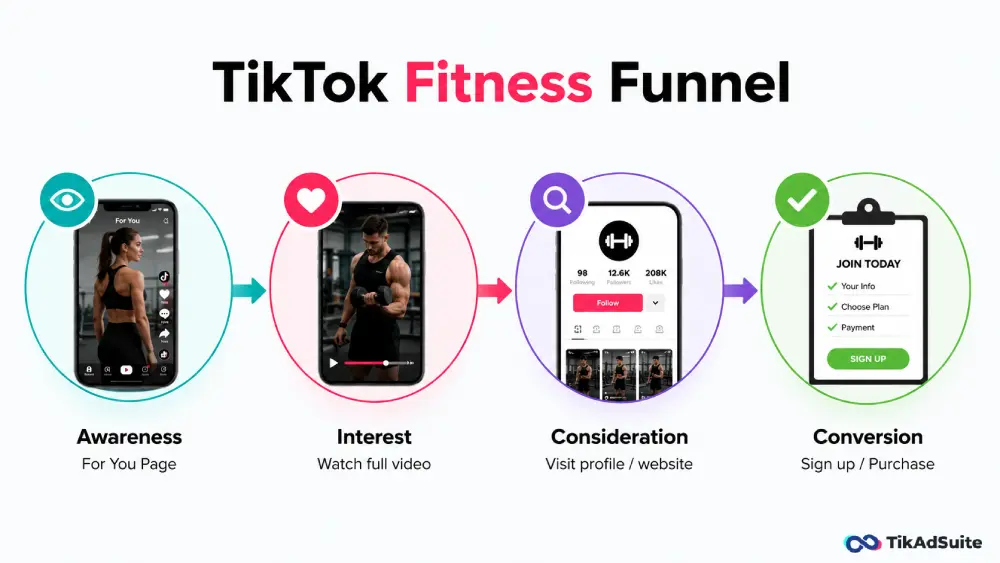
What TikTok does support directly is a full funnel. The platform runs awareness campaigns, lead generation, website conversions, app installs, and TikTok Shop sales, so a gym and a supplement brand can both use it, just through different objectives.
Ad Formats and Campaign Types That Fit Fitness Businesses
“Ad format” and “campaign type” get used interchangeably a lot, but they’re not the same thing. In-Feed and Spark Ads are formats. GMV Max is an automated campaign type. Here’s how each one actually works.
In-Feed Ads
In-Feed Ads show up as users scroll their For You Page, sitting next to organic content. For gyms, a raw 15 to 30-second clip of a real class or training session tends to feel more native here than a polished commercial.
You can pair In-Feed Ads with TikTok’s Lead Generation objective. This lets people fill out an in-app instant form, collecting a name, phone number, or fitness goal, without leaving TikTok for a separate landing page. TikTok’s own lead generation documentation notes that instant forms load faster than external pages and can pre-fill fields from the user’s TikTok account, which tends to reduce drop-off. If you want the full setup breakdown, TikTok lead gen ads covers it in more detail.
Spark Ads
Spark Ads let you put paid spend behind an organic post, either your own or a creator’s, and every like, comment, and share stays attached to the original post. That’s a real distinction TikTok documents, not just marketing language: TikTok’s Spark Ads help article confirms engagement from the boosted post is attributed to the organic content.
One detail worth being precise about: if you want to spark a coach’s or member’s video, you need their authorization code first. You can’t just boost someone else’s post without permission. If you’re weighing this format against a standard In-Feed Ad, Spark Ads vs. In-Feed Ads breaks down when each one makes sense.
Collection Ads
Gym King’s case study, covered below, used Collection Ads alongside In-Feed Ads. These direct users to an Instant Gallery Page where they can browse products inside the ad itself, which is a better fit for apparel and equipment brands than for membership-based gyms.
GMV Max
GMV Max is TikTok’s automated campaign type for TikTok Shop sellers, and it comes in two versions. Product GMV Max picks products, creative, and placements automatically for shoppable video and product listings. LIVE GMV Max does the same thing for LIVE selling.
As of July 2025, GMV Max is the only supported campaign type for new Sales-objective TikTok Shop campaigns, replacing older formats like Video Shopping Ads. Product GMV Max is currently available in the United States, United Kingdom, Indonesia, Malaysia, the Philippines, Thailand, Vietnam, and Singapore, per TikTok’s Product GMV Max setup guide.
This matters for one reason: if you run a membership gym and don’t sell physical products through TikTok Shop, GMV Max isn’t the campaign type to build your strategy around. It’s built for resistance bands, apparel, and supplements sold through TikTok Shop, not class passes. For the full mechanics, see the TikTok GMV Max guide.
Two Real TikTok Case Studies for Fitness Brands
Most articles on this topic lean on one case study: Gym King. It’s a legitimate one, but it’s worth knowing exactly what kind of business it is before you draw conclusions from it.
Gym King: an athleisure brand, not a gym
Gym King is a UK athleisure clothing company, described by TikTok as a brand where “fashion and fitness collide.” Working with agency Journey Further, Gym King ran In-Feed and Collection Ads targeting UK users aged 18 and up, using Value-Based Optimization bidding and Lookalike Audiences built from users who had added products to their cart.
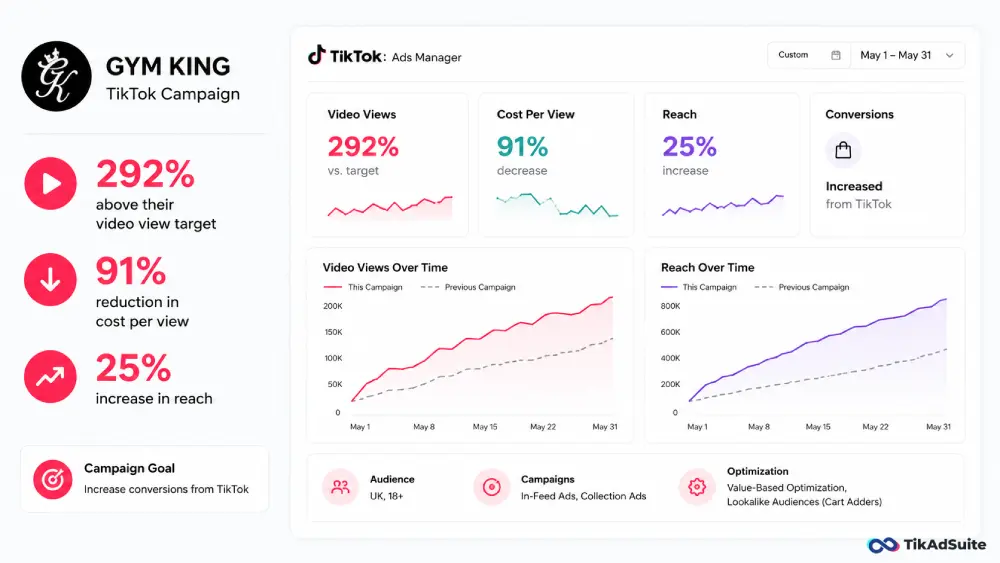
According to TikTok’s official Gym King case study, the campaign, which ran from late summer through the Black Friday period, delivered:
| Result | Figure |
|---|---|
| Video views vs. target | 292% above target |
| Cost per view | 91% lower than the previous campaign |
| Reach | 25% increase |
This is strong evidence for apparel and e-commerce brands. It’s not evidence that TikTok drives gym memberships, because Gym King doesn’t sell memberships.
Basic-Fit: an actual gym membership campaign
Basic-Fit, one of the largest gym chains in the Netherlands, ran a full-funnel TikTok campaign built around membership growth. Working with agency Maxlead, they combined TopView ads for reach, In-Feed ads for engagement, and an interactive “Shake Surprise” add-on, while using the TikTok Pixel and Events API to connect ad exposure to actual sign-ups.
Per TikTok’s Basic-Fit case study, the results were:
| Result | Figure |
|---|---|
| Conversions (membership sign-ups) | 8.2% uplift |
| Brand preference | 5.9% lift |
| Ad recall | 15% increase |
If you’re running a gym, this is the closer comparison. It’s smaller in scale than Gym King’s numbers, but it’s measuring the thing you actually care about: new members, not video views.
Creative Strategies Worth Testing
None of the following is a guarantee. Treat these as starting hypotheses to test against your own numbers, not universal laws.
Lead with a real coach, not the facility: A trainer talking straight to camera, breaking down a common mistake or a client result, tends to build a personal connection faster than a montage of equipment. Worth testing against your usual gym-tour footage.
Frame transformation around performance, not appearance: Someone going from zero pull-ups to ten is a strong, specific story. It’s also a safer creative direction under TikTok’s current ad policy, which restricts appearance-based before-and-after claims. More on that below.
Boost organic winners with Spark Ads: A short tutorial correcting a squat, or explaining a superset, builds trust for free. If it performs organically, put budget behind it instead of starting from zero with a new brand-produced ad.
Use real member content: A genuine 90-day progress video from an actual member tends to carry more weight than brand-produced content, though the size of that effect varies a lot by audience and offer. Ask members to tag your gym, then request permission before boosting anything. The UGC ads guide walks through the permission and boosting process in full.
Targeting Fitness Audiences on TikTok
Interest and behavior targeting
TikTok supports interest categories like home workouts, gym training, and wellness, plus behavior targeting layered on top. TikTok’s own behavior targeting documentation defines the exact windows: video engagement (watched, liked, shared) is captured over the past 15 days, while following or viewing a creator’s profile is tracked over the past 90 days.
Available categories vary by market and account, so what you see in Ads Manager may differ slightly from a general list like this one.
Location targeting, without the myths
TikTok supports countries, states, metro areas, cities, and zip codes. It does not support radius targeting, despite that being a common claim in TikTok marketing content. If you serve a specific neighborhood, zip code targeting is the actual tool, not a mile radius around a pin.
TikTok’s own location targeting documentation also warns that targeting very small geographic areas can reduce your impressions and clicks, and tends to raise your cost per result. That’s a real trade-off worth planning around, not a footnote. For a broader look at local strategy, see TikTok ads for local businesses.
Lookalike audiences
If you have a customer list or pixel data, Lookalike Audiences let TikTok find new users who resemble your best customers. Gym King built theirs from cart-adders rather than all site visitors, which is a reasonable model: a tighter, higher-intent seed audience.
There’s no fixed rule for exactly how narrow your seed audience should be. It depends on your customer volume, data quality, and how much reach you need. For a side-by-side of when to use custom versus lookalike audiences, see TikTok custom audiences vs. lookalike audiences, and TikTok’s lookalike audience builder can help you scope a starting seed size.
Retargeting warm viewers
Someone who watched most of your gym tour video is warmer than a cold audience, but that’s not the same as guaranteed purchase intent. Treat it as a warmer segment worth a stronger offer, like a limited trial, rather than a sure thing. The mechanics of setting this up are in TikTok retargeting.
Which Approach Fits Your Business
Fitness businesses aren’t one category. A local gym, a personal trainer, and a supplement brand need different starting points.
| Business type | Best starting approach |
|---|---|
| Local gym | Lead Generation + city or zip targeting |
| Personal trainer | Lead Generation or website conversion |
| Fitness app | App promotion objective |
| Apparel or equipment brand | Sales objective, Collection Ads |
| TikTok Shop seller | GMV Max (Product or LIVE) |
| Existing organic winner | Spark Ads |
Budgets: What TikTok Actually Requires
This is where a lot of TikTok guides get sloppy, mixing up platform minimums with practical testing budgets. Here’s the actual floor.
TikTok requires a campaign-level daily budget above $50 and an ad group-level daily budget above $20, according to TikTok’s Budget and Bidding FAQ. Go below either number and the campaign won’t run at all, regardless of your objective or industry.
Meeting the minimum keeps your campaign live. It doesn’t mean you’ll get enough data to optimize well. A useful test typically needs enough daily spend to generate a meaningful number of results, which for most gyms means budgeting well above the $20 floor once you move past initial testing. The minimum budget guide walks through how to scale from the floor to a working budget, and TikTok’s ad budget planner can help you model that out before you launch. If you’re setting up your first account, the TikTok Ads sign-up page is where that starts.
Metrics That Actually Matter
Cost Per Lead alone doesn’t tell you if your campaign is working. A cheap lead that never books a tour is worse than an expensive one that becomes a member.
| Stage | Metric | Why it matters |
|---|---|---|
| Ad | Video completion rate, CTR | Tells you if the creative holds attention |
| Lead | Cost Per Lead (CPL) | Acquisition efficiency, not business outcome |
| Qualification | Cost per qualified lead | Filters out junk leads |
| Booking | Cost per booked tour or trial | Measures real intent |
| Membership | Cost per acquired member | The number that actually matters |
Creative metrics diagnose attention. Conversion metrics diagnose the business. Track both, and connect leads back to your CRM or booking system so cheap-but-useless leads don’t get mistaken for wins. For a full breakdown of where to find each number inside Ads Manager, see the TikTok ad analytics dashboard breakdown.
TikTok’s Ad Policy on Weight and Body Claims
TikTok positions itself as a body-positive platform, and its ad policy backs that up with specific rules rather than vague good intentions.
TikTok’s Weight Management and Body Image policy, ad content and landing pages must not shame users about their bodies, suggest there’s one ideal body type, or claim that weight loss or muscle gain alone will improve someone’s life.
Exaggerated claims and content promoting disordered eating are also restricted. Any weight loss or muscle gain claims must be limited to audiences 18 and older, and framed around a healthy lifestyle rather than the product alone.
This is why the performance-based framing mentioned earlier (zero pull-ups to ten, not a before-and-after body shot) tends to be the safer creative direction. If your ad still gets flagged, why your TikTok ad was rejected covers the most common review issues.
Common Mistakes to Avoid
- Overproduced footage. Branded music and slow-motion equipment shots read as an ad, not content. Raw, slightly imperfect clips tend to hold attention longer.
- Targeting too broadly. “People interested in health” spans powerlifters and people who walked past a smoothie stand once. Narrow it to specific interests and behaviors that match your actual customer.
- Weak hooks. Opening with your logo loses the first two seconds, which is the window where most people decide to keep watching. Open with a result or a question instead. The TikTok ad hooks guide has formulas that work well for fitness specifically.
- Static creative. Fitness audiences on TikTok watch a lot of content, so the same ad running for months tends to lose steam. Watch your CTR and CPA trend, not a fixed calendar, to know when to refresh.
Frequently Asked Questions
Do TikTok ads work for local gyms, not just fitness product brands?
Yes. Local gyms can combine city or zip-code targeting with the Lead Generation objective to collect contact details through an in-app instant form. Basic-Fit’s TikTok campaign, which drove an 8.2% uplift in membership conversions, is a documented example of this working for a gym chain specifically.
What’s TikTok’s actual minimum budget?
$50 a day at the campaign level and $20 a day at the ad group level, according to TikTok’s own budget documentation. Below either number, the campaign won’t launch. That floor keeps a campaign running, but most gyms need to spend meaningfully more than $20 a day per ad group once they move past initial testing.
Is GMV Max relevant to my gym?
Only if you sell physical products through TikTok Shop. GMV Max is a TikTok Shop feature currently live in eight markets, and it’s not designed for membership or service-based businesses.
What TikTok ad policies should fitness brands know about?
TikTok’s Weight Management and Body Image policy bans body shaming, unrealistic weight loss or muscle gain claims, and content promoting disordered eating. Any weight-related claims must target users 18 and older and connect to a healthy lifestyle, not the product alone.
How do I know if my TikTok fitness ads are working?
Don’t stop at CPL. Follow leads through to qualified leads, booked tours, and actual memberships, since a cheap lead that never converts is a worse outcome than an expensive one that does.
Wrapping Up
If you run a gym, start with Lead Generation and tight local targeting, and measure success at the membership stage, not the lead stage. If you sell fitness products through TikTok Shop, GMV Max is worth testing, but only once your creative library and product catalog are ready to feed it.
Either way, treat every performance claim in this space, including the ones in this article, as something to test against your own numbers first. The two case studies above are real and TikTok-verified, but a UK apparel brand and a Dutch gym chain won’t map perfectly onto your account.
Start with one clear offer, one tightly defined audience, and a native-feeling creative. Rotate before fatigue sets in, and build retargeting once you have warm traffic to work with.