
You launched a TikTok campaign. The views rolled in. The clicks looked healthy. Then you checked your sales, and the number barely moved. That gap between attention and action is where many advertisers get stuck.
TikTok conversion rate benchmarks help you read that gap. They show whether your results are normal for your category, ahead of it, or quietly costing you money.
Without one, you end up guessing what good looks like. This page gives you the latest median numbers, explains where they come from, and shows how to compare your own rate the right way.
What you will find below:
- The current median TikTok conversion rate and how it moved over the past year
- Median conversion rates for ten ecommerce categories
- Which conversion rate column in Ads Manager to compare against a benchmark
- How to find the step where your funnel loses buyers
- Fixes that lift conversions without raising your budget
Get Up to $6000 Free TikTok Ad Credit
Table of Contents
Quick Answer
The overall TikTok ad conversion rate was 1.56% from August 2025 to July 2026, down from 2.46% a year earlier, according to Triple Whale’s TikTok benchmarks, which draw on more than 5,900 brands. A good rate is one at or above the median for your own product category, not a single platform number.
Before you compare, check that you are reading the click-based conversion rate in Ads Manager. The default column counts conversions against impressions, so it will always look far lower than any benchmark.
Key Takeaways
- The overall TikTok conversion rate fell by more than a third in the latest year of Triple Whale’s data, while ad costs also dropped.
- Category matters more than the platform average. Apparel and Lifestyle brands sat near the top, while Pets and Health brands sat at the bottom.
- TikTok Ads Manager has two conversion rate columns. Only the click-based one lines up with published benchmarks.
- A low rate with healthy clicks usually points to the landing page, offer or checkout, not the video.
- TikTok Shop removes the trip to an outside website, which takes out one of the biggest places buyers drop off.
What Is a Good TikTok Conversion Rate?
A good TikTok conversion rate is one that matches or beats the median for your category. In the latest Triple Whale data, Pets & Animals sat at the bottom and Apparel & Accessories at the top, with a wide spread between them, so the same number can be strong in one store and weak in another.
A simple way to read your own number: below your category median, there is work to do. Near it, you are on par with similar brands. Well above it, your offer and landing page are pulling their weight.
The Average TikTok Conversion Rate Right Now
The average TikTok conversion rate right now, measured across Triple Whale’s dataset, is 1.56% for August 2025 to July 2026, down from 2.46% the year before, a drop of more than a third.
Other numbers moved too. The table compares the two periods in the same data.
| Metric | Aug 2024 to Jul 2025 | Aug 2025 to Jul 2026 |
|---|---|---|
| Conversion rate | 2.46% | 1.56% |
| Click-through rate | 0.70% | 0.61% |
| CPM | $5.71 | $4.08 |
| CPA | $24.86 | $17.07 |
| ROAS | 1.43 | 1.51 |
So people bought from a smaller share of clicks, but each click and each sale cost less. That is why conversion rate is one number in a wider set of TikTok ad metrics you should track together.
Which Conversion Rate Column Should You Compare?
TikTok’s basic metrics definitions list two versions. Conversion rate (CVR) is conversions out of all impressions. CVR (clicks) is conversions out of all destination clicks.
Triple Whale’s benchmark counts conversions per ad click, so it lines up with the click-based version. If you hold your impression-based CVR up against a click-based benchmark, your campaign will look like a failure even when it is not. Add the CVR (clicks) column to your report before you compare anything.
TikTok Conversion Rate Benchmarks by Industry
Your industry shapes what a normal conversion rate looks like. A skincare brand and a kayak shop should not expect the same results, because their buyers behave differently.
The table shows Triple Whale’s median conversion rates for ten ecommerce categories, covering August 2025 to July 2026.
| Industry | Median Conversion Rate |
|---|---|
| Apparel & Accessories | 2.08% |
| Lifestyle & Boutique | 2.06% |
| Toys, Art, & Collectibles | 1.71% |
| Home & Garden | 1.61% |
| Electronics | 1.46% |
| Beauty | 1.12% |
| Food & Beverage | 0.99% |
| Sports & Outdoors | 0.99% |
| Health & Wellness | 0.80% |
| Pets & Animals | 0.38% |
Only Apparel & Accessories and Lifestyle & Boutique sit above the two percent line, and every category fell compared with the year before. Lifestyle & Boutique held almost flat, while Pets & Animals, Food & Beverage and Beauty saw the steepest drops.
Higher-priced gear and products people research first, such as sports equipment, tend to sit lower. A fast-scroll feed is a hard place to make that kind of decision.
Use your own category as your baseline. Beating the overall rate feels good, but beating your category median matters more.
Reading Clicks and Conversions Together
Reading click-through rate and conversion rate side by side tells you where to look when sales lag. Each pattern points to a different part of the funnel.
If people click but don’t buy, your ad is doing its job. The breakdown happens after the click. That points straight to your landing page, your offer, or your checkout, not your creative hook.
- Clicks fine, conversions low: fix the page, price, shipping cost or checkout.
- Clicks low, conversions fine: the people who click are buying, so work on the hook and the first seconds of the video.
- Both low: check audience fit and tracking before you change anything else.
In the latest data, both CTR and conversion rate fell across the platform, so a drop in your own numbers may partly reflect the market. Check the wider TikTok ad benchmarks to see if CTR and CPM moved the same way. Compare against your TikTok CTR history and your category median before you rebuild a campaign.
What Conversion Rate Should You Expect on TikTok Shop?
TikTok Shop gives buyers a shorter path than campaigns that send them to an outside site. The user never leaves the app. There is no slow page to load and no extra step to lose them.
We could not find an official TikTok Shop conversion rate benchmark, so treat any single figure you see online with care. What TikTok does publish is buying intent. On its conversions goal page, TikTok cites a 2022 US study by Material in which 44% of users said they had found something on TikTok in the past year and went to buy it right away.
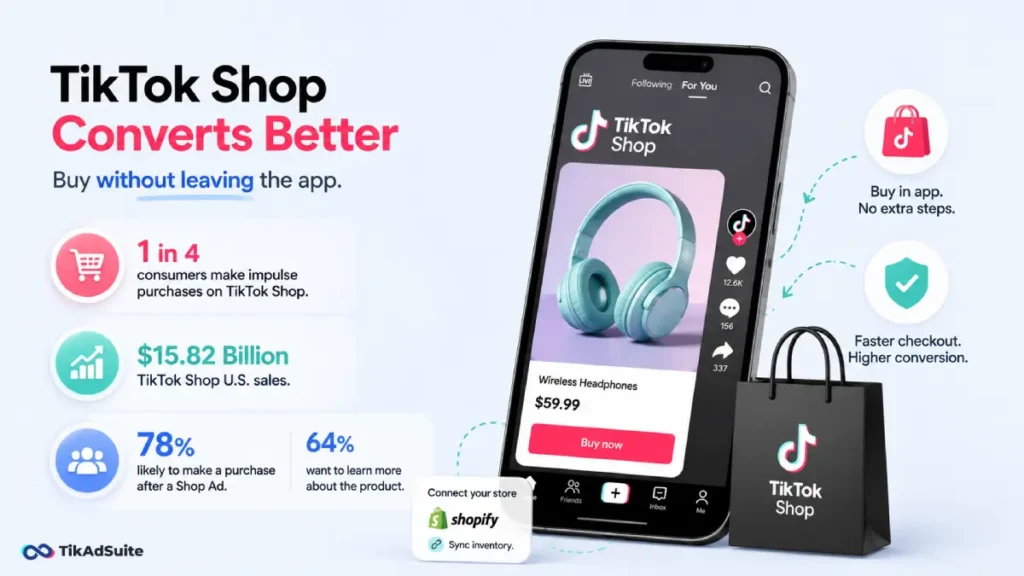
Shop Ads add to that intent. In a TikTok for Business article with Smartly, TikTok cites its 2022 Global Ecommerce Study by Material: after seeing a Shop Ad experience, 78% of users said they were likely to buy from the brand and 64% wanted to learn more about the product.
If you sell physical goods, test selling through TikTok Shop next to your website campaign and compare the two. Removing the off-platform step can change your numbers a lot. Brands running their own store can also connect inventory through a platform like Shopify to keep the buying flow smooth.
How Your Campaign Goal Changes the Benchmark
Not every conversion means the same thing. A conversion might be a purchase, a sign-up, a download, or a lead form. So the benchmark shifts with your goal.
A lead-generation campaign asking for an email will convert higher than a purchase campaign asking for a credit card. The action is easier, so more people complete it. Comparing the two is like comparing a sprint time to a marathon time.
Match your benchmark to your TikTok ad objective before you panic about a low number. A 1.2% purchase rate and a 1.2% lead rate are very different results. Always compare like with like.
Why Is My TikTok Conversion Rate So Low?
When your conversion rate falls below your category median, run through this short checklist. Most low rates trace back to one of these six issues.
- Wrong column: You are reading the impression-based CVR instead of CVR (clicks), so the number looks far lower than it is.
- Ad-to-page mismatch: Your video promises one thing, and your landing page shows another. The visitor feels misled and leaves.
- Slow mobile pages: TikTok traffic is mostly mobile. A page that loads slowly loses buyers before it even appears.
- A weak or unclear offer: If the deal is not obvious in seconds, people scroll on.
- The wrong audience: Cheap clicks from a poorly matched audience rarely turn into sales.
- Broken tracking: Sometimes the sales happen, but your pixel misses them.
That last point trips up many advertisers. Set up your TikTok Pixel correctly so you measure real results, not a false low caused by missing data.
How to Improve Your TikTok Conversion Rate
You do not need a bigger budget to lift conversions. You need fewer leaks in the path from click to checkout.
Start with these moves:
- Match the landing page to the ad. Use the same offer, colors and product shown in the video so the visitor feels they arrived in the right place.
- Speed up your mobile page. Cut heavy images and pop-ups. Faster pages keep more buyers.
- Lead with the hook. A weak first three seconds wastes the click. Keep the creative native and human.
- Give the algorithm room. Very narrow audiences often cost more per sale.
- Retarget your warm viewers. People who watched but did not buy are your easiest wins.
- Test one change at a time. Swap the offer, then the page, then the audience, so you know what actually moved the number.
On targeting, TikTok’s broad targeting guidance says fairly broad audiences, which can reach 80% or more of a country’s user accounts, get 15% lower CPA and 20% higher conversion rates on average than narrower ones.
For the creative side, an editor like CapCut helps you produce native-style video that blends into the feed instead of looking like an ad. Then build a retargeting campaign on TikTok to reach the viewers who already showed interest.
How TikTok Conversion Rates Compare to Facebook
TikTok and Facebook play different roles, so their conversion rates read differently. Facebook often catches people closer to the buying moment, while TikTok tends to reach them earlier, during discovery.
That is why a lower TikTok conversion rate is not automatically a worse result. In the latest Triple Whale figures, TikTok CPM and CPA both fell over the year even as conversion rate dropped, so each sale got cheaper.
Judge the two platforms on cost per sale and return on ad spend, not on conversion rate alone. The breakdown of TikTok ads versus Facebook ads walks through that math in more detail.
Frequently Asked Questions
How do you calculate TikTok conversion rate?
Divide your total conversions by your total clicks, then multiply by 100. For example, 30 sales from 1,500 clicks gives a 2% conversion rate. A conversion can be a purchase, a sign-up, a lead, or any action you choose as your campaign goal, so define it clearly before you measure. The conversion rate calculator does the math for you.
Is a 1% conversion rate bad on TikTok?
Not always. It sits below the overall rate, but in the latest Triple Whale data it is close to normal for categories such as Beauty, Food & Beverage and Sports & Outdoors. Check it against your category median and your campaign goal before deciding whether it is weak or normal for you.
Do TikTok ads convert better than organic TikTok posts?
Paid ads usually convert at a more predictable rate because you control the targeting and can retarget people who showed interest. Organic posts can convert well when one takes off, but reach is unpredictable, and you cannot dial it up on demand. Many brands use organic to test ideas, then put budget behind the posts that already prove they sell.
What is the difference between conversion rate and ROAS on TikTok?
Conversion rate measures how many clicks turn into actions, shown as a percentage. ROAS, or return on ad spend, measures how much revenue you earn for each dollar spent. You can have a strong conversion rate and still lose money if your product price is too low. Track both, since one counts actions and the other counts profit.
How long before TikTok conversion data is reliable?
Wait until the ad group has left the learning phase and has collected a fair number of conversions before you trust its rate. Early data swings hard on small numbers, and TikTok’s delivery system needs time to learn who converts. Cutting a campaign after one or two days often stops it just before it settles.
Wrapping Up
Start with one comparison. Pull your click-based conversion rate and set it next to your category median from the table above. If you are at or above it, keep scaling what works. If you are below it, you know where to dig.
If your rate trails the median, look past the video first. Your landing page, offer and checkout are where most sales are lost after a click.
These medians will move again next year, so check them against your own trend too. Once your page and offer are tight, you can build and test fresh campaigns inside TikTok Ads Manager and measure the lift for yourself.