
Most TikTok ad campaigns fail before the first video plays. Not because the creative is bad. Because the campaign type was wrong for the goal.
Choosing the wrong TikTok ads campaign type means you pay for results you never needed. You might run a reach campaign when you need conversions. Or push a conversion objective on a cold audience that has never heard of your brand. The platform will spend your budget either way.
This guide fixes that. You will learn exactly what TikTok campaign types exist, how the buying models work, how Smart+ campaigns differ from manual setup, and how to match every campaign type to the right business goal. No fluff, no guessing.
Table of Contents
Get Up to $6000 Free TikTok Ad Credit
Key Takeaways:
- TikTok campaign types are defined by objective first, ad format second
- You must choose between Auction and Reservation buying models before building anything
- Smart+ campaigns use TikTok’s AI to automate targeting, bidding, and creative selection
- TikTok Shop campaigns are a separate category built for eCommerce, not brand awareness
- Matching your campaign objective to your funnel stage is the single biggest factor in ad performance
What Are TikTok Ads Campaign Types?
TikTok ads campaign types are the top-level objective categories inside TikTok Ads Manager that tell the platform what result you want. Each type optimizes toward a specific goal: awareness, traffic, app installs, lead generation, or sales. You select the campaign type first, which then controls which ad formats, bidding strategies, and audience tools are available to you. Results vary based on your budget, audience size, and how well your campaign type matches your actual funnel stage.
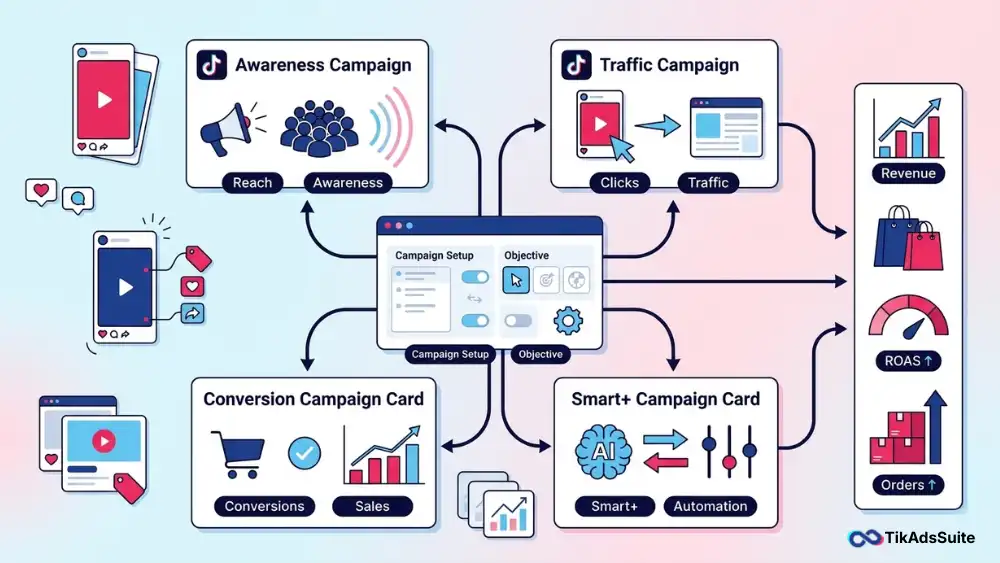
How TikTok Ads Are Structured: Campaigns, Ad Groups, and Ads
Before you pick a campaign type, you need to understand where it sits inside TikTok Ads Manager.
TikTok ads run on a three-level structure:
- Campaign level: Where you set your objective and buying model. This is your campaign type.
- Ad Group level: Where you set targeting, placement, budget, schedule, and bidding strategy.
- Ad level: Where you upload your creative, write your copy, and set your call to action.
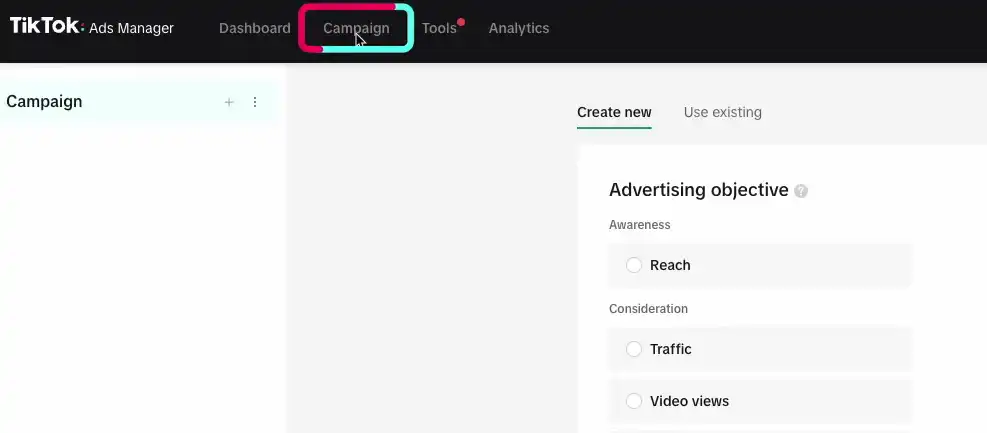
This structure matters because your campaign type decision at level one controls what options appear at levels two and three. If you pick a Reach campaign, you cannot optimize for purchases at the ad group level. The campaign type locks in the outcome that the algorithm works toward.
Most confusion about TikTok ad types comes from mixing up level one (campaign objectives) with level three (ad formats). They are not the same thing. An In-Feed video is an ad format. Conversion is a campaign type. You can run an In-Feed video under five different campaign types. The format does not define the campaign. The objective does.
The Two TikTok Campaign Buying Models: Auction vs. Reservation
This is the first decision you make in TikTok Ads Manager, and most guides skip it entirely.
Auction campaigns let you compete in real-time for ad placements. You set a budget and a bid, and TikTok’s algorithm places your ads based on relevance and bid competitiveness. Auction campaigns give you access to all performance-based objectives: traffic, conversions, app installs, lead generation, and product sales. Most advertisers run Auction campaigns because they offer full control and work at any budget level.
Reservation campaigns let you buy guaranteed placements in advance. You pay a fixed CPM (cost per thousand impressions) directly with TikTok’s sales team or through the self-serve Reach and Frequency buying type. Reservation is designed for large brand campaigns that need predictable delivery, such as a product launch or a national campaign tied to a specific date.
Here is how the two models compare:
| Feature | Auction | Reservation |
| Budget minimum | Flexible | Higher minimums |
| Delivery | Algorithm-driven | Guaranteed reach |
| Objectives available | All performance objectives | Reach and brand awareness |
| Best for | Performance and always-on | Brand launches and events |
| Setup | Self-serve | Self-serve or managed |
If you are running direct response campaigns, you will be in the Auction. If you are planning a coordinated brand moment, Reservation gives you the delivery certainty that Auction cannot guarantee.
TikTok Campaign Types by Objective: Awareness, Consideration, and Conversion
TikTok organizes all campaign types into three objective groups. Each group matches a stage of the customer journey.
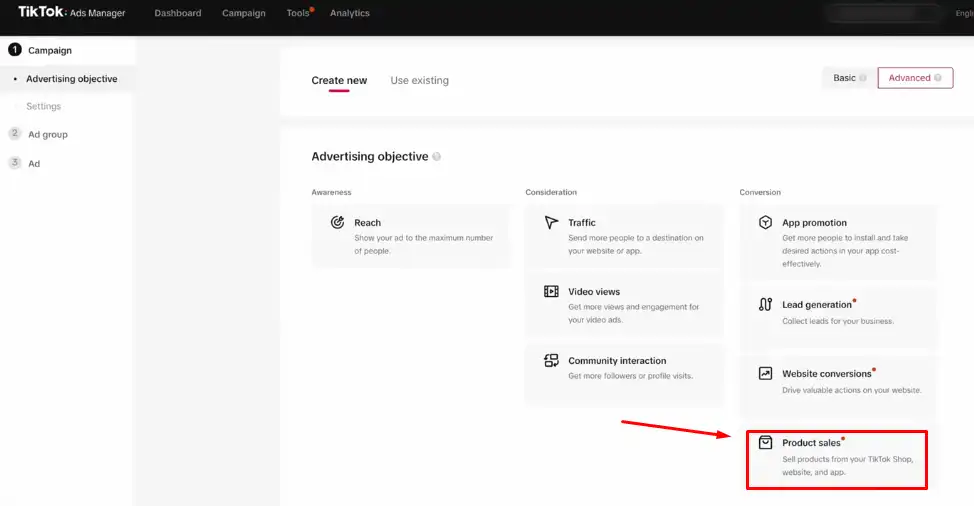
Awareness
Awareness campaigns tell TikTok to show your ads to as many relevant people as possible. The goal is reach and impressions, not clicks or conversions.
- Reach: Maximize the number of unique users who see your ad
- Brand Awareness and Reach (Reservation): Guarantee delivery at scale for brand campaigns
Use awareness campaigns at the top of your funnel when you are entering a new market, launching a product, or building recognition with a cold audience.
Consideration
Consideration campaigns optimize for users who take an action beyond seeing your ad. TikTok tracks these mid-funnel signals.
- Traffic: Drive clicks to a website or landing page
- Video Views: Maximize 2-second, 6-second, or ThruPlay video completions
- Community Interaction: Grow your TikTok profile followers and profile visits
- App Installs: Drive installs of your mobile app
Use consideration campaigns when your audience knows your brand exists but needs more exposure before converting.
Conversion
Conversion campaigns tell TikTok to find users most likely to complete a high-value action.
- Website Conversions: Optimize for purchases, sign-ups, or form fills on your site (requires TikTok Pixel)
- App Events: Optimize for in-app actions like purchases or registrations after install
- Lead Generation: Collect leads directly inside TikTok using native lead forms, no landing page required
- Product Sales: Run catalog-based ads that connect to your product feed
Conversion campaigns require sufficient data to work. According to TikTok’s official Scaling Auction Ad Spend guidance, you can start to scale a conversion campaign reliably when an ad group generates at least 50 conversions within a week and meets your performance targets.
Types of TikTok Ad Formats and Which Campaigns They Belong To
Ad formats are the creative containers your content runs inside. Each format can appear across multiple campaign objectives, but not all formats are available for every campaign type.
| Ad Format | What It Is | Compatible Objectives |
| In-Feed Ads | Native video ads in the For You page feed | All objectives |
| TopView | Full-screen video on app open (up to 60 sec) | Awareness, Traffic |
| Branded Hashtag Challenge | Sponsored hashtag + challenge mechanic | Awareness, Consideration |
| Branded Effects | Custom AR filters and stickers | Awareness, Consideration |
| Spark Ads | Boost existing organic TikTok posts as paid ads | All objectives |
| Shopping Ads | Product-linked video or catalog carousel | Product Sales |
| LIVE Shopping Ads | Ads that drive traffic to a TikTok LIVE stream | Product Sales |
Spark Ads are worth a specific mention here. You can take a high-performing organic post, from your own account or from a creator with his or her permission, and run it as a paid ad under almost any objective. This keeps your ad looking native because it starts as real organic content, not a produced ad. Many brands see stronger engagement rates with Spark Ads compared to standard In-Feed creative.
TopView and Branded Hashtag Challenges are typically Reservation placements. They require coordination with TikTok’s sales team and carry higher budget requirements. Based on current industry pricing data, TopView placements in major markets like the US start at approximately $50,000 per day or more, depending on the market and campaign timing.
Manual Campaigns vs. Smart+ Campaigns: Which Setup Is Right for You?
Smart+ is TikTok’s AI-automated campaign mode, officially launched on October 7, 2024, and expanded significantly with Smart+ 2.0 updates in 2025. It is one of the most significant changes to TikTok Ads Manager in recent years, and most guides still do not cover it.
With a manual campaign, you control targeting, bidding, and creative selection at the ad group level. You choose your audience, set your bid cap or cost cap, and decide which creatives run. Manual campaigns give you maximum transparency and control.
With a Smart+ campaign, you hand most of those decisions to TikTok’s algorithm. You provide your budget, your objective, your creative assets, and your conversion signal. TikTok handles audience targeting, bidding, and creative optimization automatically. Smart+ uses TikTok’s full behavioral data to decide who sees what and when.
Here is how to think about which to use:
| Factor | Manual Campaign | Smart+ Campaign |
| Audience control | Full control | Algorithm-driven |
| Bidding control | Manual or automated | Fully automated |
| Creative testing | You run the tests | Algorithm selects |
| Best for | Testing, learning, niche targeting | Scale, broad audiences, efficiency |
| Data requirement | Lower | Higher needs conversion history |
According to TikTok’s official Smart+ launch announcement, Smart+ Catalog Ads delivered a 36% drop in cost per acquisition versus manual campaigns in closed beta tests. Ray-Ban reported a 50% reduction in CPA after adopting Smart+ across their performance campaigns. However, these results came from accounts with established conversion history and pixel data.
If your account is new or your pixel has fewer than 50 weekly conversions, manual campaigns will give you more predictable and controllable learning.
Use Smart+ once your account has a conversion history. Use manual campaigns while you are building it.
TikTok Campaign Types for eCommerce and TikTok Shop
TikTok Shop campaigns are not just a variation of standard conversion campaigns. They are a distinct campaign category built specifically for product discovery and purchase within the TikTok ecosystem.
If you sell physical products, these are the three campaign types you need to understand:
Shopping Ads (Video Shopping Ads): These are shoppable In-Feed videos tied directly to your product catalog. When a user taps, they go to a product detail page inside TikTok, not your website. The purchase can be completed without leaving the app. You need a connected TikTok Shop to run these.
Catalog Ads: These use your product feed to automatically generate ads from your inventory. TikTok selects which products to show based on the user’s browsing behavior and purchase history. This is TikTok’s equivalent of dynamic retargeting.
LIVE Shopping Ads: These drive paid traffic directly into your TikTok LIVE session. Users arrive during the stream and can tap product links in real time while you are broadcasting. According to a report by Momentum Works and Tabcut, TikTok Shop’s global gross merchandise value reached $33.2 billion, more than doubling year over year. In the US specifically, LIVE shopping remains early-stage, accounting for approximately 10% of TikTok Shop GMV, per Statista data, with short-form video content driving the majority of sales.
To run any TikTok Shop campaign type, you need a verified TikTok Shop account, an approved product catalog, and compliance with TikTok’s commerce policies. You do not need a Shopify store. TikTok Shop operates as its own storefront.
How to Choose the Right TikTok Campaign Type for Your Goal
Match your campaign type to where your customer is in the funnel. That is the entire framework.
Use this table as your starting point:
| Your Goal | Campaign Type | Buying Model |
| Build brand awareness fast | Reach | Auction or Reservation |
| Drive website traffic | Traffic | Auction |
| Get more video views | Video Views | Auction |
| Grow your TikTok followers | Community Interaction | Auction |
| Generate app installs | App Installs | Auction |
| Collect leads without a landing page | Lead Generation | Auction |
| Drive purchases on your website | Website Conversions | Auction |
| Sell products through TikTok Shop | Product Sales / Shopping Ads | Auction |
| Launch a product to a large guaranteed audience | Brand Awareness (Reservation) | Reservation |
One rule applies to every row in that table: do not skip funnel stages with cold audiences.
If someone has never seen your brand, sending them straight into a Website Conversions campaign is expensive and usually inefficient. The algorithm will find buyers, but your CPM will be high, and your conversion rate will be low.
A short awareness or traffic phase first warms the audience. Then your retargeting conversion campaign performs against people who have already engaged.
The one exception is if you already have strong first-party data. If you can upload a customer list or use a highly specific lookalike audience, a cold conversion campaign can work from day one.
Common Mistakes When Setting Up TikTok Ad Campaign Types
These are the mistakes we consistently see in underperforming TikTok accounts, and they almost always trace back to campaign type decisions.
Running conversion campaigns with no pixel data. The TikTok Pixel needs enough signal to optimize. If your pixel has fewer than 50 conversion events per week, TikTok cannot reliably predict who will convert or help you start scaling. Start with a Traffic or Video Views campaign to build a signal first.
Choosing campaign type based on ad format, not goal. Many advertisers pick “Video Views” because they are running a video. That is not how objectives work. Ask yourself what action you want the user to take after watching. That action defines your campaign type, not your creative format.
Running awareness and conversion campaigns to the same audience at the same time. This creates internal auction competition. Your own ads bid against each other for the same users. Segment your campaign types by funnel stage and use separate audience definitions for each.
Ignoring the learning phase. According to TikTok’s official About Learning Phase documentation, every new ad group enters a learning phase when launched. Performance volatility typically starts to decline after about 25 results or 7 days, whichever comes first. Changing your bid, budget, or targeting during this window can reset the process. Give each ad group at least 7 days before making significant changes.
Treating Smart+ as a shortcut for new accounts. Smart+ requires historical conversion data to perform well. Running it without a populated pixel typically results in broad, unoptimized delivery and wasted budget. Build your conversion data manually first.
Frequently Asked Questions About TikTok Ads Campaign Types
What is the difference between TikTok campaign types and ad types?
Campaign types refer to the objective you choose at the campaign level inside TikTok Ads Manager, such as Traffic, Conversions, or Reach. Ad types refer to the creative format your ad takes, such as In-Feed video, TopView, or Spark Ad. You select your campaign type first, and your ad type at the ad level. They are separate decisions that serve different purposes.
What TikTok campaign type is best for sales?
For direct product sales on a website, you should use the Website Conversions campaign type with your TikTok Pixel installed and configured to track purchase events. For product sales within TikTok itself, you use the Product Sales campaign type with a connected TikTok Shop. The right choice depends on where you want the purchase to happen: on your site or inside TikTok.
What is TikTok’s Reach and Frequency buying?
Reach and Frequency is a Reservation-based buying model inside TikTok Ads Manager. It lets you book guaranteed impressions in advance at a fixed CPM, with control over how often each unique user sees your ad. It is designed for brand campaigns where predictable delivery matters more than performance optimization. It requires a minimum budget and is typically used for product launches or time-specific campaigns.
Do you need a TikTok Shop account to run Shopping Ads?
Yes. To run Video Shopping Ads, Catalog Ads, or LIVE Shopping Ads on TikTok, you need a verified TikTok Shop account with an approved product catalog. You cannot run TikTok Shop campaign types with only a standard TikTok Ads Manager account. You also need to comply with TikTok’s commerce eligibility policies, which vary by country.
How long does the TikTok campaign learning phase last?
According to TikTok’s official learning phase documentation, performance volatility typically starts to decline after about 25 results or 7 days, whichever comes first. The Learning Phase FAQ states that achieving 50 conversions is the most significant indicator of fully passing the learning phase. You should avoid changing your bid, budget, audience, or creative during this window, as significant edits can reset the process and restart optimization from the beginning.
What is TikTok Smart+, and how is it different from a regular campaign?
TikTok Smart+ is an AI-automated campaign type, launched in October 2024, where TikTok’s algorithm controls audience targeting, bid optimization, and creative selection on your behalf. Unlike a standard manual campaign, where you set each parameter yourself, Smart+ requires only your objective, creative assets, and budget. According to TikTok’s official newsroom, Smart+ Catalog Ads showed a 36% drop in cost per acquisition versus manual campaigns in closed beta testing. It performs best when your account has substantial conversion history and is not recommended for new ad accounts with limited pixel data.
Conclusion
TikTok ad campaigns do not fail because of bad creative. They fail because the structure underneath the creative was never built correctly.
You now have the full picture. You understand how campaigns, ad groups, and ads are layered. You know the difference between Auction and Reservation, and when each buying model serves your goal.
You can place any TikTok campaign type into its correct funnel stage, from Reach and Video Views at the top to Website Conversions and Shopping Ads at the bottom.
You know how Smart+ campaigns differ from manual setup, and exactly when the algorithm is ready to take over. And you know which common mistakes are quietly draining budget from accounts that look healthy on the surface.
Choosing the right TikTok ads campaign type is not a technical decision. It is a strategic one. Get the structure right, and the rest of the platform works with you, not against you.