
Your TikTok ad was approved, the budget is being spent, and the results are flat. You stare at the dashboard wondering which number to trust and which knob to turn first. That guessing game burns cash fast.
Most advertisers do not have a bad product. They have a messy account with five small problems stacked on top of each other.
This TikTok ad optimization checklist gives you the exact order to check those problems, so you fix the costly ones first instead of guessing.
Here is what you will learn:
- The full checklist you can run on any campaign
- How to fix a weak hook before you change anything else
- The targeting, tracking, and bidding checks most people skip
- How to test creative without draining your budget
- When to retarget, when to scale, and how often to optimize
Work through the list top to bottom. Each step builds on the one before it, so skipping ahead usually means fixing the same ad twice.
Get Up to $6000 Free TikTok Ad Credit
Table of Contents
Key Takeaways
- The biggest performance leak is almost always the first three seconds of your video, not your targeting.
- Average TikTok ad click-through rate sits near 0.84%, and TikTok ads run far cheaper than Facebook on cost per thousand views, based on WebFX 2026 benchmark data.
- Broken or missing conversion tracking makes every other optimization useless, so verify your pixel before touching bids.
- Creative fatigue kills winners fast, so you need a testing routine, not a one-time launch.
- Scale only proven ads, and scale them slowly, or you reset the learning phase and lose momentum.
What is a TikTok ad optimization checklist?
A TikTok ad optimization checklist is a fixed order of checks you run on a live campaign to find what is hurting performance. You start with metrics and tracking, then move through creative, targeting, bidding, testing, and scaling. Running the same order every time stops you from chasing random fixes and missing the real problem.
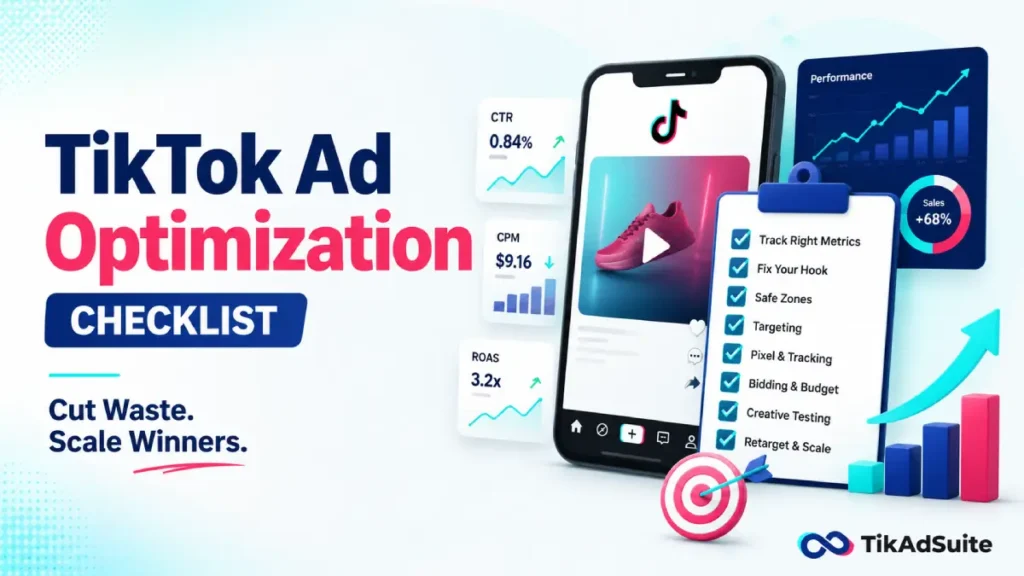
The TikTok Ad Optimization Checklist
Run these eight checks in order on every campaign. Do not skip ahead, because a later fix rarely works if an earlier one is broken.
[ ] Track the metrics that predict sales, not vanity numbers
[ ] Fix the first three seconds of your video
[ ] Keep key text and offers inside the safe zones
[ ] Tighten your audience and targeting
[ ] Verify your pixel and conversion tracking
[ ] Review bidding, budget, and the learning phase
[ ] Run a creative testing routine on a schedule
[ ] Retarget warm viewers, then scale winners slowly
The sections below explain each item, what to look for, and how to fix it.
Track the Metrics That Predict Sales
Before you change a single setting, look at the right numbers. Views and likes feel good but rarely predict revenue.
Focus on hook rate (the percent who watch past three seconds), click-through rate, cost per result, and conversion rate.
These four show you where people drop off. A high CTR with a low conversion rate points to a landing page problem, not an ad problem.
If you are unsure which numbers to trust, study the core TikTok ad metrics that actually predict performance before you cut any ads. Reading them wrong leads to killing winners and feeding losers.
Fix the First Three Seconds
If your hook is weak, nothing downstream can save the ad. People scroll past before your offer even loads.
Grab attention in the first second with movement, a bold claim, or a question. Add on-screen text that backs up your spoken hook, and lead with the problem instead of your logo.
A simple editor like CapCut makes it easy to trim a slow intro, add captions, and test three different openings of the same clip.
For proven patterns to copy, see this guide to TikTok ad hooks that stop the scroll. Fix the opening and your other metrics often climb on their own.
Keep Key Text and Offers Inside the Safe Zones
Your hook can be perfect and still fail if the price or call to action sits under TikTok’s buttons. The like, comment, and share icons cover the right and bottom edges of every screen.
Keep all important text and product details in the center of the frame. Check your ad on a real phone, not just your laptop preview.
This guide to TikTok ad safe zones shows exactly where the danger areas sit so nothing critical gets hidden.
Tighten Your Audience and Targeting
Broad targeting works well on TikTok, but broad does not mean careless. The algorithm needs a clear signal to find your buyers.
Run through these targeting checks:
- Confirm location, age, and language match your real customer
- Avoid stacking too many interests, which shrinks your audience too far
- Separate prospecting and retargeting into different campaigns
- Exclude past buyers from new-customer campaigns
Give the system room to learn. Tiny, hyper-specific audiences often cost more and deliver less because TikTok cannot optimize with so little data.
Verify Your Pixel and Conversion Tracking
This is the step most people skip, and it quietly ruins everything else. If TikTok cannot see your sales, it cannot find more buyers.
Make sure your pixel fires on the right events, like add to cart and purchase. Test a real action and watch it register in your events manager. Broken tracking means you are optimizing blind.
If your setup feels shaky, walk through how to install and verify the TikTok pixel correctly. Clean data here makes every later decision sharper.
Review Bidding, Budget, and the Learning Phase
Once tracking is solid, look at how you spend. The wrong bid or constant edits can choke a good ad.
Let new campaigns run three to four days before judging them. A large budget or audience change can reset the learning phase and start the data collection over, so keep increases small at around 20% or less.
Match your bid type to your goal, and if you are unsure which to pick, compare the main TikTok ad bidding strategies first. When you are ready to put real money behind a winner, TikTok Ads Manager gives you the caps and pacing controls to do it without overspending.
Run a Creative Testing Routine on a Schedule
One ad will not carry your account forever. TikTok creative fatigues fast, sometimes within two to three weeks, so a single winner has a short shelf life.
Test three to five new video variations every couple of weeks. Change one thing at a time, like the hook or the offer, so you know what moved the numbers. Keep the winners and retire the rest.
A repeatable system beats random uploads. Set up a simple TikTok creative testing framework so you always have fresh ads ready before the current ones fade.
Retarget Warm Viewers, Then Scale Winners Slowly
People who watched your video or visited your site are your cheapest buyers. Skipping retargeting leaves easy sales on the table.
Build audiences from video viewers, page visitors, and add-to-cart users, then show them a follow-up offer. Learn the setup in this guide to TikTok retargeting.
Only scale after an ad proves itself. Raise budgets slowly or duplicate the ad into a new campaign. Move too fast and costs spike, so follow a steady method to scale TikTok ads without breaking what works.
Why Is My TikTok Ad CPM So High?
A high CPM usually means the algorithm thinks your ad is weak or your audience is too narrow. Low engagement tells TikTok to charge you more to keep showing it.
For reference, WebFX 2026 benchmarks put TikTok ads near $9.16 CPM compared with $14.91 for Facebook, so a much higher number is a signal to act.
Fix the hook, widen a tight audience, and refresh tired creative. Those three moves beat raising your bid. This breakdown of how to lower your TikTok ads CPM walks through the full process.
Frequently Asked Questions
How Often Should You Optimize Your TikTok Ads?
Check key metrics daily, but make real changes only every three to four days. TikTok needs time to gather data, and constant edits restart the learning phase. Daily checks help you catch a sudden drop, while patient edits give each test a fair shot. Pull fresh creative into rotation every two weeks to stay ahead of fatigue.
How long before I should pause an underperforming TikTok ad?
Give a new ad three to four days and enough budget to exit the learning phase before judging it. Pausing too early wastes the data TikTok needs to optimize. If cost per result stays far above target after that window and the hook rate is low, pause it and test a new creative instead of tweaking the old one.
What is a good hook rate for TikTok ads?
A strong hook rate, meaning viewers who stay past three seconds, sits above 30%. Anything under 20% usually means your opening visual or text is weak. Fix it by leading with movement, a bold claim, or a clear problem in the first second, then reinforce it with on-screen captions.
Does creative or targeting matter more on TikTok?
Creative matters more. TikTok runs a creative-first system, so a great video with broad targeting often beats a perfect audience paired with a dull ad. Spend most of your optimization time testing hooks, formats, and offers before you obsess over narrow interest stacks.
Will editing my budget reset the TikTok learning phase?
A large budget change can reset it, which restarts data collection and can spike your costs. To avoid this, raise budgets in small steps of about 20% or less, and wait until an ad has stable results before scaling. Small, patient increases protect the performance you already built.
Wrapping Up
The fastest way to improve a TikTok campaign is to stop guessing and start checking in order. Trust the right metrics, fix the hook, confirm your tracking, then test and scale with patience.
If you only do one thing today, audit your first three seconds. That single fix lifts more accounts than any bid tweak ever will.
Run this checklist on every campaign, keep fresh creative in the pipeline, and let your proven winners carry the load.