
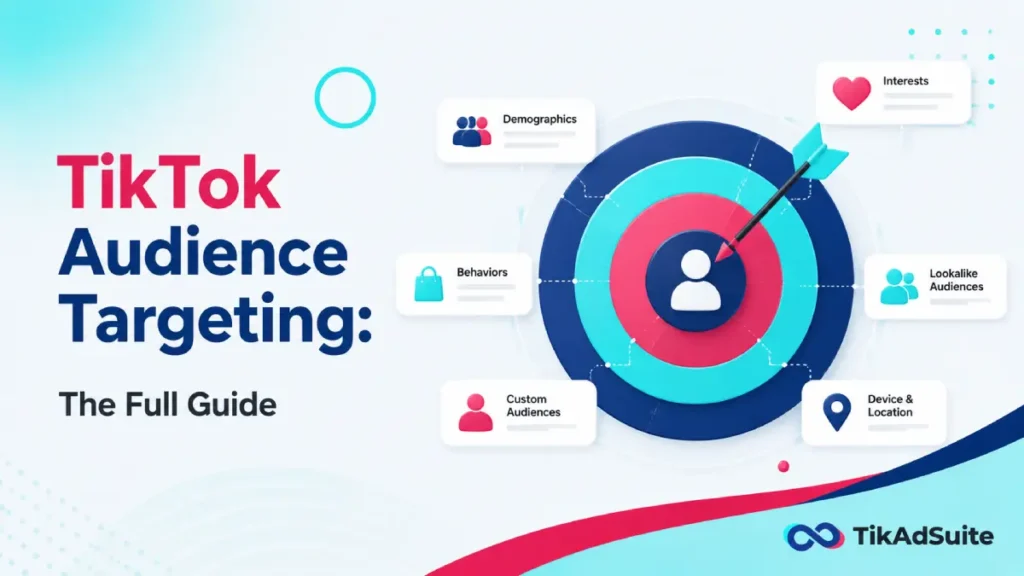
TikTok audience targeting works through five core types: Core Audience, Interest, Behavior, Custom, and Lookalike, plus an automated Smart+ layer that can run much of the decision-making for you.
Most ad budgets fail on targeting before they fail on creative. A strong hook still loses money in front of the wrong audience.
This guide covers all five types, how to match them to a campaign goal, and where TikTok’s tiered Lookalike system fits into a broader retargeting strategy.
Key Takeaways
- TikTok’s five core targeting types are Core Audience (demographics and location), Interest Targeting, Behavior Targeting, Custom Audiences, and Lookalike Audiences.
- Behavior Targeting windows differ by signal: TikTok’s own documentation sets video-engagement behavior at the past 15 days and creator-interaction behavior at the past 90 days, per TikTok’s official Behavior Targeting article.
- Custom Audiences need a minimum of 1,000 matched users before TikTok will activate them.
- Lookalike Audiences use three official similarity tiers, Narrow, Balanced, and Broad, per TikTok’s own Lookalike Audience documentation.
- Smart+ automates targeting using pixel data and creative signals, but TikTok recommends at least 50 conversion events per week before it has enough data to perform well.
Quick Answer
TikTok’s targeting system has five core types: Core Audience for demographics and location, Interest Targeting for content categories a user engages with, Behavior Targeting for recent on-platform actions, Custom Audiences built from a business’s own data, and Lookalike Audiences modeled off a source audience. Most accounts get the best results starting broad with Core Audience and Smart+ automation, then narrowing into Interest, Behavior, or Lookalike targeting only once enough conversion data exists to support it. Going narrow too early is the single most common targeting mistake.
Core Audience: Demographics, Location, and Language
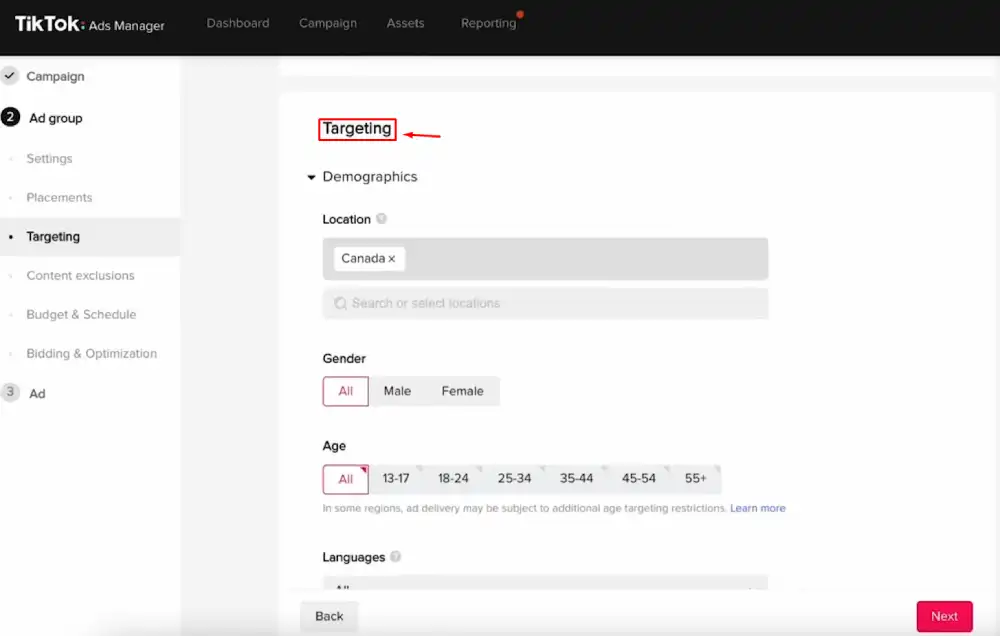
Core Audience covers the basics: age, gender, location, language, and device type.
Per DataReportal, TikTok had over 1.5 billion monthly active users globally as of early 2024.
That gives Core Audience filters real room to work even before layering on interest or behavior signals.
Location targeting can go as broad as a country or as narrow as a specific region, depending on the campaign.
Device targeting matters more than it looks. An app-install campaign for an iOS product wasted on Android impressions is a common, avoidable budget leak.
Interest Targeting: Reaching Users by What They Engage With
Interest Targeting groups users by the content categories they interact with, not by anything they’ve explicitly told TikTok about themselves.
The full category list, and how to combine interest layers without over-narrowing an audience, lives in TikTok ad targeting by interest.
Interest signals work best stacked with Core Audience filters, not used alone. The TikTok Audience Interest Finder lists the actual interest categories available in Ads Manager, so you’re picking from real options instead of guessing at names.
Interest categories on their own can still cover a very wide population.
Behavior Targeting: What TikTok’s Own Documentation Actually Says
Behavior Targeting reaches users based on recent actions on the platform, not stated interests.
This is where two commonly repeated numbers get confused, so it’s worth going straight to the source.
Per TikTok’s official Behavior Targeting article, video-engagement behavior, things like completions, likes, comments, and shares, is captured over the past 15 days.
Creator-interaction behavior, following and viewing the home pages of a specific type of creator, is captured over a longer window, the past 90 days.
Those are two different signals with two different lookback windows, not one single number.
Treating “behavior targeting” as one fixed window is a common source of confusion in TikTok ads content.
This guide uses TikTok’s own documented figures instead of repeating either simplified version.
Custom Audiences: Targeting a Business’s Own Data
Custom Audiences let a business upload its own customer data, website traffic, or app activity as a targeting source.

TikTok requires a minimum of 1,000 matched users before a Custom Audience can be activated in a campaign.
For the full setup process on pixel-based and customer-list Custom Audiences, see set up retargeting campaigns on TikTok. The TikTok Pixel Setup Helper walks through the pixel side of that setup directly.
Lookalike Audiences: Narrow, Balanced, and Broad
Lookalike Audiences model a new audience off an existing Custom Audience, a business’s strongest available targeting signal.
Per TikTok’s own Lookalike Audience documentation, the platform defines three official similarity tiers rather than open-ended percentage ranges.
| Tier | What it prioritizes | Tradeoff |
| Narrow | Highest similarity to the source audience | Smaller reachable audience |
| Balanced | A middle point between similarity and reach | Moderate size, moderate similarity |
| Broad | Larger potential reach | Lower similarity to the source audience |
Deciding whether to build a new Custom Audience or expand an existing one into a Lookalike is its own question, worked through in TikTok custom audiences vs. lookalike audiences. The TikTok Lookalike Audience Builder helps map a source audience to the right similarity tier before you set it up in Ads Manager.
Broad vs. Narrow Targeting: Which to Use When
Neither approach is universally correct; the right call depends on how much conversion data an account already has.
| Broad targeting | Narrow targeting | |
| Best for | New accounts, limited conversion data | Established accounts with proven audiences |
| How TikTok’s algorithm responds | More room to find efficient placements | Less room, but higher initial relevance |
| Risk | Some early spend on unqualified impressions | Learning phase can reset if the audience shrinks too far |
| Works well with | Smart+ automation | Lookalike and Custom Audience layering |
Matching Targeting to Your Campaign Goal
Targeting choice should follow the campaign objective, not the other way around.
An awareness campaign generally performs best broad, using Core Audience and Interest Targeting without heavy Behavior or Custom Audience layering.
A conversion campaign benefits from narrower, higher-intent signals: Custom Audiences built from past purchasers, or a Narrow-tier Lookalike modeled off them.
A retargeting campaign should rely on Custom Audiences built from site visitors or cart abandoners, not from cold Interest or Behavior signals.
Changing targeting settings too frequently mid-campaign resets TikTok’s learning phase, which is one of the more expensive mistakes an account can make.
Smart+ and Automated Targeting
Smart+ shifts targeting decisions to TikTok’s own machine learning system instead of manual audience building.
It needs three inputs: a properly configured pixel, native creative that performs without heavy targeting support, and enough conversion volume to learn from.
TikTok recommends at least 50 conversion events per week before Smart+ has enough data to perform well.
Smart+ also applies at the module level, not as a single on-off switch.
Specific targeting components can be automated while others stay manually controlled.
Accounts without that conversion volume yet tend to get better early results from manual Core Audience and Interest targeting.
Moving to Smart+ works better once enough data exists to support it.
Building a Full-Funnel Targeting Strategy
Targeting should shift as a prospect moves through the funnel, not stay fixed on one setting for every campaign.
Top-of-funnel campaigns work best broad: Core Audience plus light Interest Targeting, prioritizing reach over precision.
Middle-of-funnel campaigns narrow slightly, layering in Behavior Targeting or engagement-based Custom Audiences built from video views and profile visits.
Bottom-of-funnel campaigns go narrowest: Custom Audiences from site visitors or past purchasers, or a Narrow-tier Lookalike built from converters.
Common Targeting Mistakes to Avoid
Going narrow before there’s enough conversion data to support it is the most common mistake.
It usually shows up as high costs with little to show for them.
Changing targeting settings too often resets the learning phase and restarts the algorithm’s optimization from scratch.
Stacking too many Interest and Behavior filters at once can shrink an audience below what the algorithm needs to spend efficiently.
Ignoring device targeting on app-specific campaigns wastes spend on platforms the product doesn’t even support.
Treating Smart+ as a replacement for a working pixel, instead of a system that depends on one, is another common error.
That mismatch leaves automation with nothing useful to learn from.
Frequently Asked Questions
What are the five main TikTok ad targeting types?
Core Audience (demographics and location), Interest Targeting, Behavior Targeting, Custom Audiences, and Lookalike Audiences. Most accounts combine two or three of these depending on the campaign’s funnel stage.
How far back does TikTok’s Behavior Targeting look?
It depends on the signal. Per TikTok’s own documentation, video-engagement behavior covers the past 15 days, while creator-interaction behavior covers the past 90 days. These are two separate windows, not one shared number.
What’s the minimum audience size for a TikTok Custom Audience?
1,000 matched users. TikTok won’t activate a Custom Audience below that threshold.
What similarity tiers does TikTok use for Lookalike Audiences?
Narrow, Balanced, and Broad. TikTok’s own documentation defines these as tiers, not fixed percentage ranges, Narrow prioritizes similarity over reach, Broad does the opposite.
Should a new TikTok account start with broad or narrow targeting?
Broad, in almost every case. New accounts don’t yet have the conversion volume to support narrow targeting or Smart+ automation, and going narrow too early is the most common reason new campaigns underperform.
Wrapping Up
TikTok’s targeting system rewards starting broad and narrowing only as conversion data justifies it, not the reverse.
Match the targeting type to the funnel stage: broad Core Audience and Interest Targeting at the top, Behavior Targeting in the middle.
Custom Audiences or Narrow-tier Lookalikes belong at the bottom, once conversion data exists to support them.
Smart+ can automate large parts of this once an account has enough conversion volume.
It depends on a working pixel and real data first, not the other way around.
From here, the guides linked throughout this page cover interest targeting depth, retargeting setup, and the custom-versus-lookalike audience decision in full detail.
Sources