
TikTok ad creative works differently from every other platform’s, because the feed rewards content that doesn’t look like an ad.
A polished commercial and a raw, native-feeling clip can run the same bid on the same audience.
They still get wildly different costs, because the algorithm treats them differently, not just because viewers do.
This guide covers what TikTok’s own data says about hooks, structure, sound, and testing, plus where to go for scripts, tools, and examples.
Key Takeaways
- TikTok’s own creative guidance states that 90% of ad recall happens in the first 6 seconds, per TikTok’s official creative best practices.
- Ads featuring visible products on screen see a 65% increase in brand affinity, per the same TikTok source.
- Native, TikTok-first content style gets 3.3x more action than polished, traditional-ad style content.
- Clear CTA cards deliver a 45% lift in recall and a 19% increase in likeability.
- TikTok recommends testing 3 to 5 distinct creatives per ad group, since creative fatigue sets in faster than most advertisers expect.
Quick Answer
TikTok ad creative that performs follows a hook-body-close structure, opens with its main point inside the first 3 to 6 seconds, and looks like it belongs in the feed rather than an interruption to it. TikTok’s own platform data backs this directly: 90% of recall impact happens in the first 6 seconds, and native-style content earns over 3 times more action than polished, traditional advertising. Sound matters as much as visuals, since most users watch with audio on. Testing 3 to 5 creative variations per ad group, refreshed every 7 to 10 days, keeps cost from climbing as creative fatigue sets in.
What Makes TikTok Ad Creative Different
TikTok’s feed rewards content that fits the platform, not content that stands out from it.
Per TikTok’s official creative guidance, the platform recommends a “DIY or not overly polished style” that matches user-generated content.
That means featuring real people like creators, employees, or customers, and leaning into existing trends rather than fighting them.
That’s the opposite instinct from most brand advertising, where higher production value is usually treated as a strength.
On TikTok, a stiff, obviously-scripted commercial reads as an interruption. The algorithm serves it less, which raises its effective cost even at the same bid.
The Hook: Your First 3 to 6 Seconds
TikTok’s own data is direct about this.
90% of an ad’s recall impact is captured within the first 6 seconds, per its official creative best practices blog.
A separate TikTok article narrows that further. It recommends the main content proposition land within the first 3 seconds.
Recall barely registers past that window if the hook hasn’t landed yet.
That means the hook isn’t an intro, it’s the ad. Everything after it either earns the view that follows, or doesn’t.
TikTok’s 3-second rule covers exactly what needs to happen in that opening window, and TikTok ad hooks breaks down proven hook patterns by category.
Video Structure That Works
TikTok recommends a three-part structure instead of a fixed length: hook, body, close.
Hook: Grab attention immediately, ideally with the product or main point visible from the first frame.
Body: Deliver the value with the product actually on screen. TikTok’s data shows ads with visible product placement see a 65% increase in brand affinity.
Close: End with a clear call to action. TikTok reports CTA cards drive a 45% lift in recall and a 19% increase in likeability compared to ads without one.
TikTok ad CTA covers every button option and which one fits which goal.
Sound Is Not Optional
TikTok’s own numbers put sound near the top of what makes an ad work.
88% of TikTok users say sound is essential to the experience, per the platform’s creative best practices data.
Music specifically makes content feel more energizing and entertaining for roughly half the user base, per the same source.
An ad built for silent autoplay, the way many Facebook ads are designed, loses a real part of its impact on TikTok.
Best music for TikTok ads covers how to pick and clear a track correctly.
Text Overlays and Captions
TikTok recommends keeping on-screen text to 5 to 10 words per second for it to stay readable and effective.
Text overlays reinforce the spoken hook for viewers watching without sound, and they extend how long the core message stays visible on screen.
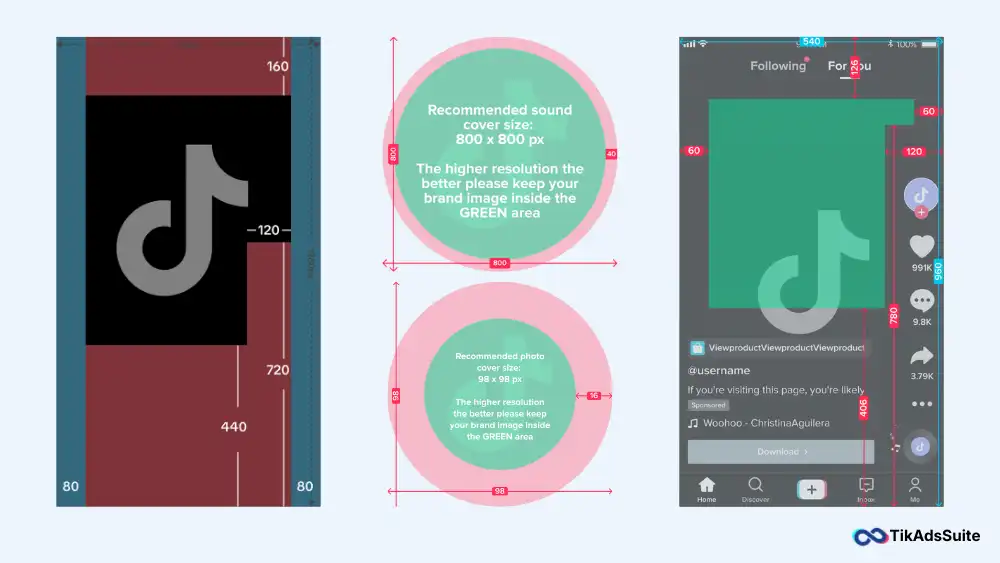
Keep any text inside the platform’s visible safe zones, since UI elements like captions, usernames, and engagement buttons can cover the edges of the frame.
Writing Scripts That Don’t Sound Like Ads
The gap between a script that performs and one that doesn’t usually isn’t the idea.
It’s whether it sounds like a real person talking or a brand reading a pitch.
TikTok ad scripts and formulas covers repeatable structures for the whole hook-body-close arc.
The TikTok ad script generator tool speeds up a first draft once you know the structure.
For a direct model of what this looks like executed well, how to create TikTok ads that don’t look like ads walks through real examples.
Producing Creative Without a Studio
Most advertisers running well on TikTok aren’t working with a production team.
They’re working with a phone, a script, and editing software built for the format.
The best TikTok video editors covers the editing tools most creators actually use.
That includes CapCut, phone-based options, and AI avatar tools for teams without a creator on hand.
Don’t skip the legal side, either. Copyright strikes and watermark removal are two of the most common ways creative gets flagged before it runs.
Testing Creative Without Guessing
TikTok recommends running 3 to 5 meaningfully different creatives per ad group, and 3 to 5 diversified ad groups per campaign.
That gives the algorithm real options to optimize across, instead of minor variations of the same idea.
Creative fatigue sets in faster on TikTok than on most platforms.
Refresh creative roughly every 7 to 10 days once spend passes meaningful volume, since a fatigued ad costs more to deliver the same result.
TikTok’s creative testing framework covers a structured system for running this correctly instead of testing at random.
Real Examples Worth Studying
Seeing what’s already working is often faster than starting from a blank script.
Viral TikTok ads breaks down real campaigns and why they worked, including several built entirely from creator-briefed UGC rather than in-house production.
Frequently Asked Questions
How long should a TikTok ad be?
TikTok doesn’t mandate a specific length. What matters more is structure: a hook within the first 3 to 6 seconds, a body that keeps the product visible, and a clear close with a CTA. Shorter, tighter edits generally outperform padded ones, since attention drops fast if the hook doesn’t pay off quickly.
Does polished, high-production creative hurt performance on TikTok?
It can. TikTok’s own data shows native, TikTok-first style content earns 3.3x more action than traditional, polished advertising style. That doesn’t mean quality doesn’t matter, it means the wrong kind of polish, the kind that looks like a TV commercial, works against the platform’s native feed.
How often should I refresh my TikTok ad creative?
Roughly every 7 to 10 days once a creative has meaningful spend behind it, since TikTok’s algorithm charges more to deliver an ad once engagement starts dropping. Running 3 to 5 distinct creatives per ad group from the start helps delay that fatigue.
Do I need professional video equipment to run TikTok ads?
No. Most well-performing TikTok ads are shot on a phone with a clear script and edited in tools like CapCut, not produced in a studio. The native, slightly rough style TikTok rewards is usually easier to achieve without professional equipment, not harder.
Why does sound matter so much for TikTok ad creative?
Because most TikTok users watch with audio on, unlike some other platforms where silent autoplay is the default. TikTok reports 88% of users consider sound essential to the experience, so an ad designed to work without audio is leaving a real part of its potential impact on the table.
Wrapping Up
TikTok ad creative that performs isn’t about production value. It’s about matching how the platform’s own data says people actually watch.
That means a hook inside the first few seconds, sound that’s built in rather than optional, and a native feel that doesn’t interrupt the feed it’s running in.
Test 3 to 5 real variations per ad group, keep creative fresh every 7 to 10 days, and build every script around a structure, not just an idea.
From here, the scripts, tools, and examples linked throughout this guide cover the execution side of turning that structure into an actual ad.
Sources