
A hook is your best anchor to your customer. TikTok ad hooks are the opening lines, visuals, or questions that appear in the first one to three seconds of your ad.
Those three seconds are all you have to turn a scroller into a buyer. You need to be creative and be attentive to what your viewers are looking for. Give proper thought, test, and time to find the best hook and get the best results.
Get them right and see your watch time climb, your cost per click drop, and your audience convert. Get them wrong, and your budget disappears into a feed that never slows down.
In this guide, you will find:
- What makes a TikTok ad hook work in 2026
- The seven hook categories with a brief breakdown of each
- A complete numbered list of 57 ready-to-adapt hook templates
- Simple tips for testing hooks without wasting budget
Whether you run ads for an eCom brand, a SaaS product, or a local business, these frameworks apply across the board.
Get Up to $6000 Free TikTok Ad Credit
Table of Contents
Key Takeaways
- A strong hook captures attention in the first one to three seconds by creating curiosity, tension, or immediate relevance
- The best-performing TikTok ad hooks feel native to the feed, not like traditional ads
- Hook types include curiosity gaps, pain points, bold claims, social proof, contrarian statements, direct CTAs, and story openers
- Testing three to five hook variations per ad group gives the algorithm enough data to identify what works
- Ads that communicate their core message within the first three seconds consistently outperform those that build slowly
What Is a TikTok Ad Hook?
A TikTok ad hook is the opening moment of your video ad, typically the first one to three seconds, designed specifically to stop someone mid-scroll and make them want to keep watching. It can take the form of a spoken line, an on-screen text overlay, a surprising visual, a direct question, or a combination of all three. A good hook does not just grab attention. It sets a specific expectation that the rest of your ad then delivers on. If the hook promises a result and the video does not follow through, viewers drop off, and your metrics suffer.
Why the First Three Seconds Decide Everything
TikTok’s algorithm does not distribute your ad equally. It rewards content that keeps people watching by pushing it to more users, which lowers your cost per impression. The reverse is equally true: ads with weak hooks receive fewer impressions over time.
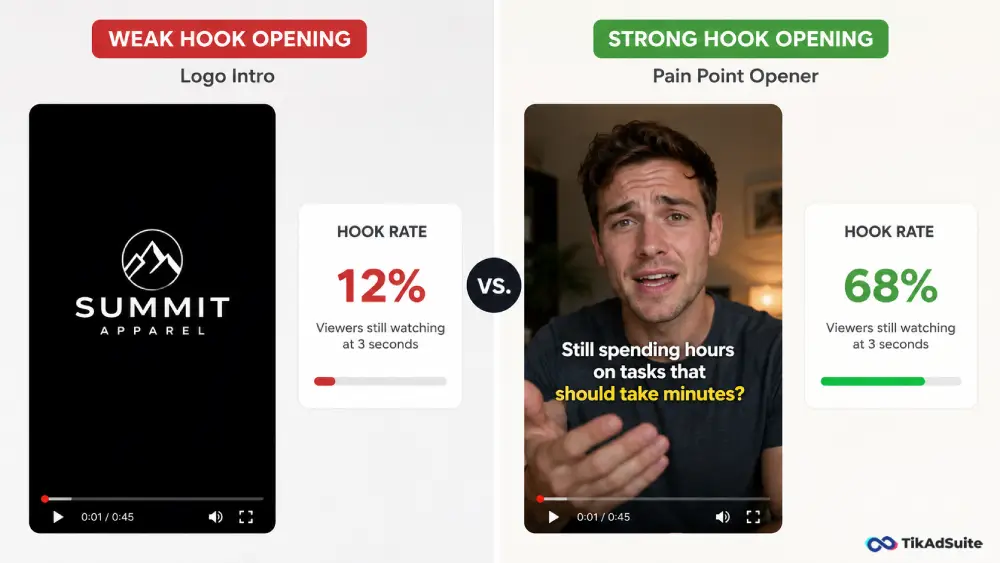
A practical benchmark to track is hook rate, which is the percentage of viewers who watch past the three-second mark. Aim for 30% or higher as a baseline. If your hook rate sits below 20%, the opening is not stopping the scroll, and the rest of your creative never gets seen.
The fix is almost always at the very start. Most underperforming ads open with a logo, a slow product shot, or a line that takes too long to reach the point.
Leading with tension rather than your brand name is the single biggest shift most advertisers can make right now.
The 7 Hook Categories
Before the full list, here is a quick breakdown of each type and when it works best.
Curiosity gap hooks create an information gap that the viewer has to close. They work well for cold traffic because they draw people in before they know they need your product. Specificity matters here. Vague curiosity feels like clickbait. Specific curiosity feels like value.
Pain point hooks name the viewer’s exact problem in the first second. They filter for high-intent audiences immediately and create a sense of being understood. Use these for people who are already aware of the problem you solve.
Bold claim hooks open with a surprising but credible statement. The claim needs to be specific enough to feel real and then backed up within the video. Vague or unverifiable claims erode trust quickly.
Social proof hooks borrow credibility from numbers, reviews, or real results. They answer the unspoken viewer question: Does this actually work for real people? Best used for audiences that know the solution but need a reason to trust your brand specifically.
Contrarian hooks challenge a widely held belief. The brain instinctively pauses when it encounters something that contradicts what it already thinks is true, which buys you a few extra seconds to make your case.
Direct CTA hooks cut straight to the offer. These work best lower in the funnel for warm audiences who are close to converting, especially when there is urgency or a limited-time element involved.
Story and scene-setting hooks drop the viewer into the middle of a moment. They work because they feel like content rather than advertising. The viewer walks into something interesting and stays to find out what happens.
57 TikTok Ad Hook Templates
Each template below is organized by category. Fill in the brackets with your specific product, result, audience, or niche. The hooks that perform best are the ones that feel written for one specific person, not for everyone at once.
Curiosity Gap
- The reason your TikTok ads keep flopping has nothing to do with your budget.
- I changed one line in my ad copy, and our ROAS doubled in four days.
- Nobody in your niche is doing this, and that is exactly why it works.
- This single tweak took our CPL from $47 to $11. Here is what we did.
- Most brands skip this step entirely. It costs them thousands every month.
- The reason [audience] keeps failing at [goal] has nothing to do with [common assumption].
- Nobody talks about this part of [topic], but it is the part that actually matters.
- Here is what [competitor category] does not want you to know.
- I changed [one small thing] and [specific result] happened in [timeframe].
- This is the part of [topic] that most guides completely skip.
Pain Point
- Still running ads that nobody clicks on?
- Tired of watching your ad budget disappear with nothing to show for it?
- If your TikTok ad CTR is below 1%, your hook is the problem.
- Spending more on ads but converting less? You are not alone.
- Running the same creative for three weeks? That is your creative fatigue talking.
- Your competitor is not smarter than you. They just have better hooks.
- Still dealing with [specific problem]? There is a reason it keeps happening.
- If [frustrating situation], this video is for you.
- How much money are you losing every month to [pain point]?
- You tried [common solution]. It did not work. Here is what it does.
Bold Claim
- We scaled to $100k in monthly revenue without a single polished ad.
- This product sells itself. Watch.
- We cut our CPM in half without changing our targeting.
- Our ugliest ad made the most money. Here is what it looked like.
- I tested 22 hooks in two weeks. Only three of them actually worked.
- This $0 creative strategy out-ROI’d our $5,000 production shoot.
- We [achieved result] without [common expectation].
- In [short timeframe], we went from [before] to [after].
- I tested [number] versions. Only one actually worked.
- Most [category] brands miss this completely. The ones that catch it grow fast.
Social Proof
- Over 40,000 people switched to this. Here is why.
- More than 12,000 five-star reviews. We had to find out if it was real.
- My first order came in 47 minutes after launching this ad.
- From 0 to 8,000 units sold in 90 days. No influencer deals. No big budget.
- Over [number] people use this every day. Here is why.
- [Result] in [timeframe]. Real customer. Real numbers.
- [Customer persona] went from [before] to [after] in [timeframe].
- This is now the most reviewed [product type] in [niche].
- [Number] five-star reviews and counting. See what they are saying.
- Every [specific role] I know uses this. Now I understand why.
Contrarian
- Stop using trending sounds in your ads. Here is why it is hurting your results.
- You do not need a big following to run profitable TikTok ads.
- High production value is killing your TikTok ad performance.
- Your hook does not need to be clever. It needs to be clear.
- Stop [common advice]. It is the reason [problem] keeps happening.
- Everyone says [common belief]. The data says something different.
- You do not need [overvalued thing] to [achieve result].
Direct CTA
- Watch this if you are still running Facebook ads in 2026.
- Stop scrolling. This is the tool you have been looking for.
- If you have under 100 customers, you need to see this.
- Watch the next 15 seconds. Then decide.
- If you are a [target persona], this ad is specifically for you.
- Tap now. This is the last time we are running this price.
Story and Scene
- Six months ago, I had zero sales and a maxed-out credit card.
- My client was about to cancel before we ran this one ad.
- I almost shut down the business. Then I found this.
- I had [relatable bad situation]. Then [turning point].
How to Test Hooks Without Burning Budget
Once you have your hooks written, the fastest way to find a winner is to hold everything constant, the script, the offer, the CTA, the product footage, and change only the first three seconds of each variation. This isolates the variable and gives you clean data.
Run a/b testing, run three to five hook variations per ad group with a small daily budget for three to five days. Check your hook rate first. If one variation holds 35% of viewers past three seconds and another sits at 12%, you already have your answer.
Pause the underperformers, shift budget to the winner, and start the next round of testing. A consistent refresh cycle prevents creative fatigue from quietly draining your results before you notice it happening.
What Makes a Hook Fail
A few patterns appear consistently in hooks that underperform:
- Opening with a brand logo or product shot before earning any attention
- Building context slowly instead of leading with the tension
- Using vague curiosity that feels like clickbait rather than a specific payoff
- Promising something the rest of the video does not actually deliver
- Using overly polished visuals that instantly read as an ad to someone scrolling through organic content
The fix is almost always the same. Start with what the viewer cares about, not what you want to say about your brand.
Frequently Asked Questions
What is a TikTok ad hook?
A TikTok ad hook is the opening moment of a video ad, usually the first one to three seconds, designed to stop a viewer from scrolling. It can be a spoken line, on-screen text, a surprising visual, or a direct question. Its job is to earn enough attention to keep the viewer watching.
How long should a TikTok ad hook be?
Your hook should land within the first one to three seconds. The line itself can be as short as three to eight words. If your opening takes more than three seconds to reach the actual point, trim it. Speed is not just a style choice on TikTok. It is a performance variable.
How do you measure whether a hook is working?
Track your hook rate inside TikTok Ads Manager, which measures the percentage of viewers who watch past the three-second mark. A rate above 30% is a solid baseline. Below 20% means your opening is not stopping the scroll. Watch time and video completion rate give useful context on top of that number.
How often should you refresh your TikTok ad hooks?
Most high-performing TikTok creatives begin to fatigue within seven to fourteen days at meaningful spend levels. Watch for rising CPMs and falling CTRs as early signals. Swapping only the hook while keeping the rest of the creative intact can extend an ad’s life without a full reshoot.
Final Thoughts
Strong TikTok ad hooks are not about being clever. They are about being immediately relevant to the person seeing your ad.
Pick five hook types from the list above, write one variation of each, and run them against each other. Let the data tell you which direction to go.
From there, the process is about testing faster than your competitors, refreshing before fatigue sets in, and matching the hook type to where your viewer is in their decision-making process.
The 57 templates above give you a starting point. The results you get from testing them will give you something far more useful: a shortlist of hooks that actually work for your specific audience.