
Your TikTok ad was approved, the budget is spending, and the results are flat. You look at the dashboard and can’t tell which number to trust or which setting to touch first.
Most advertisers don’t have a bad product. They have an account with several small problems stacked on top of each other.
This TikTok ad optimization checklist gives you the order to check them in, so you fix the expensive problems first instead of guessing. Work through it top to bottom, because each check depends on the one before it.
Get Up to $6000 Free TikTok Ad Credit
Table of Contents
Quick Answer
To optimize TikTok ads, run nine checks in a fixed order on each live campaign. First confirm the ad passed review, verify tracking and read the right metrics. Then fix the hook, check safe zones and review targeting. Finish with budget and the learning phase, creative testing, and retargeting and scaling. Change one thing at a time and give TikTok about 25 results or 7 days to settle before judging, per its learning phase guide.
Key Takeaways
- Check tracking before bids. If TikTok can’t see your conversions, every other change is a guess.
- Ads Manager reports 2-second and 6-second video views, not a 3-second view, so measure your hook with those.
- Raise budgets in steps of no more than 40% during learning and 30% after it, at most every two days, per TikTok’s budget page.
- Learning usually settles after about 25 results or 7 days, per TikTok’s learning phase guide, so don’t judge or edit a new ad group on day one.
- For context, Triple Whale’s TikTok data for August 2025 to July 2026 puts the overall CPM at $4.08, per its TikTok benchmarks.
- Creative wears out, so keep tested replacements ready instead of relying on one winner.
What Is a TikTok Ad Optimization Checklist?
A TikTok ad optimization checklist is a fixed order of checks you run on a live campaign to find what’s hurting performance. You start with review status and tracking, then move through metrics, creative, targeting, budget, testing and scaling. Running the same order every time keeps you from chasing random fixes and missing the real problem.
The TikTok Ad Optimization Checklist
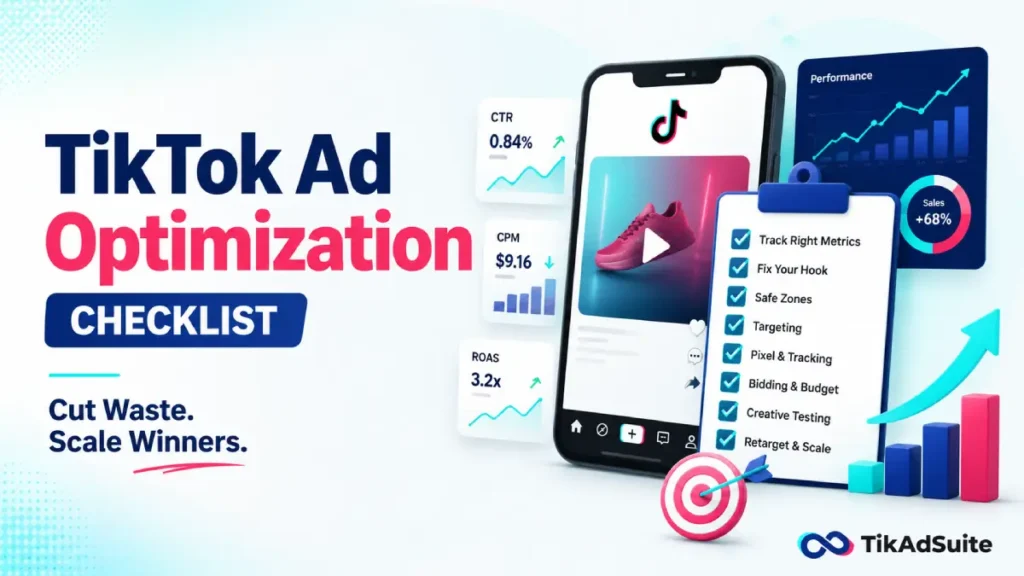
The TikTok ad optimization checklist has nine checks. Run them in order, because a later fix rarely works while an earlier one is broken:
- Confirm the ad and landing page pass review
- Verify your pixel and conversion tracking
- Track the metrics that predict sales
- Fix the opening seconds of your video
- Keep key text and offers inside the safe zones
- Review your audience and targeting
- Check budget, bidding and the learning phase
- Run a creative testing routine on a schedule
- Retarget warm viewers, then scale winners slowly
Each check below says what to look for and how to fix it.
Confirm the Ad and Landing Page Pass Review
Start with the review status, because a rejected ad or a weak landing page stops everything after it. TikTok’s landing page review checklist asks for mobile-friendly pages, and e-commerce pages need visible company information such as policies and terms, with no prohibited products anywhere on the page.
If an ad is rejected, open it, click Edit ad, fix the issue and it goes back for review. TikTok’s rejected ad guide also offers a one-click appeal when you think the rejection was a mistake.
Verify Your Pixel and Conversion Tracking
Many advertisers skip this step, and then later fixes rest on bad data. If TikTok can’t see your sales, it can’t find more buyers like them.
Make sure your pixel fires on the events that matter, such as add to cart and purchase. Place a real test order and watch it register before you touch bids. If your setup feels shaky, walk through how to install and check the TikTok pixel.
Track the Metrics That Predict Sales
Views and likes feel good but rarely predict revenue. Focus on how many people keep watching, click-through rate, cost per result and conversion rate.
For the watching part, use what Ads Manager actually reports. Its video play metrics include 2-second and 6-second video views, views at 25%, 50%, 75% and 100% of the video, and average play time. There is no 3-second metric, so compare openings with 2-second or 6-second views divided by impressions.
Read the metrics together. A high CTR with a low conversion rate points to a landing page problem, not an ad problem. For a deeper guide to each number, see TikTok ad reporting metrics.
Fix the Opening Seconds of Your Video
If the opening is weak, nothing later in the video can save the ad. People scroll past before your offer appears.
Start with movement, a bold claim or a question. Add on-screen text that backs up your spoken hook, and lead with the problem instead of your logo.
A simple editor like CapCut makes it easy to trim a slow intro, add captions and test three different openings of the same clip. For proven patterns, see these TikTok ad hooks.
Keep Key Text and Offers Inside the Safe Zones
A strong hook can still fail if the price or call to action sits under TikTok’s buttons. The like, comment and share icons and the caption cover parts of the right side and bottom of the screen.
TikTok’s Creative Codes list shooting vertically, using high-resolution footage and respecting the safe space among the basics of efficient creative. Keep important text in the center of the frame and check the ad on a real phone. A map of TikTok ad safe zones shows where the danger areas sit.
Review Your Audience and Targeting
Broad targeting often works on TikTok, but broad doesn’t mean careless. The TikTok algorithm still needs a clear signal to find your buyers.
Run through these targeting checks:
- Confirm location, age and language match your real customer.
- Avoid stacking so many interests that the audience gets tiny.
- Keep prospecting and retargeting in separate campaigns.
- Exclude past buyers from new-customer campaigns.
Give the system room to learn. Very small audiences give TikTok little data to work with.
Check Budget, Bidding and the Learning Phase
Once tracking is solid, look at how you spend. The wrong bid or constant edits can choke a good ad.
New ad groups go through a learning phase. TikTok’s learning phase guide says performance usually steadies after about 25 campaign results or 7 days, and warns that pausing or edits that restart learning hurt delivery. So check daily, but wait for that point before you judge.
Watch the budget rules as well. TikTok’s budget page requires daily budgets above $50 at the campaign level and above $20 per ad group, and suggests raising budgets by no more than 40% at a time during learning and 30% after, at most every two days.
Match your bid type to your goal. If you’re unsure which to pick, compare the main TikTok ad bidding strategies, and use TikTok Ads Manager caps and pacing controls when you put real money behind a winner.
Run a Creative Testing Routine on a Schedule
One ad won’t carry your account forever. As the same people see it again and again, results slip.
TikTok’s creative optimization tools include Fatigue Detection, which watches for early signs of creative fatigue, and Auto Refresh, which rotates creative assets in and out once fatigue shows up. They help, but keep your own supply of new ads coming too.
Test new versions on a regular schedule and change one thing at a time, like the hook or the offer, so you know what moved the numbers. A simple TikTok creative testing framework keeps fresh ads ready before the current ones fade.
Retarget Warm Viewers, Then Scale Winners Slowly
People who watched your video or visited your site already know you, which often makes them easier to convert. Skipping retargeting leaves those sales on the table.
Build audiences from video viewers, page visitors and add-to-cart users, then show them a follow-up offer. You can set this up with TikTok retargeting.
Scale only after an ad proves itself, and raise budgets in the steps above. Move too fast and costs can jump, so follow a steady method to scale TikTok ads.
Why Is My TikTok Ad CPM So High?
A high TikTok ad CPM often comes from an ad still in learning, an audience that’s too narrow, or creative people scroll past. TikTok’s bidding strategies page notes that Conversions campaigns often fluctuate before they pass the learning phase, which can mean high CPM early on.
For a reference point, Triple Whale’s TikTok benchmarks put the overall CPM at $4.08 for August 2025 to July 2026, across more than 5,900 brands. Your number will vary by country, season and industry, so use it as context, not a target.
Fix the hook, widen a tight audience and refresh tired creative before you raise your bid. If costs stay high, work through how to lower your TikTok ads CPM step by step.
Frequently Asked Questions
How often should you optimize your TikTok ads?
Check key metrics daily, but make real changes less often. TikTok’s learning phase guide says learning usually settles after about 25 results or 7 days, and edits that restart learning hurt delivery. When you raise a budget, TikTok suggests waiting at least two days between changes. Daily checks catch sudden drops, while patient edits give each change a fair read.
How long before I should pause an underperforming TikTok ad?
Give a new ad group time to leave the learning phase, which TikTok says usually takes about 25 results or 7 days. Pausing earlier wastes the data the system needs. If cost per result is still far above your target after that and few people watch past the opening, pause it and test a new creative instead of tweaking the old one.
What is a good hook rate for TikTok ads?
There is no official benchmark. Ads Manager reports 2-second and 6-second video views, not a 3-second view, so compare your own ads against each other using those views divided by impressions. Keep the opening that holds more viewers, and retest it against new openings over time.
Does creative or targeting matter more on TikTok?
Both matter, but creative is usually where the biggest gains are found, since a weak opening loses viewers no matter who sees it. Start by testing hooks, formats and offers with fairly broad targeting, then refine the audience once you have a creative that holds attention.
Will editing my budget reset the TikTok learning phase?
Large or frequent budget changes can restart learning and make costs jump. TikTok’s budget page suggests raising budgets by no more than 40% per change during learning and 30% after it, and not changing them more often than every two days.
Wrapping Up
The fastest way to improve a TikTok campaign is to stop guessing and check in order: review, tracking, metrics, hook, then targeting, budget, testing and scaling.
If you only do one thing today, compare the opening seconds of your live ads using 2-second and 6-second views. Then run this checklist on every campaign and keep tested creative ready.