
Fashion discovery has moved. Shoppers aren’t flipping through lookbooks or waiting for a runway recap. They’re scrolling TikTok, watching a try-on haul, and adding to cart before the video ends.
That shift is an opportunity, but it trips up a lot of fashion brands. Some run polished commercials that feel out of place in the feed. Others chase every trend with no real strategy behind it. Neither approach holds up.
Here’s what this guide covers:
- Which TikTok ad formats fit fashion brands right now, including what changed with TikTok Shop
- Creative approaches that drive purchases, not just views
- How to target and retarget fashion shoppers without over-narrowing your audience
- What your budget actually needs to be, based on TikTok’s current minimums
- Which metrics matter and why ROAS alone won’t tell you if you’re profitable
By the end, you’ll have a current, accurate picture of how to run TikTok ads for a fashion brand in 2026.
Get Up to $6000 Free TikTok Ad Credit
Table of Contents
Key Takeaways
- TikTok Shop advertising now runs almost entirely through GMV Max. TikTok made GMV Max the default and only supported campaign type for TikTok Shop Ads starting in July 2025, which replaced Product Shopping, LIVE Shopping, and Video Shopping Ads for Shop-based sales.
- Fifty conversions is TikTok’s own benchmark for when a campaign has passed the learning phase, not a fixed number of weeks.
- TikTok requires daily budgets above $50 at the campaign level and above $20 at the ad group level. That’s a minimum, not a recommended fashion budget.
- Spark Ads deliver a 134% higher completion rate and a 157% higher 6-second view-through rate than standard In-Feed Ads, based on TikTok’s own testing.
- Businesses have to use TikTok’s Commercial Music Library for commercial activity, including video ads. Any trending song outside that library isn’t cleared for brand use.
- ROAS tells you revenue relative to spend. It does not tell you whether a campaign is actually profitable once margin, returns, and fees are factored in.
Quick Answer
The strongest starting formats for fashion brands are In-Feed Ads and Spark Ads, paired with creative that looks native to the feed. If you sell through TikTok Shop, your Sales-objective campaigns now run through GMV Max instead of the older shopping ad formats. Budget for enough spend to hit 50 conversions, TikTok’s marker for exiting the learning phase.
What Makes TikTok Different for Fashion Advertising
TikTok is a discovery platform. People don’t open the app looking for your brand. They’re there to be entertained, and the fashion ads that work blend into that feed instead of interrupting it.
That’s a different job than a search ad or a Facebook carousel has to do. The opening moments of your video carry real weight, since most drop-off happens early. But no single number of seconds guarantees a hook works. What matters more is whether the first shot gives someone a reason to keep watching.
TikTok Ad Formats Fashion Brands Should Use
Not every format fits every brand or budget. Here’s how the main ones compare.
| Format | Best for | What to know |
|---|---|---|
| In-Feed Ads | Most fashion brands starting out | Appears in the For You feed, links to a product page or your site |
| Spark Ads | Brands with strong organic or creator content | Boosts an existing post and keeps its likes, comments, and shares |
| GMV Max (TikTok Shop) | Sellers using TikTok Shop | Now the required path for Shop Sales-objective campaigns |
| Video Shopping Ads | Non-Shop catalog sales, some Showcase setups | Still available outside the Shop Sales-objective flow |
In-Feed Ads
In-Feed Ads show up as people scroll their For You Page. They’re the easiest starting point for a fashion brand at any budget, and they can link straight to a product page or your TikTok Shop.
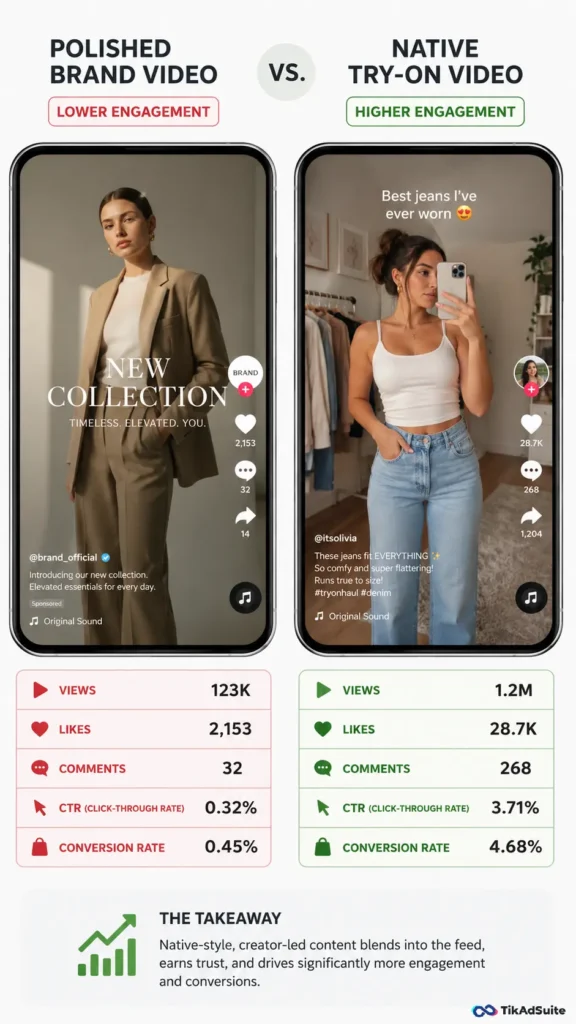
Creative quality decides whether these work. A video that looks like something a friend filmed and posted tends to hold attention better on this platform than a produced commercial. That’s a strong pattern, not a guarantee, so test both styles before you rule one out.
Spark Ads
Spark Ads let you boost an organic TikTok post, including content from a creator who tagged your brand. The likes, comments, and shares stay attached, which carries real social proof into the ad.
TikTok’s own testing shows Spark Ads deliver a 134% higher completion rate and a 157% higher 6-second view-through rate than standard In-Feed Ads. If you’re already working with creators or getting strong organic engagement, Spark Ads are worth prioritizing. See the full breakdown in Spark Ads vs. Non-Spark Ads.
GMV Max and Video Shopping Ads
This is where a lot of fashion guides fall out of date. TikTok made GMV Max the default and only supported campaign type for TikTok Shop Ads using the Sales objective, starting in July 2025. If you’re building Sales campaigns tied to TikTok Shop, GMV Max is now the setup, not an option. You set a budget and a target ROI, and TikTok’s system handles bidding, placement, and creative selection from there. Read the full mechanics in TikTok GMV Max explained.
Video Shopping Ads haven’t disappeared. They’re still available for some non-Shop setups, including certain Showcase-based sales destinations. If your catalog is large and you’re not selling through TikTok Shop, that’s the format to look at. Details are in the Video Shopping Ads guide.
One more thing worth flagging: TikTok Shop isn’t live in every market yet. Check availability for your country before you build a strategy that assumes it’s an option.
Creative Approaches That Move Product
The Try-On Format
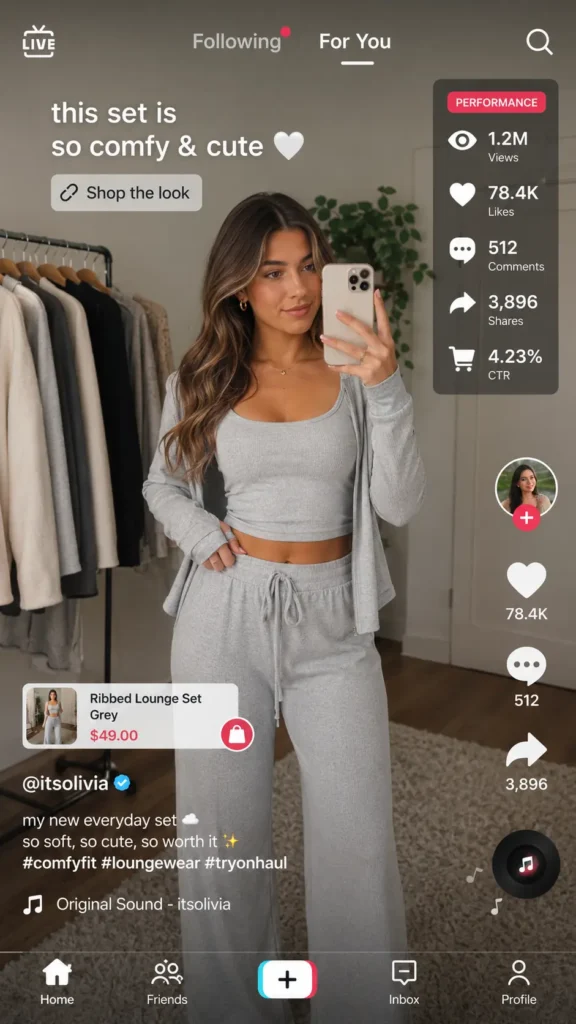
A creator tries on your piece somewhere ordinary, a bedroom, a hallway, a fitting room, with sound playing underneath. No set, no lighting rig, no script. Just the outfit and a real reaction.
This works especially well for pieces where color, fit, or texture reads clearly on a phone screen.
Get Ready With Me (GRWM)
GRWM content builds an outfit around a real occasion: a date, a work day, a night out. Your product shows up as part of someone’s actual routine instead of a staged shot.
There’s no fixed length that performs best here. Let the routine dictate the pacing, and cut it wherever the story naturally ends.
The Transition Video
A quick cut from casual to styled, or basic to complete look, gives you a reveal moment that people want to share. Keep the pacing tight and let the outfit carry the payoff.
User-Generated Content (UGC)
Real customers wearing your products carry more trust than anything brand-produced. You can collect UGC from existing customers, through TikTok’s Creator Marketplace, or by working with creators in your niche. The UGC Ads Guide covers how to build this into a repeatable pipeline.
One licensing detail matters here: for paid ads, you need music you have commercial rights to use. TikTok requires businesses to use the Commercial Music Library for commercial activity, including video ads. A song trending on personal accounts isn’t automatically cleared for a brand’s paid campaign.
If you’re editing in-house, tools like CapCut make it fast to cut clips, add captions, and drop in commercially licensed audio without a full production setup.
Targeting Fashion Audiences on TikTok
Interest and Behavior Targeting
You can target by interest, fashion, streetwear, sustainable clothing, and layer in behavior signals like recent engagement with styling content. Exact categories vary by market and account, so check what’s available inside Ads Manager for your specific setup rather than assuming every category applies to you.
Custom and Lookalike Audiences
If you have website traffic, an email list, or past customer data, Custom Audiences let you retarget people who already know your brand. Lookalike Audiences then find new users who share traits with them. See the difference in Custom Audiences vs. Lookalike Audiences.
Retargeting Engaged Viewers
Someone who watched most of your video is a warmer prospect than someone who scrolled past. That doesn’t mean they’re ready to buy, but it does mean a more direct offer or a discount can land better with them than a cold prospecting message. Full setup steps are in TikTok Retargeting.
Writing Hooks That Actually Hold Attention
The best-performing fashion ads tend to avoid looking like ads at all. A hook built around a specific feeling, “I found the most flattering pair of trousers I’ve owned,” tends to land better than a brand-first line like “Introducing our new autumn collection.” That’s a pattern worth testing, not a rule that holds every time.
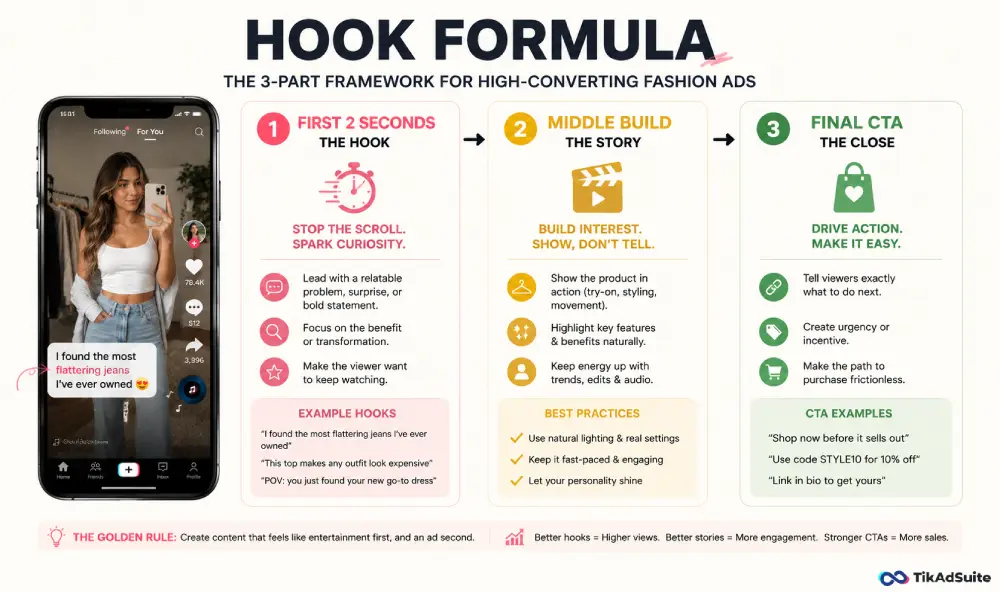
The opening matters, but it isn’t the only thing that decides an ad’s outcome. Your offer, your landing page, your price, and the rest of the video all carry weight too. For structured formulas to work from, see TikTok Ad Hooks.
What TikTok Ads Can’t Fix for a Fashion Brand
Creative and targeting only go so far if your funnel has fashion-specific friction. Before you scale spend, check whether any of these are quietly capping your conversion rate:
- Unclear sizing or a missing size chart
- No visible return or exchange policy
- Slow or expensive shipping shown late in checkout
- Product photos that don’t match real color or fabric
- No indication of model height or size worn
A strong ad can get someone to your product page. It can’t fix a page that leaves them unsure about fit.
Seasonal Moments Fashion Brands Should Plan For
Fashion buying follows a calendar, and TikTok rewards brands that build ahead of it rather than reacting late:
- Q1: New Year, Valentine’s Day, spring transition
- Q2: Festival season, Mother’s Day, summer prep
- Q3: Back to school, Fashion Week conversations, autumn drops
- Q4: Halloween, Black Friday, holiday gifting
Launch early enough to test creative, audience, and offer before peak demand hits, rather than starting cold during the busiest week.
Metrics That Matter for Fashion Ads
A video with millions of views and a low click-through rate isn’t automatically failing, and a high click-through rate isn’t automatically winning. Track these together instead of in isolation.
| Metric | What it tells you |
|---|---|
| CTR | Whether your hook and creative are compelling enough to earn a click |
| Cost Per Purchase | How efficiently spend is turning into sales |
| ROAS | Revenue relative to ad spend, not profit |
| CPA | What each conversion actually costs you |
| Video Completion Rate | How well the content holds attention through the end |
| Add-to-Cart Rate | Where buyers are dropping off in the funnel |
ROAS is the one people get wrong most often. It tells you revenue against spend, not whether the campaign is profitable. Profitability depends on your margin, returns, shipping cost, and payment fees too. If your margin before ad spend is 40%, your rough break-even ROAS is 1 ÷ 0.40, or 2.5x, before you factor in those other costs. Tools like the TikTok Ads ROAS Calculator can help you run that math against your own numbers. For the fuller metric-by-metric breakdown, see TikTok Ads Metrics.
Common Mistakes Fashion Brands Make on TikTok
Running a polished brand commercial without adapting it for the feed. Content built for a website tends to get scrolled past here.
Targeting too broadly to chase cheap impressions. A narrower audience at a slightly higher CPM usually beats reach that isn’t likely to buy.
Stopping creative testing too soon. Fashion trends shift fast, and what worked last month can flatten out. Keep testing hooks, creators, and offers on a rolling basis using a structured creative testing framework.
Frequently Asked Questions
How much should a fashion brand budget for TikTok ads?
TikTok’s current minimums require daily budgets above $50 at the campaign level and above $20 at the ad group level. Beyond that floor, budget for enough spend to reach 50 conversions, TikTok’s own marker for exiting the learning phase, rather than a fixed dollar target.
What’s the best TikTok ad format for a small fashion brand?
In-Feed Ads combined with Spark Ads are the most practical starting point on a limited budget. They’re flexible and let you amplify organic content that’s already resonating instead of building separate paid creative from zero.
Do I need a TikTok Shop to run fashion ads?
No. You can run In-Feed or Video Shopping Ads that send traffic to your own site. If you do sell through TikTok Shop, your Sales-objective campaigns now run through GMV Max instead of the older shopping formats.
Can I use any trending TikTok sound in a paid ad?
No. Paid ads need commercially licensed audio, which means pulling from TikTok’s Commercial Music Library rather than the general sound library available to personal accounts.
How do I find creators for fashion Spark Ads?
Use TikTok’s Creator Marketplace and filter by niche, audience demographics, and location. Look past follower count toward audience fit, past conversion history, and whether the creator’s content already looks native to your target buyer.
Wrapping Up
TikTok rewards fashion brands that treat the feed like the feed, not like a billboard. Start with In-Feed or Spark Ads, build creative that looks like something a real person would post, and budget around TikTok’s actual minimums instead of a guessed number.
Then watch the metrics that connect to revenue, not just views. ROAS tells you part of the story. Your margin tells you the rest.
Fashion moves fast, and TikTok moves faster. The brands that keep testing usually keep winning.