
You found a product you love. You posted about it, and a few sales came in. Then your reach dried up, and the same video stopped showing up in anyone’s feed.
Paid ads can break that ceiling, but affiliate marketers don’t play by the same rules as brands. You don’t own the checkout, the product, or the customer data. Your job is to send the right attention to an offer and get paid when it converts. TikTok actually gives you two separate ways to do that, and most guides only explain one.
This guide walks you through:
- How to set up a TikTok account and campaign built for affiliate goals, not brand goals
- The two real models affiliates use on TikTok, and how they pay differently
- Where you can legally send affiliate traffic without losing the ad review
- Why your TikTok numbers and your affiliate network’s numbers will never match perfectly
- How to work out your break-even cost per conversion before you spend a dollar
Some of this is TikTok mechanics. Some of it is math you need to run before you touch Ads Manager. Skip either one and you’re gambling with your own budget.
Get Up to $6000 Free TikTok Ad Credit
Table of Contents
Key Takeaways
- TikTok now requires GMV Max for new TikTok Shop sales campaigns. The older Product Shopping Ads and Video Shopping Ads formats no longer accept new campaigns, though existing ones keep running.
- Affiliates can run their own paid campaigns to an approved destination, or authorize a seller to run their content as Shop Ads and earn a creative commission instead. These are two different businesses, not one.
- A TikTok Pixel on your bridge page only tracks what happens on that page. It does not automatically know when someone buys on a different company’s checkout.
- According to Sprout Social’s Social Media Index, 36% of social media users have made a purchase on TikTok, which shows real buying intent but says nothing about whether your specific ad will convert.
- Your affiliate program’s own paid-traffic rules matter as much as TikTok’s ad policies. One violates your account. The other can get you dropped from the program entirely.
Can You Run TikTok Ads as an Affiliate Marketer?
Yes. You can run TikTok ads as an affiliate as long as your destination follows TikTok’s ad policies and your affiliate program allows paid social traffic. You either build your own campaign to an approved landing page, or you authorize a TikTok Shop seller to use your content in their ads and earn a commission when it sells.
Two Ways Affiliates Actually Advertise on TikTok
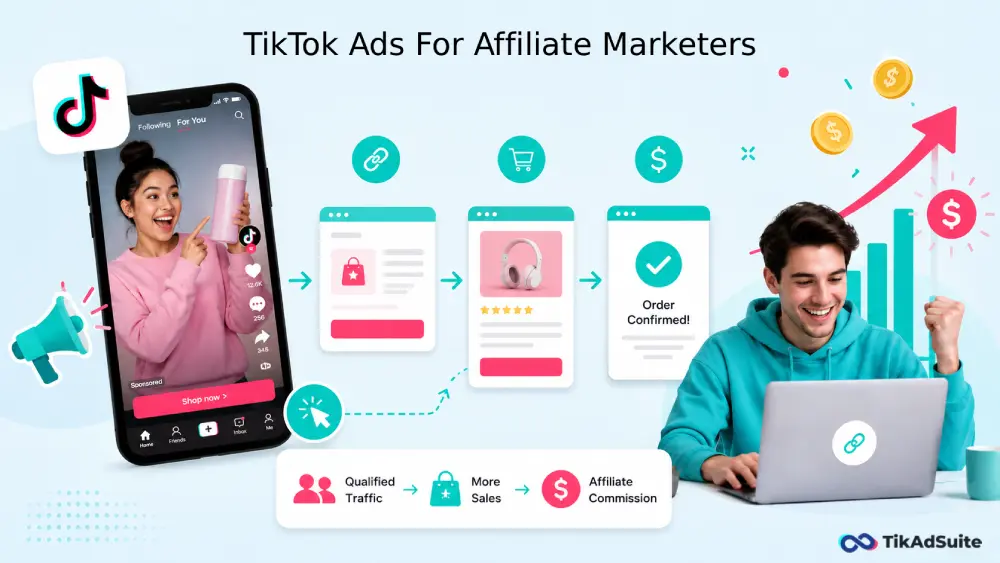
Most affiliate guides treat TikTok ads as one thing. It’s actually two different setups, and mixing them up leads to bad decisions.
Model A: You run the ads yourself. You build a campaign in TikTok Ads Manager, point it at your own landing page or bridge page, and drive traffic straight to your affiliate offer. You control the budget, the targeting, and the creative.
Model B: A seller runs the ads, using your content. You post organic content that includes a TikTok Shop affiliate link. You then authorize a seller to reuse that video in their Shop Ads or GMV Max campaign. When their ad sells the product, you earn an affiliate creative commission on top of your normal affiliate cut.
| Model A: You run the ad | Model B: Seller runs the ad | |
|---|---|---|
| Who pays for media | You | The seller |
| Who controls targeting | You | The seller |
| What you need | Ads Manager account, approved destination | Ad authorization turned on for your posts |
| How you get paid | Standard affiliate commission | Affiliate commission plus creative commission |
If you’re selling through TikTok Shop, this guide to affiliate marketing on TikTok Shop breaks down how the commission structure and product tagging actually work.
Set Up Your Account the Right Way
TikTok splits accounts into personal and business types. You can switch a personal account to a business account when you need it, and a business account is what unlocks Ads Manager, analytics, and creative tools.
Getting into Ads Manager itself needs one more layer: an identity. That identity can be a Business Account you own, or another account that has authorized you to post for it. This matters if you plan to run Spark Ads using a creator’s video instead of your own.
If you haven’t built a business account yet, this walkthrough on how to create a TikTok business account covers the setup steps. Once your account is live, you’ll build and launch that first campaign directly through TikTok Ads.
Pick a Campaign Objective That Actually Fits
TikTok merged Website Conversions and Product Sales into one Sales objective. Depending on your setup, Sales can point to TikTok Shop, your own website, an app, or a mix.
If you’re promoting a TikTok Shop product, the objective picture changed again in 2025. According to TikTok’s own migration guidance, GMV Max is now the only supported campaign type for new TikTok Shop sales campaigns.
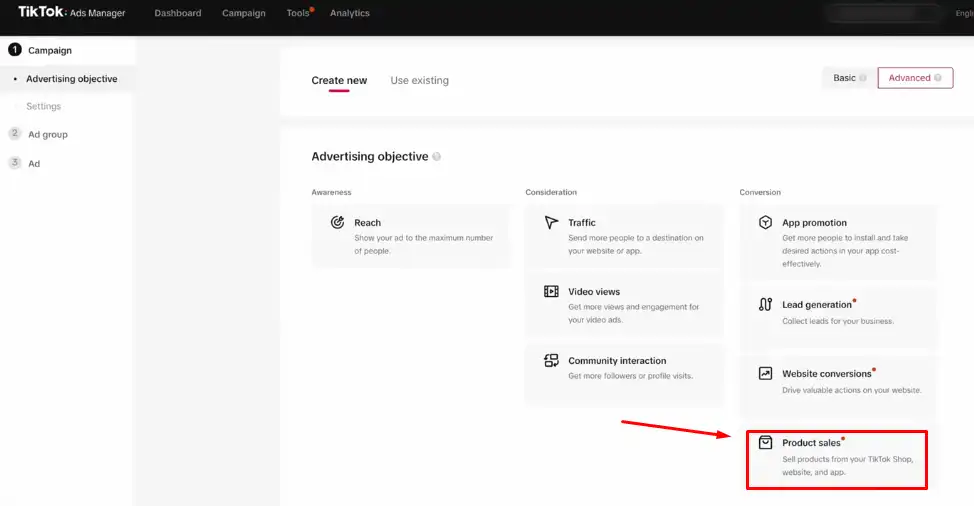
You can no longer create new Video Shopping Ads or Product Shopping Ads, though existing campaigns keep running. GMV Max automates targeting and budget allocation across your paid, organic, and affiliate traffic at once.
If your offer lives off TikTok, you’ll usually start with Traffic for cheap early testing, then move to Sales once your own tracking has enough data to optimize against.
For a full breakdown of how GMV Max actually behaves, including its attribution quirks, this guide to TikTok GMV Max walks through the mechanics.
Where You Can Actually Send Affiliate Traffic
TikTok reviews your landing page for consistency with your ad, mobile usability, and basic functionality. A raw affiliate link with a long redirect chain often struggles here, but there’s no official rule saying every direct affiliate link gets rejected outright. What actually matters is whether the destination is consistent, loads fast, and matches what the ad promised.
A bridge page, a TikTok Shop product page, or your own landing page can all work. None of them is automatically safe just because it’s not a direct affiliate link. If your ad gets bounced, this breakdown of why TikTok ads get rejected covers the specific review issues to check first.
How TikTok Shop Affiliate Authorization Works
If you want to go the Model B route, TikTok gives you two authorization options. Mass Authorization lets a seller use any of your qualifying affiliate videos on an ongoing basis. A video code is a one-time authorization for a single post, and the seller can even swap in a different product if you allow it.
Authorizing a video doesn’t transfer ownership. You keep the post, and TikTok’s documentation on authorizing affiliate videos for Shop Ads confirms you’re eligible for an affiliate creative commission when a seller’s ad using your video drives a sale.
One thing this workflow assumes you already checked: TikTok Shop isn’t live in every country. Confirm it operates where your audience actually shops before you build a strategy around it.
Creative That Doesn’t Look Like an Ad
Hook People Before They Swipe
You have almost no runway to earn attention. According to Asia Research, 71% of TikTok users decide whether to keep watching a video within the first three seconds. Open with the problem, the result, or a claim strong enough to stop a thumb mid-scroll.
For proven opening formats you can adapt to an affiliate offer, this collection of TikTok ad hooks is a decent starting point.
Use Spark Ads With Content You’re Allowed to Use
Spark Ads let you promote an existing organic post as a paid ad, keeping the original engagement and profile link intact. You can’t just grab any creator’s affiliate video and run it, though. The account has to have authorized that specific post for ad use first.
This comparison of Spark Ads versus standard in-feed ads explains when the native feel of Spark Ads is worth the extra authorization step.
Check Your Affiliate Program’s Rules Before You Spend
TikTok approving your ad is only half the compliance picture. Your affiliate network or merchant has its own rules, and those rules can quietly override anything TikTok allows.
Before you spend a dollar, confirm the following with your affiliate program:
- Paid social traffic is allowed at all, not just organic posts
- Direct linking or bridge pages are permitted, if that’s your plan
- Your target countries are approved for that offer
- Trademark or brand-name bidding restrictions don’t apply to your keywords
- The commission structure survives returns, refunds, and chargebacks
Skipping this step is how affiliates lose a commission on a sale that TikTok is perfectly happy to have approved.
Why Your Tracking Numbers Won’t Match
What the TikTok Pixel Actually Sees
A Pixel installed on your bridge page tracks activity on that page: views, clicks, maybe an outbound click to your affiliate link. It does not automatically know that the visitor went on to buy something on a merchant’s checkout somewhere else. If you don’t control that checkout, you don’t get a native TikTok Pixel purchase event from it.
If you’re setting up tracking for the first time, this guide on how to use the TikTok Pixel explains what it can and can’t capture out of the box.
Match TikTok’s Data to Your Network’s Data
TikTok appends a click identifier called ttclid to your landing page URL whenever someone clicks your ad. Your affiliate network usually has its own click ID or sub-ID system too. If you don’t pass both through your bridge page, you’ll end up staring at three different numbers: TikTok’s clicks, your network’s clicks, and the merchant’s reported sales, none of which line up cleanly.
This walkthrough on UTM tracking for TikTok ads shows how to build URLs that carry both identifiers through the redirect.
Targeting, Bidding, and the Math That Actually Matters
Starting with broad targeting and letting TikTok’s system find buyers is a reasonable default once you have enough conversion signal for it to learn from. It’s not a universal rule for every affiliate offer, especially low-volume or geo-restricted ones. This guide to TikTok ad bidding strategies covers how to match your bid type to how much data you already have.
Here’s the calculation most affiliate guides skip: your break-even cost per acquisition.
If your commission on a sale is $40, your break-even CPA is $40. Spend $50 to earn that $40 commission, and you’re down $10 before you count refunds, network fees, or your own time. A CPA sitting below your commission is necessary for profit. It isn’t proof of profit, since refunds, reversed commissions, and attribution gaps can still eat the difference.
Before you commit real budget, running the numbers on a specific offer through the TikTok ad offer analyzer can show you whether the commission actually covers realistic acquisition costs.
Budget Your Test the Right Way
“Start small” isn’t a plan. A workable version looks like this: if your commission is $30, a $300 test budget buys you roughly 10 break-even conversions worth of room to see if the campaign has a pulse. That’s a testing budget, not a guarantee, and it’s separate from whatever minimum daily spend TikTok itself requires per ad group.
This breakdown of the minimum budget for TikTok ads lays out current platform minimums so you’re not guessing at the floor.
Read Your Metrics the Right Way
Click-through rate and conversion rate only mean something once you know which step they’re measuring: ad click to landing page, landing page to outbound click, or outbound click to actual sale. Lumping these together hides where a campaign is actually breaking.
ROAS is only useful if TikTok is receiving accurate revenue data from your setup. If you’re not passing real commission value back into TikTok, treat ROAS as a rough signal, not a scoreboard. This set of TikTok conversion rate benchmarks gives you a baseline to compare against once your funnel steps are properly separated.
A high CTR with no sales usually means one of a few things: a routing mismatch, a weak landing page, tracking that isn’t capturing the sale, or an offer that simply doesn’t match the audience you’re reaching. It’s rarely just one cause, so check routing and tracking before you blame the offer.
Disclosure Rules You Can’t Skip
If you’re marketing to US consumers, the FTC treats an affiliate commission as a material connection that requires clear disclosure. The FTC’s updated endorsement guidance also makes clear that relying on a platform’s built-in disclosure label isn’t automatically enough on its own; placement, visibility, and wording all matter.
This is a US regulation, not a global one. If you’re targeting other markets, check the disclosure laws that actually apply there. And responsibility isn’t only yours: FTC guidance also covers liability for advertisers and brands, not just the creator posting the ad.
A PartnerCentric survey cited by Sprout Social found that 25% of TikTok Shop buyers first found the item they purchased through a TikTok ad, which is worth remembering when you decide whether disclosure and destination quality are worth the extra effort. They clearly are.
Frequently Asked Questions
Can I use a direct affiliate link in a TikTok ad?
Sometimes, depending on the offer, redirects, and landing page quality. TikTok reviews for consistency and functionality rather than banning affiliate links outright. Many affiliates still route through a TikTok Shop product, their own landing page, or a bridge page to reduce review friction and keep tracking cleaner.
Do I need a TikTok Shop account to run affiliate ads?
No. TikTok Shop helps for physical products by keeping the purchase inside the app, but it’s optional. If your offer is off-platform, you can run ads to a landing page or bridge page that sends visitors to your affiliate link instead.
Why am I getting clicks but no sales?
This usually points to a routing problem, a slow or mismatched landing page, broken tracking, or an audience that doesn’t match the offer. Check your redirect chain and your click-ID setup before assuming the offer itself is the issue.
How long before a TikTok affiliate campaign turns a profit?
Give it enough conversions to calibrate before judging it. TikTok’s own optimization guidance for some campaign types cites a 3 to 7 day learning window with a minimum conversion threshold. Cutting an ad group before it hits that volume tells you very little.
Is TikTok Shop available in every country?
No. TikTok Shop is live in a specific set of markets. Confirm your target country supports it before building a campaign around in-app checkout.
Putting This to Work
Start with one offer you understand well enough to explain in one sentence. Pick your model, either your own paid campaign or authorized content for a seller’s Shop Ads, and build your tracking before your first dollar of spend, not after.
Track cost per conversion against your actual break-even math, not against vanity clicks. Once you can explain why a number moved, you have a real basis for deciding what to scale next.