
You paid a creator and got back a video that sounds like someone reading a cue card. Or a fun vlog that never says why your product is different. Both problems usually start with the brief.
Below is the whole process for TikTok UGC ads: where the videos come from, how to brief creators so the result feels natural and stays compliant, and how to run the finished clips as ads you can test.
Table of Contents
Quick Answer
TikTok UGC ads are short videos made by creators or customers in a casual, native style and run as paid ads. TikTok’s creative best practices recommend featuring creators, employees or customers and a DIY, not overly polished look that fits in with user-generated content on the app.
To make them, find creators (or customers who already post about you), send a short brief with one goal, approved claims and the exact offer, and sign a contract that covers paid usage. Then run the video as a Spark Ad from the creator’s post or upload it as a standard ad under your brand.
Key Takeaways
- A UGC ad on TikTok is a creator-made video run as a paid ad, and most are UGC-style: a brand paid for them.
- You can source UGC from creators you hire, from TikTok One, or from customers already posting about your brand.
- Use three documents: a short creative brief, an approved-claims sheet, and a contract.
- A Spark Ads code only lets you promote one TikTok post. Your contract still needs to cover paid usage, editing, likeness, territory, and how long you can run the video.
- TikTok rejects or restricts ads with undisclosed AI-generated content, before-and-after product results, and offers that don’t match the landing page.
Where Do You Get UGC for TikTok Ads?
You get UGC for TikTok ads from three places: customers and creators who already post about your brand, creators you find through TikTok One, and creators you hire directly. Each one needs the creator’s permission before the video runs as an ad.
Videos That Already Mention Your Brand
Start with what already exists. TikTok’s Content Suite help page says the tool searches organic TikTok videos for your brand name and keywords, ranks them by ad potential and lets you request Spark authorization from the creator. The same page says creator payout is free for advertisers when you use Content Suite, so you pay only for the ad spend.
Creators on TikTok One
For new videos, TikTok One’s Creator Marketplace is TikTok’s own platform for brand and creator deals. TikTok’s TikTok One overview says its Creator AI Search can return up to 200 creator matches from a pasted brief. The TikTok Creator Marketplace walkthrough covers sign-up and campaign types.
Creators You Hire Directly
Plenty of UGC creators sell video packages directly. Here the brief, claims sheet and contract below matter most, because no platform sets the rules for you.
Spark Ad or Uploaded Ad?
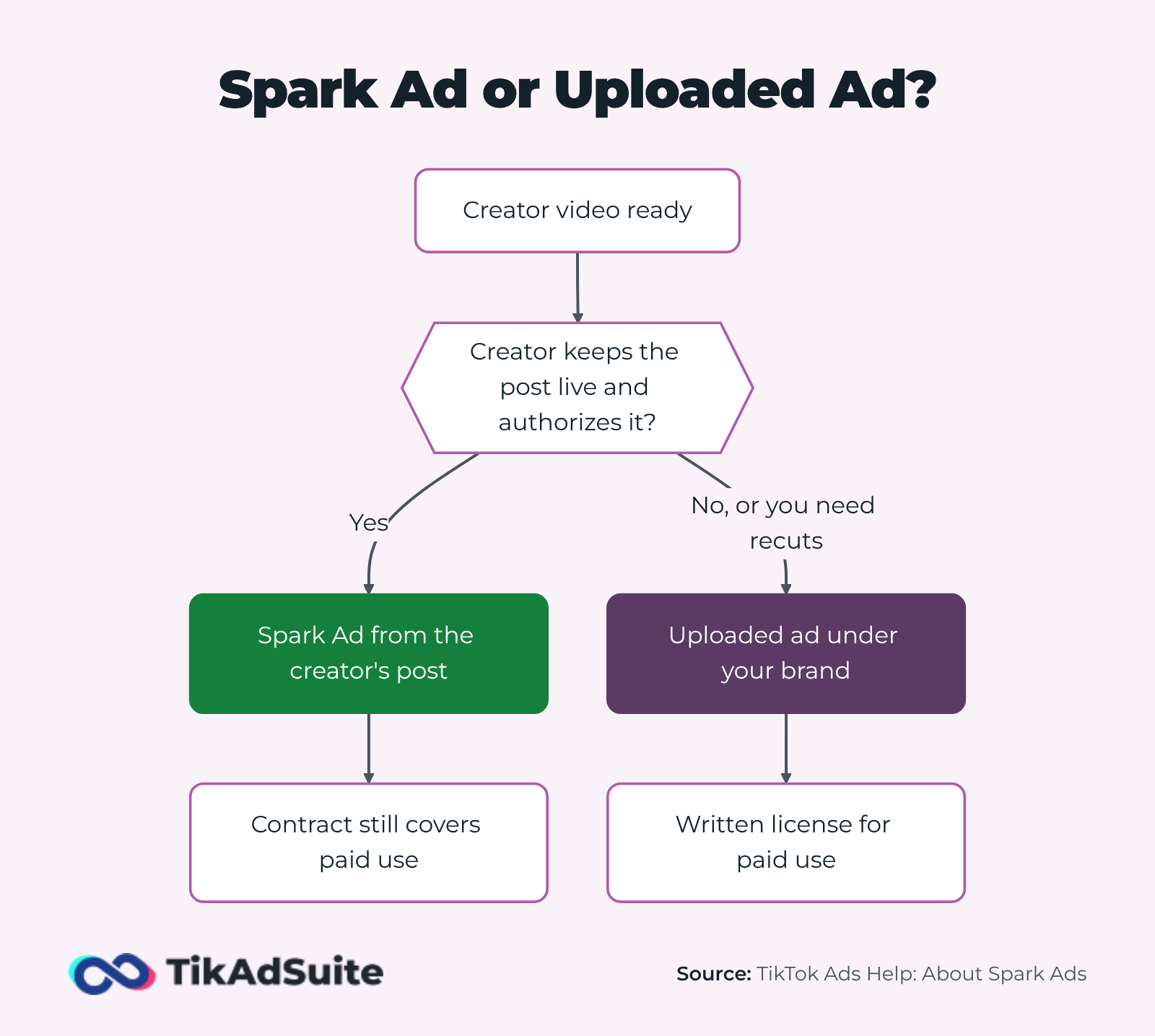
Once you have the video, you run it one of two ways:
- Spark Ad: the ad runs from the creator’s own post. TikTok’s Spark Ads page says the paid promotion credits its views, likes, comments, shares and follows to the creator’s organic post, and you need the creator’s authorization to use their post.
- Uploaded (non-Spark) ad: you upload the file in Ads Manager and run it under your brand. This suits recuts and videos the creator never posted, but it needs a written license for paid use.
How Do You Brief TikTok Creators for UGC Ads?
Send a one- or two-page creative brief with one goal, one target viewer, hook options, talking points, and the exact offer. Attach an approved claims sheet with evidence. Put rights, deadlines, payment, and revisions in a separate contract. Review every cut against your final checklist before it runs.
Copy This TikTok UGC Creator Brief Template
Copy this nine-field TikTok UGC creator brief template and fill it in before you contact a creator.
| Field | What to include |
|---|---|
| 1. Campaign goal | Awareness, traffic, or sales. One goal per video. |
| 2. Target viewer | Who they are, their situation, and their biggest doubt |
| 3. Approved claims | Exact wording, evidence on file, banned claims, required disclaimers |
| 4. Creative direction | Hook options, talking points, exact offer and CTA, tone, reference videos |
| 5. Production specs | 9:16, resolution, captions, safe zones, music rules, file formats |
| 6. Deliverables and dates | Main cut, alternate hooks, clean master, raw footage, due dates |
| 7. Disclosure and AI | TikTok toggle, spoken or on-screen disclosure, AI labels, local market rules |
| 8. Rights and payment | Points to the contract: fee, payment date, usage term, platforms, Spark code |
| 9. Final checklist | Claims, offer, music, captions, rights, landing page, ad preview |
Give Creators Talking Points, Not a Script
A word-for-word script can sound stiff when it doesn’t match how the creator talks, which kills the native feel of TikTok ads that don’t look like ads.
Get Up to $6000 Free TikTok Ad Credit
A good default is to script only what must be exact and leave the rest flexible:
- Script exactly: prices, discount terms, deadlines, and required disclaimers.
- Give as prompts: the hook idea and the CTA, so the creator can say them naturally.
- List as talking points: three or four approved benefits from your claims sheet.
This is a starting framework, not a law. Some creators do better with tighter scripts.
How hooks become deliverables. Share three to five hook ideas. The creator picks or adapts one as the main opening, then films two more as alternate openings. Keep the body, offer, and CTA identical across all three so you can compare hooks fairly. A TikTok ad hook generator can help you draft that first list.
Start With One Goal and One Viewer
Goal. An awareness video can teach and entertain. A sales video needs a clear offer. If you mention urgency, it must be real, like an actual end date or limited stock.
Viewer. Describe a person, not a demographic, such as a college student whose skin breaks out during exams. Add their biggest doubt so the creator can answer it. This persona is a guide for tone, not a claim to make about the viewer.
Separate Legal Rules, TikTok Rules, and Brand Preferences
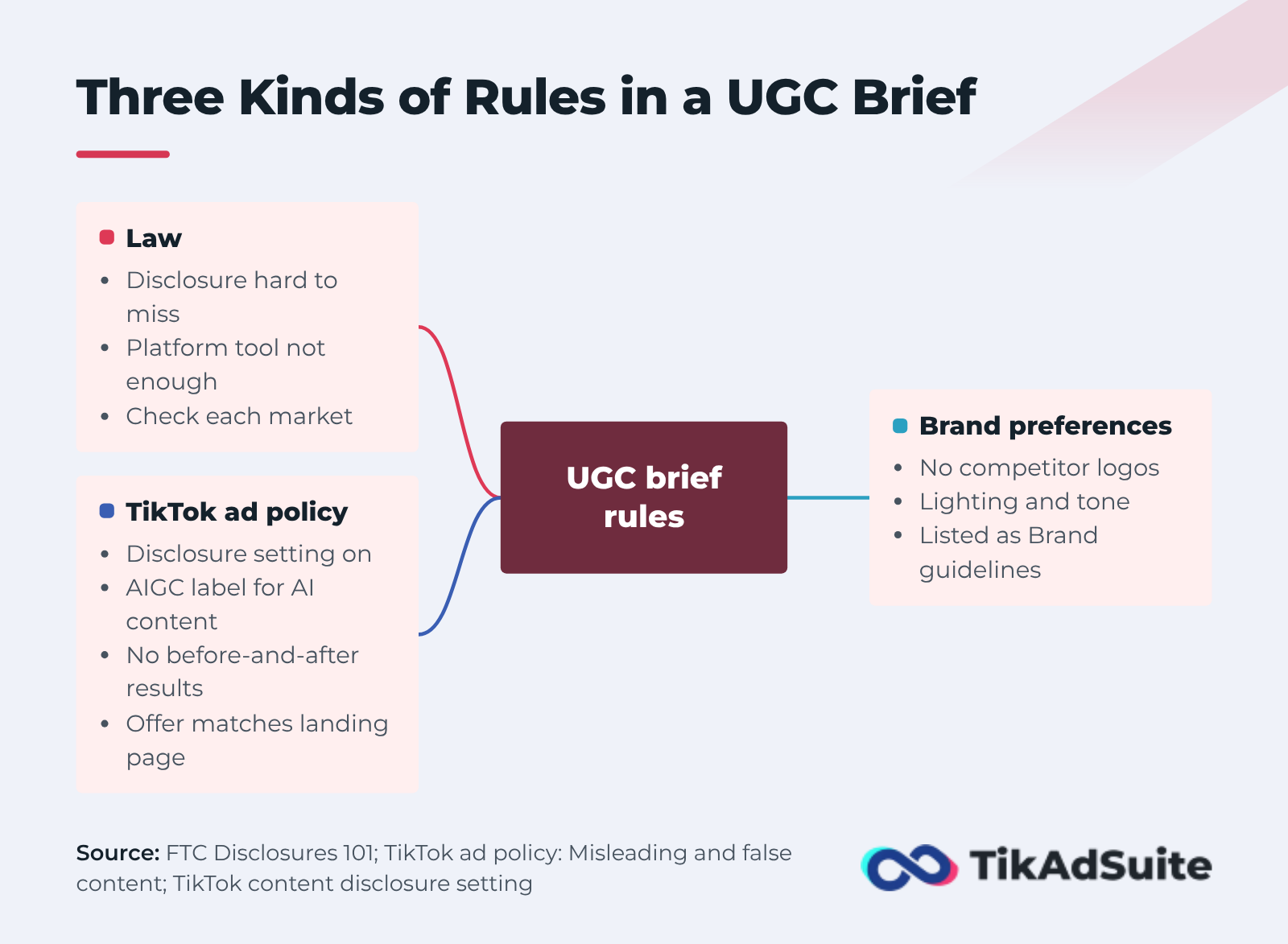
A UGC brief mixes three kinds of rules: laws on claims and disclosure, TikTok’s ad policies, and your own brand preferences. Label each one so creators know which rules are fixed and which are taste.
Claims Need an Approved List and Evidence
Don’t ask creators to invent safer wording. Give them exact approved claims, banned claims, and proof for every objective claim before filming.
Claims are not all equal. Fresh lemon scent is a product description. Pet safe is a safety claim, and dries in 10 seconds is a performance claim. Both need evidence. A creator’s honest opinion doesn’t replace that proof.
TikTok’s misleading and false content policy bans ads that promise or exaggerate a product’s results, along with product-effect comparisons such as before-and-after results. Beauty and health claims face stricter rules, and they’re a common cause of rejected TikTok ads. Name one contact who approves any unplanned claim.
Disclosure Has Two Layers
TikTok’s commercial content disclosure page says creators must turn on the disclosure setting when a post promotes a brand, product or service, and all TikTok One projects switch it on automatically.
The legal layer depends on where the ad runs. For US audiences, the FTC’s Disclosures 101 for Social Media Influencers says to place the disclosure so it’s hard to miss and not to assume a platform’s disclosure tool is good enough. Ask creators to say and show a plain label such as Ad or Paid partnership with your brand name. Other countries have their own rules, so check each market you target.
AI Use Needs a Label and Permission
The same TikTok policy allows significantly edited or AI-generated content only with TikTok’s AIGC label or a clear disclaimer, caption, watermark or sticker. If TikTok finds undisclosed AI-generated content, the ad is rejected or restricted.
Ask creators to declare any AI voice, avatar, or heavy AI edit before production, and say who applies the label. Get written permission for any real person’s voice or likeness. Ban AI testimonials that suggest a real person used the product.
Offers Must Match the Landing Page
TikTok’s policy also bans ads whose promotion, price or discount doesn’t match the landing page. Approve the discount amount, end date, exclusions, and stock before filming. Creators should never improvise an offer.
Brand Preferences Are Yours, So Label Them
No competitor products, no other logos, and good lighting are fine choices, but they aren’t TikTok rules. List them under a separate Brand guidelines heading in the brief.
Clear the Music by Market and Placement
TikTok’s general music library isn’t cleared for business use. Ask creators to use the Commercial Music Library, which TikTok describes as a pre-cleared library of 1 million songs that businesses can use for free, or deliver a voiceover-only version.
Confirm the track is available in your campaign region and placement, and check for background music already in the raw footage. If you plan to run the video on Instagram or YouTube, clear the music separately, because TikTok’s library is meant for commercial activity on TikTok. A rundown of commercial sounds for TikTok ads covers your options.
Put Rights, Dates, and Money in the Contract
A Spark Ads code is TikTok’s permission to promote one post. It is not a license to your raw footage or to recut the video for other platforms. Cover both in writing.
Rights to spell out:
- Spark Ads authorization length, plus room to extend
- Paid usage term, platforms, and territories
- Use of the creator’s name, face, and voice in edits and recuts
- Raw footage and clean masters, with file formats
- Exclusivity and reuse after the campaign
Logistics to spell out:
- Due dates for first cut and final files
- Fee, payment date, and currency
- Product shipping and returns
- What counts as a revision versus a reshoot or new request
- What happens if the creator misses a deadline or cancels
Raw footage lets your team build new versions in an editor like CapCut. To decide between promoting the creator’s post and uploading the file yourself, compare Spark and non-Spark ads.
Give Specs That Survive the TikTok Interface
- Format: Vertical 9:16. TikTok’s in-feed ad specs set 540×960 pixels as the minimum for vertical video, so ask for 1080×1920, twice that size, as your delivery standard.
- Safe zones: TikTok’s caption and buttons cover parts of the screen, and that area changes with caption length. Ask creators to keep text and product near the center. The TikTok ad safe zones breakdown shows where overlays sit.
- Captions: On-screen text helps the message land with sound off.
Preview the final ad in its real format before launch.
How Long Should a TikTok UGC Ad Be?
There’s no single ideal length for a TikTok UGC ad. The same in-feed spec page allows uploaded videos of up to 10 minutes, so the limit rarely matters. A practical starting test is one main cut plus a much shorter cut of the same idea, then let results decide which length you scale.
The opening matters more than total length. TikTok’s creative best practices say to introduce your content proposition in the first 3 seconds and land the hook within the first 6, which is the idea behind the TikTok 3-second rule.
Structure the Video in Three Flexible Beats
Treat these as a sequence, not fixed timestamps. A 12-second cut compresses all three.
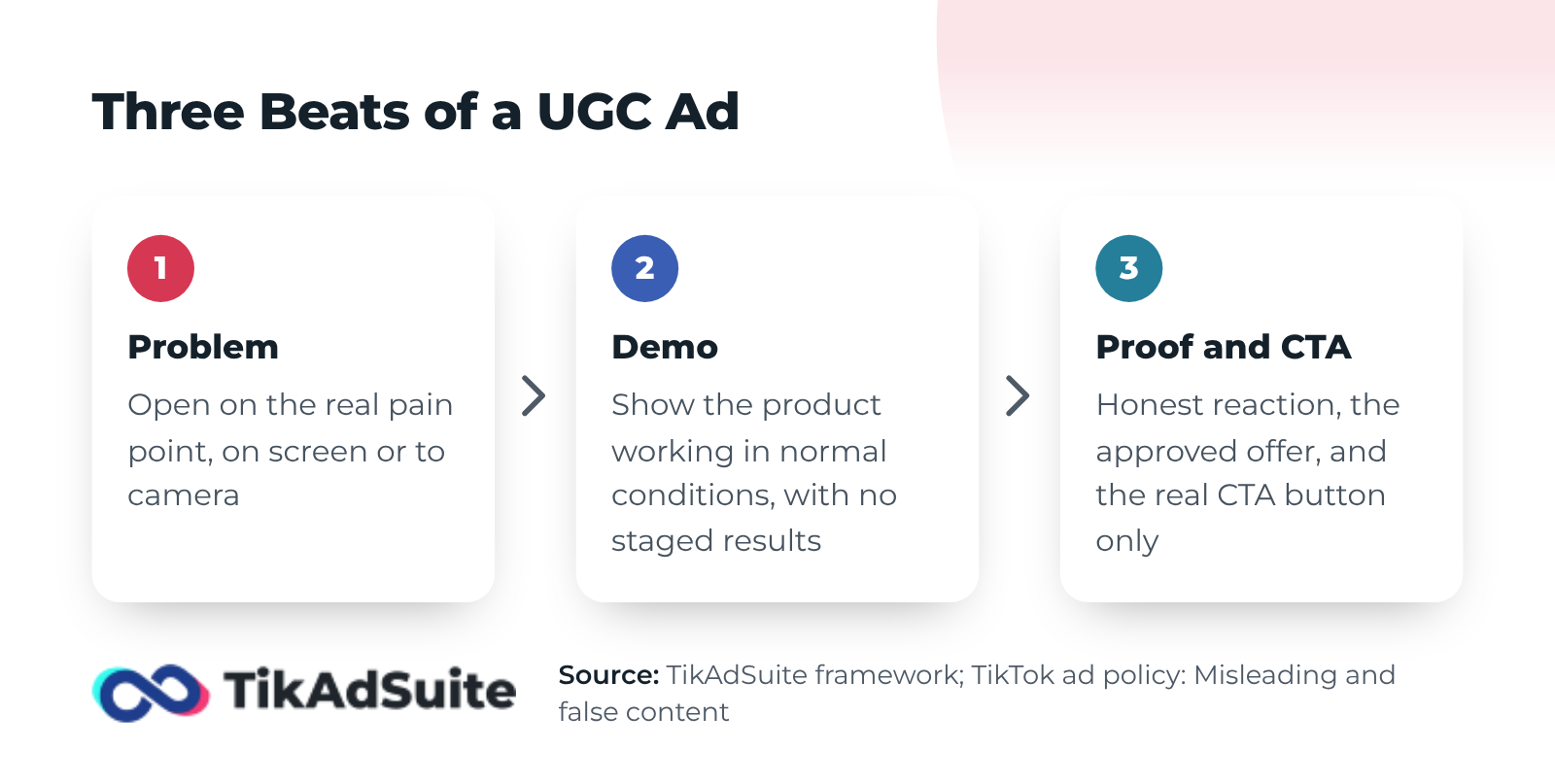
- Problem. Open on the real pain point, on screen or straight to camera.
- Demo. Show the product working under normal conditions. Don’t stage results or exaggerate them in editing.
- Proof and CTA. Share the creator’s honest reaction, then the approved offer.
A creator can point toward the real CTA button. TikTok’s ad policy bans fake call-to-action buttons and other elements that don’t work as they look, so never add drawn buttons or swipe-up text that promises something TikTok doesn’t do. The TikTok ad CTA options page covers which actions work best.
Use References Without Inviting Copies
Share two or three reference videos for pace and tone, with a plain note telling the creator not to copy footage, scripts, music, or distinctive ideas from them.
A TikTok competitor ads finder shows what your niche is running. A long-running ad is a clue, not proof of profit.
How Do You Give Creators Feedback That Gets Fixed?
Creators fix feedback faster when they get one set of combined notes from one approver, by an agreed date.
Tie each note to a timestamp, for example a blurry label at 0:12, and mark it as a fix (it misses the brief) or a new request (it may cost extra).
When you test, change one thing at a time. Compare hooks from the same creator first, and test different creators as a separate experiment. TikTok’s creative best practices suggest 3 to 5 different creatives per ad group, so plan the brief for at least that many cuts. A creative testing framework keeps those tests clean.
FAQs
What is a UGC ad on TikTok?
A UGC ad is a creator-made video in a casual, native style that runs as a paid ad. Most are better called UGC-style ads, because a brand paid for them rather than a customer posting on their own. They work on TikTok because they look like the videos people already watch.
How do you get UGC for TikTok ads?
Look for videos customers and creators already post about your brand, and ask them for Spark Ads authorization. For new videos, brief creators through TikTok One’s Creator Marketplace or hire UGC creators directly. Either way, get written permission for paid use before the video runs.
Is AI UGC allowed in TikTok ads?
Yes, with a label. TikTok’s ad policy allows significantly edited or AI-generated content only when you apply the AIGC label or add a clear disclaimer, and it rejects or restricts ads with undisclosed AI content. AI avatars should never pose as real customers who used the product.
How much should you pay for a UGC video?
There’s no universal rate. Price depends on the creator’s experience, the number of deliverables, raw footage, usage length, platforms, and exclusivity. Longer paid usage and more variations raise the fee. A breakdown of TikTok influencer marketing rates gives context.
Can I run a creator’s video as an ad without a Spark Ads code?
Yes. You can upload the file to TikTok Ads Manager as a standard ad under your brand’s identity. You still need a written license covering paid use, duration, platforms, and the creator’s likeness. Spark Ads run from the creator’s original post and keep its likes and comments.
Does the rule of 7 apply to TikTok ads?
The rule of 7 is a general marketing idea that people need several exposures before buying. It isn’t a TikTok rule, and seven isn’t a magic number. On TikTok, you can apply the idea with a sequence: a hook-led video, then social proof, then an offer. The TikTok retargeting setup shows how to build it.
Wrapping Up
Your best next step is to copy the template and build your claims sheet before you contact a creator. That sheet prevents many rejected ads and reshoots. Then test one variable at a time.
When your first batch is approved, launch and test it in TikTok Ads Manager.