
TikTok ads have a specific three-tier structure that controls everything from your daily spend to how your data gets organized. Most of the performance issues people blame on bad creative or weak targeting actually trace back to a messy account structure.
When campaigns, ad groups and ads are set up clearly, your reports are easier to read, your changes are easier to make, and your budget stays where you meant it to go. When they are not, you end up guessing which setting caused which result.
The structure itself is simple. The harder part is deciding how many of each level to run, where the budget sits, and how the layout should change once something starts to work.
Quick Answer
A TikTok ads campaign structure has three levels: campaign, ad group and ad. According to TikTok’s ads structure page, updated February 2025, the campaign holds the objective and the campaign budget, the ad group holds placement, audience, budget, schedule, optimization goal and bid, and each ad group contains one or more ads with the creative and text. A practical start is one campaign per goal with 3 to 5 ad groups and 3 to 5 creatives in each, the range suggested in TikTok’s creative best practices.
Get Up to $6000 Free TikTok Ad Credit
Table of Contents
Key Takeaways
- Every TikTok ads account runs on three levels: campaign, ad group and ad. A choice at one level shapes everything below it.
- The campaign is where the goal lives, and TikTok’s edit settings page says only the campaign name and budget can change after creation, so pick the objective with care.
- Most of the control sits in the ad group: placement, audience, budget, schedule, optimization goal and bid strategy.
- TikTok suggests 3 to 5 ad groups per campaign and 3 to 5 creatives per ad group, enough options for testing without spreading the budget too thin.
- Smart+ and GMV Max automate parts of this layout, so check which campaign type you are building before you plan ad groups by hand.
The Three Tiers of TikTok Ads Structure
TikTok organizes every account into the same hierarchy. Understanding what each level controls is the foundation for running TikTok ads well.
| Level | What you set | What you can change after launch |
|---|---|---|
| Campaign | Objective, campaign type (Manual, Search or Smart+), special ad category, campaign budget or Campaign Budget Optimization | Name and budget |
| Ad Group | Placement, audience targeting, budget and schedule, optimization goal, bid strategy | Name, targeting, budget and schedule, bidding and optimization (not placement) |
| Ad | Identity, video or image, ad text, call to action, tracking | Every setting |
The last column follows TikTok’s edit settings page, updated November 2025. The placement lock comes from TikTok’s eligible placements page, updated September 2026, which says placement is picked when you create an ad group and cannot be changed after that.

A campaign can contain multiple ad groups. An ad group can contain multiple ads. Settings flow downward, so a campaign-level decision (like an objective) applies to every ad group and ad inside it.
Campaign Level: The Settings That Apply to Everything Below
The campaign is where you tell TikTok what result you want. That choice decides how TikTok delivers your ads and which results it tries to get more of, and you cannot swap it once the campaign exists.
Campaign-level settings include:
- Advertising objective: TikTok’s objective page, updated April 2025, groups them as Awareness (Reach), Consideration (Traffic, Video views, Community interaction, Branded Mission) and Conversion (App promotion, Lead generation, Sales).
- Campaign type: the campaign setup page, updated October 2025, lets you choose a Manual, Search or Smart+ campaign.
- Special ad category: advertisers offering housing, employment or credit to people in the United States or Canada declare it here, as TikTok’s Special Ad category page explains (updated April 2026).
- Campaign budget: a daily or lifetime budget, plus the Campaign Budget Optimization and split test toggles. TikTok’s budget page, updated July 2026, says a daily campaign budget must be more than $50.
One recent change is easy to miss. TikTok’s Sales objective page, updated March 2026, says Website Conversions and Product Sales merged into a single Sales objective that is rolling out in phases. If your Ads Manager still shows the old names, your account has not switched yet.
The cleanest rule for most accounts is one campaign per objective. If you run a Traffic campaign and a Sales campaign, keep them apart, because each objective counts success in its own way and mixed reports are hard to read.
When you are unsure which goal fits, compare the TikTok ad objectives side by side with practical use cases before you build.
Ad Group Level: Where Most of Your Decisions Actually Happen
The ad group is where you decide who sees your ads, where they run, how much you spend each day and how TikTok bids for you. Most performance differences inside an account come from choices made here.
Ad group settings include:
- Placement: where your ads run. TikTok’s eligible placements page lists TikTok, Lemon8, Global App Bundle and TikTok Ad Network (formerly Pangle), with availability that varies by country and objective.
- Targeting: demographics, interests, behaviors, custom audiences and lookalikes.
- Budget and schedule: daily or lifetime spend, start and end dates, and dayparting if you need it. Per TikTok’s budget page, the daily ad group minimum is above $20.
- Optimization goal: the specific action TikTok optimizes toward, such as a click, a lead or a purchase.
- Bid strategy: Ads Manager offers two, per TikTok’s bidding strategies page (updated September 2026): Maximum Results and Target cost per result. Value-based campaigns for websites use Highest Value or Minimum ROAS instead, according to TikTok’s value-based bidding page (updated March 2025).
Because targeting lives at the ad group level, this is where you build separation between audiences you want to test. To compare interest targeting against a lookalike audience, put them in two ad groups under the same campaign.
Placement deserves the most care, since you cannot fix it later. To try a different mix, you build a new ad group, so check the TikTok ad placements before you save. The same goes for bidding: knowing how the TikTok bidding strategies behave helps you pick one you can live with.
Ad Level: Your Creative Variations
The ad level holds what people actually see. Each ad inside an ad group shares that group’s targeting, budget and bidding, but has its own identity, video or image, ad text, call to action and tracking, as TikTok’s ads structure page describes.
This is where you run creative tests. TikTok’s creative best practices suggest 3 to 5 different creatives per ad group and add that creatives with big differences work better, especially when testing. Fewer ads give you little to compare. Far more can spread a small budget so thin that some ads barely deliver.
When an ad wears out, add new creatives to the same ad group instead of building a new one. The creative best practices page recommends this to extend the ad group’s life. A simple creative testing framework keeps those tests fair and easy to read.
Campaign Budget Optimization vs Ad Group Budgets
Campaign Budget Optimization (CBO) puts one budget on the campaign and lets TikTok split it across the ad groups, while ad group budgets give each ad group its own fixed amount. TikTok’s CBO page, updated August 2026, says CBO aims for the most conversions at campaign level instead of ad group by ad group.
CBO comes with rules worth knowing before you switch it on:
- Every ad group in the campaign must use the same optimization goal.
- The bid strategy is Maximum Results or Target Cost per Result.
- CBO does not work with only one active ad group. TikTok’s CBO page suggests 3 to 5 ad groups with 2 to 3 creatives in each.
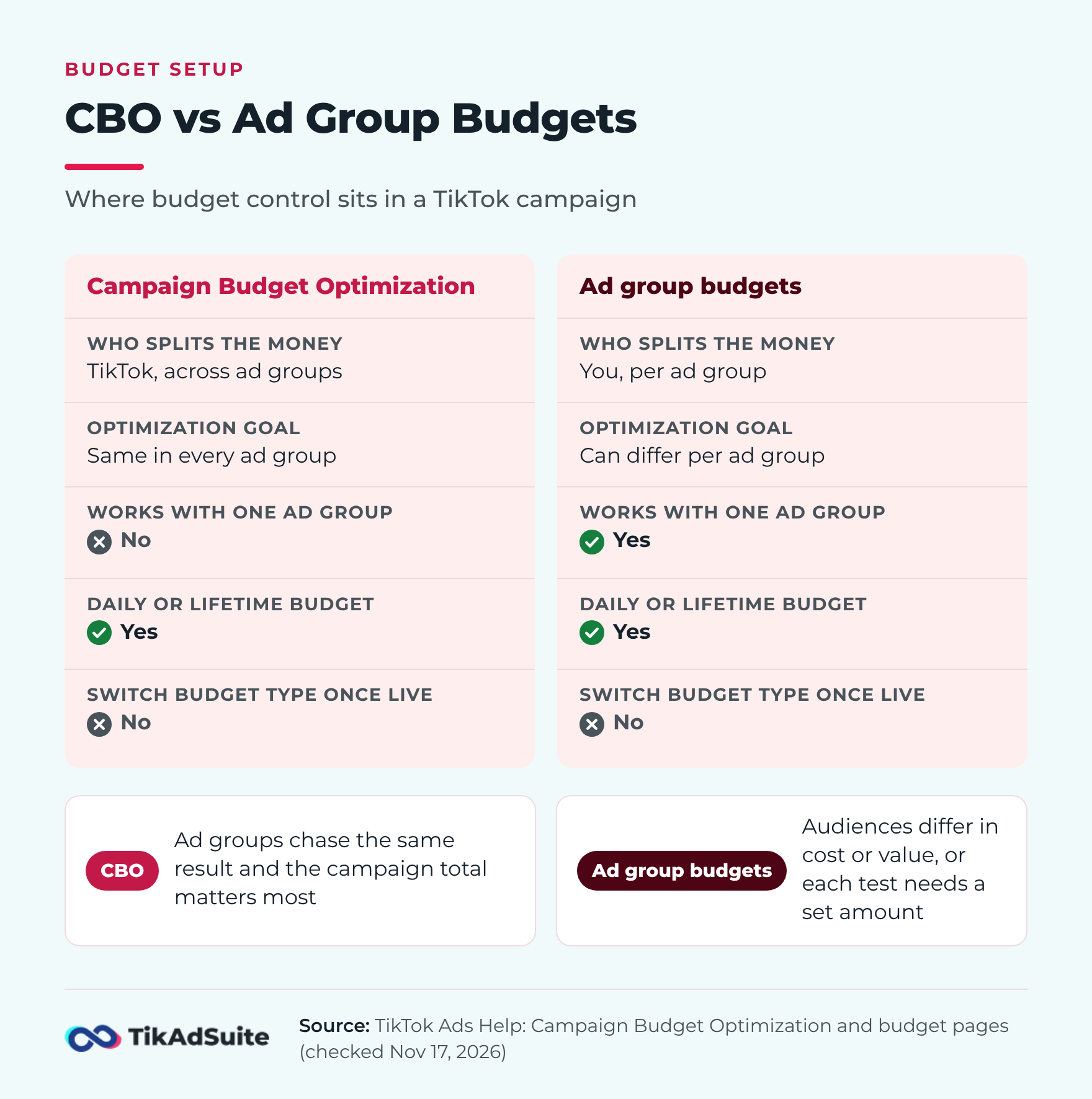
Ad group budgets suit you when audiences differ a lot in cost or value, or when each test needs a set amount of spend. CBO suits a campaign whose ad groups chase the same result, where the total matters more than how much each group gets.
One more limit: TikTok’s budget page says you can raise or lower the amount after launch, but you cannot switch between daily and lifetime budget once a campaign or ad group is live. If you keep ad group budgets, a few budget optimization tips help you split spend without starving the best group.
How Many Campaigns Does Your Account Actually Need?
The answer depends on how many separate goals you are running. Most accounts need fewer campaigns than they think.
A simple guideline:
- One business goal: one campaign with several ad groups for audience testing
- Two business goals (for example, awareness and sales): two campaigns, each with its own objective
- Several product lines or services: separate campaigns per line when budgets, audiences or margins differ a lot
How Many Ad Groups per Campaign
TikTok’s creative best practices suggest 3 to 5 diversified ad groups per campaign. That gives you enough audiences to compare while each group still has money to learn with. Keep the minimum in mind too: with each ad group above $20 a day, five ad groups already need more than $100 a day (example math from TikTok’s budget page minimum).
How Many Ads per Ad Group
The same TikTok page suggests 3 to 5 different creatives per ad group. On a small budget, start at the low end so each ad gets a fair share of delivery.
Resist the urge to create a new campaign for every small variation. Ten campaigns with one ad group each give you scattered data and ten learning phases to wait through. Results usually steady after about 25 campaign results or 7 days, according to TikTok’s learning phase page (updated June 2026), so every extra campaign is one more wait.
Consolidating into fewer, well-structured campaigns gives TikTok’s system enough volume to optimize properly.
A Clean Starting Structure for Most Accounts
Most accounts need two layouts: a testing structure to find what works, then a scaling structure that gives the winners more money without restarting them. The layout below is an example, not a TikTok rule; the numbers that come from TikTok pages are named.
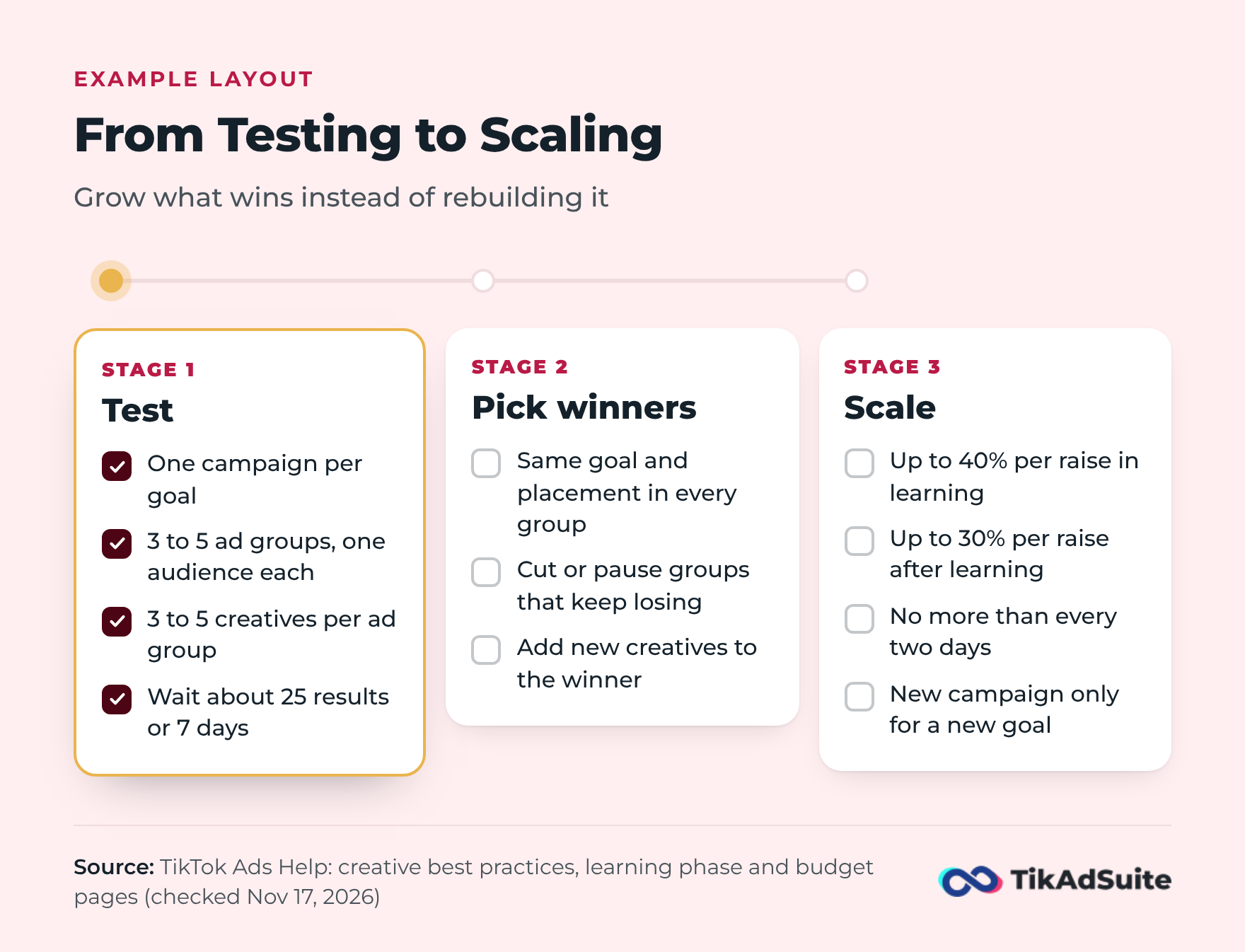
Testing Structure
Example: Campaign 1, Sales objective
- Ad Group A: interest targeting (3 to 5 creatives)
- Ad Group B: lookalike of past buyers (3 to 5 creatives)
- Ad Group C: broad targeting (3 to 5 creatives)
Keep the optimization goal and placement the same across the three groups, so the audience is the only thing that changes. Give each one time to get through learning, about 25 results or 7 days on TikTok’s learning phase page, before you judge it. If you want a cleaner comparison, the campaign setup page also offers a Create split test toggle.
Scaling Structure
Once an ad group clearly wins, grow it instead of rebuilding it:
- Raise its budget in steps. According to TikTok’s budget page, that means no more than 40% per change while in learning, no more than 30% after it, and not more often than every two days.
- Add fresh creatives to the winning ad group rather than copying it into a new one.
- Cut the budget of ad groups that keep losing, or pause them.
- Open a new campaign only for a new goal, product line or market.
For example, a winning ad group at $100 a day that has left learning could go to $130, then two days later to $169 (example math using the 30% step).
If you build in TikTok Ads Manager, the Ads Manager campaign builder walks you through each level in order, which keeps this layout consistent from one campaign to the next.
How Smart+ and GMV Max Change the Structure
Smart+ and GMV Max are TikTok’s automated campaign types, and both take over choices you would otherwise make by hand at the ad group and ad level. Check which one you are building before you plan ad groups.
Smart+ Campaigns
TikTok’s Smart+ upgrades page, updated October 2026, says the upgraded Smart+ works with the Traffic, Sales, Lead Generation and App Promotion objectives and may not be available to every account yet. It keeps the three levels but changes what sits in each:
- Campaign: choose an automatic campaign budget that TikTok spreads across ad groups, or custom budgets for each ad group.
- Ad group: you can run several ad groups. Automatic placement is the default, and you can switch to Select placement.
- Ad: each ad works like an asset group with its own destination URL and up to 50 creative assets, the same page says, and TikTok delivers the combinations that perform best.
In practice, a Smart+ layout has fewer ad groups and more assets per ad. If you are weighing how much to hand over, the trade-offs of TikTok ads automation are worth a look first.
GMV Max for TikTok Shop
TikTok’s GMV Max migration page, updated March 2026, says GMV Max became the default and only supported campaign type for TikTok Shop Ads starting July 2025, while older Shopping Ads campaigns keep running.
According to TikTok’s Product GMV Max page, updated September 2026, it uses all available creative assets to build ads, sets campaign settings, creates and pauses ads, and adjusts audience settings by itself. For a Shop seller, structure work moves away from ad groups toward picking products, setting an ROI target and feeding in strong videos. More detail on that setup sits in the TikTok GMV Max breakdown.
Naming Conventions That Save You Time Later
Once your account has more than a few campaigns running, naming gets critical. A clear naming system makes reporting faster, prevents mistakes, and shows which ad group does what without opening every setting.
A reliable format looks like this:
- Campaign: [Objective] | [Product/Service] | [Date]
- Ad Group: [Audience Type] | [Targeting Detail] | [Placement]
- Ad: [Creative Concept] | [Hook] | [Version]
Example:
- Campaign: Sales | Summer Promo | Jun26
- Ad Group: Lookalike | Past Purchasers 1% | TikTok Only
- Ad: UGC Testimonial | Hook 1 | V2
Room is not a problem: according to the campaign setup page, campaign names support 512 characters. Short names are still easier to scan in reports. Once you run dozens of ad groups, you will be glad each name already tells you what that group does.

Common Structure Mistakes That Slow Down Performance
Most structure mistakes come from splitting the budget too thin or rebuilding too often, and both slow down how fast TikTok learns.
Splitting audiences across too many ad groups: Five tiny ad groups testing five overlapping audiences will starve each one of data. Combine similar audiences and let TikTok’s system find the best signal.
Mixing goals in one campaign: Every ad group shares its campaign’s objective, so a Sales campaign cannot double as your awareness test. Give each goal its own campaign.
Rebuilding instead of refreshing: TikTok’s learning phase page lists pausing and edits that retrigger learning among the things that keep a campaign stuck in it. Plan the structure up front, and add new creatives to a working ad group instead of rebuilding it after every test.
Running only one ad per ad group: Without creative variation, you have no way to compare what is working. Aim for the 3 to 5 creatives TikTok suggests when budget allows.
Big budget jumps: Doubling a winner overnight goes well past the 40% and 30% steps on TikTok’s budget page, which ties those limits to keeping your cost per action stable.
As your account grows beyond the first setup, a guide on how to scale TikTok ads covers expanding without breaking the structure that already works.
FAQs
What is the correct order to build a TikTok ads campaign?
Start at the campaign level with the objective, campaign type and budget. Then set up the ad group with placement, targeting, budget and schedule, optimization goal and bid strategy. Finish with the ads: creative, text, call to action and tracking. Building from the top down keeps each choice in line with the one above it.
How many ad groups should I have per campaign?
TikTok’s creative best practices suggest 3 to 5 diversified ad groups per campaign, each with 3 to 5 different creatives. If you turn on Campaign Budget Optimization, keep at least two active ad groups, because TikTok’s CBO page says it does not work with only one.
Can I change the campaign objective after launching?
No. TikTok’s edit settings page says that after a campaign is created, only its name and budget can change. If you need a different objective, build a new campaign and move your best creatives into it.
Can I change the placement once an ad group is running?
No. Placement is chosen when you create the ad group, and TikTok’s eligible placements page says it cannot be changed afterward. To test another placement mix, create a new ad group with the placements you want.
Should I use campaign budget optimization or ad group budgets?
Use ad group budgets when audiences differ a lot in cost or value, or when each test needs a fixed amount. Use Campaign Budget Optimization when every ad group chases the same optimization goal and you care about the campaign total. Choose before launch if you can, since daily and lifetime budget types cannot be switched once live.
Wrapping Up
A well-built TikTok ad structure does not guarantee great performance, but a messy structure almost always limits it.
One campaign per goal, 3 to 5 ad groups with 3 to 5 creatives in each, and a clear naming system give you a base that grows cleanly. When something wins, raise its budget in small steps and feed it new creatives rather than starting over.
If you run Smart+ or GMV Max, let the system carry more of the ad group work and spend your time on products, goals and creative. Get the structure right early, and the reports that follow are much easier to trust.